RomeOutdoor Escape Game & Treasure Hunt
Porta Magica, catacombs and the Popes' Passetto
Rome, the Eternal City, is an open-air museum where every street and piazza tells a thousand-year-old story. Beyond the must-sees like the imposing Colosseum, the majestic Roman Forum, or the enchanting Trastevere district with its cobbled streets and picturesque trattorias, Rome is full of hidden gems and unique experiences. If you're looking for an original and immersive way to discover its secrets, an outdoor escape game is the perfect activity. Forget classic guided tours and dive into a thrilling adventure that combines a scavenger hunt with a treasure hunt. It's an unusual activity that will make you see Rome from a new perspective, solving puzzles while exploring its wonders. Get ready for a total immersion where history comes alive through play. Our routes are waiting to transform your Roman exploration into a memorable quest.
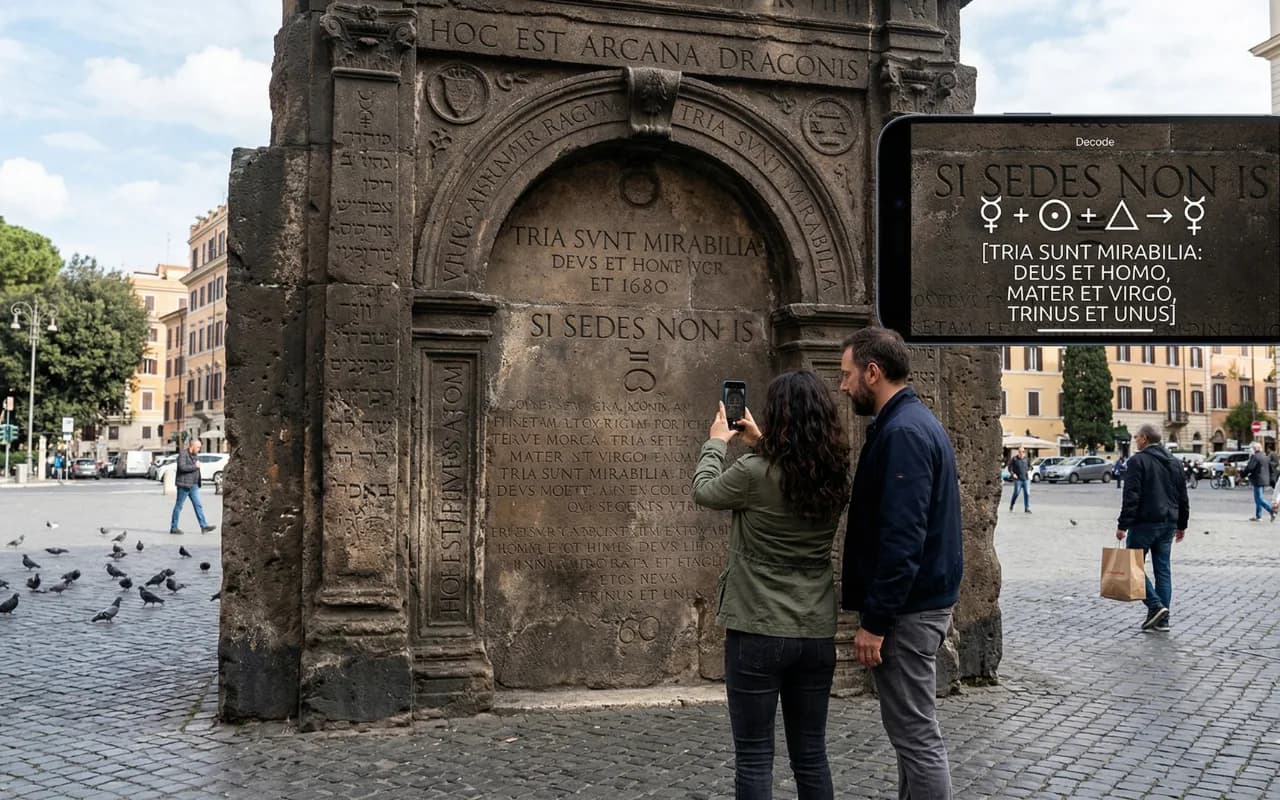
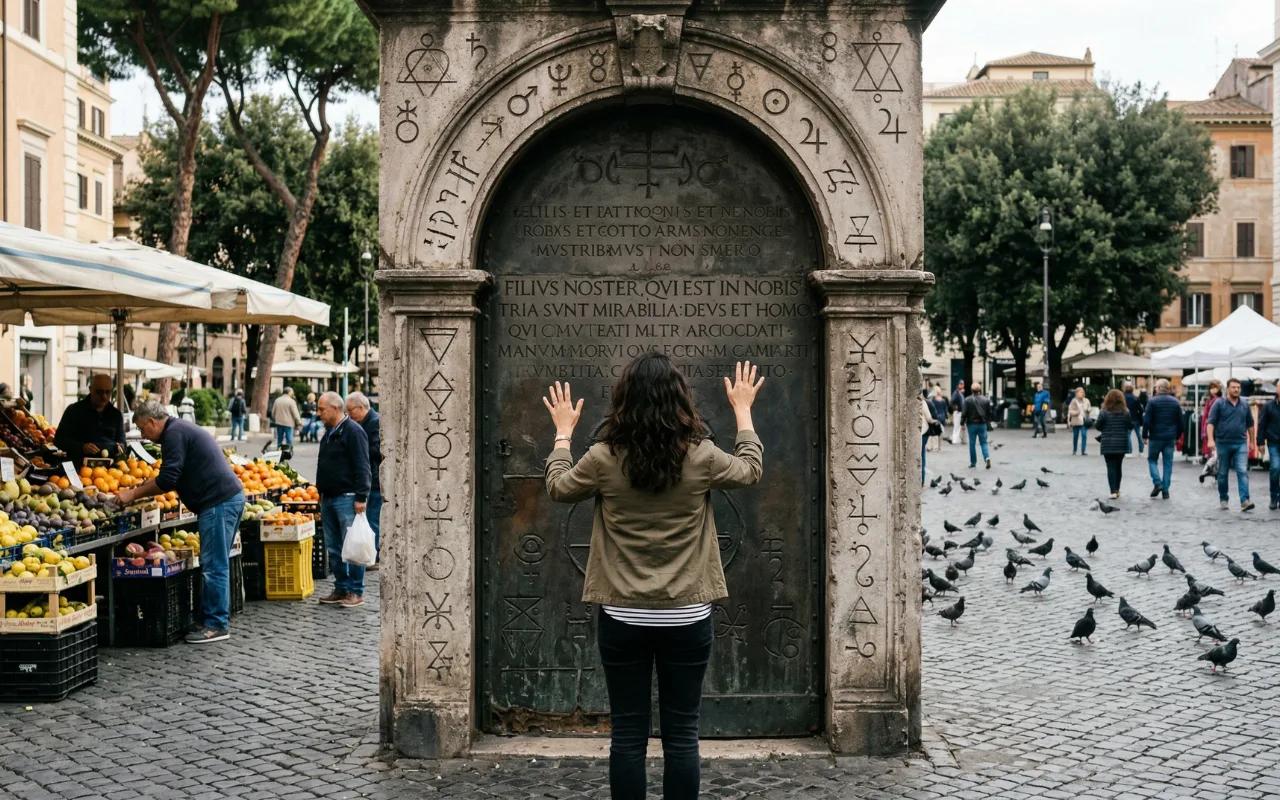
The Magic Door and the Alchemist
Baroque Rome and alchemical pentagon
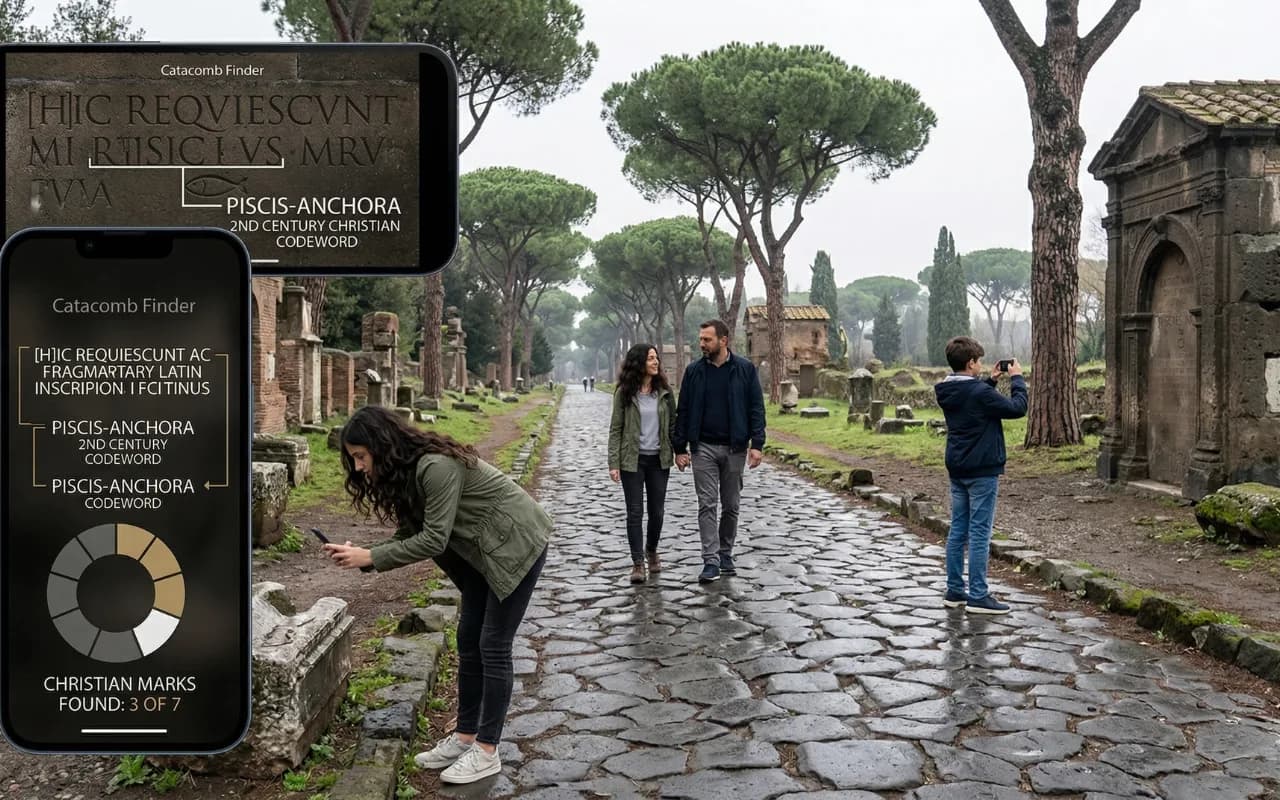
The Appian Way and the Catacombs
Early Christians and apocryphal library
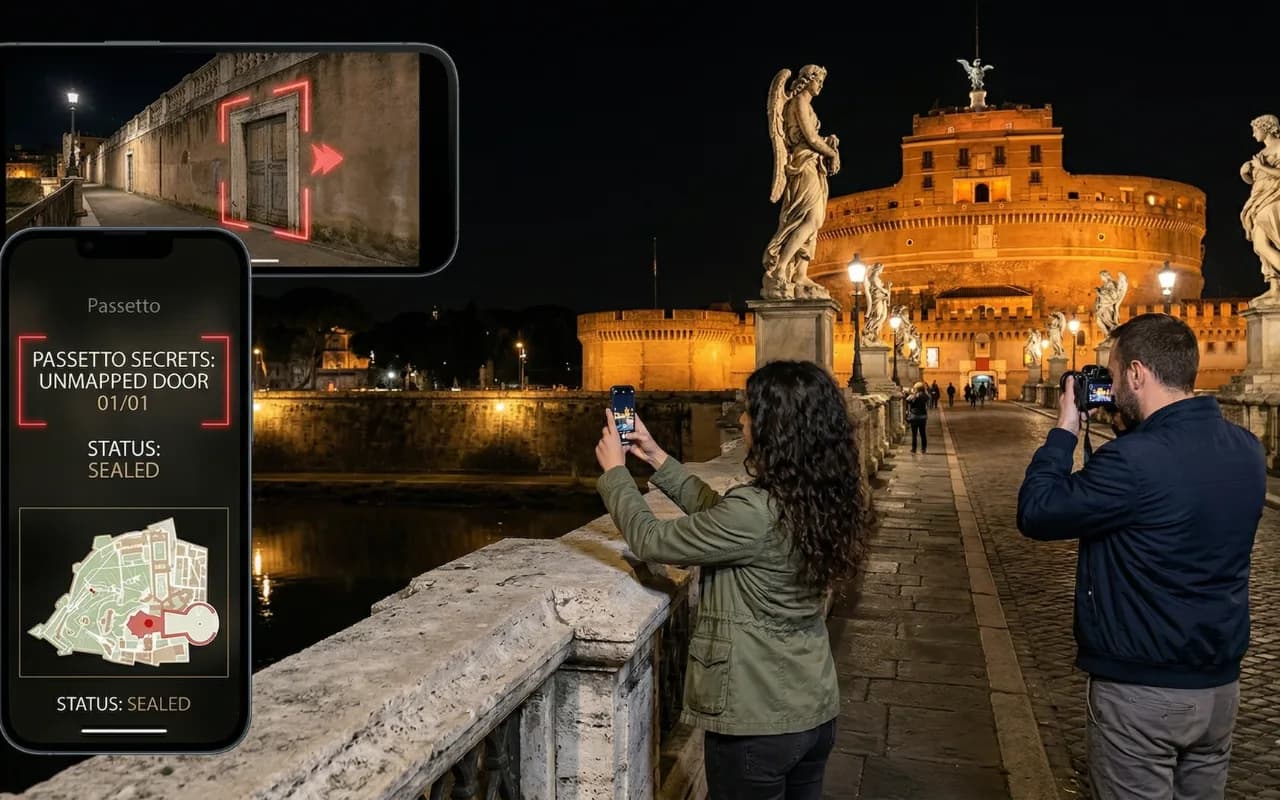
The Castle of Angels
Mausoleum, Passetto and sealed chest
Unusual things to do in Rome
Looking to step off the beaten path during your stay in Rome? Our outdoor escape games are the ultimate unusual activity for explorers eager for novelty. Instead of just admiring monuments, you interact with the urban environment, deciphering codes and solving puzzles that lead you through iconic sites and lesser-known corners of the city. It's a fun and original way to discover Roman history and legends, far from the usual crowds. Let yourself be surprised by an adventure that combines culture, intellectual challenge, and urban exploration.
Things to do in Rome with kids
Rome is a fantastic city to explore with family, and our outdoor escape games offer a perfect activity for all ages. Imagine your children transformed into young detectives, working together with you to solve mysteries in the heart of the Eternal City! It's an interactive and educational way to discover Roman history, from Porta Magica to the catacombs, all while having fun. The routes are designed to stimulate curiosity and teamwork, making monument visits much more exciting than a simple stroll. Create unforgettable memories with a life-sized treasure hunt.
Rome for couples
For a romantic getaway in Rome, our outdoor escape games offer a unique experience to share as a couple. Far from typical candlelight dinners, embark on a thrilling adventure hand-in-hand, solving puzzles through picturesque alleys and iconic squares. It's an original way to strengthen your bond, have fun, and discover the Eternal City from a different perspective, creating memorable moments together. Imagine deciphering the secrets of the Passetto dei Papi or exploring hidden gardens, turning each challenge into a moment of complicity.
What to do in Rome when it rains
What to do in Rome on a rainy day? Our escape games are primarily outdoor activities. While a light shower won't spoil the adventure with a good umbrella and appropriate clothing, heavy rain might make the experience less enjoyable. We recommend checking the weather before starting. For torrential days, Rome offers many indoor museums, galleries, and historical sites, such as the Vatican Museums or the Borghese Gallery, which make excellent alternatives.
Where is Rome, and where do the routes start?
Starting points of our routes and the places they pass through.
Route starting points
Places in Rome
- Piazza Vittorio Emanuele II
- Santa Maria degli Angeli
- Palazzo delle Esposizioni
- Santa Maria Maggiore basilica
- Fontana dell'Acqua Felice
- Piazza della Repubblica
- Domus Aurea
- Porta Magica
- Castel Sant'Angelo (exterior)
- Passetto di Borgo
- Campo de' Fiori
- Ponte Sant'Angelo
- Piazza Navona
- Pantheon
- Via dei Coronari
- San Pietro in Vincoli basilica
- Porta San Sebastiano
- Tomba di Cecilia Metella
The history of Rome
From Republic to Empire: The City's Foundations
Rome's origins are traditionally placed in 753 BCE with its founding by Romulus on the Palatine Hill. From a small settlement, it developed into the center of the Roman Republic and then the Roman Empire. Its location on the Tiber River provided trade routes and natural defenses, contributing to its early growth. The construction of infrastructure, including aqueducts, roads, and public buildings like the Roman Forum, established its role as a capital. The Pax Romana, starting in the 1st century BCE, was a period of stability and construction, shaping much of the city's visible ancient fabric.
Decline and Rebirth: Echoes in Stone
The Western Roman Empire's decline in the 5th century CE brought significant changes to Rome. The city was sacked by the Visigoths in 410 CE and the Vandals in 455 CE, leading to population decrease and the decay of many structures. During the Middle Ages, Rome's function shifted to being the center of the Catholic Church. Popes became patrons, commissioning new churches, palaces, and urban projects that often reused materials from ancient ruins. This era saw the construction of basilicas like Santa Maria Maggiore, dating to the 5th century, and the transformation of imperial structures such as Hadrian's Mausoleum into Castel Sant'Angelo, a papal fortress. The Renaissance and Baroque periods, from the 15th to the 18th centuries, brought artistic and architectural activity. Figures like Bernini and Borromini left their mark on the city, creating many of the fountains, piazzas, and churches that define Rome's character.
What to see in Rome
- Piazza Vittorio Emanuele II — Rome's largest square, built after Italy's unification in 1870. It has porticoes on all sides, the 17th-century Porta Magica (an alchemical gate), and the "Trophies of Marius," remnants of a 3rd-century Roman fountain.
- Santa Maria degli Angeli e dei Martiri — This basilica is built within the frigidarium (cold bath) of the ancient Baths of Diocletian, a Roman bath complex from the 4th century. Michelangelo designed the church in the 16th century, incorporating the Roman architecture.
- Palazzo delle Esposizioni — A neoclassical exhibition hall and cultural center opened in 1883. It was one of the first public buildings constructed in Rome after it became the capital of Italy and hosts art and cultural exhibitions.
- Santa Maria Maggiore Basilica — One of Rome's four papal basilicas, founded in the 5th century. Its interior contains 5th-century mosaics depicting Old Testament scenes and a coffered ceiling said to be gilded with the first gold brought from the Americas.
- Fontana dell'Acqua Felice (Fountain of Moses) — This fountain, completed in 1588, marks the terminus of the Acqua Felice aqueduct, restored by Pope Sixtus V. It was the first new monumental wall fountain built in Rome since antiquity and features a large statue of Moses.
- Piazza della Repubblica and Fontana delle Naiadi — This piazza, originally the exedra of the Baths of Diocletian, features the Fountain of the Naiads, inaugurated in its current form in 1914. The fountain's bronze sculptures of water nymphs generated discussion when first unveiled.
- Castel Sant'Angelo — Originally built as Emperor Hadrian's mausoleum in the 2nd century CE, it was later converted into a papal fortress and prison. It connects to the Vatican by the Passetto di Borgo, an elevated fortified corridor.
- Ponte Sant'Angelo — This pedestrian bridge, built by Emperor Hadrian in 134 AD, leads to Castel Sant'Angelo. It is adorned with ten angel statues designed by Gian Lorenzo Bernini in the 17th century, each holding an instrument of Christ's Passion.
When to visit Rome
Spring (April to May) and autumn (September to October) are suitable times to visit Rome. The weather is mild, good for walking and outdoor exploration. Light conditions are often clear. Crowds are present but generally less dense than in summer. Avoid July and August if possible; temperatures can be high, and the city is crowded. Winter (November to March) has fewer crowds and lower prices, but some attractions may have reduced hours, and the weather can be cold and rainy.
Getting around Rome
Rome is served by Leonardo da Vinci–Fiumicino Airport (FCO), 30 kilometers southwest of the city center. The Leonardo Express train connects FCO directly to Termini Station, Rome's main railway hub, which links to the metro and bus networks. Ciampino Airport (CIA) is smaller and 15 kilometers southeast, serving budget airlines, with bus connections to Termini.
Central Rome is walkable, with many attractions close together. For longer distances, Rome has a public transport system including metro, buses, and trams. Single tickets are valid for 100 minutes, allowing one metro ride or unlimited bus/tram rides. Day and multi-day passes are available. Parking in central Rome is difficult and costly, with restricted areas. Public transport or walking is recommended. Most shops and attractions follow standard European hours; some smaller businesses close midday.
Things you probably do not know about Rome
Verified details most visitors walk straight past.
- Fontana dell'Acqua Felice
- What's wrong with the Moses statue on the Fontana dell'Acqua Felice? The central statue of Moses on the Fontana dell'Acqua Felice was criticized after its unveiling in 1588. Romans nicknamed it the 'Ridiculous Moses' because its proportions were considered incorrect, and it depicted Moses holding the Tablets of the Law even though he had not yet received them at the time of the miracle it portrays.
- Piazza Vittorio Emanuele II
- Why is there a sculpture group in Piazza Vittorio Emanuele II that was called 'mixed fry'? The sculpture group featuring three tritons, a dolphin, and a large octopus in Piazza Vittorio Emanuele II was originally intended for the Fontana delle Naiadi in Piazza della Repubblica. Romans disliked its design, ironically nicknaming it 'Fritto Misto' (mixed fry), leading to its relocation here in 1913.
- Fontana delle Naiadi, Piazza della Repubblica
- What caused a scandal when the Fontana delle Naiadi was first unveiled? When the bronze sculptures of the Naiads were added to the fountain in 1901, their sensual forms caused controversy among the Roman public. The fountain remained hidden behind a wooden enclosure for a period due to the protests.
- Ponte Sant'Angelo
- What details do the angels on Ponte Sant'Angelo reveal about Christ's Passion? The ten angel statues on Ponte Sant'Angelo, mostly designed by Bernini, each hold a specific instrument of Christ's Passion, such as the column where he was scourged, the whips, or the crown of thorns. This creates a chronological narrative of the Passion as one crosses the bridge towards Castel Sant'Angelo.
- Castel Sant'Angelo
- How did Castel Sant'Angelo get its name, and what vision is associated with it? Castel Sant'Angelo, originally Hadrian's Mausoleum, received its current name in 590 AD. Pope Gregory the Great reportedly saw the Archangel Michael sheathing his sword atop the mausoleum, signifying the end of a devastating plague in Rome.
- Porta Magica, Piazza Vittorio Emanuele II
- What mysterious symbols cover the Porta Magica in Piazza Vittorio Emanuele II? The Porta Magica, or Alchemical Gate, in Piazza Vittorio Emanuele II is covered with alchemical symbols and inscriptions. It was the entrance to the 17th-century Villa Palombara, owned by an alchemist, and is the only surviving gate from that villa.
Questions about visiting Rome
How many days should I spend in Rome?
To experience Rome's major historical sites, museums, and enjoy its culinary scene without feeling rushed, a minimum of 3 to 4 full days is recommended. This allows time for landmarks like the Colosseum, Vatican City, and Trastevere, plus some deeper exploration.
What are the best neighborhoods to stay in Rome?
Popular neighborhoods include Monti for its central location, Trastevere for its streets and nightlife, Prati for proximity to the Vatican and shopping, and Termini for budget options and transport links. Each offers a different atmosphere and accessibility to attractions.
What is the typical budget for a trip to Rome?
A mid-range budget for Rome might be around €100-€150 per person per day, covering accommodation, food, transport, and some attractions. Budget travelers could aim for €60-€90, while luxury experiences can exceed €250 per day.
Is Rome a good city to visit with children?
Rome can be a city for families. Many historical sites like the Colosseum and Roman Forum engage imagination, and there are parks, gelato, and pizza that children often enjoy. Consider activities like gladiator schools or interactive museums for younger visitors.
How easy is it to get around Rome?
Central Rome is walkable, allowing you to discover many sites on foot. The city also has a public transport system, including a metro, buses, and trams, useful for longer distances. Taxis and ride-sharing services are also available.
What's the best time of year to visit Rome for good weather and fewer crowds?
For a balance of pleasant weather and manageable crowds, aim for late spring (April-May) or early autumn (September-October). Temperatures are mild, and the major tourist rush of summer has not fully set in or has begun to subside.
Frequently asked questions
How much does an outdoor escape game cost in Rome?
The price for our outdoor escape games in Rome is €12 per team. Yes, you read that right, it's a single flat rate for the entire team, regardless of the number of participants (usually 2 to 6 players). This is a very economical solution for a memorable group activity. This price includes access to the game via our app, the puzzles, and the complete adventure through the streets of Rome. No hidden fees, just pure fun!
Is it suitable for children / families?
Absolutely! Our escape games are designed to be accessible and fun for the whole family. The routes are suitable for children aged 8 and up, provided they are accompanied by adults. It's a great way to stimulate their curiosity and teamwork while discovering the wonders of Rome. The puzzles are varied, combining observation, logic, and a bit of history, allowing everyone, young and old, to contribute to the adventure. A perfect activity to create family memories!
How long does an escape game in Rome last?
The duration of our escape games in Rome generally varies between 1h30 and 2h30, depending on the chosen route and your pace. Some players like to take their time to admire the monuments and take breaks, while others prefer to focus on the puzzles and move faster. The advantage is that you are completely free to manage your time. You can even take a break for a coffee or gelato and resume the game whenever you wish. It's your adventure, at your own pace!
Do I need to book in advance?
No, advance booking is not necessary for our outdoor escape games in Rome! This is one of the great advantages of our games. You can purchase and start your route whenever you want, directly from our app. Whether you have a sudden urge for adventure or are looking for a last-minute activity, OddballTrip is here for you. All you need is a smartphone with an internet connection, and you're ready to go on an adventure. It's total flexibility to explore Rome!
What to visit in Rome beyond the escape games?
Rome is full of treasures to discover beyond our games! After solving the mysteries of Porta Magica or the Passetto dei Papi, don't miss the must-sees: the Colosseum and the Roman Forum for a journey back in time, the Pantheon for its impressive architecture, the Trevi Fountain to toss a coin and make a wish, and the Vatican City with St. Peter's Basilica and the Vatican Museums. Stroll through the charming Trastevere district, taste the delights of Roman cuisine, and get lost in its narrow streets. Every corner of Rome is an invitation to wonder!
What is the best season to visit Rome?
The best season to visit Rome and fully enjoy our outdoor escape games is spring (April-May) or autumn (September-October). During these periods, the weather is generally mild and sunny, ideal for walking and exploring the city on foot without suffering from intense summer heat or winter cold. Additionally, there are fewer crowds than in mid-summer, making the experience more pleasant. Summer can be very hot, and winter, although quieter, can be rainy and cool.
Other destinations in Lazio
Viterbo
The endless conclave and the San Pellegrino quarter
Bomarzo
The Monster Garden of the mad prince Orsini
Civita di Bagnoregio
The dying city perched on a tuff bridge
Cerveteri
In the footsteps of the Etruscans, between ancient mysteries and modern life
Tarquinia
In the footsteps of the mysterious Etruscans
More cities in Italy
Siena
The Contrade war and the world's oldest bank
Naples
Napoli Sotterranea, Dracula and the skull cult
Florence
Medici, Templars and Palazzo Vecchio alchemists
Paestum
The world's best-preserved Greek temples
Bologna
Hidden canals, leaning towers and the world's oldest university
Venice
Alchemy, Kabbalah and Arsenal of the Serenissima's spies
Palermo
Normans, Arabs, Byzantines — the city of three crowns
Activities to discover nearby
Guided tours, skip-the-line tickets and local experiences to book in advance.
💡 Optional booking — you can also buy on-site. All links open in a new window, your OddballTrip visit stays preserved.