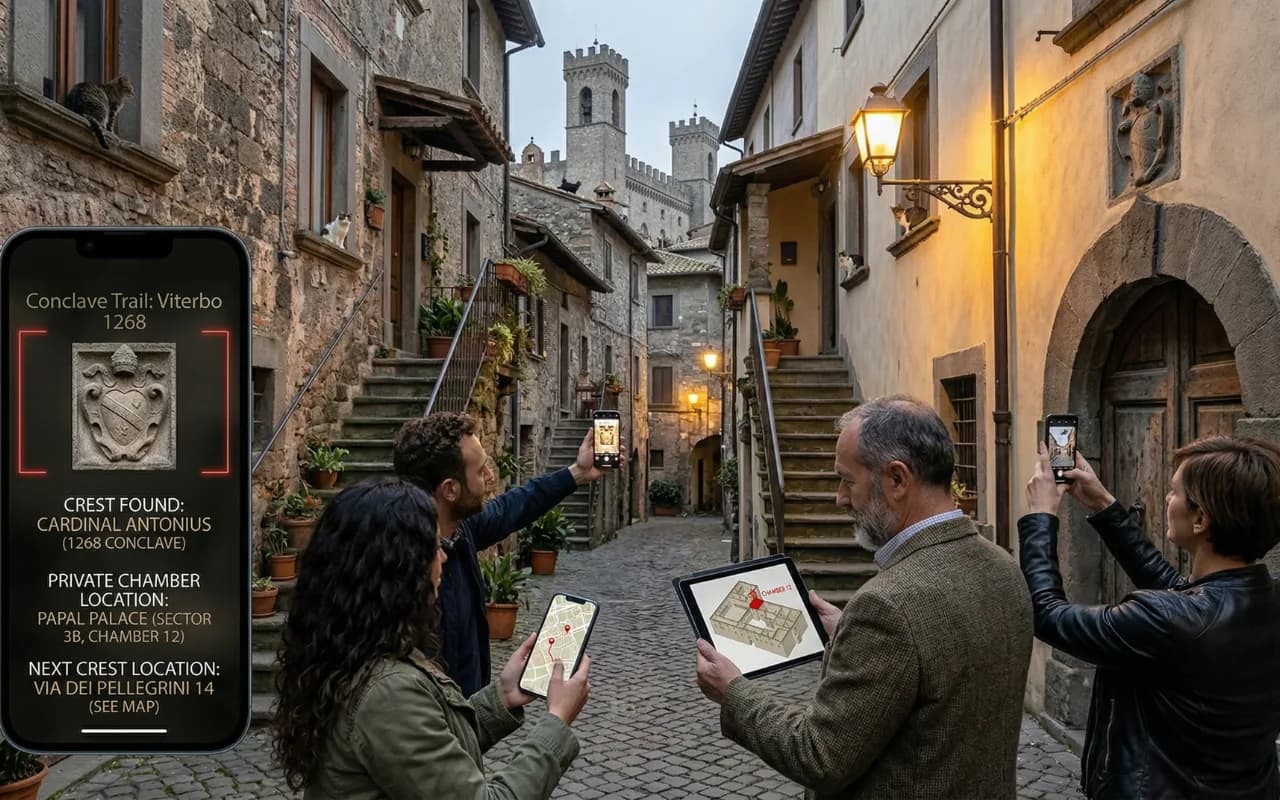
ViterboOutdoor Escape Game & Treasure Hunt
The endless conclave and the San Pellegrino quarter
Viterbo, the "City of Popes," invites you on a fascinating journey into the heart of medieval Italy. Far from the crowds of major capitals, this pearl of Lazio is full of hidden treasures, cobbled streets, and historic squares. Stroll through the San Pellegrino Quarter, one of Europe's best-preserved medieval districts, and be impressed by the imposing Papal Palace, witness to legendary conclaves. For a truly immersive experience and an unusual activity, why not turn your visit into a real outdoor escape game? Our unique treasure hunt combines urban exploration with captivating puzzles. Get ready to discover Viterbo in a fun and memorable way, solving mysteries that will lead you to the city's most beautiful corners. Discover the adventure course that awaits you below for an unforgettable experience.
Unusual things to do in Viterbo
Viterbo is full of secrets and stories, and our outdoor escape game is the ultimate unusual activity to uncover them. Forget traditional guided tours and dive into an urban adventure where every street corner can hide a clue. This treasure hunt offers a unique perspective on the San Pellegrino Quarter and the Papal Palace, transforming the city into a vast playground. It's a scavenger hunt that sparks curiosity and guarantees memorable experiences, far from the beaten path.
Things to do in Viterbo with kids
Viterbo is a fantastic destination for families, and our outdoor escape game is the perfect activity for all ages. Our courses are designed to foster teamwork and collaboration, allowing everyone, from children to parents, to actively participate in solving the puzzles. It's a fun and educational way to discover Viterbo's history and monuments, such as the Papal Palace or the San Pellegrino Quarter, while enjoying the fresh air. A treasure hunt that promises laughter and discoveries for the whole family.
Viterbo for couples
For a romantic and original getaway in Viterbo, our outdoor escape game offers a charming alternative to traditional strolls. Imagine yourselves, hand in hand, solving puzzles in the medieval alleys of the San Pellegrino Quarter or in front of the imposing Papal Palace. It's an activity that strengthens bonds, stimulates communication, and creates unique memories for two. Share moments of complicity, laughter, and discovery, exploring the city from a new and exciting angle.
What to do in Viterbo when it rains
Our escape games are primarily outdoor activities, which means rainy weather can make the experience less enjoyable. We encourage our players to check the weather forecast and come prepared (umbrella, raincoat). If the rain is too heavy, Viterbo offers other indoor options such as visiting the Papal Palace or the Civic Museum. The adventure can still be attempted in the rain for the most adventurous, but caution is advised to fully enjoy the treasure hunt.
Where is Viterbo, and where do the routes start?
Starting points of our routes and the places they pass through.
Route starting points
Places in Viterbo
- Piazza del Plebiscito & Palazzo dei Priori
- San Pellegrino quarter & Fontana Grande
- Palazzo dei Papi & Duomo San Lorenzo
- San Lorenzo cathedral
- Santa Rosa church
- Fontana Grande
- Chiesa del Gesù
- Colle del Duomo Museum
The history of Viterbo
Etruscan Origins and Papal Influence
Viterbo's history begins with Etruscan settlements, though a precise founding date is not recorded. The name Castrum Viterbii appears in records from the late 7th century, possibly referring to a 'fortress of the old town' (Vetus Urbs). By 310 BC, Roman control was established over the Etruscan site. The city gained importance in the 11th century, initially as part of the Papal States and then, by 1095, as a free commune. Its location on the Via Francigena, a pilgrimage route to Rome, supported its early growth.
The Papal City and the Longest Conclave
Viterbo became a papal residence in the 13th century, offering a retreat from political unrest in Rome. In 1257, Pope Alexander IV moved the Papal Curia to Viterbo, establishing it as a papal seat for 24 years. During this period, Viterbo held importance comparable to Rome. A notable event was the papal conclave of 1268-1271, held in the Palazzo dei Papi. Following Pope Clement IV's death in 1268, 18 cardinals deliberated for 1006 days to elect a successor, hindered by political and national divisions. The Viterbese citizens, seeking a resolution, confined the cardinals to the great hall, reduced their provisions, and removed part of the roof to encourage a decision. This event led to the term "conclave" (from Latin clausi cum clave, "locked with a key"), and Pope Gregory X was eventually elected. After the papacy moved to Avignon in 1309, Viterbo's prominence decreased. The city sustained significant damage from bombing during World War II, with nearly 70% of the town destroyed, but was among the first in Lazio to undergo post-war reconstruction.
What to see in Viterbo
- Palazzo dei Papi — This Gothic palace, built between 1255 and 1266, served as a papal residence for over two decades in the 13th century. Visitors can see the Aula del Conclave, where the longest papal election occurred. The Loggia delle Benedizioni, added in 1267, provides views over the city.
- Duomo di San Lorenzo — Next to the Papal Palace, this Romanesque cathedral dates to the 12th century. It gained importance during the papal residency. Inside, the central nave features a Cosmatesque floor and paintings.
- Quartiere San Pellegrino — This medieval district contains intact 12th and 13th-century streets, towers, and houses. It is recognized as one of Europe's preserved medieval quarters. The area features profferli (external staircases) and buildings constructed from local grey tuff stone.
- Fontana Grande — This is Viterbo's oldest and largest medieval fountain, commissioned in 1212. It is at the intersection of Via Garibaldi and Via Cavour. Its design was modified in 1424 with a central column and four lion heads, symbols of Viterbo.
- Piazza del Plebiscito & Palazzo dei Priori — This area functions as the administrative center of the city, housing the Town Hall (Palazzo dei Priori). The square is a central point, often displaying papal coats of arms from the 13th century.
- Colle del Duomo Museum — Located on Piazza San Lorenzo, this museum offers information on the history of the cathedral and the Papal Palace.
When to visit Viterbo
The best times to visit Viterbo are during spring (April to June) and fall (September to October). These months offer mild weather suitable for walking. Spring includes the "San Pellegrino in Fiore" festival in early May, when the medieval quarter is decorated with flowers. Early September features the Festa di Santa Rosa on September 3rd, a UNESCO-recognized procession where a large illuminated structure is carried through the streets. Avoid July and August if high temperatures are a concern, as average highs can reach 30-32°C (86-89°F), with humidity. Winters (December to March) are cooler, with average highs around 11°C (52°F), making the thermal baths a suitable option.
Getting around Viterbo
Viterbo is about 80 kilometers (50 miles) north of Rome. It can be reached by regional train from Roma Termini or Roma Tiburtina stations, a journey of 1.5 to 2 hours. Driving or taking a bus are also options. The historic center is enclosed by medieval walls, mostly intact from the 11th to 13th centuries, with ancient gates. Within the walls, Viterbo is walkable. Many cobbled streets are narrow, and some lack sidewalks, requiring pedestrians to share lanes with local drivers. Bus lines primarily operate around the perimeter of the walls. Parking is generally available outside the city walls. Viterbo has an agricultural tradition, so local markets are common. Many shops and businesses may close midday, especially in smaller Italian towns, so plan accordingly.
Things you probably do not know about Viterbo
Verified details most visitors walk straight past.
- Fontana Grande
- What unusual detail was added to Viterbo's oldest fountain in the 15th century, and why? In 1424, during a refurbishment financed by Pope Martin V (Oddone Colonna), four lion heads were added to the basin of the Fontana Grande. These lions are a symbol of Viterbo and were incorporated into the fountain's design.
- Palazzo dei Papi
- The word "conclave" originated in Viterbo. But what extreme measures did the citizens take to speed up a papal election? After 1006 days of stalemate in 1268-1271, the frustrated Viterbese citizens locked the cardinals in the palace, reduced their food and water, and eventually removed part of the roof to force them to elect a new Pope.
- Fontana di Santa Maria in Poggio (Fontana della Crocetta)
- A small sculpture atop this fountain tells a story of a broken pitcher. What miracle is it said to depict? The sculpture depicts a young girl whose ceramic pitcher broke while she was filling it. Saint Rose of Viterbo is said to have comforted the child and miraculously mended the broken pitcher.
- Porta San Pietro
- This ancient city gate has been bricked up multiple times throughout history. What unusual reason led to its closure for over a century? The Porta San Pietro was completely closed for more than a century after a plague epidemic struck the city, an extreme measure to prevent the spread of disease.
- Chiesa di Sant'Angelo in Spatha (Piazza del Plebiscito)
- What ancient Roman artifact, dating back to the 2nd century AD, can be found next to the entrance of this church? Next to the main entrance of the Chiesa di Sant'Angelo in Spatha, there is a 2nd-century AD Etrusco-Roman white marble sarcophagus. The original is now kept at the Civic Museum.
- Palazzo dei Priori
- What unique architectural feature, common in Viterbo's medieval quarter, can be found within the Palazzo degli Alessandri, a building often associated with the Palazzo dei Priori? The Palazzo degli Alessandri, a three-story building, preserves an internal *profferlo*, which is an external staircase connecting the courtyard to the ground floor, often with a star-decorated parapet.
Questions about visiting Viterbo
How do I get to Viterbo from Rome?
You can reach Viterbo from Rome by taking a regional train from Roma Termini or Roma Tiburtina stations. The journey typically takes about 1.5 to 2 hours. Driving or taking a bus are also options.
How many days should I spend in Viterbo?
A good itinerary length for Viterbo is two to three days to explore its main highlights, such as the Palazzo dei Papi and the Duomo. For a more extended stay, including the thermal baths or day trips to nearby towns, consider four to five days.
What are the best neighborhoods to explore in Viterbo?
The Quartiere San Pellegrino is a essential, recognized as one of Europe's best-preserved medieval districts. Pianoscarano is another historic district worth exploring, known for its fountains and Romanesque churches.
What is the best time of year to visit Viterbo?
The best times to visit Viterbo are spring (April to June) and fall (September to October) for mild weather and fewer crowds. Summer (July-August) can be very hot, while winter (December-March) is cooler but suitable for visiting the thermal baths.
Is Viterbo a walkable city?
Yes, Viterbo's historic center is very walkable, enclosed by medieval walls. However, be aware that many streets are narrow and cobbled, sometimes without dedicated sidewalks, so pedestrians share the lanes with local traffic.
Are there any specific local dishes I should try in Viterbo?
When in Viterbo, you should try local dishes such as *acquacotta*, a traditional vegetable soup; *pappardelle al cinghiale*, pasta with wild boar sauce; and *tozzetti*, which are almond biscuits.
Frequently asked questions
How much does an outdoor escape game cost in Viterbo?
Our outdoor escape game in Viterbo is available at a single price of €12 per team. This price is fixed, whether you are 2, 3, 4, or even 6 players, making the activity very affordable and social. There is no per-person cost; you pay for access to the complete treasure hunt. It's an excellent option for an economical and fun group activity, allowing you to fully enjoy Viterbo without breaking the bank.
Is it suitable for children / families?
Absolutely! Our outdoor escape game in Viterbo is designed to be accessible and fun for all ages. It's a quintessential family activity that encourages collaboration and communication. Children love the treasure hunt aspect and solving puzzles, while adults appreciate the city discovery element. We recommend at least one adult per team to guide the younger ones, but the adventure is a memorable experience for the entire family.
How long does an escape game in Viterbo last?
The duration of our outdoor escape game in Viterbo typically ranges between 1.5 and 2.5 hours, depending on your pace and puzzle-solving ability. It's not a race against time; the goal is to enjoy the experience, explore the city, and have fun. You are free to take breaks, grab a coffee, or visit a monument along the way. The adventure is at your own rhythm, allowing you to savor every moment of your treasure hunt.
Do I need to book in advance?
No, it is not necessary to book in advance for our outdoor escape game in Viterbo. Our game is available 24/7. You can purchase your game online whenever you wish, even a few minutes before starting your adventure. Once purchased, you instantly receive instructions to start the game on your smartphone. This offers complete flexibility to organize your activity spontaneously, without time constraints or slots.
What to visit in Viterbo beyond the escape games?
Beyond our exciting escape game, Viterbo is full of treasures to explore. Don't miss the magnificent Papal Palace, with its Loggia of the Conclaves, and get lost in the medieval alleys of the San Pellegrino Quarter, a true open-air museum. The Duomo di Viterbo, Piazza del Plebiscito, and its historic palaces are also must-sees. For relaxation, the Terme dei Papi offer a unique thermal experience. Viterbo is a city rich in history and beauty, perfect for in-depth exploration.
What is the best season to visit Viterbo?
The best season to visit Viterbo and fully enjoy our outdoor escape game is spring (April-June) or autumn (September-October). During these periods, the climate is mild and pleasant, ideal for walking and exploring the city on foot. Summer (July-August) can be very hot, but mornings and evenings are still suitable for activities. Winter is cooler and potentially rainy, but the city retains its charm. Each season offers a different perspective on Viterbo.
Other destinations in Lazio
Rome
Porta Magica, catacombs and the Popes' Passetto
Bomarzo
The Monster Garden of the mad prince Orsini
Civita di Bagnoregio
The dying city perched on a tuff bridge
Cerveteri
In the footsteps of the Etruscans, between ancient mysteries and modern life
Tarquinia
In the footsteps of the mysterious Etruscans
More cities in Italy
Siena
The Contrade war and the world's oldest bank
Florence
Medici, Templars and Palazzo Vecchio alchemists
Bologna
Hidden canals, leaning towers and the world's oldest university
Naples
Napoli Sotterranea, Dracula and the skull cult
Paestum
The world's best-preserved Greek temples
Venice
Alchemy, Kabbalah and Arsenal of the Serenissima's spies
Activities to discover nearby
Guided tours, skip-the-line tickets and local experiences to book in advance.
💡 Optional booking — you can also buy on-site. All links open in a new window, your OddballTrip visit stays preserved.