
PaestumOutdoor Escape Game & Treasure Hunt
The world's best-preserved Greek temples
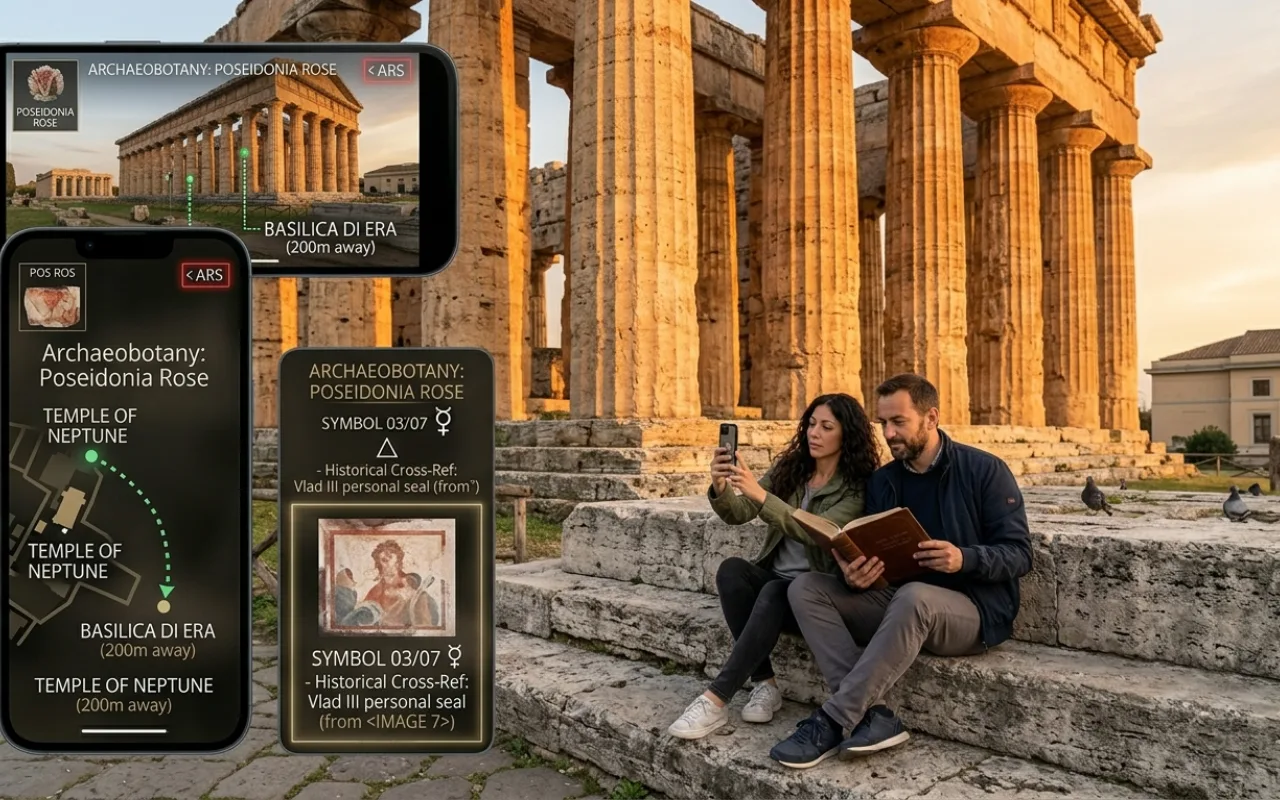
What to do in Paestum? Immerse yourself in ancient history by exploring this exceptional archaeological site, a UNESCO World Heritage gem. Paestum, once the Greek Poseidonia and later Roman Paestum, is renowned for its three remarkably preserved Doric temples: the Temple of Hera, the Temple of Neptune (or Poseidon), and the Temple of Athena (or Ceres). Beyond these majestic structures, the site also hosts the remains of an ancient city, its forum, and amphitheater. For an unusual activity in Paestum, our outdoor escape game invites you on a life-sized treasure hunt, transforming your visit into a fun and educational adventure. It's perfect for discovering the secrets of this millennia-old place in an original way. Here is the trail we offer in Paestum:
Poseidonia
The city of Poseidon in Magna Graecia

Paestum — Poseidonia's Lost Treasure
Uncover the cursed treasure of Poseidonia hidden by priests during the fall of the city. Decipher ancient clues across temples and ruins to claim it before a vengeful spirit does.
Landmarks of Paestum
Monuments and sites covered by our escape games across the city.
Unusual things to do in Paestum
For an unusual activity in Paestum, our outdoor escape games offer a unique perspective on the ancient ruins. Imagine deciphering riddles at the foot of the Temple of Neptune, or following hidden clues along the walls of the Roman agora. It's an original outing that encourages you to observe every detail, look up at the Doric capitals, and imagine life 2500 years ago. Far from classic guided tours, our trails transform the site into a huge playground where history reveals itself through adventure.
Things to do in Paestum with kids
What to do with the family in Paestum? Our outdoor escape games are an ideal activity for kids and teens to explore the archaeological site. Suitable from age 8, they transform the discovery of the temples into a real treasure hunt. The youngest will enjoy searching for visual clues, while older children and adults will take on the challenge of historical puzzles. It's a teen-friendly outing that combines the fun of gaming with learning, ensuring that the whole family leaves with memorable souvenirs and a better understanding of this fascinating place.
Paestum for couples
Paestum for couples is a timeless romantic getaway. Imagine strolling hand in hand among the majestic columns of the temples at sunset. Our outdoor trails offer an original couples' outing, transforming your walk into a shared investigation. It's an unexpected romantic activity: solving historical riddles together, sharing moments of complicity in front of the grandeur of the place. A unique way to strengthen your bond while exploring exceptional heritage, away from the crowds and beaten paths.
What to do in Paestum when it rains
What to do in Paestum when it rains? Our outdoor escape games are primarily open-air activities. Paestum is an open archaeological site, so it is preferable to enjoy our trails in dry weather. However, light rain can lend a mystical and dramatic atmosphere to the ancient temples, offering unique photo opportunities. In case of heavy rain, the National Archaeological Museum of Paestum, located on the site itself, offers shelter and perfectly complements the visit with its treasures. For a wet-weather activity, prioritize dry days for optimal immersion.
Where is Paestum, and where do the routes start?
Starting points of our routes and the places they pass through.
Route starting points
Places in Paestum
- Near Porta Sirena (East Gate)
- Public path offering a view of the Temple of Athena
- Northern section of the Greek walls
- Public area with panoramic view towards the Roman Forum
- Vantage point offering a distant and clear view of the Temple of Poseidon
- Vantage point offering a perspective on the Temple of Hera (Basilica)
- Public square or area in front of the National Archaeological Museum
- Public path near the remains of the Roman Amphitheater (exterior view)
- Tempio di Cerere & Roman forum
- Tempio di Nettuno
- Basilica (Tempio di Era) & Mura greche
- Paestum National Archaeological Museum
- Diver's necropolis
- Ekklesiasterion
- Heraion
- Porta Sirena
The history of Paestum
From Greek Poseidonia to Roman Paestum
Paestum, originally Poseidonia, was founded around 600 BCE by Greek settlers from Sybaris. The city became a trade center, dedicated to Poseidon. During its Greek period, Poseidonia saw the construction of its Doric temples. The Temple of Athena was built around 580 BCE and reconstructed around 500 BCE. The Temple of Hera, also known as the Basilica, dates from 560–520 BCE.
Around 400 BCE, the Lucanians, an Italic people, took control of the city, renaming it Paistos. The city continued to produce red-figure pottery and painted tombs. In 273 BCE, the Romans established a Latin-rights colony, renaming the city Paestum. This brought new sacred and civic monuments, including a forum. The Roman highway, the Via Popilia, bypassed Paestum in the 2nd century BCE, leading to an economic decline. By the end of the 1st century CE, Paestum's role as a major Roman city had diminished.
Decline and Rediscovery
The collapse of the Roman Empire from the 4th century AD brought economic crisis to Paestum. The city's population decreased, and malaria, from spreading swamps of the Salso River, forced inhabitants to move to higher ground. The city was abandoned between the 8th and 9th centuries. The temples remained standing but lost their sacred function, sometimes used as shelters. Paestum was largely forgotten until its rediscovery in 1762, during the construction of a modern road. This renewed interest, particularly during the Grand Tour era, led to the first archaeological investigations in 1907.
What to see in Paestum
- Temple of Hera (Basilica) — This is the oldest of the three major temples, dating from 560–520 BCE. Observe its Doric columns and the remains of two altars.
- Temple of Poseidon — Built around 460 BCE, this temple is a well-preserved Doric temple in Italy. Its scale and architectural details are evident.
- Temple of Athena — Located on the highest point of the ancient city, this temple dates from around 500 BCE. It features a Doric frieze in its pediment.
- Roman Forum — This rectangular area was the center of Roman Paestum's civic and religious life. See the remains of public buildings, including the Capitolium, dedicated to Jupiter, Juno, and Minerva.
- Roman Amphitheater — Though partially excavated, the remains of the amphitheater show the Roman city's public gatherings.
- Paestum National Archaeological Museum — This museum houses artifacts from the site, including sculptures, bas-reliefs, and tools. The "Tomb of the Diver" fresco, from 470 BCE, is a highlight.
When to visit Paestum
Visit Paestum during spring (April to June) and autumn (September to October). The weather is warm, the plain is green, and wildflowers are present. Crowds are moderate. Many Italian businesses may close for part of August. Winter (November to March) offers clear light and fewer crowds, but daylight hours are shorter, and some days can be wet. Avoid July and August due to intense heat and larger crowds, as there is little shade on the site.
Getting around Paestum
Paestum has its own railway station, Stazione di Paestum, 800 meters from the archaeological park, a walk of under 10 minutes. Regional trains from Salerno take 30-35 minutes; from Naples (Napoli Centrale), the journey is about 1 hour 30 minutes, often with a change. The closest airports are Salerno Costa d'Amalfi Airport and Naples International Airport (NAP). From Naples Airport, a train (with a transfer) takes about 1 hour 55 minutes.
If driving, take the A3 motorway to Battipaglia and exit towards SS18 for Paestum. Parking is available near the archaeological site; "Parking Paestum Archeologico Park" is 750 meters away and charges €3 per hour. Paid street parking is available 200 meters from the site. The archaeological park is unshaded and extensive, so comfortable walking shoes are necessary. The Paestum National Archaeological Museum is included in the archaeological park ticket.
Things you probably do not know about Paestum
Verified details most visitors walk straight past.
- Temple of Hera (Basilica)
- Why does the Temple of Hera, the oldest of Paestum's grand temples, have an odd number of columns across its front? Unlike most Doric temples that feature an even number of columns on their facades, the Temple of Hera has nine columns. This unusual design choice is thought to be an archaic feature, predating the more standardized architectural conventions that later emerged in Greek temple construction.
- Paestum National Archaeological Museum
- What secret does the famous 'Tomb of the Diver' fresco reveal about ancient Greek beliefs on life and death? The unique fresco from the Tomb of the Diver, dating to 470 BCE, depicts a young man diving into water. This imagery is believed to symbolize the transition from life to death, or the soul's leap into the unknown, a rare insight into Greek funerary symbolism.
- Ancient City Walls
- How did the ancient inhabitants of Paestum manage to build such extensive city walls that still stand today? The city walls of Paestum, stretching over 5 kilometers, are an important example of Western Greek fortification. They were constructed with immense limestone blocks, a testament to the engineering prowess of the Greeks who founded Poseidonia.
- Temple of Athena
- Why was the Temple of Athena, originally a Greek temple, later repurposed as a Christian church? During the decline of Paestum in late antiquity, as the city was gradually abandoned due to malaria and other factors, the Temple of Athena was converted into a Christian basilica around the 5th century AD, demonstrating a fascinating religious syncretism.
- Roman Forum
- What happened to the original Greek public buildings when the Romans took over Paestum? When the Romans established their colony in 273 BCE, they deliberately buried some key monuments from Poseidonia's Greek past, such as the Heroon and the Ekklesiasterion, to make way for new Roman civic and sacred structures like the Forum.
Questions about visiting Paestum
How much time should I allocate to visit Paestum?
Most visitors find that 2 to 4 hours are sufficient to explore the archaeological park thoroughly, including a visit to the Paestum National Archaeological Museum. The site is extensive, so plan for a good amount of walking.
Is Paestum easily accessible with public transport?
Yes, Paestum has its own train station, Stazione di Paestum, which is a short walk from the archaeological site. Regional trains connect it to major cities like Salerno and Naples, making it a convenient day trip by public transport.
What are the best ways to get around Paestum?
The archaeological park itself is best explored on foot, as it is a large, open-air site. The area immediately surrounding the ruins is also walkable. If you're staying further afield, a car is useful for exploring the wider region.
What is the typical budget for a day trip to Paestum?
The combined entrance fee for the archaeological park and museum is €15 from March to November, and €10 during winter months (December-February). Train tickets from Salerno are around €4. Parking costs vary but can be around €3-€5 per hour.
Is Paestum a good destination for families with children?
Paestum can be a great educational and engaging experience for families. The expansive open spaces allow children to explore, and the impressive temples often spark their imagination about ancient history. The museum also offers fascinating artifacts.
Are there any specific local customs or closures to be aware of in Paestum?
The archaeological park and museum are generally open daily, but the museum closes at 1:40 PM on the first and third Mondays of each month. Both are closed on December 25th and January 1st. Some local businesses might close for part of August.
Frequently asked questions
How much does an outdoor escape game in Paestum cost?
Our outdoor escape games in Paestum start at €12 per team (1 phone). For more players on the same trail, it's €19 for 2 phones and €25 for 3. The price is fixed per team, regardless of the number of participants, making it a very affordable activity for families or groups of friends.
Are the Paestum escape games suitable for children / families?
Yes, our trail in Paestum is designed to be a family-friendly activity and is suitable from age 8. The puzzles are varied and require observation and thought from everyone: children love searching for visual clues among the ruins, while adults appreciate the historical aspect. The secure GPS guidance allows you to enjoy the adventure without the risk of getting lost on the vast archaeological site.
How long does an outdoor escape game in Paestum last?
Expect between 1h30 and 2h30 to complete our outdoor escape game in Paestum, depending on your pace and the time you take to admire the temples and ruins. Our games are self-guided, meaning you can start whenever you want and take breaks to explore the site at your leisure, with no time constraints.
Do I need to book in advance for an escape game in Paestum?
Online booking is not mandatory, but it is highly recommended, especially during peak tourist season. You receive an activation code instantly by email after purchase, usable whenever you wish, with no expiry date. This offers you complete flexibility to plan your adventure in Paestum.
What is Paestum famous for? / What to visit in Paestum?
Paestum is world-renowned for its three incredibly well-preserved Greek Doric temples: the Temple of Hera, the Temple of Neptune, and the Temple of Athena. Beyond the temples, the archaeological site also includes a Roman forum, an amphitheater, and the remains of the ancient city. The National Archaeological Museum of Paestum, located on site, houses treasures such as the frescoes from the Tomb of the Diver. Our escape game incorporates these iconic locations into its trail.
When is the best season to visit Paestum?
Spring (April-June) and autumn (September-October) are the ideal seasons to visit Paestum. Temperatures are mild, the site is less crowded than in summer, and the light beautifully highlights the temples. Summer can be hot, so it's best to play early in the morning or late in the afternoon. In winter, the site is quiet and offers a different atmosphere, but the days are shorter.
More cities in Italy
Rome
Porta Magica, catacombs and the Popes' Passetto
Palermo
Normans, Arabs, Byzantines — the city of three crowns
Civita di Bagnoregio
The dying city perched on a tuff bridge
Syracuse
Archimedes' city and the Ear of Dionysius
Siena
The Contrade war and the world's oldest bank
Florence
Medici, Templars and Palazzo Vecchio alchemists
Bologna
Hidden canals, leaning towers and the world's oldest university
Activities to discover nearby
Guided tours, skip-the-line tickets and local experiences to book in advance.
💡 Optional booking — you can also buy on-site. All links open in a new window, your OddballTrip visit stays preserved.