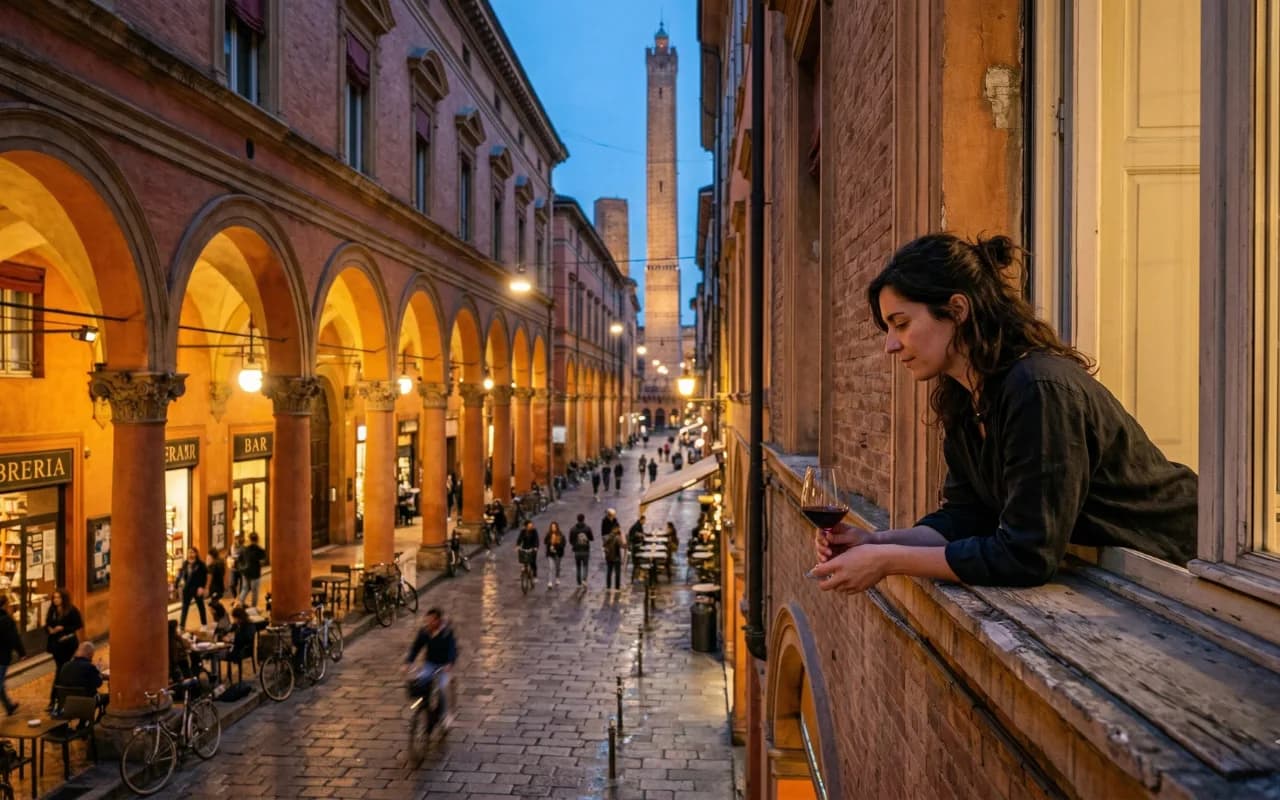
BolognaOutdoor Escape Game & Treasure Hunt
Hidden canals, leaning towers and the world's oldest university
Welcome to Bologna, the fascinating 'Red City'! Between its hidden canals, iconic leaning towers like the Asinelli and Garisenda, and its status as home to the world's oldest university, Bologna is an invitation to explore. Stroll under its miles of porticoes, get lost in the lively alleys of the Quadrilatero, and indulge in world-renowned cuisine. But to truly unlock the mysteries of this historic city and discover its hidden gems in a unique way, why not embark on an adventure? Our OddballTrip outdoor escape games transform the city into a giant playground. It's the ultimate unusual activity, a life-sized treasure hunt or a captivating scavenger hunt that will make you see Bologna in a new light, far beyond classic tourist guides. Ready to take on the challenge and explore our routes?
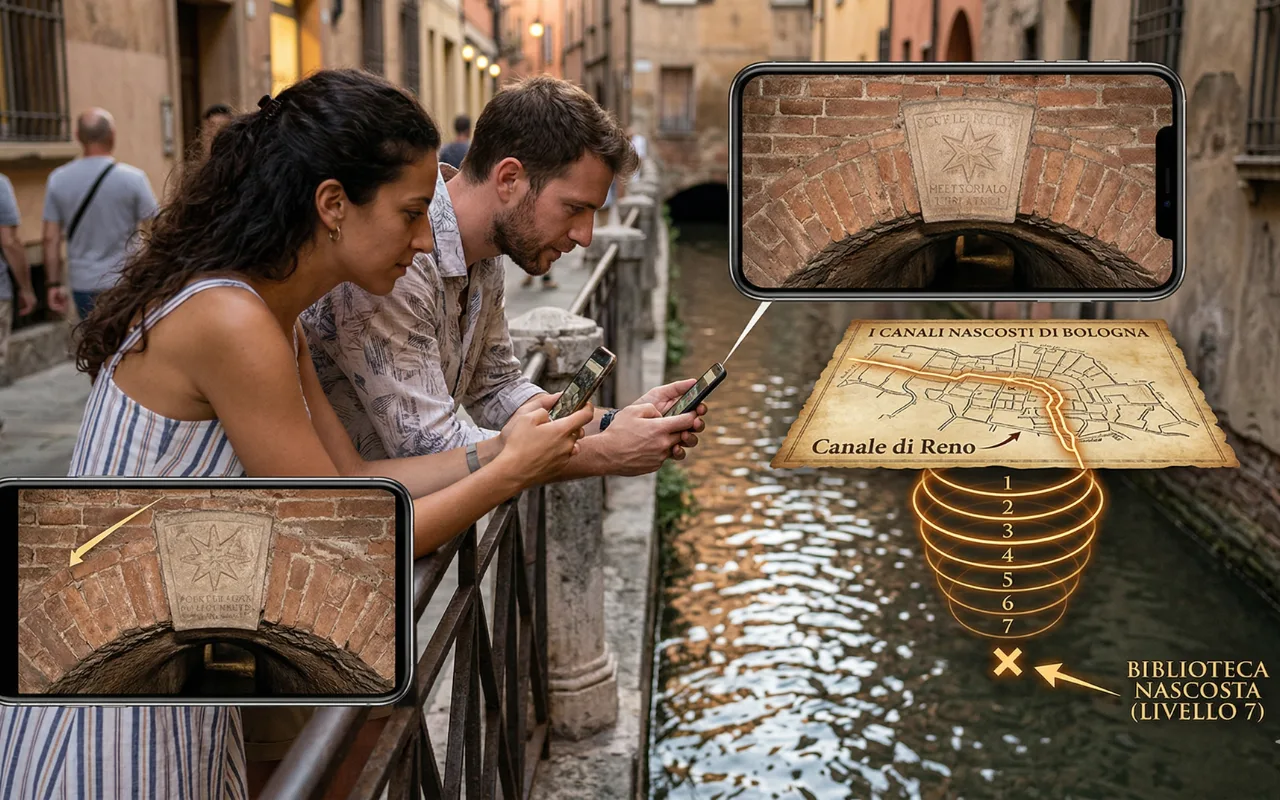
Bologna's Hidden Canals
A learned brotherhood beneath the porticoes
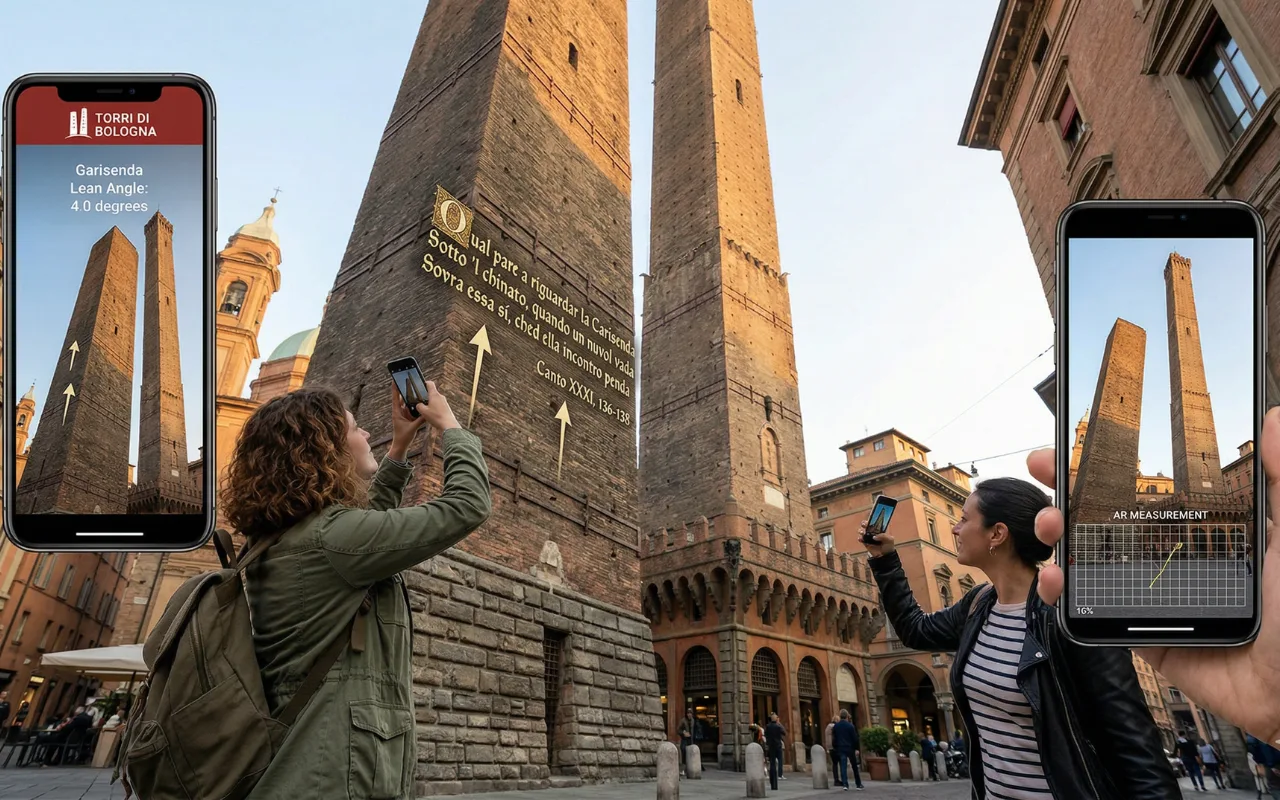
The Leaning Tower and the Garisenda Curse
Dante, rival families and the seven circles
Unusual things to do in Bologna
Bologna is a city full of secrets and little-known anecdotes, even for its residents! Our OddballTrip outdoor escape games are the perfect opportunity to explore this hidden side. Far from traditional guided tours, you embark on a real urban treasure hunt, discovering architectural details, discreet inner courtyards, and fascinating stories that only the most curious uncover. It's an unusual and immersive activity that turns every street corner into a clue, every facade into a puzzle, guaranteeing you a memorable and original experience in the heart of Emilia-Romagna's capital.
Things to do in Bologna with kids
What to do in Bologna with family? Our OddballTrip routes are an excellent answer! Designed to be accessible and fun, they transform city exploration into a large-scale scavenger hunt. Children, from 6-8 years old with adult help, love solving puzzles, looking for clues, and unlocking stages. It's a playful and interactive way to spend quality time together, stimulate their curiosity, and create unforgettable memories while exploring Bologna's wonders, away from screens and museums that are too quiet for the youngest.
Bologna for couples
Bologna is an incredibly romantic city, perfect for a couple's getaway. What if you added a touch of adventure to your stay? Our OddballTrip outdoor escape games are an original way to discover the city hand in hand. Imagine solving puzzles together, exploring hidden corners, and sharing laughs, all while creating unique memories. It's an activity that strengthens bonds, stimulates teamwork, and allows you to live an immersive and interactive experience, off the beaten path, for an unforgettable date in the heart of Italy.
What to do in Bologna when it rains
Let's be completely honest, our escape games are primarily outdoor activities. This means that in rainy weather in Bologna, a good umbrella is your best ally to enjoy the adventure! If the weather really turns bad, Bologna offers many alternatives: its famous porticoes provide natural shelter, you can take refuge in one of its superb art galleries, visit a museum, or simply settle into a historic café to enjoy local specialties while waiting for the sun to return.
Where is Bologna, and where do the routes start?
Starting points of our routes and the places they pass through.
Route starting points
Places in Bologna
- Piazza Maggiore & Via Clavature
- Via Piella & Due Torri
- Piazza Santo Stefano
- Archiginnasio
- Mercato di Mezzo
- San Luca porticoes
- Sant'Andrea della Zuccala church
- Porta Saragozza
- Piazza di Porta Ravegnana
- San Giacomo Maggiore & Palazzo Poggi
- Piazza Aldrovandi
- Santa Maria dei Servi
- Museo Civico Medievale
- Santo Stefano complex
- Piazza Verdi
- Archiginnasio Library
The history of Bologna
From Etruscan Felsina to Roman Bononia
Bologna's origins trace back to the 6th century BCE when the Etruscans founded Felsina, a significant settlement in the Po Valley. By the 4th century BCE, the Gaulish Boii tribe occupied the site. It later became a Roman colony and municipium named Bononia around 196 BCE. During the decline of the Western Roman Empire, Bologna faced repeated sacks by the Goths.
Medieval Flourishing and Papal Rule
A new era of importance began in the 11th century, leading to Bologna reaching its height in the 13th century. The University of Bologna, established in 1088, is the oldest continuously operating university in the world. It became a central hub for legal studies, drawing scholars from across Europe. In 1256, Bologna was the first European city to abolish serfdom. The city's militia defeated the emperor's army in 1249, capturing King Enzo, son of Frederick II Hohenstaufen, and holding him prisoner until his death. Despite periods of political instability and infighting among prominent families in the late 13th century, Bologna expanded its city walls and became one of Europe's most populated centers, comparable to Paris in urban development. After a series of wars and civil strife, Bologna lost its full sovereignty and was incorporated into the Papal States by Pope Julius II in 1506. Papal rule brought over three centuries of peace and prosperity, interrupted only by a brief period of French control (1797–1814) before the city joined the Kingdom of Italy in 1860.
What to see in Bologna
- Piazza Maggiore — Bologna's main square, surrounded by buildings like the Basilica di San Petronio and Palazzo Comunale. It is a central point for observation and events.
- Due Torri (Asinelli and Garisenda) — These two leaning medieval towers are city symbols. The Asinelli Tower, the taller of the two, offers views of the city's rooftops.
- Piazza Santo Stefano — A complex of interconnected religious buildings, referred to as the "Seven Churches." It provides a quiet square with cafes.
- Archiginnasio — Once the main building of the University of Bologna, it houses the Anatomical Theatre and a library. Its courtyards and halls display thousands of student coats of arms.
- Quadrilatero — This ancient market district, east of Piazza Maggiore, is a network of narrow streets like Via Pescherie Vecchie and Via delle Drapperie. Stalls sell produce, meats, and cheeses.
- Porticoes of Bologna — A UNESCO World Heritage site, these covered walkways extend for over 60 kilometers across the city, providing shelter and pedestrian routes.
When to visit Bologna
The best times to visit Bologna are during spring (April to June) and early autumn (September to October). Temperatures are mild, ranging from 10°C to 25°C, suitable for walking. Spring offers blooming gardens and various festivals. Autumn provides comfortable weather for walking and is good for food seasonality, including the start of the white truffle harvest in October.
Avoid visiting in July and August. These months are hot and humid, with temperatures often reaching 30-35°C, making midday sightseeing difficult. Many locals take vacations in August, leading to some shops and restaurants closing, especially around Ferragosto.
Getting around Bologna
Bologna's Guglielmo Marconi Airport (BLQ) is 6-10 km from the city center. The Marconi Express monorail reaches Bologna Centrale train station in about 7 minutes, costing €12.80 one-way. A standard Marconi Express ticket includes 75 minutes of TPER urban travel. Taxis take around 20 minutes and cost €20-€25.
The historic center is compact and walkable, with porticoes providing cover. Bologna's center is a Limited Traffic Zone (ZTL), restricting driving and incurring fines. Arriving by train or parking outside the ZTL is recommended. Public transport, especially buses, is reliable. A single urban bus ticket costs €2.30, valid for 75 minutes; a day ticket is €9. Children under one meter travel free on buses.
Shops typically open Monday to Saturday from 9 AM to 1 PM and 3:30 PM to 8 PM. Many close on Thursday afternoons and Sundays, and most close in August. The Quadrilatero market district is generally open daily from 8 AM to 7 PM, with shorter hours on Sundays. On weekends and public holidays, certain central streets, including Via Rizzoli, Via Indipendenza, and Via Ugo Bassi (Zona T), become pedestrian and bicycle-only zones from 8 AM Saturday to 10 PM Sunday.
Things you probably do not know about Bologna
Verified details most visitors walk straight past.
- Palazzo del Podestà, Piazza Maggiore
- Have you ever wondered if walls could truly whisper secrets across a crowded square? Under the Voltone del Podestà, an archway in Palazzo del Podestà, there is an acoustic trick known as the "Whispering Walls." If you stand in one corner and whisper into the wall, a person in the opposite corner can hear you clearly, even with the noise of the piazza.
- Basilica di San Petronio, Piazza Maggiore
- Look closely at the floor of Bologna's main basilica, and you might spot something unexpected for telling time. Inside the Basilica di San Petronio, on the floor of the main aisle, is one of the world's largest indoor sundials. Designed by Giovanni Domenico Cassini in 1655, a small hole in the roof projects a dot of sunlight onto the meridian line, indicating the exact moment the sun crosses at noon.
- Via Piella
- Bologna is known for its porticoes, but did you know it also hides remnants of a different kind of urban landscape? On Via Piella, there is a small window, the 'Finestrella,' that offers a glimpse of one of Bologna's few remaining open canals. This hidden waterway is a reminder of the extensive canal network that once crisscrossed the city, vital for trade and industry in medieval times.
- Torre degli Asinelli
- Why do Bologna's famous towers lean, and what was their original purpose beyond just looking impressive? The Due Torri, Asinelli and Garisenda, were built between 1109 and 1119 by rival noble families as symbols of their power and wealth. Their lean is due to subsidence of the ground. In the 12th and 13th centuries, Bologna had over a hundred such towers, creating a 'turreted city.'
- University of Bologna
- Bologna has the oldest university in the Western world, but its early structure was quite different from modern institutions. Founded in 1088, the University of Bologna was initially a student-run corporation, where students hired and paid their professors, and even set their salaries and lecture times. This unique model gave students considerable power over their education.
Questions about visiting Bologna
How many days should I spend in Bologna?
To get a good feel for Bologna and explore its main attractions, 2 to 3 days are generally recommended. This allows enough time to wander through the historic center, enjoy the food, and perhaps visit a museum or climb a tower. If you plan day trips to nearby cities like Modena or Parma, extend your stay to 3-4 days.
What is the best way to get around Bologna?
Bologna's historic center is quite compact and mostly flat, making it very walkable. The extensive network of porticoes provides excellent cover from both sun and rain. For longer distances or to reach areas outside the center, the local bus system is efficient and easy to use. Driving within the city center's ZTL (Limited Traffic Zone) is generally not recommended due to restrictions and fines.
Is Bologna a good city to visit with children?
Yes, Bologna is family-friendly. The city center is walkable and stroller-friendly, with porticoes offering shade and shelter. Children under one meter tall ride free on buses. Activities like the Whispering Walls in Piazza Maggiore, the San Luca Express tourist train to the basilica, and the Carpigiani Gelato Museum offer engaging experiences for kids. Parks like Giardini Margherita provide green spaces for play.
What is the typical budget for a day in Bologna?
Bologna can be explored on a moderate budget. Accommodation costs vary, but budget options are available outside the immediate historic center. Public transport is affordable, with single tickets at €2.30 and day tickets for €9. Eating at local markets like Quadrilatero or trying 'piatto del giorno' at small osterie can provide meals for €6-€10. Many major sights, like walking the Portico di San Luca or visiting the Basilica di San Petronio, are free.
Which neighborhoods are best for visitors in Bologna?
For first-time visitors, the Historic Center, particularly around Piazza Maggiore and the Quadrilatero, offers access to major sights and a lively atmosphere. Areas like Santo Stefano and Castiglione provide a quieter experience. For those seeking a social vibe, the University area is a good choice. Bolognina, outside the city walls, offers better value accommodation and a strong local food scene.
What are Bologna's market days and typical shop opening hours?
The Quadrilatero market district is generally open daily, usually from 8 AM to 7 PM, with shorter hours on Sundays. For fresh produce, Mercato delle Erbe on Via Ugo Bassi is open mornings and evenings, except Sundays and Thursday afternoons. Shops typically operate Monday to Saturday, from 9 AM to 1 PM and then from 3:30 PM to 8 PM. Many smaller shops close on Thursday afternoons and Sundays, and August sees widespread closures.
Frequently asked questions
How much does an outdoor escape game cost in Bologna?
The price for our outdoor escape games in Bologna is €12 per team, not per person! This is a fixed rate for downloading the game, regardless of the number of participants in your group (we recommend 2 to 6 players for an optimal experience). Once purchased, the game is yours, and you can play it whenever you want, with no time constraints or reservations. It's an economical and flexible solution to discover the city in an original and fun way.
Is it suitable for children / families?
Absolutely! Our escape games are perfectly suited for families and children. They are designed as large interactive treasure hunts. Younger participants, from 6-8 years old, love searching for clues and solving puzzles, especially if they are accompanied by adults for a little help. It's an excellent way to make visiting Bologna fun and engaging for everyone, stimulate their sense of observation and logic, and create memorable team memories.
How long does an escape game in Bologna last?
The duration of our escape game routes in Bologna is flexible and entirely depends on your pace! In average, players take between 1h30 and 2h30 to complete a game. The advantage is that you are free to take breaks whenever you wish: to grab a coffee, enjoy an ice cream, visit a monument that particularly interests you, or simply rest. You can even spread the adventure over several days if you like. It's your game, at your own pace!
Do I need to book in advance?
No, not at all! One of the great advantages of our outdoor escape games is their flexibility. You don't need to book a time slot or report to a fixed meeting point. Once you've purchased the game online, you instantly receive all the instructions to start the adventure whenever you want. Whether it's this morning, this afternoon, or in a few days, you decide the ideal time to embark on your exploration of Bologna. It's total freedom!
What to visit in Bologna beyond escape games?
Bologna is full of treasures to discover! Beyond our fun routes, don't miss the majestic Piazza Maggiore, the city's beating heart, with the Basilica of San Petronio. Climb (if you're not afraid of heights) the Torre degli Asinelli for breathtaking views. Explore the Archiginnasio, the former university, and its anatomical theatre. Stroll through the Quadrilatero for its markets and tastings. The National Art Gallery of Bologna also offers superb collections. And of course, get lost under its famous porticoes, a UNESCO World Heritage site!
What is the best season to visit Bologna?
To fully enjoy Bologna and its outdoor activities, like our escape games, spring (from April to June) and autumn (from September to October) are undoubtedly the best seasons. Temperatures are mild and pleasant, ideal for walking and exploring the city on foot without suffering from summer heat or winter cold. Tourist crowds are also less intense than in mid-summer, allowing you to discover Bologna's charms in a more serene and authentic atmosphere. Summer can be very hot!
More cities in Italy
Florence
Medici, Templars and Palazzo Vecchio alchemists
Venice
Alchemy, Kabbalah and Arsenal of the Serenissima's spies
Siena
The Contrade war and the world's oldest bank
Civita di Bagnoregio
The dying city perched on a tuff bridge
Turin
Alchemy, Templars and witches in the esoteric capital
Rome
Porta Magica, catacombs and the Popes' Passetto
Naples
Napoli Sotterranea, Dracula and the skull cult
Paestum
The world's best-preserved Greek temples
Activities to discover nearby
Guided tours, skip-the-line tickets and local experiences to book in advance.
💡 Optional booking — you can also buy on-site. All links open in a new window, your OddballTrip visit stays preserved.