
Civita di BagnoregioOutdoor Escape Game & Treasure Hunt
The dying city perched on a tuff bridge
What to do in Civita di Bagnoregio? Perched on its rocky outcrop, accessible only by a long pedestrian bridge, this medieval town seems suspended out of time. Nicknamed "the dying city" due to the constant erosion that gnaws at it, Civita di Bagnoregio offers a unique natural and architectural spectacle. Far from the crowds of big cities, it's the ideal place for an unusual activity, a scavenger hunt, or an outdoor escape game that will immerse you in its millennial history. Our outdoor escape games will guide you through its narrow streets, from Porta Santa Maria to Piazza San Donato, revealing the secrets of its stone houses and its breathtaking views over the Calanchi valley. An immersive experience to discover the legends and challenges of this Umbrian gem. Get ready for an unforgettable adventure. Here is the trail we offer in Civita di Bagnoregio:
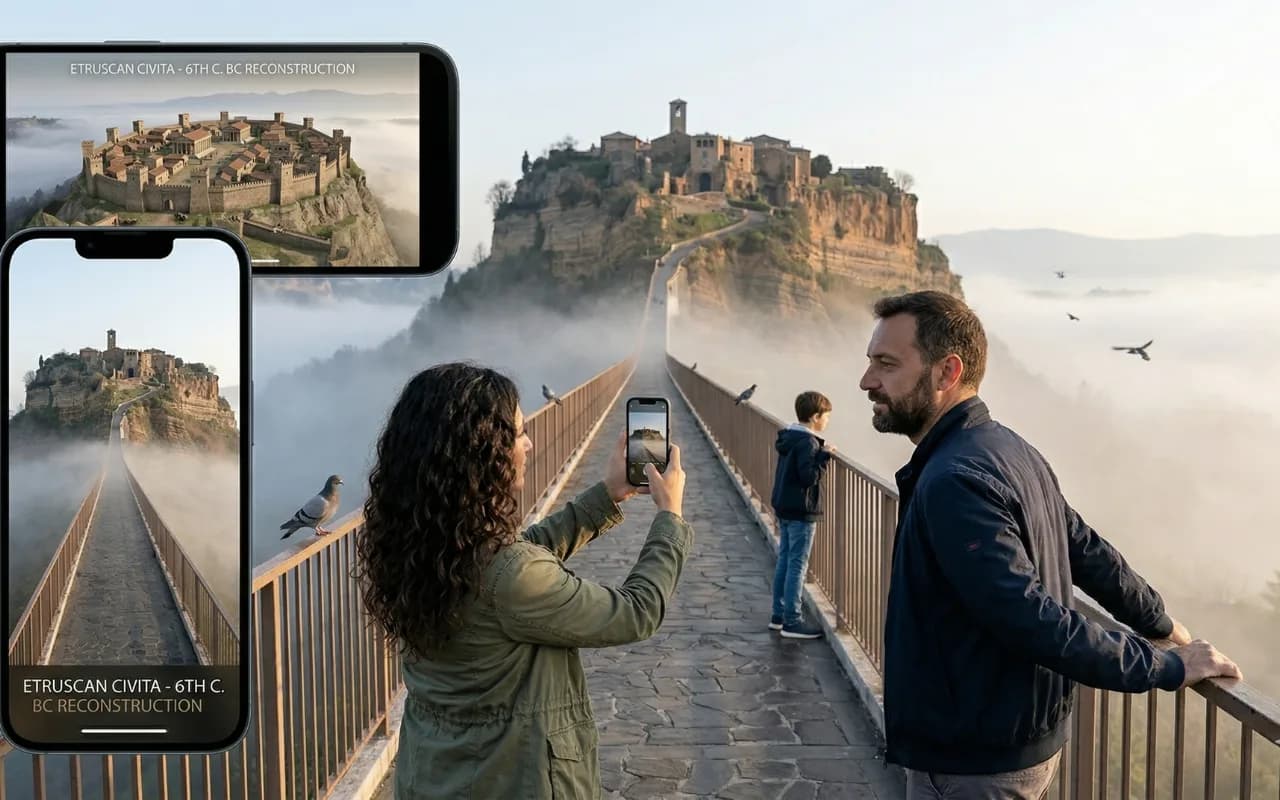
The Dying Town
Civita di Bagnoregio and the Etruscan testament

Civita's Last Stand — Unearth the Etruscan Secret Before Time Erases It
Decipher the Etruscan curse threatening to swallow Civita whole. Race against erosion to uncover why this 2,500-year-old settlement refuses to vanish, and expose the hidden truth buried beneath its crumbling cliffs.
Landmarks of Civita di bagnoregio
Monuments and sites covered by our escape games across the city.
Unusual things to do in Civita di Bagnoregio
For an unusual activity in Civita di Bagnoregio, our escape games offer a perfect immersion. Far from classic guided tours, you'll explore the hidden corners of the city, deciphering puzzles that lead you through vaulted passages and suspended gardens. An original outing that reveals not only the city's history but also the geological challenges that have shaped its destiny. Each clue invites you to observe architectural details and the surrounding landscapes with fresh eyes, transforming a simple walk into a true quest of exploration.
Things to do in Civita di Bagnoregio with kids
What to do with the family in Civita di Bagnoregio? Our outdoor escape game is an ideal kids' activity. From age 8, the youngest can actively participate in the clue hunt, while teenagers get excited about solving the puzzles. The GPS-guided trail is completely safe, allowing everyone to enjoy the exploration without getting lost. It's a teen-friendly outing that's different from museums, offering a fun and interactive way to discover the unique heritage of this suspended city. A memorable experience for the whole family.
Civita di Bagnoregio for couples
Civita di Bagnoregio for couples is a romantic getaway par excellence. Imagine strolling hand in hand through its cobbled streets, with breathtaking views over the Calanchi valley. Our outdoor trails, perfect for a couples' outing, transform this walk into a shared adventure. Solving puzzles together, discovering hidden architectural details, and sharing moments of wonder before unique panoramas is the unexpected romantic activity that strengthens bonds. An intimate and original way to soak up the magic of Civita.
What to do in Civita di Bagnoregio when it rains
What to do in Civita di Bagnoregio when it rains? Although our escape games are an outdoor activity, Civita's uniqueness lies in its covered passages and small arcades that offer partial shelter. The city then reveals an even more mystical atmosphere, with wet stones gleaming under diffused light. The trail will lead you through areas where you can briefly take cover, transforming bad weather into an opportunity to explore the city from a different, more intimate and dramatic angle. A wet-weather activity that reveals the hidden charms of the dying city.
Where is Civita di Bagnoregio, and where do the routes start?
Starting points of our routes and the places they pass through.
Route starting points
Places in Civita di Bagnoregio
- Piazza del Vescovado
- Belvedere Giovanni Paolo II
- Via Porta del Ponte
- Path near the walkway access (archaeological information point)
- Chiesa Collegiata di San Nicola
- Via Francesco Agosti
- Punto Panoramico (near P1 parking)
- Via Giacomo Matteotti
- Bagnoregio panorama & crossing
- Central square & church of San Donato
- Grotta di San Bonaventura & north viewpoint
- Porta Santa Maria
- Geological Museum and Landslides
- Etruscan oil press
- San Bonaventura cave
- South belvedere
The history of Civita di Bagnoregio
Etruscan Settlement and Roman Influence
Civita di Bagnoregio's origins date back over 2,500 years. The Etruscans established a settlement around 500 BC on a tufa hilltop overlooking the Valle dei Calanchi. This location provided defensive advantages and views of the Tiber River valley. The Etruscans engineered structures to protect the village from earthquakes, managed rivers, and created drainage channels. They also carved underground passages and chambers into the soft volcanic rock. When the Romans arrived in 265 BC, they continued and expanded these water management systems.
Medieval Development and Decline
After the Western Roman Empire fell, the area came under Lombard rule. Bagnoregio was known as Balneum Regis, meaning 'the bath of the king,' as Lombard King Desiderius reportedly sought treatment in local hot springs. By the 12th century, Civita became a free commune, though it remained under Orvieto's political influence. The town's decline accelerated in the late 17th century, following a major earthquake in 1695. This event caused significant damage and prompted many inhabitants, including the bishop and municipal government, to relocate to the more stable Bagnoregio. Continuous erosion of the tufa rock, intensified by seismic activity and landslides over centuries, gradually isolated Civita, leading to its nickname "the dying city."
What to see in Civita di Bagnoregio
- Ponte Pedonale — This 300-meter pedestrian bridge is the only access to Civita di Bagnoregio. Crossing it offers views of Civita on its tufa rock and the Valle dei Calanchi.
- Porta Santa Maria — The only remaining entrance to Civita, this gate was carved into the tufa by the Etruscans. It features a Gothic arch from the Middle Ages and two lions gripping human heads, symbolizing the town's 15th-century victory over despots.
- Piazza San Donato — Civita's main square has been a central point for millennia. It contains the Romanesque Church of San Donato, restored in the 16th century, which houses a 15th-century wooden Crucifix attributed to Donatello's school and a fresco from Perugino's school.
- Museo Geologico e delle Frane (Geological and Landslides Museum) — Located in Palazzo Alemanni on Piazza San Donato, this museum explains Civita's geological history and the ongoing erosion of its landscape.
- Grotta di San Bonaventura — An ancient chamber tomb carved into the tufa, named after Saint Bonaventure, born in Civita in 1221. Saint Francis of Assisi is said to have cured a boy here, who later became Bonaventure.
- Etruscan Caves — Civita has Etruscan-era tunnels and caves, some of which are part of a museum of rural life.
When to visit Civita di Bagnoregio
Visit Civita di Bagnoregio in spring (April-May) and autumn (September-October). During these seasons, the weather is mild, and crowds are thinner. Early mornings (8 AM-9 AM) or late afternoons (after 7 PM) offer the best light for photography and a quieter experience, avoiding midday crowds. Avoid July and August, as these are peak tourist months with large crowds and intense summer heat, making the bridge crossing difficult.
Getting around Civita di Bagnoregio
Civita di Bagnoregio is in the province of Viterbo, 125 kilometers from Rome. The nearest train stations are Orvieto and Viterbo, with bus connections to Bagnoregio. If driving, use the A1 motorway: from the north, exit at Orte towards Viterbo; from the south, exit at Orvieto towards Bagnoregio. Vehicles cannot enter Civita. Parking is available in Bagnoregio. Piazzale Alberto Ricci (Belvedere) is the closest, but Piazzale Battaglini, 1.5 km from the bridge, offers more spaces. From Piazzale Battaglini, walk 15 minutes or take a €1 shuttle bus to the pedestrian bridge. The pedestrian bridge is 300 meters long and takes 10-15 minutes to cross. An entrance fee applies: €3 on weekdays and €5 on weekends and public holidays. Tickets are sold at the info point near the bridge.
Things you probably do not know about Civita di Bagnoregio
Verified details most visitors walk straight past.
- Porta Santa Maria
- What do the lions on Porta Santa Maria have in their claws, and what do they represent? The two carved lions on Porta Santa Maria are depicted holding human heads between their claws. This imagery symbolizes the successful popular uprising of Civita's inhabitants against the Monaldeschi family, who controlled the region in the 15th century.
- Valle dei Calanchi
- Civita di Bagnoregio is often called 'the dying city,' but what exactly is 'dying'? The nickname 'the dying city' refers to the relentless geological erosion of the tufa rock plateau on which Civita stands. The surrounding Valle dei Calanchi, composed of clay, is also continuously eroded by wind and water, gradually isolating the town and threatening its very existence.
- Church of San Donato
- Before the current church, what stood on the site of the Church of San Donato? The site where the Church of San Donato now stands has been a place of worship for centuries. Archaeological evidence suggests that an Etruscan temple, followed by a Roman temple, occupied this central location before the construction of the current Catholic church.
- Grotta di San Bonaventura
- What miraculous event is associated with the Grotta di San Bonaventura? The Grotta di San Bonaventura, an ancient Etruscan chamber tomb, is linked to Saint Francis of Assisi. Legend says that during his stay in Civita, Saint Francis cured a young boy named Giovanni di Fidanza in this grotto, who later became Saint Bonaventure.
- Underground passages
- Beyond its visible streets, what lies beneath Civita di Bagnoregio? The soft tufa rock beneath Civita is riddled with an extensive network of ancient cellars, tunnels, and cisterns, many dating back to Etruscan times. These underground spaces were used for storing wine, collecting rainwater, and one pre-Roman tunnel even served as a bomb shelter during World War II.
- Old olive press (in a restaurant)
- What ancient piece of machinery can still be seen in one of Civita's restaurants? One restaurant in Civita di Bagnoregio proudly displays a 1,500-year-old olive press. Until the 1960s, donkeys, often blindfolded, would walk in a circle to operate this press, crushing olives to produce oil for the town.
Questions about visiting Civita di Bagnoregio
How do I get to Civita di Bagnoregio?
Civita di Bagnoregio is accessible by car to the neighboring town of Bagnoregio. From there, you can park and either walk or take a shuttle bus to the base of the pedestrian bridge. The final leg to Civita is a walk across the 300-meter-long pedestrian bridge.
How long does it take to visit Civita di Bagnoregio?
Most visitors spend between 2 and 4 hours exploring Civita di Bagnoregio, not including time for lunch or dinner. This allows for comfortable wandering through its streets, visiting the main sights, and enjoying the panoramic views.
Is Civita di Bagnoregio suitable for children?
Yes, Civita di Bagnoregio can be a magical experience for school-aged children. The unique location and the pedestrian bridge are exciting, and kids often enjoy exploring the small alleys, looking for cats, and visiting the Etruscan Caves and the Geological Museum.
What is the best time of day to visit Civita di Bagnoregio?
To avoid crowds and the intense summer heat, it's best to arrive early in the morning, between 8 AM and 10 AM, or late in the afternoon, after 7 PM. These times also offer excellent lighting for photography.
Are there places to eat in Civita di Bagnoregio?
Yes, despite its small size, Civita di Bagnoregio has several restaurants, trattorias, and bars where you can enjoy a meal or a drink. It's a good idea to make a lunch reservation, especially during peak season.
Is there an entrance fee to Civita di Bagnoregio?
Yes, there is an entrance fee to visit Civita di Bagnoregio. It costs €3 per person on weekdays and €5 on Saturdays, Sundays, and public holidays. This fee contributes to the town's preservation and maintenance.
Frequently asked questions
How much does an outdoor escape game in Civita di Bagnoregio cost?
Our outdoor escape games in Civita di Bagnoregio start at €12 per team (1 phone). For more players on the same trail, it's €19 for 2 phones and €25 for 3. There is only one trail available in this city for now.
Are the escape games in Civita di Bagnoregio suitable for children / families?
Yes, our trail in Civita di Bagnoregio is suitable from age 8. The puzzles are designed for group solving: children love searching for visual clues in the alleys, teenagers decipher codes, and adults connect everything to the city's rich history. The GPS guides you step-by-step, ensuring a safe and stress-free exploration.
How long does an outdoor escape game in Civita di Bagnoregio last?
Expect between 1h30 and 2h30 to complete our trail in Civita di Bagnoregio, depending on your pace and the time you take to admire the landscapes. Our games are self-guided: no fixed start time, you play at your own rhythm. This is ideal to fit into your visit schedule.
Do I need to book in advance?
Online booking is not mandatory but highly recommended, especially during high season and on weekends, to guarantee your access and avoid any waiting. You receive an activation code instantly by email, usable whenever you wish — no expiry date.
What is Civita di Bagnoregio famous for? / What to visit in Civita di Bagnoregio?
Civita di Bagnoregio is world-famous as "the dying city," a village perched on a rocky outcrop that is eroding. Must-sees include Porta Santa Maria, the only access gate, Piazza San Donato with its cathedral, and the Geological and Landslide Museum to understand its unique geology. Our trail incorporates these iconic locations into its puzzles.
What is the best season to visit Civita di Bagnoregio?
Spring (April-June) and autumn (September-October) are ideal: temperatures are mild, the light is beautiful for photos, and there are fewer crowds. Summer can be hot, so prefer early morning or late afternoon. In winter, the city has a mystical charm, and the trail remains enjoyable even in cool weather.
Other destinations in Lazio
Rome
Porta Magica, catacombs and the Popes' Passetto
Viterbo
The endless conclave and the San Pellegrino quarter
Bomarzo
The Monster Garden of the mad prince Orsini
Cerveteri
In the footsteps of the Etruscans, between ancient mysteries and modern life
Tarquinia
In the footsteps of the mysterious Etruscans
More cities in Italy
Siena
The Contrade war and the world's oldest bank
Florence
Medici, Templars and Palazzo Vecchio alchemists
Bologna
Hidden canals, leaning towers and the world's oldest university
Naples
Napoli Sotterranea, Dracula and the skull cult
Venice
Alchemy, Kabbalah and Arsenal of the Serenissima's spies
Paestum
The world's best-preserved Greek temples
Turin
Alchemy, Templars and witches in the esoteric capital
Activities to discover nearby
Guided tours, skip-the-line tickets and local experiences to book in advance.
💡 Optional booking — you can also buy on-site. All links open in a new window, your OddballTrip visit stays preserved.