PompeiiOutdoor Escape Game & Treasure Hunt
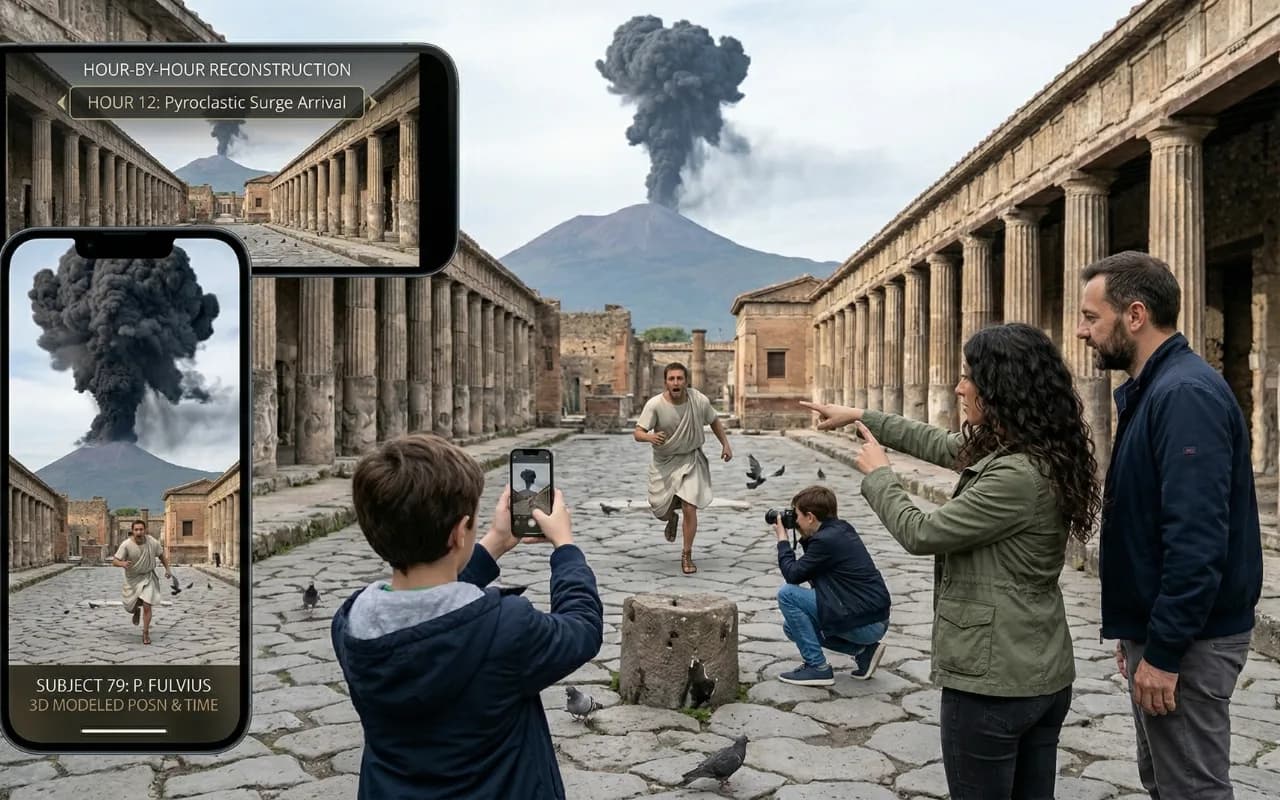
The city frozen under the ashes of Vesuvius
Welcome to Pompeii, the ancient city frozen in time by the eruption of Vesuvius! Beyond its emblematic ruins, Pompeii is a city that invites exploration and discovery. What to do in Pompeii? Of course, a visit to the famous archaeological excavations is a must: stroll through the Forum, admire the frescoes of the House of the Faun, or imagine the grandiose spectacles of the Amphitheater. But if you're looking for an original and captivating way to immerse yourself in the history of this fascinating city, OddballTrip.com offers an unusual activity that will transform your visit. Embark on an outdoor escape game, a real treasure hunt or a life-sized city game that will lead you through the ruins, solving puzzles while exploring. It's the perfect opportunity to rediscover Pompeii from a new and fun perspective, an adventure that will perfectly complement your exploration of the sites. Ready to take on the challenge and uncover Pompeii's secrets with our games?
Unusual things to do in Pompeii
Beyond traditional visits, Pompeii is full of hidden treasures and stories to unearth. If you're looking for a truly unusual experience, our outdoor escape games are for you. Transform the ancient streets and ruins into a gigantic playground where every corner can reveal a clue. It's much more than just a visit: it's an interactive treasure hunt that plunges you into the heart of Pompeii's mysteries. Forget classic guides and experience a unique adventure, full of twists and turns, that will make you see the city from a completely new angle.
Things to do in Pompeii with kids
Visiting Pompeii as a family can be a memorable experience, but long historical explanations can sometimes tire out the youngest. Our city games are the ideal solution to captivate the whole family! Designed to be fun and educational, these routes transform the discovery of the ruins into a real adventure. Children will love searching for clues and solving puzzles, while adults will appreciate learning history interactively. It's a fantastic way to create memories together and make exploring Pompeii exciting for all ages.
Pompeii for couples
Pompeii offers an incredibly romantic and history-rich setting for a couple's getaway. Imagine yourselves hand in hand, exploring the remains of an ancient civilization. To spice up your visit and share a unique moment, our escape games are a perfect activity. Off the beaten path, you'll collaborate to solve puzzles and uncover buried secrets, strengthening your bond while exploring the city differently. It's an original way to create unforgettable memories, combining romance, adventure, and cultural discovery in the heart of this legendary city.
What to do in Pompeii when it rains
Pompeii, with its vast archaeological sites, is predominantly an outdoor destination. Therefore, options for rainy weather are limited. Our escape games are also primarily outdoor activities, designed to be played in the open air. A light shower won't necessarily spoil the experience if you're prepared, but in case of heavy rain, it's best to postpone. Be honest and check the weather to make the most of your adventure.
Where is Pompeii, and where do the routes start?
Starting points of our routes and the places they pass through.
Route starting points
Places in Pompeii
- Forum & Temple of Jupiter
- Lupanar
- Casa del Fauno & Teatro Grande
- Villa dei Misteri
- Pompeii amphitheatre
- House of the Vettii
- Suburban baths
- Porta Ercolano
The history of Pompeii
From Oscan Settlement to Roman Colony
Pompeii's origins date to the 7th century BC, when the Oscan people settled on a volcanic plateau overlooking the Sarno River valley. This location, near the river's mouth and the Bay of Naples, provided access to agricultural land and maritime trade routes. During the 6th and 5th centuries BC, the city was influenced by both Greek and Etruscan cultures. By the 5th century BC, the Samnites, an Italic people, conquered Pompeii, leading to urban development over the following centuries.
In 89 BC, the Roman general Lucius Cornelius Sulla besieged Pompeii during the Social War. Marks from Roman projectiles are visible on sections of the city walls. After its conquest, Pompeii became a Roman colony in 80 BC, known as Colonia Cornelia Veneria Pompeianorum. This began a period of prosperity, with Roman veterans settling in the city and new public buildings reflecting its ties to Rome. The city's economy relied on agriculture, particularly wine and olive oil production, and trade, including the manufacturing of garum, a fermented fish sauce. Pompeii was a wealthy town with a population estimated between 10,000 and 20,000 residents.
The Earthquake and the Eruption
In 62 AD, an earthquake damaged Pompeii and other towns in Campania. The Roman senate ordered the city's reconstruction, but these efforts were cut short. On August 24, 79 AD, Mount Vesuvius erupted, burying Pompeii, Herculaneum, Stabiae, and Oplontis under 4 to 6 meters of volcanic ash and pumice. The eruption preserved the city almost exactly as it was, offering a snapshot of Roman life. Excavations began in 1748, and the site has been under continuous study since, revealing hundreds of homes, businesses, and public buildings.
What to see in Pompeii
- Forum — This central public space was the heart of Pompeii's civic life, flanked by temples and government buildings. It served as a hub for trade and social interaction.
- Lupanar — This two-story brothel is one of the most preserved in Pompeii, featuring erotic frescoes above each cubicle depicting the services offered. It shows a specific aspect of daily life.
- Terme Stabiane (Stabian Baths) — The oldest and largest of Pompeii's public bath complexes, dating to around 125 BC. Visitors can explore the frigidarium (cold bath), tepidarium (warm bath), and caldarium (hot bath), and observe stucco work in the men's section.
- Casa del Fauno (House of the Faun) — One of the largest private residences in Pompeii, known for its mosaics, including the Alexander Mosaic (now in Naples), and the bronze statue of a dancing faun in its impluvium.
- Teatro Grande (Large Theater) — Built in the 2nd century BC, this open-air theater could seat thousands and was used for plays and performances. Its structure allows for imagining ancient Roman entertainment.
- Villa dei Misteri (Villa of the Mysteries) — Located outside the city walls, this villa is known for its preserved frescoes in the triclinium, depicting a Dionysian rite. These frescoes offer insight into Roman religious practices and art.
- Pompeii Amphitheatre — The oldest stone amphitheater in the Roman world, built around 70 BC, it could seat approximately 20,000 spectators and hosted gladiator combats and other arena games.
- House of the Vettii — This domus, reopened in 2023 after two decades of restoration, belonged to two wealthy freedmen. It is known for its extensive Fourth Style wall paintings, including mythological scenes and a fresco of Priapus.
- Terme Suburbane (Suburban Baths) — These baths from the early Imperial period were built outside the city walls near Porta Marina. They are notable for their architecture, design, and surviving erotic wall paintings.
When to visit Pompeii
The best times to visit Pompeii are spring (April to early June) and fall (September to October). During these months, temperatures are mild, ranging from 15-21°C in spring and 17-24°C in autumn, making it comfortable for walking through the extensive outdoor site. Crowds are smaller compared to the summer season. Spring offers blooming wildflowers.
Avoid visiting in July and August if possible, as temperatures can reach 30-32°C, and the site becomes crowded. While winter (November to February) sees fewer tourists, there is a higher chance of rain and shorter daylight hours, with temperatures around 10-14°C.
Getting around Pompeii
Pompeii is accessible from Naples. The most common way is to take the Circumvesuviana train from Napoli Centrale (Piazza Garibaldi station) towards Sorrento. The journey takes about 35 minutes, and the Pompei Scavi - Villa dei Misteri station is across from the Porta Marina entrance to the archaeological site. A one-way ticket costs around €3.30.
If driving, take the A3 Naples-Salerno motorway and exit at Pompei Ovest. Supervised parking lots are available near the main entrances, particularly near Porta Marina and Piazza Esedra. Maxi Parking at Via Plinio 95 is about 150 meters from the ruins. Rates range from €2-€3 per hour, with full-day options around €10-€20. Arriving before 10:00 AM is recommended during peak season, as lots fill quickly.
The archaeological site covers 66 hectares and is explored on foot. Wear comfortable shoes as the ancient streets are uneven stone.
Things you probably do not know about Pompeii
Verified details most visitors walk straight past.
- Pompeii Amphitheatre
- What makes Pompeii's Amphitheatre particularly significant in Roman history? Built in 70 BC, Pompeii's Amphitheatre is the oldest known stone amphitheater in the Roman world, predating the Colosseum by over a century.
- House of the Vettii
- The owners of the House of the Vettii had an unusual path to wealth for Roman society. What was it? Aulus Vettius Conviva and Aulus Vettius Restitutus were freedmen, former slaves who amassed considerable wealth, likely as wine merchants, allowing them to own one of Pompeii's most lavish homes.
- Stabian Baths
- Before the public aqueduct, how did the Stabian Baths get their water, and what changed? Initially, the Stabian Baths drew water from a well and stored it in a rooftop reservoir. Around the 1st century AD, they were connected to the public aqueduct, which revolutionized bathing culture by allowing for heated pools and running fountains.
- Suburban Baths
- Why were the Suburban Baths built outside the city walls, and what unique features did they have? Built in the early Imperial period (possibly under Emperor Tiberius), the Suburban Baths were located outside the city walls because the walls had lost their defensive role. They were notable for their higher standard of luxury, panoramic views of the Bay of Naples, and surviving erotic wall paintings.
- Streets of Pompeii
- How did ancient Pompeians manage traffic and pedestrian crossings on their narrow streets? Many of Pompeii's narrow streets were one-way, evidenced by wear on stone curbs. They also featured raised stepping stones at intervals, acting like modern-day crosswalks to help pedestrians avoid dirty water.
- Bakeries of Pompeii
- What surprising food item has been found remarkably preserved in Pompeii's bakeries? Archaeologists have discovered carbonized loaves of bread, known as *Panis Quadratus*, so well-preserved they look as if they just came out of the ovens.
Questions about visiting Pompeii
How much time should I allocate to visit Pompeii?
To see the main highlights, a quick visit to Pompeii will take at least 2-3 hours. To explore the archaeological site and appreciate its details, a full day (5-7 hours) is recommended.
Is Pompeii easily accessible for visitors with mobility issues?
The ancient streets of Pompeii are paved with uneven stones and many areas have steps, which can be challenging for visitors with mobility issues. There are some accessible routes, but it is advisable to check the official site for information on accessible pathways.
What kind of budget should I plan for a visit to Pompeii?
Beyond the entrance ticket, budget for transportation (e.g., Circumvesuviana train is about €3.30 one-way from Naples), food, and any guided tours or audio guides. Parking costs around €10-€20 for a full day if driving. Prices for food and drinks inside or near the site can be higher than in local towns.
Are there places to eat within or near the archaeological site?
Yes, there are cafes and refreshment points within the archaeological park. Outside the main entrances, particularly near Porta Marina and Piazza Esedra, visitors will find various restaurants, pizzerias, and snack bars.
Can I visit Pompeii with children?
Pompeii can be an experience for children, bringing history to life. The site is large and exposed, so plan for breaks, shade, and water. Some areas, like the Lupanar, contain explicit frescoes, which parents should be aware of.
What are the opening hours for the Pompeii archaeological site?
Opening hours vary by season. From November 1st to March 31st, the site is generally open from 9:00 AM to 5:00 PM. From April 1st to October 31st, hours extend from 9:00 AM to 7:00 PM. Last admission is typically 1.5-2 hours before closing. It is always best to check the official website for the most current schedule.
Frequently asked questions
How much does an outdoor escape game cost in Pompeii?
An OddballTrip escape game in Pompeii costs €12 per team, not per person! This single price allows you to play with your friends or family, whether you are 2, 3, 4, or even 5 players. It's a very economical way to enjoy a fun and original activity while exploring the city. The price remains the same regardless of the number of participants in your group, making the adventure accessible to everyone.
Is it suitable for children / families?
Absolutely! Our escape games are designed to be a family activity par excellence. The puzzles are accessible and stimulating for all ages. We recommend children participate from 6 to 8 years old, always accompanied by an adult. It's an excellent opportunity for them to learn about Pompeii's history in an interactive and fun way, far from classic visits that can sometimes be a bit too static. Get ready to laugh and collaborate as a family!
How long does an escape game in Pompeii last?
The duration of our routes in Pompeii is flexible and depends entirely on your pace of exploration and puzzle-solving. On average, allow between 1h30 and 2h to complete the adventure. Some faster players may finish in a little less time, while others will prefer to take their time to admire the sites and soak up the atmosphere. The important thing is to have fun and enjoy every moment!
Do I need to book in advance?
No, not at all! One of the great advantages of our outdoor escape games is their flexibility. You don't need to book a specific time slot. Once you have your game, you can start the adventure whenever you want, at the time that suits you best, and even take breaks if you wish. It's ideal for adapting to your Pompeii visit schedule without constraints. Play spontaneously and at your own pace!
What to visit in Pompeii beyond the escape games?
Pompeii is full of historical and archaeological treasures! Beyond our games, which will make you explore the city differently, a thorough visit to the excavations is, of course, essential. Don't miss the Forum, the heart of civic life, the majestic Villa of the Mysteries with its incredible frescoes, or the Amphitheater, one of the oldest in the Roman world. Every street and every house tells a fascinating story. Feel free to get lost in the alleys for a total immersion!
What is the best season to visit Pompeii?
To fully enjoy Pompeii, we recommend visiting in spring (April-May) or autumn (September-October). During these periods, temperatures are pleasant and ideal for outdoor exploration, and crowds are generally less dense than in mid-summer. Summer can be very hot and sunny, making visits to archaeological sites more tiring. Winter is cooler and potentially rainy but offers a calmer atmosphere.
More cities in Italy
Rome
Porta Magica, catacombs and the Popes' Passetto
Civita di Bagnoregio
The dying city perched on a tuff bridge
Palermo
Normans, Arabs, Byzantines — the city of three crowns
Siena
The Contrade war and the world's oldest bank
Syracuse
Archimedes' city and the Ear of Dionysius
Florence
Medici, Templars and Palazzo Vecchio alchemists
Activities to discover nearby
Guided tours, skip-the-line tickets and local experiences to book in advance.
💡 Optional booking — you can also buy on-site. All links open in a new window, your OddballTrip visit stays preserved.