GubbioOutdoor Escape Game & Treasure Hunt
The Race of the Candles and medieval rituals
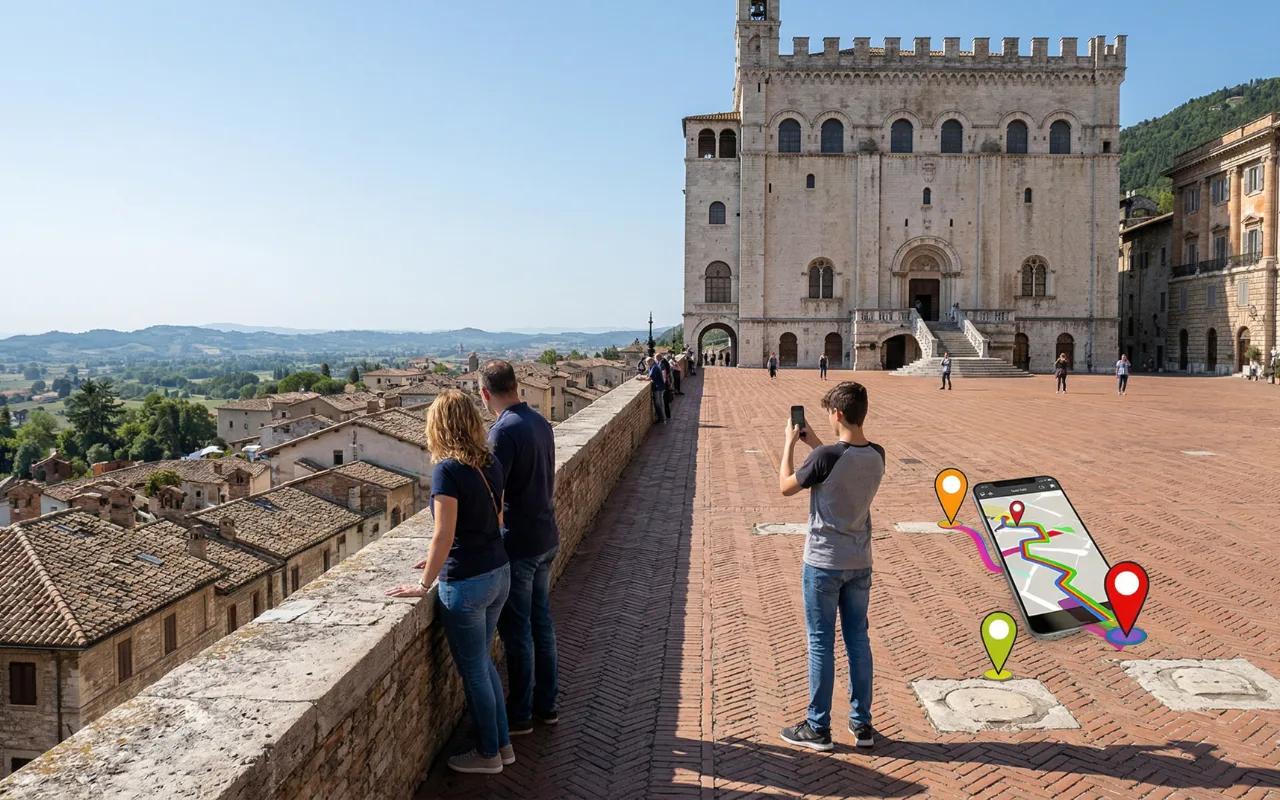
Gubbio, a medieval gem in Umbria, invites you on a timeless journey where history comes alive around every corner. Stroll through the majestic Piazza Grande, admire the imposing Palazzo dei Consoli dominating the city, and get lost in the cobblestone streets of the medieval quarter, where every stone whispers ancient legends. But Gubbio is more than just an open-air museum; it's also a fantastic playground for modern explorers. If you're looking for an unusual activity, an outdoor escape game is the perfect adventure to discover the city in a unique way. Transform your visit into a thrilling scavenger hunt or a real-life treasure hunt, solving puzzles inspired by the city's rich past. It's an immersive way to soak up Gubbio's atmosphere while having fun. Get ready to unveil Gubbio's secrets with our courses designed to give you a memorable experience.
Unusual things to do in Gubbio
For those looking to venture off the beaten path, Gubbio abounds with unusual activities, and our outdoor escape games are the perfect example. Far from traditional guided tours, our treasure hunts offer a playful immersion into the city's history and legends. Imagine solving puzzles in front of the Palazzo dei Consoli or deciphering hidden codes in the medieval alleys. It's an original and interactive way to discover Gubbio's secrets, transforming the city into a vast playground. A unique experience that combines culture, adventure, and critical thinking for unforgettable memories.
Things to do in Gubbio with kids
Gubbio is an ideal destination for families looking for adventure and discovery. Our outdoor escape games are designed to entertain both young and old, offering a fun and educational activity. Children will love transforming into detectives exploring the city's hidden treasures, while parents will appreciate the historical richness and beauty of the surroundings. It's an excellent opportunity to collaborate as a team, stimulate curiosity, and create memorable moments together. After the game, enjoy an ice cream on Piazza Grande or a stroll through the historic center.
Gubbio for couples
For a romantic getaway with a touch of adventure, Gubbio offers a perfect setting. Stroll hand in hand through the charming medieval alleys, admire the breathtaking views from Piazza Grande, and share a unique moment with our outdoor escape games. It's an original and intimate way to discover the city together, solving puzzles and exploring secret corners. Our courses are an invitation to collaboration and mutual discovery, strengthening your bond while offering a memorable experience off the beaten path. End your day with a romantic dinner in one of Gubbio's typical restaurants.
What to do in Gubbio when it rains
If rain decides to join your visit to Gubbio, please note that our escape games are primarily outdoor activities. However, Gubbio's magic doesn't fade away. You can still explore the city's museums like the Palazzo dei Consoli or the Duomo, which offer shelter and a fascinating dive into history. Our games remain playable with an umbrella and good rain gear, but it's good to be aware. Plan for a covered alternative if the weather is truly unpredictable.
Where is Gubbio, and where do the routes start?
Starting points of our routes and the places they pass through.
Route starting points
Places in Gubbio
- Piazza dei Quaranta Martiri
- Palazzo dei Consoli
- Via Baldassini
- Sant'Ubaldo basilica
- Fontana dei Matti
- Roman theatre of Gubbio
- Via dei Consoli
- Funicular and Monte Ingino summit
The history of Gubbio
From Umbrian Roots to Roman Grandeur
Gubbio's history begins as Ikuvium, a center for the ancient Umbrian people, contemporaries of the Etruscans, dating back to at least the 7th century BC. Evidence of human habitation in the Gubbio valley stretches back to the Middle Palaeolithic period, with permanent settlements emerging during the Neolithic era (6000–3000 BCE). The city's pre-Roman significance is shown by the discovery of the Iguvine Tablets in 1444, a collection of seven bronze tablets inscribed with the Umbrian language. These tablets are a resource for understanding the lost Umbrian language and culture.
By the 3rd century BC, Ikuvium became an ally of the Roman Republic, eventually assimilating into Roman culture by the 1st century BC. The Roman presence is visible today in the Roman theatre, constructed in the late 1st century BC, around the Augustan period. This theater, one of the largest surviving Roman theaters, accommodated approximately 6,000 spectators.
Medieval Power and Renaissance Influence
Gubbio experienced a period of growth in the Middle Ages, particularly around the year 1000, as a free commune. The city sent 1,000 knights to the First Crusade, and tradition states they were among the first to enter the Holy Sepulchre in 1099. A victory against Perugia in 1151, under the leadership of Bishop Ubaldo, marked a period of prosperity. The Palazzo dei Consoli, a Gothic building, was constructed between 1332 and 1349, designed by Angelo da Orvieto. This civic building served as the administrative center of the free commune and stands on Piazza Grande.
In 1384, Gubbio became part of the Montefeltro State. Federico da Montefeltro, Duke of Urbino, born near Gubbio in 1422, commissioned the construction of the Ducal Palace between 1476 and 1480. This Renaissance palace, facing the Gubbio Cathedral, served as a summer residence for the dukes and incorporated earlier medieval structures. Gubbio became part of the Papal States in 1631 and was incorporated into the Kingdom of Italy in 1860.
What to see in Gubbio
- Palazzo dei Consoli — This Gothic palace, built between 1332 and 1349, stands on Piazza Grande. It houses the Civic Museum, where the Iguvine Tablets, bronze plates inscribed in the ancient Umbrian language, are displayed.
- Piazza Grande — This three-sided piazza offers views of the terracotta rooftops and the Umbrian countryside. It was designed as a central meeting place during Gubbio's communal age.
- Roman Theatre of Gubbio — Located outside the medieval walls, this theater dates back to the 1st century BC. It once seated around 6,000 spectators and is used for performances today, particularly in July and August.
- Ducal Palace — Constructed between 1476 and 1480 for Federico da Montefeltro, this Renaissance palace stands next to the Gubbio Cathedral. It is notable for its Renaissance architecture and the archaeological excavations beneath it.
- Basilica of Sant'Ubaldo — This basilica, restored in the 1500s, is on Monte Ingino. It is the destination for the Ceri during the Festa dei Ceri. It can be reached via a cable car ride for views of Gubbio and the valley.
- Fontana dei Matti (Fountain of the Madmen) — Located in Largo Bargello, this fountain is associated with a local tradition where making three laps around it and getting wet, in the presence of a Gubbio resident, can earn an honorary "madman's license."
When to visit Gubbio
The most comfortable times to visit Gubbio are late April to mid-June and again in September. During these periods, temperatures are mild, ranging from 10°C to 19°C in spring and around 16.5°C in September, with sunshine. May is appealing, with the Festa dei Ceri on May 15th, though accommodation should be booked months in advance. September offers warm days without the peak summer crowds.
Avoid November, the wettest month with about 112mm of rain, which can make navigating the steep streets challenging. July and August can be hot, with highs reaching 27°C, and bring larger crowds. However, summer also features music festivals at the Roman Theatre.
Getting around Gubbio
Gubbio is best explored on foot, with most major attractions within walking distance. The town's narrow, steep streets are part of its character. For reaching higher parts of town, free public lifts are available. If arriving by car, parking is available in Piazza 40 Martiri. From there, it is an easy walk into the historic center.
Public transport connects Gubbio to other towns in Umbria by bus. The nearest major airports are Perugia San Francesco d'Assisi Airport (PEG) and Florence Airport (FLR), with train connections to nearby cities like Fossato di Vico-Gubbio station, requiring a bus transfer to Gubbio itself.
A weekly market takes place every Tuesday morning in Piazza 40 Martiri, offering fresh produce and local cheeses. An antiques market is held on the third Sunday of each month, and a local farmer's market on the fourth Sunday, both under the Logge dei Tiratori.
Things you probably do not know about Gubbio
Verified details most visitors walk straight past.
- Palazzo dei Consoli
- How did the builders of the Palazzo dei Consoli manage to construct such a massive building on a steep hillside in the 14th century? The Palazzo dei Consoli was built on a large platform against the hillside, with its lower floors extending beneath Piazza Grande. This design allowed for a stable foundation and integrated the building with the challenging terrain.
- Fontana dei Matti (Fountain of the Madmen)
- What's the unusual tradition associated with Gubbio's Fontana dei Matti? Locals claim you can earn a 'madman's license' by circling the fountain three times and getting wet, provided a Gubbio resident is there to certify the act.
- Church of San Francesco della Pace
- What surprising discovery was made beneath the Church of San Francesco della Pace in 1872? During renovations, the skeleton of a large wolf, several centuries old, was found under a slab near the church wall. It was reburied inside, linking to the legend of St. Francis and the Wolf of Gubbio.
- Roman Theatre of Gubbio
- Beyond entertainment, how was Gubbio's Roman Theatre repurposed after the fall of the Roman Empire? Following the Roman Empire's decline, the theater was transformed into a fortified garrison in the 6th century to defend Gubbio, which was strategically located along a road connecting Rome and Ravenna.
- Ducal Palace
- What happened to the famous Studiolo from Gubbio's Ducal Palace? The Duke's Studiolo, a small study intricately decorated with wood-panel inlay work, was designed by Francesco di Giorgio Martini. Today, it can be seen in the Metropolitan Museum of Art in New York.
- Festa dei Ceri
- Why does the same team always win the Festa dei Ceri, despite it being a race? By tradition, the team carrying the Cero of Saint Ubaldo always wins the race, symbolizing good fortune for the town. The real contest lies in how many times the Ceri are dropped.
Questions about visiting Gubbio
How do I get around Gubbio?
Gubbio is a compact town best explored on foot, with most main attractions easily accessible. For reaching the higher parts of the city, there are free public lifts available. A tourist train also operates during peak season, offering a hop-on, hop-off option for sightseeing.
How long should I stay in Gubbio?
Gubbio can be visited in a day or even an afternoon to see most of its main attractions. However, to fully immerse yourself in its atmosphere, explore the museums, and enjoy the local cuisine, a stay of two to three days is recommended.
What are the best neighborhoods or areas to explore?
The historic center, particularly around Piazza Grande and Via dei Consoli, offers a concentration of medieval architecture, shops, and restaurants. The area near the Roman Theatre provides a glimpse into Gubbio's ancient past, while the ascent to Monte Ingino offers views.
What is the best time of year to visit Gubbio?
The best times to visit Gubbio are late April to mid-June and September. These periods offer mild weather, fewer crowds than peak summer, and various festivals. May is notable for the Festa dei Ceri.
What is a reasonable budget for a trip to Gubbio?
Gubbio can be visited on a moderate budget. Accommodation prices vary, but are generally lower outside of peak festival times. Dining at local trattorias is affordable, and many key attractions offer combined tickets or free entry, like the Gubbio Cathedral.
Is Gubbio suitable for families with children?
Yes, Gubbio is family-friendly. Children often enjoy the Roman Theatre, the funicular ride up Monte Ingino, and the local playgrounds, including one next to the Roman Theatre. There's also a Dinosaur Museum in Gubbio.
Frequently asked questions
How much does an outdoor escape game cost in Gubbio?
Our outdoor escape games in Gubbio are designed to be accessible and offer excellent value. The price is €12 per team, regardless of the number of participants (within the recommended limit for a better experience, usually 2 to 6 players). This single team rate allows you to fully enjoy the adventure without worrying about the cost per person, making the activity ideal for families, friends, or couples. It's an economical and exciting way to discover the city.
Is it suitable for children / families?
Absolutely! Our outdoor escape games in Gubbio are perfectly suited for families and children. The puzzles are designed to be stimulating without being too difficult, encouraging collaboration between generations. It's an excellent activity to spark the curiosity of the youngest and help them discover Gubbio's history in a fun way. We recommend the presence of at least one adult per team to guide the children, but the adventure is designed to appeal to everyone.
How long does an escape game in Gubbio last?
The duration of our outdoor escape games in Gubbio generally ranges from 1 hour 30 minutes to 2 hours 30 minutes, depending on your pace and the complexity of the chosen route. This time includes solving puzzles, moving between different points of interest, and exploring the city. You are free to take your time and take breaks if you wish. The goal is to enjoy the experience at your leisure, combining play and tourist discovery.
Do I need to book in advance?
No, there's no need to book in advance for our outdoor escape games in Gubbio! Our games are designed to be played at any time, at your convenience. Simply download the app, purchase the game, and start the adventure whenever you want. It's ideal for a last-minute decision or to adapt to a flexible schedule. You have the freedom to start your game as soon as you are ready to explore Gubbio.
What to visit in Gubbio beyond the escape games?
Gubbio is full of treasures to explore after or before your escape game! Don't miss the majestic Palazzo dei Consoli and Piazza Grande, offering breathtaking views. Visit the Duomo (Cathedral) and the Ducal Palace for a dive into history. For a unique experience, take the funivia (cable car) up Mount Ingino to admire the panorama. Stroll through the medieval alleys, discover the Roman Theater, and soak up the unique atmosphere of this fascinating city.
What is the best season to visit Gubbio?
The best season to visit Gubbio and fully enjoy our outdoor escape games is spring (April-June) or autumn (September-October). During these periods, the weather is generally mild and pleasant, ideal for walking and exploring the city on foot. Summer can be hot, but evenings are often very pleasant. Winter is cooler, but the city retains a special charm under a grey sky, and the games remain accessible for the bravest.
More cities in Italy
Civita di Bagnoregio
The dying city perched on a tuff bridge
Siena
The Contrade war and the world's oldest bank
Florence
Medici, Templars and Palazzo Vecchio alchemists
Bologna
Hidden canals, leaning towers and the world's oldest university
Rome
Porta Magica, catacombs and the Popes' Passetto
Venice
Alchemy, Kabbalah and Arsenal of the Serenissima's spies
Naples
Napoli Sotterranea, Dracula and the skull cult
Paestum
The world's best-preserved Greek temples
Activities to discover nearby
Guided tours, skip-the-line tickets and local experiences to book in advance.
💡 Optional booking — you can also buy on-site. All links open in a new window, your OddballTrip visit stays preserved.