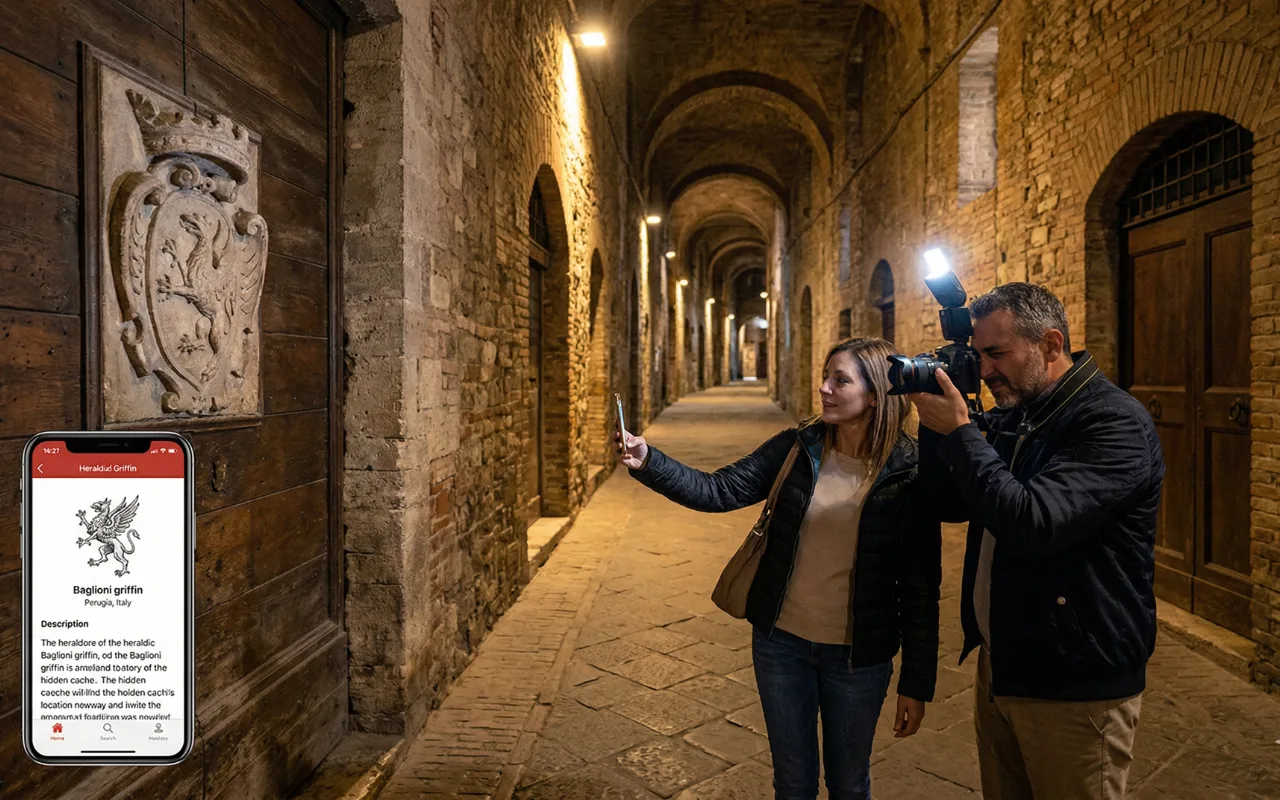
PerugiaOutdoor Escape Game & Treasure Hunt
The Baglioni revenge beneath the Rocca Paolina
Perugia, the capital of Umbria, is a captivating city where history and modernity intertwine seamlessly. Stroll along Corso Vannucci, admire the majestic Fontana Maggiore in Piazza IV Novembre, or explore the underground ruins of the Rocca Paolina, an imposing fortress that whispers tales of centuries past. Every cobblestone alley, every Etruscan arch like the Arco Etrusco, reveals a fragment of its glorious heritage. But Perugia is more than just an open-air museum; it's also a vibrant place that invites adventure. For those seeking an unusual activity, our outdoor escape game offers a unique way to discover the city. Forget conventional tours and immerse yourself in a real-life treasure hunt, a thrilling scavenger hunt that will lead you through the city's secrets. Get ready to solve puzzles while exploring Perugia's hidden corners, as our adventure awaits you right after this.
Unusual things to do in Perugia
If you're looking for unusual activities in Perugia, you've come to the right place! Beyond museums and art galleries, the city is full of surprises for curious explorers. Our outdoor escape game is one of these gems: it transforms the historic streets into a huge playground. Imagine solving puzzles at the foot of ancient monuments, deciphering hidden codes in picturesque alleys, and discovering surprising anecdotes about Perugia, all while progressing through a captivating adventure. It's an original and immersive way to experience the city, far from the beaten path. A unique experience that combines culture, game, and urban exploration.
Things to do in Perugia with kids
Perugia is a wonderful destination for families, and our outdoor escape game is the ideal activity to create unforgettable memories together. Away from screens, young and old alike will be invited to collaborate, communicate, and use their logic to solve the challenges of the game. It's an excellent way to explore the city in a fun and interactive manner. Children will love the "treasure hunt" aspect and feel like real detectives, while adults will appreciate discovering Perugia's cultural richness from a new perspective. Plan a great afternoon of adventure that will appeal to all ages and strengthen family bonds.
Perugia for couples
For a romantic getaway in Perugia, our outdoor escape game offers a charming alternative to candlelit dinners. Imagine yourselves, hand in hand, wandering through medieval alleys, solving puzzles together, and sharing laughs over unexpected challenges. It's a unique way to strengthen your bond and discover the city in a new light, away from the usual crowds. The game will lead you through iconic landmarks and secret corners, offering magnificent opportunities for photos and intimate moments. A couple's activity that promises adventure, discovery, and a good dose of romance, transforming every street corner into a shared memory.
What to do in Perugia when it rains
What to do in Perugia on a rainy day? This is an important question, as most of our escape games are designed to be played outdoors. Our game in Perugia is no exception and requires good weather conditions to be fully enjoyed. If the sky is gray, we recommend exploring the city's museums, such as the Galleria Nazionale dell'Umbria, or taking shelter in one of the many historic cafes. Save our escape game for a sunny day, when you can fully enjoy exploring the streets of Perugia without getting wet!
Where is Perugia, and where do the routes start?
Starting points of our routes and the places they pass through.
Route starting points
Places in Perugia
- Piazza IV Novembre
- Upper old city
- Underground Rocca Paolina
- Palazzo dei Priori
- Porta Marzia
- Corso Vannucci
- Via dei Priori
- San Pietro abbey
The history of Perugia
From Etruscan Heights to Papal Control
Perugia's story begins with the Etruscans, who founded the city in the 4th century BC. Its hilltop position made it a significant center, and remnants of their civilization, like the Porta Marzia and the Arco Etrusco, still stand. After the Battle of Sentinum in 295 BC, the city came under Roman control, though it largely retained its character.
The Middle Ages saw Perugia develop as a free comune. The Palazzo dei Priori, begun in 1293, stands as evidence of this era, housing the city's governing body. However, this independence was often challenged. In 1540, the city's spirit clashed with Pope Paul III in the 'Salt War.' The Pope, angered by a salt tax revolt, crushed the Perugian rebellion and ordered the construction of the Rocca Paolina. This fortress, designed by Antonio da Sangallo the Younger, was built directly over the razed homes of the Baglioni family, burying a part of the medieval city to assert papal authority. The Rocca Paolina remained a symbol of papal control until Italy's unification in the 1860s, when citizens largely dismantled it.
A City Reconnected
While much of the Rocca Paolina was destroyed, its underground passages, incorporating ancient streets and structures, were rediscovered and restored in 1932 and again in 1965. Today, these subterranean routes, along with escalators installed in 1983, connect the lower parts of the city with its historic core. Visitors can walk through centuries of Perugia's layered past. The city maintains its historical integrity while integrating contemporary life, supported by its two universities.
What to see in Perugia
- Piazza IV Novembre — This is Perugia's main square, where Roman and Etruscan civilizations once converged. It contains the Fontana Maggiore and the Palazzo dei Priori, showing medieval civic architecture.
- Fontana Maggiore — Built between 1275 and 1278 by Nicola and Giovanni Pisano, this medieval fountain is a work of sculpture. Its two polygonal basins have 74 sculptures depicting biblical scenes, allegories, the months of the year, and zodiac signs.
- Palazzo dei Priori — This Gothic palace, constructed between 1293 and 1443, served as the seat of Perugia's medieval government. Its irregular shape reflects centuries of enlargements. Today, it houses part of the municipality, the Nobile Collegio del Cambio, the Nobile Collegio della Mercanzia, and the Galleria Nazionale dell'Umbria.
- Underground Rocca Paolina — Explore the remains of this 16th-century papal fortress. Walk through ancient streets, medieval arches, and chambers that were buried when Pope Paul III ordered its construction in 1540.
- Porta Marzia — An Etruscan gate from the 3rd century BC, this entrance was incorporated into the Rocca Paolina by architect Antonio da Sangallo the Younger. Its travertine arch and five sculpted figures, including Jupiter, are visible.
- Collegio del Cambio — Located within the Palazzo dei Priori, this frescoed hall was the seat of the Money Changers' guild. Perugino's frescoes, created between 1498 and 1500, are a feature.
- San Pietro Abbey (Abbazia di San Pietro) — Founded around 996 on the site of Perugia's first cathedral, this Benedictine abbey includes a basilica, two cloisters, and a garden, with art from the 15th to 17th centuries.
When to visit Perugia
The shoulder seasons, April-May and September-October, offer a balanced experience in Perugia. Temperatures are pleasant, ranging from 17-24°C in spring and 16-26°C in autumn, suitable for walking. Crowds are smaller than in summer. Events include the International Journalism Festival in April or Eurochocolate in October.
Summer (July and August) brings hot weather, often reaching 28-36°C, and peak tourist crowds and prices, especially during the Umbria Jazz Festival in July. Many local businesses may close around Ferragosto (August 15th).
Winter (December-February) is cold, with temperatures around 3-8°C, and some closures. It offers a quieter atmosphere and is the peak season for black truffles.
Getting around Perugia
Perugia's main train station, Perugia Fontivegge, is about 3 km southwest of the historic center. From there, take a bus or the Minimetrò, an automated light rail system, which connects the station to the city center in about 5 minutes. A single Minimetrò ticket costs 1.50 euro and is valid for 70 minutes, also covering city buses.
If arriving by bus, the main bus terminal, Piazza Partigiani, is a walk from the city center. For those driving, parking is available, but the historic center is largely a pedestrian zone, best explored on foot. Escalators help navigate the city's hilly terrain, connecting different levels of the city.
Perugia is connected to major Italian cities. Direct trains link Florence to Perugia in 2 hours, and with a transfer, Rome is about 2 hours 40 minutes away. Perugia San Francesco d'Assisi Airport serves several low-cost European airlines.
Things you probably do not know about Perugia
Verified details most visitors walk straight past.
- Fontana Maggiore
- What secret did the 13th-century sculptors of the Fontana Maggiore hide in plain sight? The fountain's panels, carved by Nicola and Giovanni Pisano, were damaged during the 1348 earthquake and later reassembled in an arbitrary order, disrupting their original narrative sequence.
- Palazzo dei Priori
- Why does Perugia's grandest civic palace have an irregular, slightly wavy facade? The Palazzo dei Priori was built in several phases between the 13th and 15th centuries, with constant additions and the incorporation of earlier buildings, leading to its asymmetrical appearance.
- Rocca Paolina
- What happened to Pope Paul III's statue after the Perugians rebelled against his rule? During the French occupation of Perugia in 1797, the Perugians, rebelling against papal authorities, removed inscriptions and papal arms from the Rocca Paolina and threw the statue of Pope Paul III into the moat.
- Porta Marzia
- How did a 16th-century fortress manage to preserve a 3rd-century BC Etruscan gate? When Antonio da Sangallo the Younger built the Rocca Paolina in 1540, he ingeniously preserved the ancient Porta Marzia by embedding its upper portion into the fortress walls, transforming it into a decorative element.
- San Pietro Abbey
- What unexpected event led to the burning of this powerful Benedictine abbey in the 14th century? In 1398, angry citizens of Perugia set fire to the San Pietro Abbey, accusing its abbot, Francesco Guidalotti, of participating in a conspiracy against Biordo Michelotti, the leader of the popular party.
- Corso Vannucci
- What unique feature keeps this ancient capital's main street lively well into the night? Corso Vannucci is filled with students from two thriving universities, giving this ancient capital an unexpectedly youthful and cosmopolitan pulse that keeps its cafés and piazzas lively.
Questions about visiting Perugia
How many days should I spend in Perugia?
Three to four full days is a good amount for a first visit to Perugia, allowing you to explore the main neighborhoods on foot, enjoy meals, and even take a day trip. If you plan to explore the surrounding Umbrian region, consider extending your stay to five or six days.
What are the best ways to get around Perugia?
Perugia's historic center is walkable, and escalators connect the lower and upper parts of the city. The Minimetrò, an automated light rail system, is a convenient option to travel between the main train station (Perugia Fontivegge) and the city center. Buses and taxis are also available.
What is the best time of year to visit Perugia?
The shoulder seasons of April-June and September-October offer comfortable weather for exploring and fewer crowds. These periods also host cultural events like the International Journalism Festival in April and Eurochocolate in October. Summer can be hot and crowded, especially during the Umbria Jazz Festival in July.
Is Perugia a good destination for families with children?
Perugia can be a good destination for families, particularly during the milder shoulder seasons when temperatures are ideal for exploring. The city's layered history and unique underground passages can be engaging for children. Consider combining cultural visits with outdoor activities in the surrounding Umbrian countryside.
What is the typical budget for a trip to Perugia?
Accommodation prices in Perugia are generally easier to find in spring, before the high season of June-August. Overall, Perugia tends to be less tourism-led compared to Florence, potentially offering more budget-friendly options.
Are there any specific neighborhoods to explore in Perugia?
Beyond the central Piazza IV Novembre, explore the medieval descent of Via dei Priori for its historic charm. The Borgo XX Giugno area, home to San Pietro Abbey, offers a quieter experience. The underground passages of Rocca Paolina provide a unique perspective on the city's history.
Frequently asked questions
How much does an outdoor escape game cost in Perugia?
Our outdoor escape games in Perugia are designed to be accessible and offer a quality experience. The price is €12 per team, making it very affordable, especially if you play with several people! This rate includes access to the game, the puzzles to solve via your smartphone, and total immersion in Perugia's history and secrets. It's excellent value for an activity that combines urban exploration, culture, and entertainment. No hidden fees, just an exciting adventure waiting for you in the heart of the city.
Is it suitable for children / families?
Absolutely! Our escape game in Perugia is perfectly suited for families and groups with children. The puzzles are designed to be challenging without being overly complex, allowing everyone to participate and contribute. It's a great opportunity to spend quality time together, stimulate the curiosity of the youngest, and help them discover the city in a fun way. We recommend at least one adult per team to guide the children, but the adventure is designed to be enjoyed by all ages.
How long does an escape game in Perugia last?
The duration of our escape game in Perugia generally varies between 1h30 and 2h30. This, of course, depends on your team's pace, your ability to solve puzzles, and the time you take to admire the magnificent urban landscapes and monuments you'll encounter. There's no excessive time pressure; the main goal is to have fun and enjoy the experience. You are free to take breaks if you wish, to grab a coffee or explore a place that particularly appeals to you.
Do I need to book in advance?
Yes, we strongly recommend booking your escape game in Perugia in advance. While our games are available at any time via the app, prior booking allows us to better anticipate demand and, most importantly, ensure that all necessary information and technical support are ready for your adventure. This guarantees a smooth and seamless experience from the start. Moreover, it allows you to plan your day with peace of mind, knowing your activity is confirmed.
What to visit in Perugia beyond the escape games?
Perugia is full of treasures to explore! After your OddballTrip adventure, don't miss Piazza IV Novembre with its magnificent Fontana Maggiore and the Palazzo dei Priori, which houses the Galleria Nazionale dell'Umbria. Dive into underground history by visiting the Rocca Paolina, a fascinating experience. Stroll along Corso Vannucci, the city's main artery, lined with elegant shops and cafes. The Arco Etrusco and the medieval walls offer breathtaking views. Perugia is also renowned for its chocolate and jazz festival, so feel free to explore its flavors and culture.
What is the best season to visit Perugia?
The best season to visit Perugia and fully enjoy our outdoor escape game is undoubtedly spring (April-June) or early autumn (September-October). During these periods, the climate is generally mild and sunny, ideal for strolling through the streets and solving outdoor puzzles. Summer can be very hot, especially in July and August, which might make the experience less comfortable. Winter, though charming, brings cooler temperatures and an increased risk of rain, less suitable for an outdoor activity.
More cities in Italy
Civita di Bagnoregio
The dying city perched on a tuff bridge
Siena
The Contrade war and the world's oldest bank
Florence
Medici, Templars and Palazzo Vecchio alchemists
Rome
Porta Magica, catacombs and the Popes' Passetto
Bologna
Hidden canals, leaning towers and the world's oldest university
Venice
Alchemy, Kabbalah and Arsenal of the Serenissima's spies
Naples
Napoli Sotterranea, Dracula and the skull cult
Paestum
The world's best-preserved Greek temples