FerraraOutdoor Escape Game & Treasure Hunt
The Renaissance city of the Este and Orlando Furioso
Ferrara, this pearl of the Italian Renaissance, invites you on a timeless journey to the heart of Emilia-Romagna. A UNESCO World Heritage site, the city of the Este family is a true open-air museum. Stroll along its imposing medieval walls, admire the majesty of the Castello Estense, an emblematic fortress dominating the city center, or marvel at the sculpted facades of the Palazzo dei Diamanti. Every cobblestone street, every square, like Piazza Trento e Trieste with its magnificent Cathedral of San Giorgio, tells a story. But Ferrara is also a vibrant city perfectly suited for a fun and original discovery. If you're looking for an unusual activity to explore its secrets differently, our outdoor escape games are for you. Embark on an immersive adventure, a real-life scavenger hunt, or a treasure hunt that will lead you through the historic alleys and hidden treasures of this fascinating city. Get ready to solve puzzles and unlock Ferrara's mysteries with our unique routes, designed to give you an unforgettable experience.
Unusual things to do in Ferrara
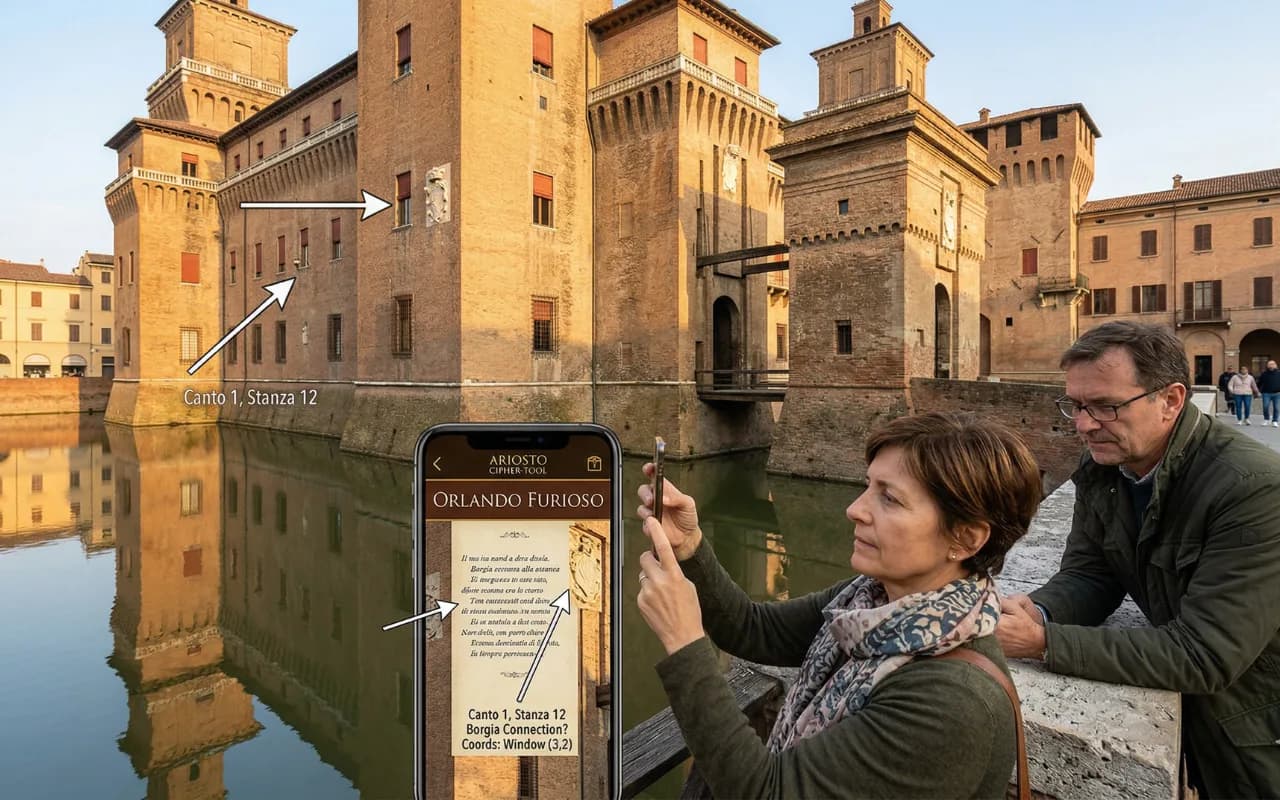
Looking to step off the beaten path in Ferrara? Beyond classic visits, the city is full of surprises for curious minds. Our outdoor escape games offer a completely new perspective on Ferrara's heritage. Imagine solving puzzles outdoors, deciphering codes hidden in architectural details, or following clues that lead you from a historic monument to a lesser-known district. It's the ultimate unusual activity to spice up your stay, combine culture with fun, and explore Ferrara like a true detective. A memorable experience is guaranteed, far from crowds and traditional tourist guides.
Things to do in Ferrara with kids
Ferrara is a fantastic destination for families, and our outdoor escape games transform discovering the city into an unforgettable collective adventure. Away from screens, young and old will collaborate to solve challenges, search for clues, and unlock the city's secrets. It's a fun and educational way to explore the Castello Estense, the ramparts, or the charming alleys, stimulating everyone's curiosity and team spirit. Our courses are designed to be accessible to all ages, guaranteeing laughter and shared memories. Treat your children to a real-life treasure hunt in the heart of Ferrara's history!
Ferrara for couples
Ferrara, with its romantic atmosphere and picturesque landscapes, is ideal for a couple's getaway. Imagine yourselves hand in hand, exploring the gardens of the Castello Estense or getting lost in the medieval alleys. For a touch of originality, our outdoor escape games offer an adventure for two, where complicity and ingenuity will be your best assets. Solve puzzles together, decipher codes, and discover hidden corners of the city, transforming your stroll into an exciting scavenger hunt. It's a unique way to strengthen your bond, create memorable memories, and see Ferrara from a new and playful perspective.
What to do in Ferrara when it rains
If rain invites itself during your stay in Ferrara, don't worry, the city offers alternatives. You can explore the riches of the Castello Estense or the Palazzo dei Diamanti, which house museums and exhibitions. However, let's be honest: our escape games are predominantly outdoor activities. While a light drizzle won't stop the adventure, very rainy weather might make the experience less enjoyable. Consider checking the forecast before starting, or save our games for a sunny day!
Where is Ferrara, and where do the routes start?
Starting points of our routes and the places they pass through.
Route starting points
Places in Ferrara
- Castello Estense
- Palazzo dei Diamanti & Via Mazzini
- Palazzo Schifanoia
- Ariosto's house
- San Giorgio cathedral
- Corso Ercole I d'Este
- Via delle Volte
- Palazzina Marfisa d'Este
The history of Ferrara
The Este Dynasty and Urban Expansion
Ferrara's history is defined by the House of Este, who governed the city for over three centuries, starting in the 13th century. While the city's origins trace back to a 7th-century Byzantine military settlement on the Po River, it was under the Este family that Ferrara developed its character.
The medieval core, with its narrow streets, was transformed beginning in 1492. Duke Ercole I d'Este commissioned architect Biagio Rossetti to undertake an urban expansion known as the Addizione Erculea, or Herculean Addition. This project doubled the walled city's size, introducing broad avenues and integrated green spaces. This urban planning led historian Jacob Burckhardt to consider Ferrara the "first modern city in Europe." The Addizione Erculea's design is still visible in the city's layout, particularly in areas like Corso Ercole I d'Este.
From Fortress to Ducal Residence
The Castello Estense, the city's main landmark, was not initially conceived as a residence. Its construction began in 1385 at the command of Marquis Niccolò II d'Este, following a popular uprising over high taxes. Designed by Bartolino da Novara, it was built as a defensive stronghold to protect the ruling family. The original structure incorporated a 12th-century watchtower, the Torre dei Leoni, and was surrounded by a moat and drawbridges.
By the 1450s, the castle began its transformation from a military fortress into a palace under successive Este dukes. In 1476, the Este court moved into the castle, initiating its evolution into a permanent ducal residence with decorated apartments. After the Este family left Ferrara in 1598, the castle lost its residential function and served as a papal residence, military barracks, and a prison before becoming a civic museum.
What to see in Ferrara
- Castello Estense — A 14th-century moated fortress, it stands at the center of Ferrara. Visitors can explore its dungeons, where historical figures like Parisina Malatesta and Ugo d'Este were held, and climb the Torre dei Leoni for city views.
- Palazzo dei Diamanti — This palace, built between 1493 and 1503, is recognized by its exterior walls covered in over 8,500 white marble blocks carved to resemble diamonds. It houses the Pinacoteca Nazionale di Ferrara, displaying paintings from the Ferrarese school, and hosts art exhibitions.
- Corso Ercole I d'Este — This wide avenue is an example of Renaissance urban planning from the Addizione Erculea. It connects the Castello Estense to the city walls and is lined with palaces, including the Palazzo dei Diamanti.
- Via delle Volte — A medieval alleyway, this street shows Ferrara's past with its arches and covered passages that once connected merchant houses and workshops.
- Palazzo Schifanoia — Known for its Salone dei Mesi (Hall of the Months), this palace offers insight into Renaissance court life with frescoes depicting allegories of the months, zodiac signs, and daily life in 15th-century Ferrara.
- Palazzina Marfisa d'Este — A smaller, elegant Renaissance residence built in the 16th century, it features original frescoes and period furnishings, providing a look at the Este family's private life. It also has a garden.
- San Giorgio Cathedral (Duomo di Ferrara) — While its Romanesque facade is under restoration, the cathedral remains a central landmark in Piazza della Cattedrale. Its interior combines Gothic and Renaissance elements, and the adjacent museum houses artworks from the cathedral's history.
When to visit Ferrara
The best times to visit Ferrara are during spring (mid-April to early June) and early autumn (September to early October). Temperatures are mild, ranging from 18°C to 28°C (64-82°F), suitable for walking or cycling. May is the wettest month, averaging 9 rainy days. These periods offer good light for photography and fewer crowds than summer.
Avoid July and August if possible, as summers are hot and humid, with daytime highs often reaching 32°C (88°F) or more. Many local businesses may close around Ferragosto (August 15th). Winters (November to February) are cold, foggy, and damp, with temperatures rarely above 12°C (53°F), which can make sightseeing difficult.
Getting around Ferrara
Ferrara is connected by train. The closest major airport is Bologna Guglielmo Marconi Airport (BLQ), about 45 km away. From Bologna Centrale train station, direct trains to Ferrara take 20-28 minutes. Venice Marco Polo Airport (VCE) is about 93.5 km away, with bus connections to Mestre train station for onward travel to Ferrara.
Ferrara is known as the "city of bicycles," and exploring on two wheels is recommended, with over 200 km of cycle paths. The historic center is a Limited Traffic Zone (ZTL), restricting driving. Paid parking is available just outside the ZTL, with hourly rates around 1.50-2 euros. Free parking can be found along the city walls, particularly near Via del Lavoro or Via Darsena, about a 10-25 minute walk to the center. Parking is generally free overnight (8 PM - 8 AM) and on Sundays.
Market days are Monday and Friday, in Piazza Travaglio, offering produce and local specialties. An antiques market takes place on the first weekend of every month (except August) between the Castello and the Duomo.
Things you probably do not know about Ferrara
Verified details most visitors walk straight past.
- Palazzo dei Diamanti
- Why are the 8,500 marble blocks on the Palazzo dei Diamanti's facade not all identical? The diamond-shaped marble blocks are positioned and oriented differently depending on their location on the wall, creating a unique visual effect designed to maximize the light reflected off the building throughout the day.
- Castello Estense
- What was the original, rather grim, purpose of the Castello Estense's construction? The castle was built in 1385 by Marquis Niccolò II d'Este to protect the ruling Este family from the citizens of Ferrara, following a violent popular uprising over high taxes and bread levies.
- Corso Ercole I d'Este
- How did this grand avenue come to be, and what was its significance in Renaissance urban planning? Corso Ercole I d'Este was a central feature of the Addizione Erculea, an urban expansion commissioned by Duke Ercole I d'Este in 1492. It was designed by Biagio Rossetti as the main north-south axis of the new city, making Ferrara a pioneering example of Renaissance urban planning.
- Via delle Volte
- What secret did the arches and covered passages of Via delle Volte hold in medieval times? The arches and covered passages of Via delle Volte once connected the houses and workshops of merchants, allowing them to move goods and conduct business discreetly and efficiently without having to go out into the main street.
- Palazzo Schifanoia
- What makes the Salone dei Mesi in Palazzo Schifanoia so historically significant? The Salone dei Mesi features a cycle of frescoes from the 15th century, depicting the months of the year with astrological symbols, classical deities, and detailed scenes of daily life at the Este court, offering a rare glimpse into Renaissance society.
- Palazzina Marfisa d'Este
- What was the Palazzina Marfisa d'Este originally used for, and what can visitors see there today? This elegant 16th-century palazzina served as a private residence for Marfisa d'Este, a prominent figure of the Este court. Today, visitors can explore its well-preserved interiors with original frescoes and period furnishings, along with its garden.
Questions about visiting Ferrara
How long should I plan to stay in Ferrara?
To appreciate Ferrara's historic center, a UNESCO World Heritage site, plan for at least two full days. This allows time to explore the Castello Estense, Palazzo dei Diamanti, and wander the medieval streets. If you wish to visit the Po Delta or surrounding areas, add an extra day or two.
What is the best way to get around Ferrara?
Ferrara is known as the "city of bicycles," and cycling is the best way to get around. The city is flat, has an extensive network of cycle paths, and its ancient walls offer a 9 km ring that can be cycled. The historic center is also walkable.
Is Ferrara a good destination for families with children?
Yes, Ferrara is family-friendly. The flat terrain makes it suitable for cycling with children, and the city walls offer a safe, car-free route. The Castello Estense, with its moat and dungeons, often interests younger visitors, and Parco Massari provides a green space with a playground.
What are the typical food specialties of Ferrara?
Ferrara is known for its cuisine. Try *cappellacci di zucca*, a type of pasta filled with pumpkin, and *salama da sugo*, a cured sausage. Local produce like Aglio di Voghiera DOP garlic and violina squash are also available.
What is the budget like for a trip to Ferrara?
Ferrara can be a more budget-friendly option compared to larger Italian cities. Accommodation prices, especially during the low season (January-February), can be 25-40% lower. Many attractions are walkable or accessible by inexpensive bike rentals. Dining costs vary, but local trattorias offer good value.
How do I get to Ferrara from nearby airports?
The closest airport is Bologna Guglielmo Marconi Airport (BLQ), about 45 km away. From there, you can take a direct shuttle bus (Bus&Fly) to Ferrara city center or a bus to Bologna Centrale train station for a train connection.
Frequently asked questions
How much does an outdoor escape game cost in Ferrara?
The price of our outdoor escape games in Ferrara is very affordable and designed for groups. It's €12 per team, not per person! This means that if you come with several people (for example, 4 or 5 friends), the cost per player becomes truly minimal. This single team rate gives you access to the entire course, puzzles, and the immersive adventure we've designed to help you discover Ferrara in a fun and original way. It's an excellent option for an economical and memorable group activity.
Is it suitable for children / families?
Absolutely! Our outdoor escape games in Ferrara are perfectly suited for children and families. We design our courses to be accessible and fun for all ages. The puzzles are varied; some require observation, others logic, allowing everyone to contribute. It's a fantastic activity to stimulate the curiosity of the youngest, make them interact with the city's history and monuments in a playful way, and create unforgettable family memories. Children love pretending to be real explorers or detectives!
How long does an escape game last in Ferrara?
The duration of our escape games in Ferrara is designed to offer you a complete immersion without being too long. On average, allow between 1h30 and 2h to complete a course. This includes the time needed to solve all the puzzles, move between different stages, and fully enjoy the city's environment. It's an ideal format that then leaves you time for other visits or to enjoy a good meal. The pace is free; you can take your time or complete the challenge more quickly!
Do I need to book in advance?
No, great flexibility is one of the advantages of our outdoor escape games in Ferrara! It is not necessary to book in advance. You can purchase your game whenever you want, even at the last minute, and start the adventure as soon as you're ready. This allows you to adapt your schedule based on the weather, your desires, or your on-site timetable. It's a valuable freedom for spontaneous travelers or those who prefer not to have time constraints.
What to visit in Ferrara beyond the escape games?
Beyond our exciting escape games, Ferrara is full of treasures to explore! Don't miss the majestic Castello Estense, the historical heart of the city. Stroll through the medieval streets and admire the Palazzo dei Diamanti with its unique facade. The Cathedral of San Giorgio is also a must-see. Rent a bike to ride along the magnificent city walls, a unique experience. Explore the historic Jewish quarter or relax in the gardens of Parco Massari. Ferrara offers a rich heritage, fascinating museums, and a charming atmosphere for all your discoveries.
What is the best season to visit Ferrara?
Ferrara is pleasant to visit almost all year round, but spring (April-May) and autumn (September-October) are often considered the best seasons. The climate is mild and sunny, ideal for strolling through the historic streets, cycling along the city walls, and enjoying our outdoor escape games without suffering from the summer heat. Summer (July-August) can be very hot, but the city offers cultural events. Winter is quieter, perfect for an intimate atmosphere, although cooler and potentially rainy.
More cities in Italy
Venice
Alchemy, Kabbalah and Arsenal of the Serenissima's spies
Florence
Medici, Templars and Palazzo Vecchio alchemists
Siena
The Contrade war and the world's oldest bank
Civita di Bagnoregio
The dying city perched on a tuff bridge
Turin
Alchemy, Templars and witches in the esoteric capital
Rome
Porta Magica, catacombs and the Popes' Passetto
Naples
Napoli Sotterranea, Dracula and the skull cult