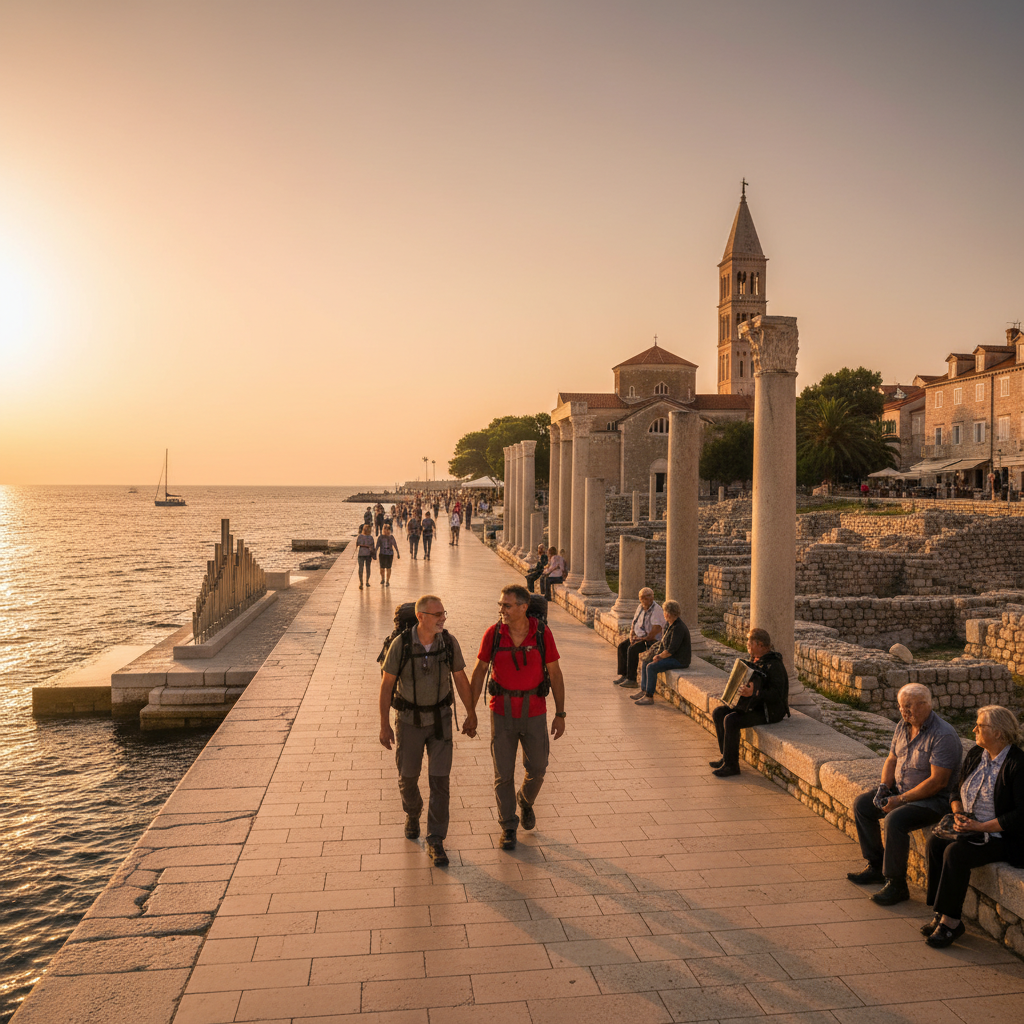
ZadarOutdoor Escape Game & Treasure Hunt
Between sea organ and ancient ruins, the pearl of the Adriatic
Looking to discover Zadar in a unique way? This pearl of the Adriatic, where history meets modernity, offers much more than just its sublime landscapes. Dive into the heart of the old town, a true open-air museum, where the Roman Forum stands beside the impressive St. Donatus Church. But for a truly memorable experience, why not embark on an outdoor escape game? Imagine wandering through cobbled streets, solving puzzles while exploring the secrets of the Kalelarga district. It's a real-life treasure hunt, an unusual activity that transforms sightseeing into a thrilling adventure. Whether you're seeking ancient ruins or the enchanting ambiance of the Sea Organ at sunset, Zadar promises discoveries around every corner, making every moment unforgettable with a captivating scavenger hunt.
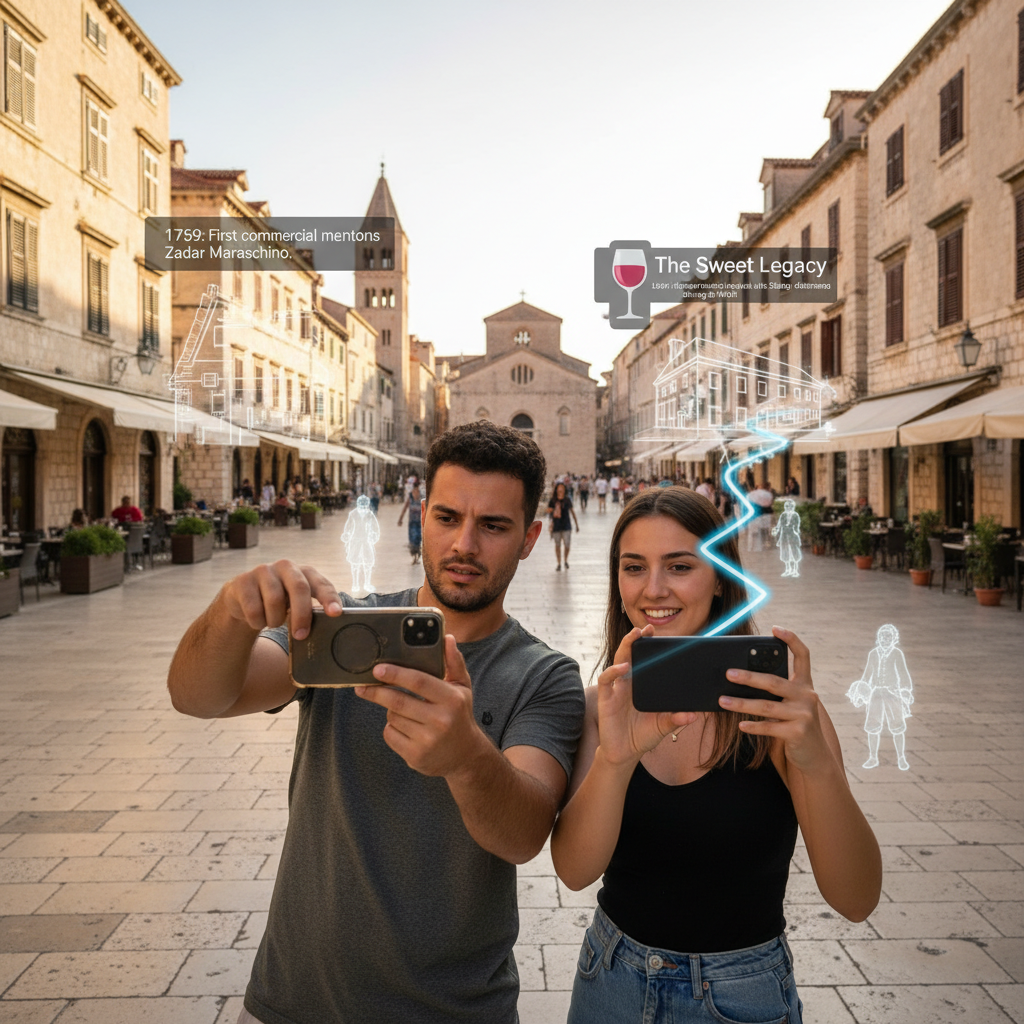
Zadar Old Town — Red Gold Conspiracy
Uncover the Venetian conspiracy behind Zadar's stolen Red Gold: the Maraschino recipe vanished from merchant vaults. Decode ledgers, decipher symbols on ancient stones to reclaim the secret formula.
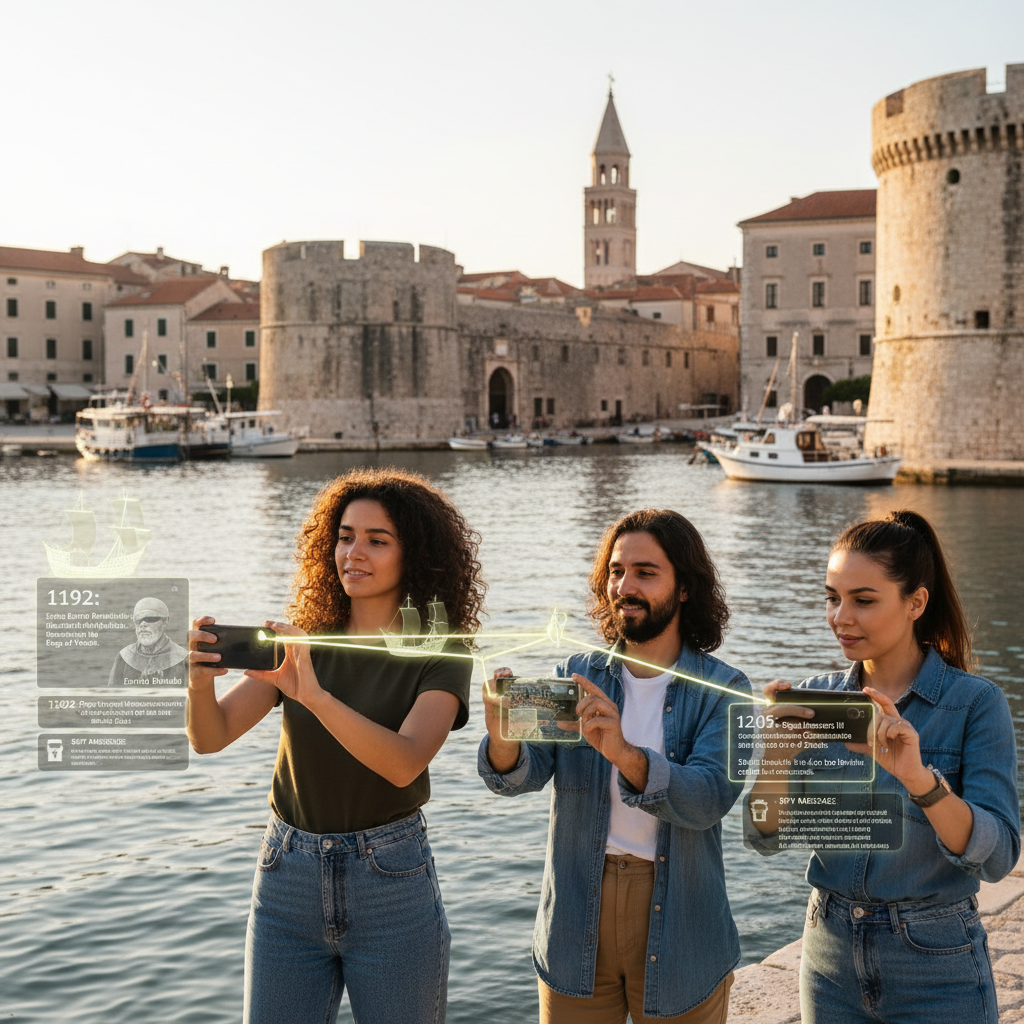
Zadar's Betrayal — Uncover Dandolo's Crusade Conspiracy
Decode the Venetian Doge's treachery: how Enrico Dandolo diverted the Fourth Crusade to sack Christian Zadar in 1202. Uncover the hidden conspiracy that changed history.
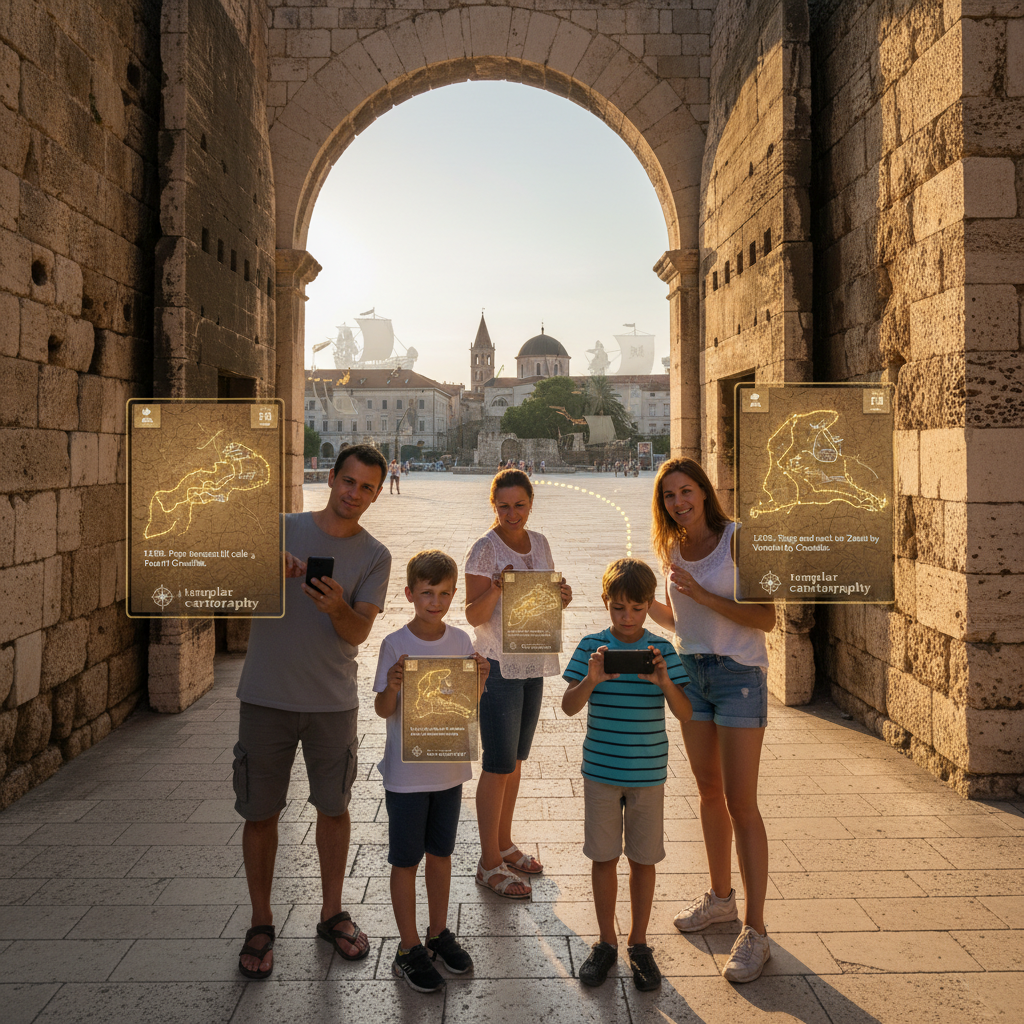
Zadar Old Town — The Relics of Zadar
Uncover the secret trail of sacred relics hidden across Zadar’s Old Town after a broken crusader oath triggers a centuries‑old curse.
Unusual things to do in Zadar
For an unusual activity in Zadar, the experience isn't limited to typical sites. Imagine yourself at dusk, not just to admire the sunset, but to experience it interactively. The Sea Organ and Greeting to the Sun, these unique artistic installations, become the stage for an original outing where you decipher clues inspired by the sounds of the sea and the solar lights. It's a playful and cultural immersion that transforms city exploration into a real game, off the beaten path, revealing hidden anecdotes and new perspectives on Zadar's heritage. An truly unusual activity in Zadar for a unique and memorable original outing.
Things to do in Zadar with kids
Zadar is a fantastic destination for families seeking adventure. If you're wondering what to do in Zadar with family, our scavenger hunts are perfect for entertaining children and teenagers from 8 years old. Away from screens, they stimulate curiosity and teamwork. Imagine your little explorers deciphering puzzles in historic alleys, transforming a simple stroll into an exciting treasure hunt. It's a fun activity that combines cultural discovery with entertainment, guaranteeing memorable souvenirs for the whole family, all while discovering the city's wonders. An ideal activity for kids and teens.
Zadar for couples
Strolling hand in hand through Zadar's ancient streets is to offer yourselves an unforgettable romantic interlude. For couples, the city reveals its most intimate charm through its secret passages and breathtaking views of the Adriatic. Imagine a sunset to the melodic sound of the Sea Organ, followed by a playful exploration of its heritage. Our scavenger hunts are an original way to share laughter and moments of togetherness, transforming each discovery into a precious memory. A unique experience for Zadar as a couple, where adventure and romance intertwine beautifully.
What to do in Zadar when it rains
Even in the rain, Zadar retains its charm and offers opportunities for exploration. If you're wondering what to do in Zadar on a rainy day, our outdoor escape games are an excellent option. Designed to take advantage of the old town's architecture, approximately 80% of our routes run under arcades, covered passages, or sheltered by historic buildings. This allows you to continue your adventure, solve puzzles, and discover the city without being fully exposed to the elements. An ideal solution to turn a grey day into a bright and intriguing experience.
Where is Zadar, and where do the routes start?
Starting points of our routes and the places they pass through.
Route starting points
Places in Zadar
- Narodni trg (People's Square)
- Trg pet bunara (Five Wells Square)
- Kopnena vrata (Land Gate)
- Crkva sv. Donata (St. Donatus Church)
- Roman Forum
- Morska vrata (Sea Gate)
- Katedrala sv. Stošije (St. Anastasia Cathedral)
- Riva (Seafront Promenade)
- Foša (Old Port)
- St. Mary's Church and Monastery
- Bell Tower of St. Anastasia's Cathedral
- Kneževa palača (Governor's Palace)
- Petar Zoranić Square
- St. Chrysogonus Church
- Archaeological Museum (exterior)
- Pozdrav Suncu (Greeting to the Sun) / Westernmost point of the peninsula
- Five Wells Square
- Roman Forum of Zadar
The history of Zadar
From Ancient Iadera to Venetian Stronghold
Zadar's history began in the 9th century BC as Iader, a settlement of the Illyrian Liburnian tribe. It served as a trade hub with Greeks and Romans. By 59 BC, it was renamed Iadera and became a Roman municipium, then a Roman colony in 48 BC. Under Roman rule, Zadar developed a Roman urban layout with a street grid, a forum, and a capitolium with a temple. The Roman Forum, commissioned by Emperor Augustus and completed by the 3rd century AD, was the center of public life. After the fall of the Western Roman Empire in 476 AD, Zadar became the capital of the Byzantine Theme of Dalmatia.
Medieval Transformations and Modern Resilience
In the early 9th century, Zadar briefly fell under Frankish rule. The city's strategic location on the Adriatic coast led to centuries of various rulers, including being sold to the Venetian Empire in 1409. During Venetian rule, Zadar became an important administrative center and naval base outside of Venice. Facing frequent attacks from the Ottoman Turks, Zadar's defenses were reinforced in the 16th century by Venetian engineers. These city walls, now a UNESCO World Heritage site, were designed with low walls, moats, and pentagonal bastions to withstand cannon fire. Zadar was part of the Kingdom of Italy from 1919-1940 after World War I, and was the only Croatian city extensively damaged in World War II. The city has rebuilt, blending its ancient past with modern infrastructure.
What to see in Zadar
- Roman Forum — Walk on the original pavement and stairs of what was the center of Roman Iadera, built between the 1st century BC and 3rd century AD. Remnants of two monumental columns are visible, one in its original place.
- Crkva sv. Donata (Church of St. Donatus) — This circular 9th-century church, originally named the Church of the Holy Trinity, is the largest pre-Romanesque building in Croatia. It was built directly on the foundations of the Roman Forum, incorporating ancient Roman materials into its structure.
- Kopnena vrata (Land Gate) — Built in 1543 by the Venetians, this Renaissance gate features a carved figure of St. Chrysogonus on horseback and the winged lion of St. Mark, the coat of arms of the Republic of Venice.
- Trg pet bunara (Five Wells Square) — Constructed in 1574 during an Ottoman siege, this square features five wellheads over a large cistern that supplied the city with water. It is located between the medieval city walls and the Renaissance Grimani bastion.
- Morske orgulje (Sea Organ) — An architectural sound art object opened in 2005, where sea waves push air through a system of polyethylene tubes and a resonating cavity under large marble steps, creating musical sounds.
- Pozdrav Suncu (Greeting to the Sun) — Located next to the Sea Organ, this solar-powered installation consists of 300 multi-layered glass plates arranged in a 22-meter diameter circle. It collects solar energy during the day and creates a light show at sunset.
When to visit Zadar
The best times to visit Zadar are May to June and September to October. During these shoulder seasons, temperatures are pleasant (around 21-28°C in May-June and 23-26°C in September), and crowds are thinner than in peak summer. The sea is warm enough for swimming by June and remains so in September. July and August are peak season, with temperatures reaching 31-32°C, making the old town crowded and accommodation prices higher. Winters (December to February) are mild but rainy, and many tourist businesses may be closed. Avoid days when the fierce bora wind blows, as streets can become deserted.
Getting around Zadar
Zadar Airport (ZAD) is approximately 8 kilometers from the city center; shuttle services are available. The historic Old Town is largely a pedestrian zone, suitable for exploring on foot. For travel in the wider city, public transport is available. If arriving by car, parking in the Old Town is limited. A semi-open parking garage at 112. brigade, about a 10-minute walk from the Old Town, offers 630 spaces and 24/7 surveillance. Other public parking spaces are divided into zones with varying hourly rates, with free parking often available on Sundays and holidays outside of peak summer. The main Zadar City Market, or Pijaca, is located in the old part of the city on the peninsula, near the old city walls. It offers fresh produce and a daily fish market, typically open in the mornings until around 1 PM.
Things you probably do not know about Zadar
Verified details most visitors walk straight past.
- Roman Forum
- What was the purpose of the lone standing column in the Roman Forum during the Middle Ages? In medieval times, one of the monumental columns in the Roman Forum was repurposed as a "pillar of shame," a place where offenders were publicly humiliated.
- Crkva sv. Donata
- The distinctive circular Church of St. Donatus wasn't always a church. What other roles did it play throughout history? Due to its excellent acoustics, the Church of St. Donatus has been secularized and is now primarily used as a concert venue for the annual International Festival of Medieval Renaissance Music. It also served as a warehouse under Venetian, French, and Austrian rule, and briefly as an archaeological museum in the 20th century.
- Kopnena vrata (Land Gate)
- Beyond its decorative elements, what significant political message did the Land Gate convey? The Land Gate prominently displays the winged lion of St. Mark, the symbol of the Republic of Venice, often paired with Zadar's patron, St. Chrysogonus, signifying Zadar's crucial role within the Venetian Empire.
- Trg pet bunara (Five Wells Square)
- Why was a square with five wells built in Zadar in the 16th century? The Five Wells Square was built in 1574 during a siege by the Ottoman Empire. The Venetians constructed a large water cistern with five wells to ensure Zadar had a fresh water supply during the attacks.
- Morske orgulje (Sea Organ)
- What inspired the creation of the modern Sea Organ in Zadar? The Sea Organ was designed by architect Nikola Bašić in 2005 to revitalize the Zadar waterfront, which had been left as a monotonous concrete wall after the devastation of World War II. It aimed to reconnect the city with the Adriatic Sea through sound.
Questions about visiting Zadar
How many days should I spend in Zadar?
Most visitors find that a 3-day trip to Zadar is sufficient to see the main highlights. If you wish for a more in-depth experience or plan day trips to nearby attractions like Plitvice Lakes, a week would allow for a more flexible itinerary.
What is the best way to get around Zadar?
The historic Old Town of Zadar is compact and best explored on foot, as it is largely a pedestrian zone. For destinations outside the peninsula, public transportation is available. Taxis and ride-sharing services are also an option.
What is the typical budget for a trip to Zadar?
A mid-range traveler can expect to spend around €110 (approximately $125 USD) per person per day, covering accommodation, meals, local transportation, and some activities. Budget travelers might spend closer to €47 ($53 USD) daily, while luxury travel can reach €231 ($263 USD) or more.
Is Zadar a good destination for families with children?
Zadar offers a relaxed atmosphere and pedestrian-friendly Old Town, making it suitable for families. Children might enjoy the sounds of the Sea Organ, exploring the Roman Forum, and playing in the parks. The nearby beaches also provide opportunities for family activities.
What are Zadar's main neighborhoods?
The main area of interest for visitors is the Old Town, located on a peninsula, which contains most of the historical sites. Other notable areas include the modern port of Gaženica, and residential areas surrounding the historical core.
What cultural events or festivals take place in Zadar?
Zadar hosts several events, particularly during the warmer months. The Zadar Summer Theatre Festival runs from June to August, featuring theater, music, and dance. The Full Moon Festival, held on the night of the full moon in July or August, fills the streets with food markets and traditional music.
Frequently asked questions
How much does an outdoor escape game cost in Zadar?
An outdoor escape game in Zadar is a very affordable activity, especially considering the entertainment and discovery it offers. The price is €12 per team, not per person! This means that if you come as a group of four, the cost per player is negligible, making this adventure accessible to all budgets. It's an excellent option for an outing with friends, family, or as a couple, allowing you to enjoy a unique experience without breaking the bank. The price includes access to the game, puzzles, and a guided exploration of the city.
Is it suitable for children / families?
Absolutely! Our outdoor escape games in Zadar are designed to be a quintessential family activity. The puzzles are varied and crafted to stimulate the thinking of everyone, from the youngest to the oldest. We generally recommend active participation from age 8, but younger children can certainly accompany and help search for clues. It's a fun and interactive way to discover the city together, strengthen bonds, and create memorable experiences. A wonderful opportunity to share laughter and challenges as a family!
How long does an escape game last in Zadar?
The duration of an outdoor escape game in Zadar typically ranges between 1.5 and 2 hours. This time is calculated to allow you to fully enjoy the experience, solve all the puzzles at your own pace, and admire the iconic landmarks you pass through. There's no excessive time pressure; the main goal is to have fun and discover the city. You can take breaks, snap photos, and immerse yourself in Zadar's ambiance, making this adventure a personalized and relaxed experience.
Do I need to book in advance?
While our escape games are accessible and flexible, we highly recommend booking in advance, especially if you plan to play during peak tourist season or on weekends. This guarantees the availability of your chosen route and allows you to plan your day stress-free. Online booking is simple and quick; it secures your spot and gives you access to all the necessary information to prepare for your adventure. It's the best way to ensure a smooth and enjoyable experience.
What to visit in Zadar beyond escape games?
Zadar is full of treasures to explore! After your escape game, be sure to marvel at the Sea Organ and the Greeting to the Sun, unique artistic installations that offer unforgettable sound and light shows at sunset. Dive into history at the Roman Forum, visit the impressive St. Donatus Church, and stroll along Kalelarga Street, the vibrant heart of the old town. The Archaeological Museum or the colorful market are also must-sees. Every corner reveals a piece of Zadar's soul, between ancient heritage and modernity.
What is the best season to visit Zadar?
To fully enjoy Zadar, spring (April-June) and early autumn (September-October) are ideal seasons. The weather is generally mild and sunny, perfect for outdoor activities like our escape games, and tourist crowds are less dense than in mid-summer. This allows you to explore the city at your own pace, enjoy outdoor cafes without waiting, and admire the iconic sites in a more serene atmosphere. Summer remains an option, of course, if you love the heat and seaside vibrancy.
Other destinations in Dalmatia
Dubrovnik
The Pearl of the Adriatic, where history meets turquoise sea.
Hvar
Adriatic gem, between history and secret coves.
Knin
Royal fortress, historical heart of Croatia
Korcula
Marco Polo's island, between history and the Adriatic Sea
Nin
Ancient royal capital, between salt and sea
Omis
Pirate city, between sea and canyon
Sibenik
Between medieval fortresses and the Adriatic Sea
Split
Diocletian's Palace, the beating heart of a millennial city
Trogir
UNESCO medieval city, jewel of the Adriatic.
Activities to discover nearby
Guided tours, skip-the-line tickets and local experiences to book in advance.
💡 Optional booking — you can also buy on-site. All links open in a new window, your OddballTrip visit stays preserved.