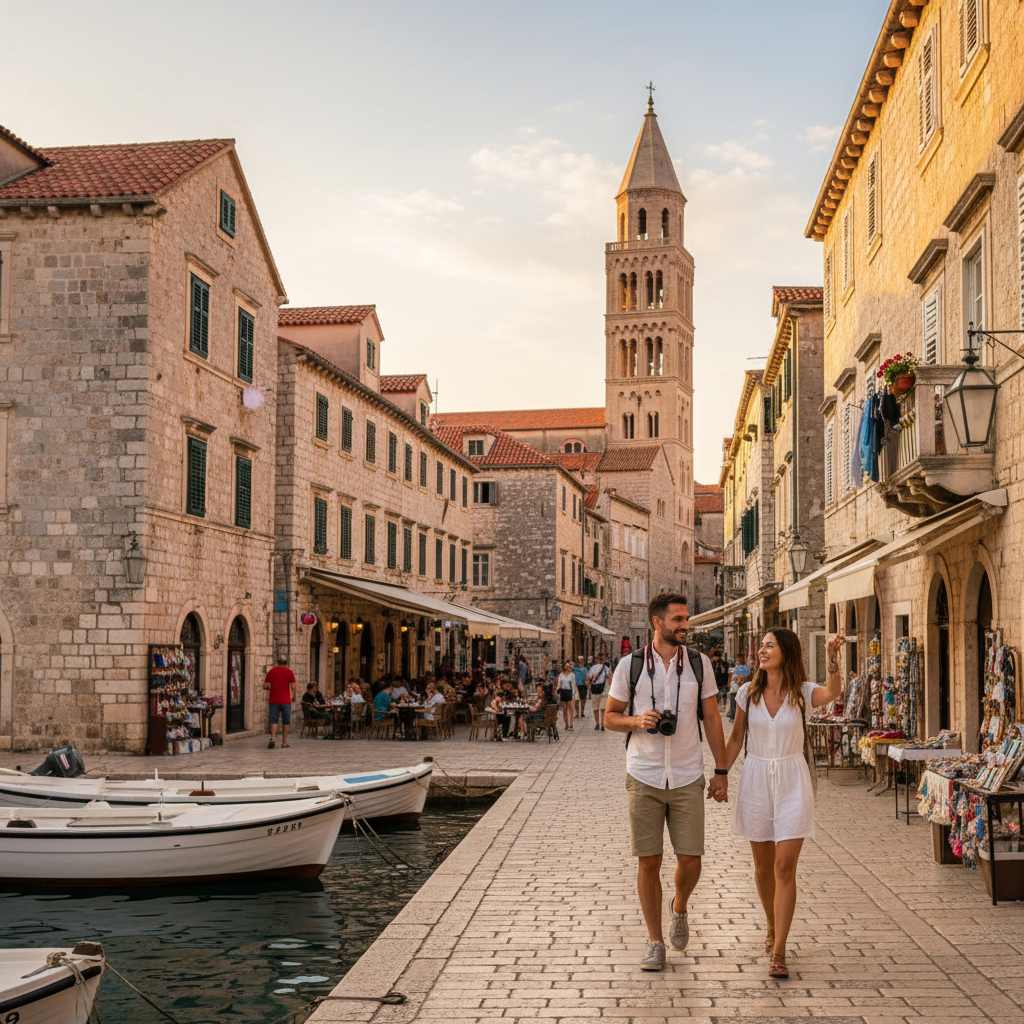
TrogirOutdoor Escape Game & Treasure Hunt
UNESCO medieval city, jewel of the Adriatic.
Trogir, a true pearl of the Adriatic, invites you on a timeless journey where every cobblestone alley whispers centuries-old stories. A UNESCO World Heritage site, this medieval city offers much more than just sightseeing. Imagine strolling around the majestic Cathedral of St. Lawrence, whose Radovan's Portal is a true masterpiece, or exploring the ramparts of Kamerlengo Fortress, offering breathtaking views of the harbor. For an unusual activity and memorable experience, why not embark on an outdoor escape game? It's a fantastic way to discover the old town by transforming your exploration into a real treasure hunt or a captivating scavenger hunt. You'll solve puzzles while immersing yourself in Trogir's unique atmosphere, far beyond the usual tourist paths. It's a playful adventure that blends cultural discovery with the joy of puzzle-solving.
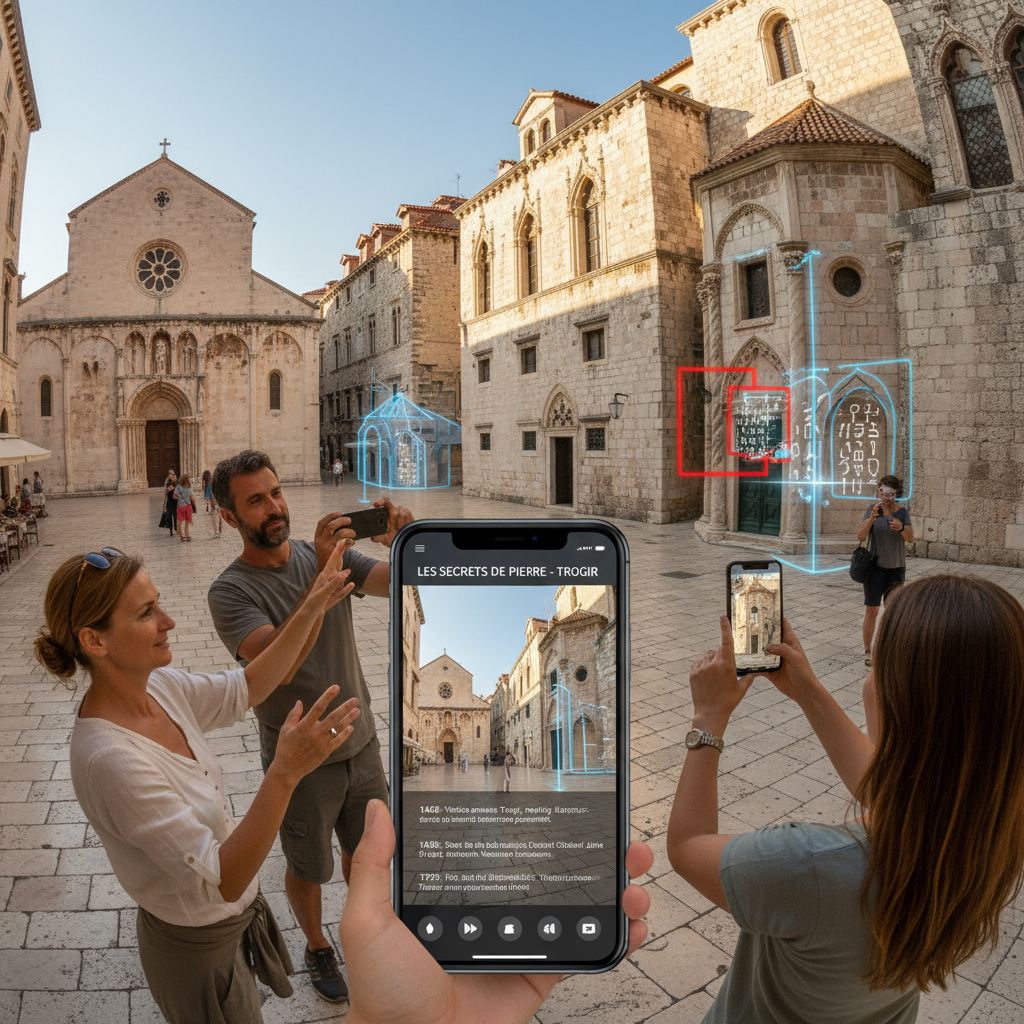
Unusual things to do in Trogir
For an unusual activity in Trogir, let yourself be tempted by a thematic exploration that reveals the city's hidden secrets. Beyond the iconic monuments, Trogir abounds with narrow passages and inner courtyards that invite adventure. Imagine following in the footsteps of ancient merchants or pirates, solving riddles that lead you to unexpected panoramas or little-known historical anecdotes. It's an original outing that transforms the city into a life-sized playground, where every street corner can hide a clue. A unique way to experience Trogir, away from the crowds, connecting with its medieval soul.
Things to do in Trogir with kids
Trogir is a wonderful destination for families, offering activities that will captivate children and teenagers alike. Beyond the nearby beaches, the old town itself is a fascinating playground for exploration. A scavenger hunt or treasure hunt transforms heritage discovery into a playful adventure where young and old collaborate to solve puzzles. It's an excellent way to stimulate their curiosity and teamwork spirit. Our trails are designed to be accessible from 8-10 years old, with varied challenges that appeal to everyone. It's an opportunity to create memorable family memories while learning Trogir's history in an interactive and fun way.
Trogir for couples
Trogir for couples is a romantic experience par excellence. Imagine strolling hand in hand through the cobblestone alleys of the old town, illuminated by the soft evening light. Every corner reveals a discreet charm, from intimate squares to hidden passages. Climb to Kamerlengo Fortress to admire a spectacular sunset over the Adriatic, or find a small restaurant with a harbor view for a candlelit dinner. The rich architectural heritage creates an idyllic backdrop for special moments, away from the hustle and bustle, where history and beauty meet for an unforgettable getaway for two.
What to do in Trogir when it rains
If rain decides to visit Trogir, don't panic! The old town is incredibly well-suited. Approximately 80% of our outdoor escape game route takes place under arcades, covered passages, or sheltered by historic buildings. You can thus continue your adventure without getting too wet, while enjoying the unique atmosphere of the city in the rain. It's an opportunity to see Trogir in a different light, with its gleaming stones and even more intimate alleys. A warm cup of coffee in one of the many cafes under the arcades can also be a charming alternative.
Where is Trogir, and where do the routes start?
Starting points of our routes and the places they pass through.
Route starting points
Places in Trogir
- Trg Ivana Pavla II
- Katedrala Sv. Lovre – West Portal (Radovan's Portal)
- Katedrala Sv. Lovre – Exterior of the Chapel of Saint John of Trogir
- Veliki Ćipiko (Great Ćipiko Palace)
- Kopnena Vrata (Land Gate)
- Trg Ivana Pavla II (next to the City Hall)
- Ulica Kamanata (near the Trogir City Museum)
- Obala bana Berislavića (Riva promenade, facing Kamerlengo Fortress)
The history of Trogir
From Greek Colony to Roman Municipality
Trogir's history began around 380 BC when Greek colonists from the island of Vis (ancient Issa) established a trading post named Tragurion, meaning "island of goats." This islet, located between the mainland and the island of Čiovo, provided a sheltered anchorage and access to inland trade routes. The Greeks laid out the town with an orthogonal street plan, a grid pattern still visible in the main streets. By the 1st century BC, Roman expansion absorbed Tragurion, and it became a Roman municipality known as Tragurium. While it was a minor coastal town, some Roman street patterns and foundations remain.
Venetian Dominance and Architectural Development
Following periods under Byzantine and Croatian rule, Trogir came under Venetian domination in 1420, which lasted until 1797. During this time, Trogir became a fortified frontier town, under threat from Ottoman incursions. This period saw economic and cultural development, leaving an architectural legacy. Many of the city's palaces, fortifications, and public buildings, including the Kamerlengo Fortress, were constructed or reshaped during these Venetian centuries. The Croatian language was preserved despite Italian being the official language. After the fall of Venice, Trogir experienced French rule (1806-1814) before passing to the Habsburg Empire until 1918. The town's medieval character was largely preserved due to economic marginalization in the 19th and 20th centuries, preventing modern redevelopment. This preservation contributed to its UNESCO World Heritage status in 1997.
What to see in Trogir
- Trg Ivana Pavla II (John Paul II Square) — This is the central square of Trogir's old town. It is surrounded by historical buildings, including the Cathedral of St. Lawrence and the City Loggia.
- Katedrala Sv. Lovre (Cathedral of St. Lawrence) — Construction began in the 13th century. Radovan's Portal, the main west portal, is a work of Romanesque-Gothic art. Visitors can climb the bell tower for views of the city and the Adriatic.
- Veliki Ćipiko (Great Ćipiko Palace) — Facing the cathedral on Trg Ivana Pavla II, this 15th-century palace shows Renaissance design. It was the residence of the Ćipiko family.
- Kopnena Vrata (Land Gate) — This gate, dating to the 17th century, was the main entrance to the fortified city. The Venetian lion above the arch symbolizes Venetian rule. The gate connects the old town to the mainland via a stone bridge.
- Kamerlengo Fortress — Located at the western end of the island, this 15th-century Venetian stronghold was built for defense. Visitors can walk along its walls and climb the tower for views of Trogir, the harbor, and the island of Čiovo.
- Obala bana Berislavića (Riva promenade) — This waterfront promenade runs along the southern edge of the old town. It offers views of the Kamerlengo Fortress and the boats in the harbor. The promenade is lined with restaurants and cafes.
When to visit Trogir
The best times to visit Trogir are from early April through mid-June or early September through October. During these shoulder seasons, temperatures range from 20-25°C (68-77°F) in May and early June, and around 24-27°C (75-81°F) in September. Crowds are smaller than in peak summer, and accommodation prices are generally lower. The Adriatic Sea is warm enough for swimming from September.
Avoid July and August if you prefer fewer crowds and lower temperatures, as these are the busiest months. Daytime highs can reach 33°C (91°F). While the sea is warmest for swimming then, the old town's narrow streets can be crowded. Winter, from November to March, is quiet and cool, with many services closed.
Getting around Trogir
Trogir's historic center is a small, car-free island, making walking the primary way to explore. The entire old town is walkable within minutes. Split Airport (SPU) is a few kilometers away, about a 5-10 minute taxi or transfer ride, or a short bus journey on local line 37. This bus also connects Trogir to Split's central bus station, with a journey time of 40-50 minutes and a cost of approximately €4.
If arriving by car, parking is not allowed within the old town. Parking is available on the mainland side or on the island of Čiovo, connected by short bridges. Options like Parking T4 typically cost around €1 per hour or €10 per day. During July and August, parking spaces near the center can fill quickly, so arriving before 10:00 AM is advisable. Croatia uses the Euro. Cards are widely accepted, but carrying some cash for markets or smaller establishments is useful. Tipping around 10% for service is customary.
Things you probably do not know about Trogir
Verified details most visitors walk straight past.
- Katedrala Sv. Lovre (Cathedral of St. Lawrence)
- The Radovan's Portal on the Cathedral of St. Lawrence includes a detail about its creator. Radovan's Portal, completed in 1240, is signed by Master Radovan himself. His signature is carved into the portal, a rare occurrence for medieval artists and a testament to his involvement in this Romanesque-Gothic work.
- Veliki Ćipiko Palace
- The Great Ćipiko Palace has an architectural feature that once connected its different parts. The Great Ćipiko Palace is a complex of buildings. A small, narrow street once ran between its two main wings. A Gothic trifora window connected the two parts of the palace over this alley, indicating the family's influence.
- Kopnena Vrata (Land Gate)
- The Land Gate once had a defense mechanism for the city. The Land Gate, built in the 17th century, originally featured a drawbridge that could be raised to protect the city from invaders. Below the gate, there was also a small dungeon for holding prisoners.
- Kamerlengo Fortress
- This fortress has a connection to a fantasy series. Kamerlengo Fortress served as a filming location for the fictional city of Qarth in the second season of the HBO series *Game of Thrones*.
- Trg Ivana Pavla II
- The central square of Trogir reflects an ancient urban plan. The orthogonal street plan of Trogir, including the layout of its main square, dates back to its Hellenistic foundation in the 3rd century BC. The ancient Roman forum was located at the intersection of the cardo and decumanus, which are still reflected in the modern street plan.
- Ulica Kamanata (near the Trogir City Museum)
- The building housing the Trogir City Museum has undergone architectural changes over time. The Trogir City Museum is housed in the former Garagnin-Fanfogna Palace, a complex of buildings that evolved from Romanesque and Gothic structures to its current Baroque appearance. It once belonged to a prominent noble family.
Questions about visiting Trogir
How long should I spend in Trogir?
Allow 2.5 to 4 hours to explore Trogir's historic center, including the cathedral, bell tower, Kamerlengo Fortress, and Riva promenade, with time for lunch or coffee. If you have a specific interest in medieval architecture, you could extend your visit to a full day.
How do I get around Trogir?
The historic old town of Trogir is small and entirely pedestrianized, so walking is the only way to get around. To reach areas outside the old town, such as beaches on Čiovo Island, you can use local buses or taxis.
What is the best way to get to Trogir from Split?
The easiest way to get to Trogir from Split is by local bus line 37, which runs frequently from Split's central bus station. The journey takes 40-50 minutes and costs around €4. Taxis or rideshares are also an option, costing approximately €35-50.
Where can I park my car in Trogir?
The old town is car-free, so you will need to park outside. Public parking lots are available on the mainland side or on Čiovo Island. Parking T4 costs about €1/hour or €10/day. Closer lots can be more expensive and fill quickly in peak season.
What is the budget like for a visit to Trogir?
Trogir offers options for various budgets. Accommodation and dining prices are generally higher during the peak summer months (July and August). Visiting during the shoulder seasons (May, June, September, October) can offer better value with lower prices for hotels and fewer crowds.
Is Trogir suitable for families with children?
Yes, Trogir is suitable for families. The car-free old town is safe for walking, and children can explore the medieval streets and climb the Kamerlengo Fortress. Nearby Čiovo Island offers beaches for swimming.
Frequently asked questions
How much does an outdoor escape game cost in Trogir?
An outdoor escape game in Trogir costs €12 per team. This price is fixed, regardless of the number of players in your group (typically 2 to 6 people for an optimal experience). It offers excellent value for money for an activity that combines city discovery, puzzle-solving, and shared moments with friends or family. Think of it as your entry ticket to a unique urban adventure, where every euro invested brings you a little closer to Trogir's secrets.
Is it suitable for children / families?
Absolutely! Our outdoor escape games are designed to be a fantastic activity for the whole family, including children and teenagers. The puzzles are varied and accessible, stimulating logic and observation without being overly complex. We generally recommend a minimum age of 8-10 years for children to actively participate in solving the mysteries, but younger ones can also have fun searching for clues. It's a wonderful opportunity to collaborate as a family and create memorable experiences together.
How long does an escape game in Trogir last?
The duration of an outdoor escape game in Trogir typically ranges from 1 hour 30 minutes to 2 hours 30 minutes. This largely depends on your pace, observational skills, and ability to solve the puzzles. Some faster groups finish in less time, while others prefer to take their time to admire the scenery and soak in the city's atmosphere. The important thing is to have fun and enjoy the experience at your own pace, without any pressure.
Do I need to book in advance?
For our outdoor escape games in Trogir, booking is generally not mandatory. Our games are designed to be played at any time, at your convenience. You can purchase the game online and start whenever you wish. However, for larger groups or if you have specific needs, it's always best to contact us in advance. This allows us to ensure everything is perfect for your adventure and to offer you the best possible experience.
What to visit in Trogir beyond escape games?
Beyond our exciting escape games, Trogir is full of treasures to explore. Don't miss the Cathedral of St. Lawrence and its impressive Radovan's Portal, a masterpiece of Romanesque art. Kamerlengo Fortress offers magnificent panoramic views of the city and the Adriatic. Stroll through the narrow streets of the UNESCO-listed old town, discover the City Loggia and the Duke's Palace. The local market is also a vibrant place to soak up the atmosphere and taste fresh produce.
What is the best season to visit Trogir?
The best season to visit Trogir is undoubtedly spring (April-June) or early autumn (September-October). During these periods, the climate is pleasantly mild, ideal for exploring the city on foot and enjoying our outdoor escape games without the intense summer heat. Crowds are also less dense than during the peak summer season, making the experience more pleasant and authentic. This way, you can fully appreciate the beauty and the serenity of this historic city.
Other destinations in Dalmatia
Dubrovnik
The Pearl of the Adriatic, where history meets turquoise sea.
Hvar
Adriatic gem, between history and secret coves.
Knin
Royal fortress, historical heart of Croatia
Korcula
Marco Polo's island, between history and the Adriatic Sea
Nin
Ancient royal capital, between salt and sea
Omis
Pirate city, between sea and canyon
Sibenik
Between medieval fortresses and the Adriatic Sea
Split
Diocletian's Palace, the beating heart of a millennial city
Zadar
Between sea organ and ancient ruins, the pearl of the Adriatic
More cities in Croatia
Activities to discover nearby
Guided tours, skip-the-line tickets and local experiences to book in advance.
💡 Optional booking — you can also buy on-site. All links open in a new window, your OddballTrip visit stays preserved.