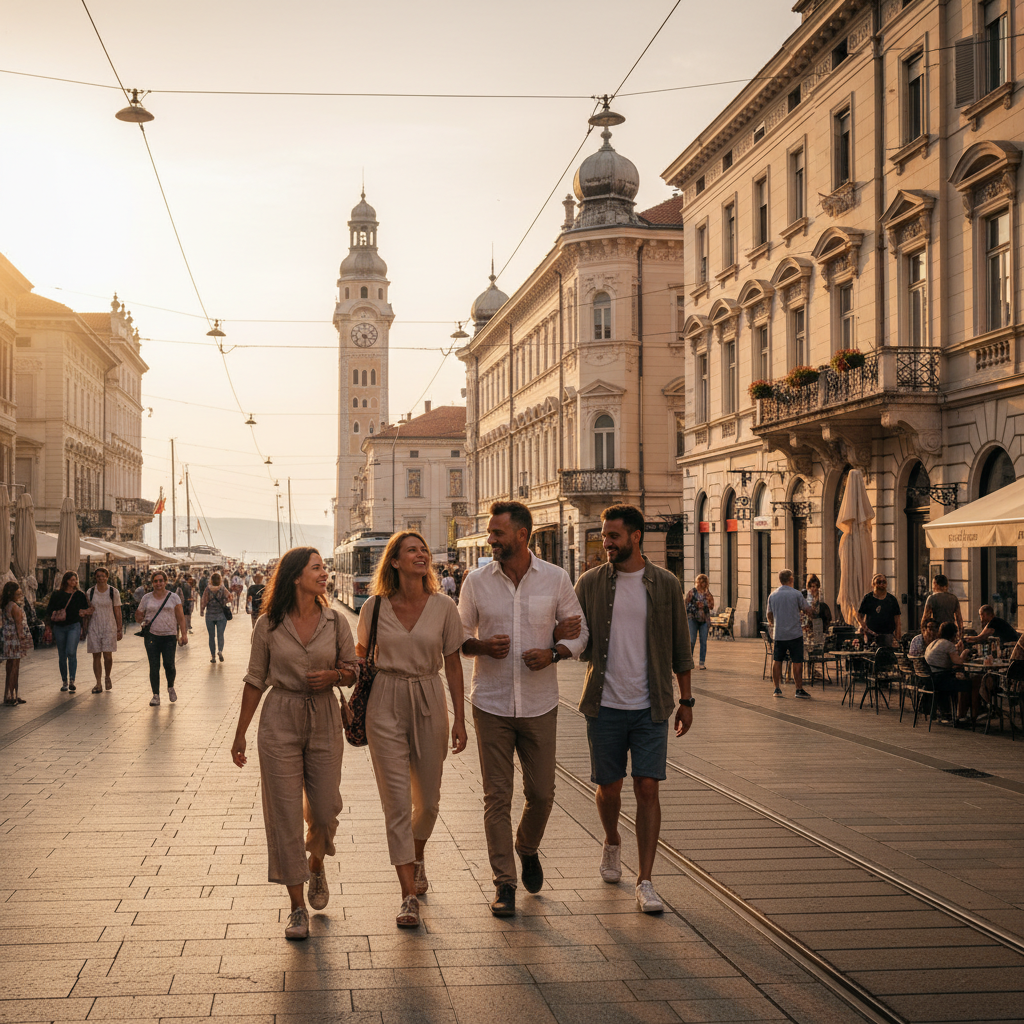
RijekaOutdoor Escape Game & Treasure Hunt
Vibrant Adriatic port, where history meets culture
Rijeka, a vibrant Adriatic port, is a city that surprises with its unique blend of industrial history and Mediterranean culture. If you're wondering "what to do in Rijeka", prepare to explore well beyond the beaten path. Stroll along Korzo, the lively main artery, the true beating heart of the city, or travel back in time by visiting the impressive Trsat Castle, offering spectacular panoramic views of the bay. For a deeper immersion and a dose of adrenaline, our outdoor escape games transform you into urban explorers. It's a perfect unusual activity to discover the city's hidden secrets, turning every alley into a clue for a huge treasure hunt. Imagine a life-sized scavenger hunt where Rijeka's history unfolds with each puzzle solved. Whether for its eclectic museums, nearby beaches, or cultural events, Rijeka promises a rich and memorable experience, away from the crowds.

Fiume's Shadow — Uncover the Legionnaire Conspiracy
Decode the secret network of D'Annunzio's renegade legionnaires who plotted to destabilize the Free State of Fiume. Uncover their hidden messages, betrayals, and the conspiracy that threatened to ignite a second civil war in 1920s Adriatic.
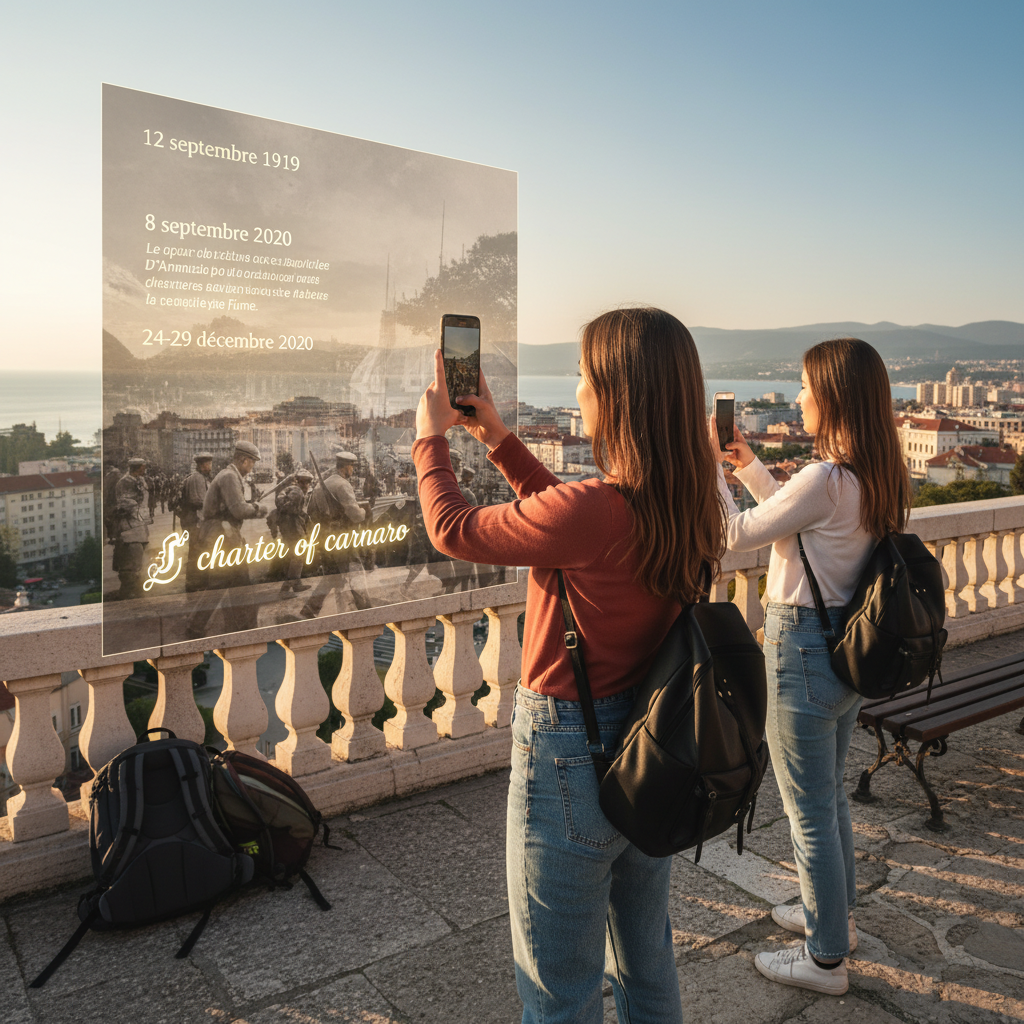
Rijeka — Decode D'Annunzio's Hidden Manifesto
Uncover the secret codes embedded in Gabriele D'Annunzio's lost Carnaro constitution. Decipher cryptic messages hidden across Rijeka's monuments to expose the truth behind the 1920 occupation.
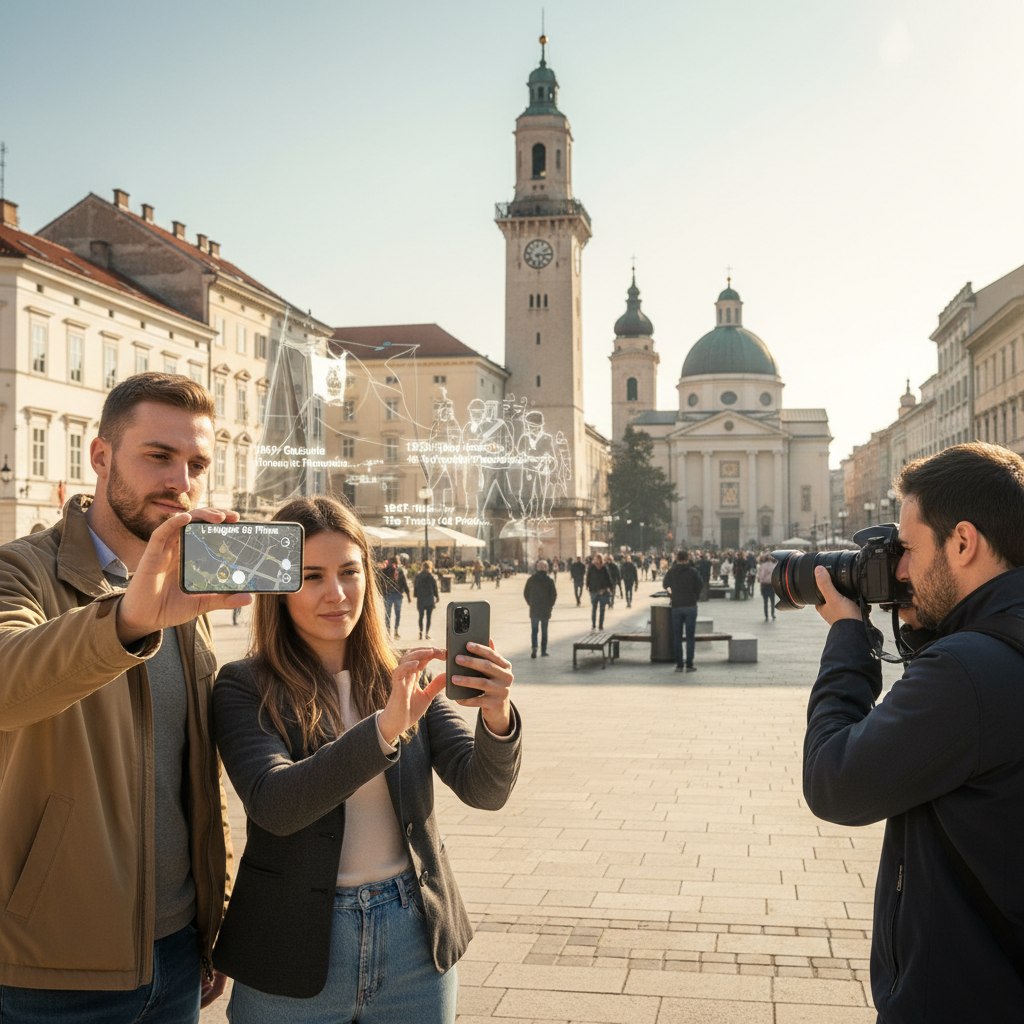
Rijeka — Fiume's Lost Manifesto
Uncover the fragments of a secret manifesto hidden by a desperate Fiuman to preserve the city's polyglot soul amid its turbulent past. Reassemble it before it's lost forever.
Unusual things to do in Rijeka
For an unusual activity in Rijeka, let yourself be surprised by its rich industrial past, often highlighted by urban art installations and dedicated museums, such as the Museum of Modern and Contemporary Art housed in a former factory. The city is also a melting pot of counter-culture, with its many alternative bars and murals adorning facades, transforming the city into an open-air gallery. An original outing could be to follow a street art trail, or venture into the Rijeka Tunnel, a World War II air-raid shelter now open to the public. These experiences offer a unique glimpse into Rijeka's rebellious and creative soul.
Things to do in Rijeka with kids
Rijeka is a fantastic destination for a family vacation. "What to do in Rijeka with family" becomes an exciting question with our outdoor escape games, perfectly suited for children from 8-10 years old and teens. The playful aspect of our scavenger hunts transforms the discovery of the city into a captivating adventure, where everyone, from the youngest to the oldest, can contribute to solving the puzzles. Beyond the games, Trsat Castle offers spaces to run and explore, while nearby beaches like Kostrena are ideal for relaxing. Interactive museums and city parks ensure that the whole family will find something to enjoy, combining learning and entertainment.
Rijeka for couples
For a romantic getaway, "Rijeka as a couple" offers an intimate and authentic setting. Get lost in the cobbled streets of the old town, discover hidden squares and charming cafes. Climb up to Trsat Castle at sunset to admire breathtaking views of the Kvarner Bay and surrounding islands, a perfect moment to share a magical instant. A stroll along Molo Longo, Rijeka's long breakwater, is also ideal for a hand-in-hand walk, lulled by the sound of the waves. The many fresh seafood restaurants promise intimate dinners, perfect for savoring the local culinary heritage in a warm atmosphere.
What to do in Rijeka when it rains
Even in the rain, Rijeka retains its charm. "What to do in Rijeka when it rains" is not a major issue, as a large part of our outdoor escape game routes will lead you under the elegant arcades of Korzo or through covered passages that protect from bad weather. Approximately 80% of the game can be completed under cover, allowing you to continue the adventure without getting soaked. Take the opportunity to explore the city's many museums, such as the Rijeka City Museum or the Maritime and History Museum of the Croatian Littoral, both housed in magnificent buildings.
Where is Rijeka, and where do the routes start?
Starting points of our routes and the places they pass through.
Route starting points
Places in Rijeka
- Korzo
- Rijeka Central Market
- Croatian National Theatre Ivan Zajc
- Our Lady of Lourdes Church (Capuchin Church)
- Governor's Palace
- City Tower
- St. Vitus Cathedral
- Molo Longo (Jetty) / Rijeka Port
- Korzo (Main Promenade)
- Modello Palace
- Old Roman Gate (Old Town)
- Rijeka Port
- Rijeka Resolution Square (Trg Riječke rezolucije)
- City Tower (Gradski Toranj)
- St. Vitus Cathedral (Katedrala Sv. Vida)
- Governor's Palace (Guvernerova palača)
- Molo Longo / Port of Rijeka (Riječka luka)
- Žabica Square (Trg Žabica)
The history of Rijeka
A Port Forged by Empires
Rijeka's story begins before its modern name. Evidence of human presence in the region dates back to the Palaeolithic and Neolithic ages. The Romans established a settlement called Tarsatica in the 1st century AD, with a forum, thermal baths, and defensive walls. Parts of these ancient walls are visible near the Old Roman Gate. After the 4th century, the city was rededicated to Saint Vitus, becoming known as Terra Fluminis sancti Sancti Viti, or Sankt Veit am Pflaum in German.
By the 13th century, two settlements existed: Trsat on the hill and Rijeka on the shore. Rijeka, a small fortified town, was enclosed within walls and defensive towers. From 1466, the city came under Habsburg rule, which shaped its destiny for centuries.
The Free Port and Industrial Boom
A turning point came in 1719 when Emperor Charles VI declared the Port of Rijeka a free port, alongside Trieste, breaking Venetian dominance in the Adriatic. This move fostered trade and established Rijeka as a key maritime connection for the Habsburg Monarchy. The city experienced an economic upswing, with industries like sugar refining emerging. However, an earthquake in 1750 destroyed much of the city. Empress Maria Theresa approved funding for its rebuilding as a "new city" in 1753. This reconstruction gave Rijeka's Old Town its Baroque appearance.
In 1779, Rijeka was annexed to the Kingdom of Hungary as a corpus separatum, operating directly from Budapest as Hungary's sole international port. This led to development, with Hungarian investments transforming the port into a rival to Austria's Trieste. By 1913–1914, the Port of Rijeka was the tenth-busiest port in Europe. This period also saw the construction of civic buildings, including the Governor's Palace, designed by Hungarian architect Alajos Hauszmann between 1892 and 1897.
What to see in Rijeka
- Korzo — This pedestrian promenade is the city's main artery, with cafes, shops, and historic buildings.
- Rijeka Central Market — A market where locals have shopped for centuries. It offers fresh produce, meats, cheeses, and a large indoor fish market by the coast. Arrive early for the day's catch.
- Croatian National Theatre Ivan Zajc — This architectural landmark hosts performances. Its design reflects the Austro-Hungarian influence on Rijeka.
- Our Lady of Lourdes Church (Capuchin Church) — This neo-Gothic basilica, built in the early 20th century, features a facade with stone carvings by Antonio Marietti and sculptures by Urbano Bottasso. Inside, there are stained-glass windows and frescoes by Romolo Venucci.
- Governor's Palace — Designed by Hungarian architect Alajos Hauszmann and completed in 1897, this neo-Renaissance palace served as the residence for Rijeka's governors. Today, it houses the Maritime and History Museum of the Croatian Littoral, offering insights into the city's past and maritime heritage.
- City Tower — A landmark on Korzo, this clock tower is a remnant of the medieval city gates.
- St. Vitus Cathedral — The only Baroque rotunda of monumental proportions in Croatia, this cathedral was built by the Jesuits starting in 1638. Its central octagonal space under the dome, with dark-marble Tuscan pillars and arches, is an architectural feature.
- Molo Longo (Jetty) / Rijeka Port — Croatia's largest port, it has been a hub since 1281. A stroll along the Molo Longo, a long pier, offers views of the city and the working port.
- Modello Palace — Built in 1885 by Viennese architects Ferdinand Fellner and Herman Helmer, this palace is an example of Historicism with Renaissance and Baroque inspirations. It originally served as a bank and features two facades and an interior.
When to visit Rijeka
The best times to visit Rijeka are during the shoulder seasons: May to early June and September to October. During these months, the weather is warm, crowds are thinner, and prices for accommodation and activities are lower. Daytime temperatures in May are around 22°C, and in September, they are around 19°C.
Summer, particularly July and August, is peak season, with temperatures reaching up to 30°C. While the sea is warmest in August, the city can be busy with tourists. Winter (November to March) is cold and quiet, though the Rijeka Carnival in February is a draw. January is typically the wettest month, so avoid it if you prefer dry weather.
Getting around Rijeka
Rijeka Airport (RJK) is on the island of Krk, approximately 26 kilometers (16.2 miles) from the city center. The drive takes about 30-35 minutes. An airport shuttle bus runs a few times a day, timed with flight arrivals, and costs around €10 for a one-way ticket to Jelačićev Trg in the eastern part of the city center. From there, it is a 10-minute walk to the main bus station.
Within the city, the center is pedestrian-friendly, especially around Korzo. For longer distances, Rijeka has a local bus network. Parking is available in various garages and street parking zones, but it is often easier to walk or use public transport in the compact city center. The Rijeka Central Market is open Monday to Saturday, from early morning to early afternoon, except on holidays.
Things you probably do not know about Rijeka
Verified details most visitors walk straight past.
- Old Roman Gate
- What's the story behind the solitary Roman arch standing in Rijeka's Old Town? The Old Roman Gate is the only above-ground remnant of the ancient Roman settlement of Tarsatica, which dates back to the 1st century AD. It's a tangible link to Rijeka's earliest urban beginnings.
- St. Vitus Cathedral
- Why does Rijeka's cathedral have such an unusual, round shape? St. Vitus Cathedral is the only Baroque rotunda of monumental proportions in Croatia. The Jesuits, who began its construction in 1638, originally planned a larger church, but groundwater issues and defensive considerations led them to opt for a central, round ground plan, atypical for Jesuit churches.
- Governor's Palace
- Who was the grand Governor's Palace built for, and why is it so prominent? The Governor's Palace, completed in 1897, was built as the official residence and business center for the Hungarian governor of Rijeka, Count Lajos Batthyány. Its prominent location on a hill, with a white stone façade facing the port, was chosen to symbolize the monarchy's prestige and the city's importance as a major port.
- Molo Longo (Rijeka Port)
- Before modern cruise ships, what kind of passengers filled Rijeka's port? In the late 19th and early 20th centuries, the Port of Rijeka was a main departure point for emigrants from the Austro-Hungarian Empire heading to the Americas. Companies like Cunard Line had ships sailing directly from Rijeka to New York.
- Our Lady of Lourdes Church (Capuchin Church)
- What ambitious architectural feature was planned for the Capuchin Church but never completed? According to the original plans for the Capuchin Church of Our Lady of Lourdes, a 75-meter-high lighthouse with a large angel was intended to crown the main façade, but it was never built.
- City Tower
- What hidden detail on the City Tower points to a specific historical event? Near the entrance of St. Vitus Cathedral, a cannonball is lodged into the wall, a lasting reminder of the Napoleonic Wars when the French briefly occupied Rijeka between 1809 and 1813.
Questions about visiting Rijeka
How many days should I spend in Rijeka?
To get a feel for Rijeka and explore its main attractions, including the Old Town, Korzo, and some museums, two to three days is a good starting point. This allows for a relaxed pace and time to experience the local atmosphere.
What are the best ways to get around Rijeka?
Rijeka's city center is walkable, with many key sights accessible on foot. For longer distances or reaching areas outside the immediate center, the city has a local bus system. Taxis are also available.
Which neighborhood is best to stay in Rijeka?
The city center, particularly around Korzo and the Old Town, is suitable for first-time visitors due to its proximity to major attractions, restaurants, and shops. For a quieter stay with views, consider areas closer to Trsat Castle.
Is Rijeka a good destination for families with children?
Yes, Rijeka can be a family destination. Children might enjoy exploring Trsat Castle, walking along the Molo Longo, and visiting the Maritime and History Museum. The city also offers access to nearby beaches and natural parks for outdoor activities.
What is the typical budget for a day in Rijeka?
A moderate daily budget for Rijeka, excluding accommodation, could range from €50-€80 per person. This would cover meals at local restaurants, public transport, entrance fees to a couple of attractions, and a coffee or two on Korzo.
What is Rijeka like during the winter months?
Winter in Rijeka is cold and quieter, with average daytime highs around 8°C in January. While some outdoor activities might be limited, it is a time to experience the city's indoor cultural offerings and the Rijeka Carnival in February.
Frequently asked questions
How much does an outdoor escape game cost in Rijeka?
Our outdoor escape games in Rijeka are designed to be accessible and fun for everyone. The price is €12 per team, which is excellent value for money, especially if you play with several people! This unique price per team allows you to share a memorable experience and discover the city in a completely new way, with no hidden costs. It's an economical and entertaining way to turn your visit into an interactive adventure, ideal for friends, family, or couples wanting to explore Rijeka on a budget.
Is it suitable for children / families?
Absolutely! Our outdoor escape games in Rijeka are perfectly suited for families and children aged 8-10 and up. The puzzles are designed to be stimulating without being overly complex, encouraging collaboration and critical thinking from all team members. It's a fantastic activity to spend quality time together, where everyone can contribute. Children love the treasure hunt aspect, and parents appreciate the fun cultural discovery. It's an interactive and memorable way to explore the city as a family.
How long does an escape game in Rijeka last?
The duration of our outdoor escape games in Rijeka generally ranges from 1h30 to 2h30, depending on your pace and how quickly you solve the puzzles. This is an ideal length for an activity that doesn't take up the whole day, leaving you plenty of time to enjoy other city attractions. You are free to take breaks, stop for a drink or a photo, as the game adapts to your exploration. The goal is to have fun and discover the city at your own tempo.
Do I need to book in advance?
No, one of the great advantages of our outdoor escape games is flexibility! There's no need to book in advance. You can start your adventure whenever you want, at any time of the day, as soon as the mood strikes. Simply download the game to your smartphone and get started. This spontaneity is perfect for travelers who love freedom and don't want to be constrained by fixed schedules. It's your game, at your pace, without booking constraints.
What to visit in Rijeka beyond the escape games?
Rijeka is full of treasures to explore! Beyond our exciting escape games, don't miss strolling along Korzo, the lively main artery, and visiting the majestic Trsat Castle for its breathtaking views. The central market is a festival of local colors and flavors. History buffs will appreciate the Rijeka City Museum and the Maritime and History Museum of the Croatian Littoral. For a nature break, the beaches of Kostrena are just minutes away. Rijeka offers a rich blend of culture, history, and relaxation.
What is the best season to visit Rijeka?
The best season to visit Rijeka and fully enjoy our outdoor escape games is spring (April to June) or early autumn (September to October). During these periods, the weather is generally mild and sunny, ideal for exploring the city on foot without the intense summer heat. Crowds are also smaller than during peak summer season. Summer (July-August) is also very pleasant if you enjoy the heat and want to combine your adventure with swimming in the Adriatic.
More cities in Croatia
Porec
Between Roman ruins and the Adriatic Sea
Pula
Pula: Tracing the Roman Empire's legacy in Istria
Zagreb
Where Austro-Hungarian grandeur meets Balkan spirit
Krapina
On the trail of Neanderthal man
Zadar
Between sea organ and ancient ruins, the pearl of the Adriatic
Čakovec
Where Croatian history unfolds along the Drava
Activities to discover nearby
Guided tours, skip-the-line tickets and local experiences to book in advance.
💡 Optional booking — you can also buy on-site. All links open in a new window, your OddballTrip visit stays preserved.