NinOutdoor Escape Game & Treasure Hunt
Ancient royal capital, between salt and sea
Nin, this ancient royal capital of Croatia, is a small pearl of Dalmatia brimming with history and charm. If you're wondering what to do in Nin, prepare to be surprised by its rich heritage and gentle atmosphere. Beyond its idyllic beaches like the famous Queen's Beach, the town offers a unique immersion into the past. Imagine strolling through its cobbled streets, exploring the incredible Church of the Holy Cross, often called the smallest cathedral in the world, or wandering near the remains of the Roman city walls and the City Gate. For a truly memorable experience, why not embark on an outdoor escape game? It's an unusual activity that transforms the discovery of Nin into a life-sized treasure hunt. An interactive scavenger hunt that will lead you through the city's secrets, combining adventure and culture. It's a fun and original way to appropriate Nin's history, with family or friends.
Unusual things to do in Nin
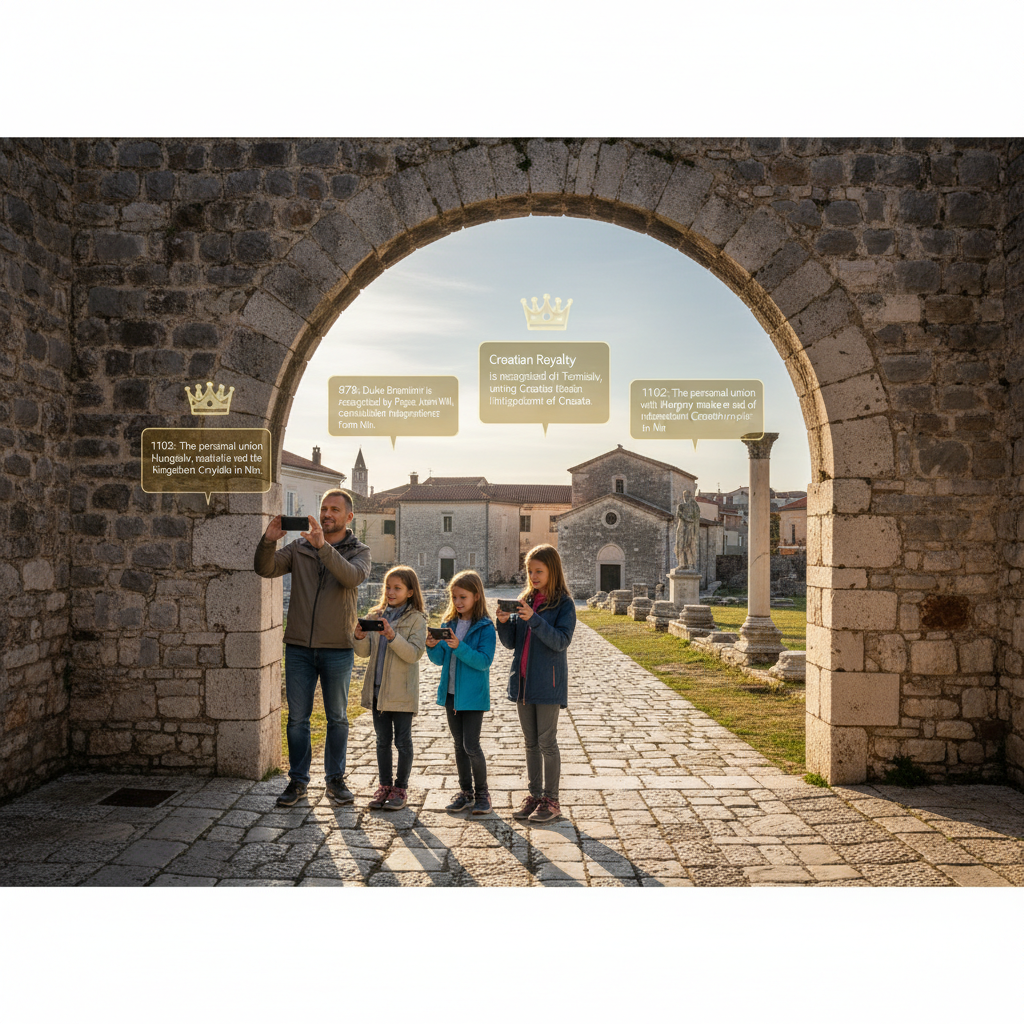
For an unusual activity in Nin, off the beaten path, the town offers unique experiences. Besides its famous sea salt, which can be discovered at the Salt Museum, Nin is renowned for its medicinal mud, "peloid," found on some of its beaches. An original outing could be to cover yourself with this natural mud, known for its therapeutic virtues, before rinsing off in the Adriatic Sea. It's a quirky and relaxing way to enjoy the local nature. And of course, the OddballTrip outdoor escape game adds a dimension of adventure and mystery to your exploration, turning every street corner into a clue for a captivating enigma.
Things to do in Nin with kids
Nin is a fantastic destination for a family holiday. What to do with family in Nin? The shallow beaches are perfect for young children, and the playful aspect of discovering the city is a major asset. With an OddballTrip outdoor escape game, children (from 8-10 years old accompanied, or 12+ independently) and teens can embark on a real treasure hunt. It's an activity that stimulates teamwork, observation, and puzzle-solving, all while exploring Nin's heritage interactively. An excellent way to combine entertainment and culture for the whole family.
Nin for couples
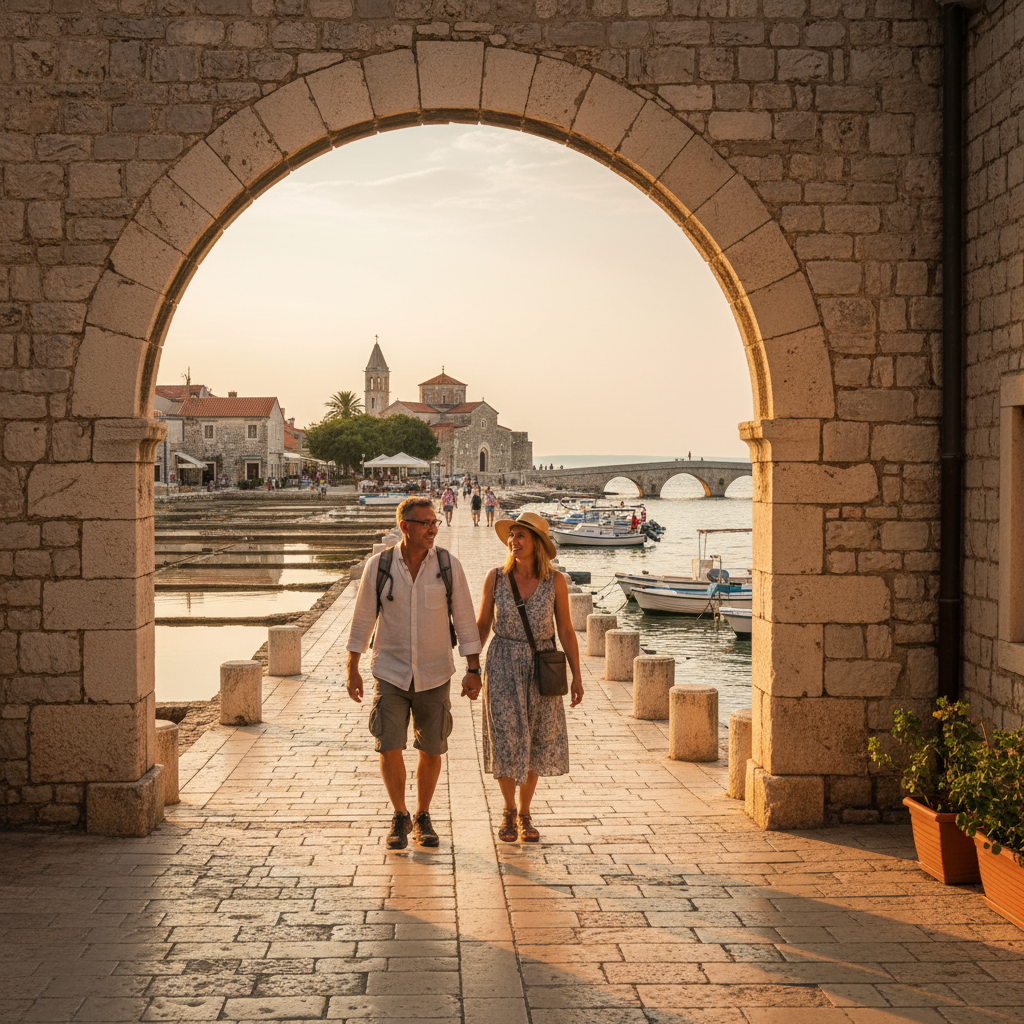
Nin offers an idyllic setting for a romantic getaway for couples. Imagine yourselves hand in hand, strolling through the cobbled streets of the old town, discovering secret corners and breathtaking views of the sea and mountains. In the evening, an intimate dinner at one of the local restaurants, savoring Dalmatian specialties, is a must. The historical heritage, such as the Church of the Holy Cross or the Roman remains, adds a touch of grandeur to your walks. An outdoor escape game can even become a fun and complicit activity to explore the city together, sharing laughs and challenges.
What to do in Nin when it rains
Even if the sun often shines in Nin, what to do in Nin on a rainy day? The good news is that the OddballTrip outdoor escape game in Nin is designed to be playable even if the sky is gray. Approximately 80% of the route takes place under covered passages, arcades, or near shelters, allowing you to continue the adventure protected from the weather. It's an excellent alternative to enjoy the city without being fully exposed. You can also visit the Salt Museum or the Archaeological Museum for a dry cultural immersion.
Where is Nin, and where do the routes start?
Starting points of our routes and the places they pass through.
Route starting points
Places in Nin
- Lower Gate (Donja Vrata)
- Church of the Holy Cross (Crkva sv. Križa)
- Remains of the Roman Temple (Ostaci Rimskog Hrama)
- Statue of Duke Branimir (Spomenik knezu Branimiru)
- Courtyard of St. Anselm Church (Plato ispred Crkve sv. Anselma)
- The Stone Bridge (Kameni Most)
- Church of St. Nicholas (Crkva sv. Nikole)
- Walls of Nin (Zidine Nina)
The history of Nin
From Liburnian Settlement to Roman Municipality
Nin's history extends over 3,000 years, with evidence of settlement from the Palaeolithic era. The Illyrian tribe of Liburnians founded the first colony, Aenona, in the 9th century BC. This early settlement on a small island was fortified with walls, and houses were constructed using dry-stone techniques.
With the arrival of the Romans, Aenona became a municipality and seaport. During Roman rule, a port was built in the area of what is now Zaton Holiday Resort. The most significant Roman complex was the Forum with its Capitolium. A monumental temple, one of the largest of its kind on the eastern Adriatic coast, was erected by Emperor Vespasian in the 1st century AD. Remains of Roman houses and mosaics indicate a prosperous lifestyle during this period.
The Cradle of the Croatian State
After the fall of the Roman Empire, Croatian tribes settled the area. From the 7th to the 13th centuries, Nin became the first political, religious, and cultural center of medieval Croatia. It served as the seat for Croatian dukes like Višeslav, Trpimir, and Branimir, and later for kings such as Tomislav, Petar Krešimir IV, and Zvonimir. In the 9th century, Nin also became the seat of the first Croatian bishopric. Bishop Gregory of Nin (Grgur Ninski) was a figure in the 10th century, known for advocating the use of the Old Slavonic language and the Glagolitic alphabet in church services.
Nin's strategic importance led to its destruction several times throughout its history. In 1646, the town was completely razed by Venice to prevent its capture by the Ottoman Turks, a sacrifice made to protect the fort of Zadar. Despite this devastation, Nin gradually rebuilt and stands as a testament to its historical significance.
What to see in Nin
- Church of the Holy Cross (Crkva sv. Križa) — This 9th-century Pre-Romanesque church is known for its small dimensions (7.80 m long, 7.60 m wide, and 8.20 m high internally). Its architecture allowed it to function as a calendar and sundial, with the positioning of its windows determining solstices and equinoxes.
- Remains of the Roman Temple (Ostaci Rimanskog Hrama) — Explore the foundations of what was once the largest Roman temple on the eastern Adriatic coast, built in the 1st century AD during Emperor Vespasian's reign. A reconstructed Corinthian column, originally 17 meters tall, stands on the site of the former Roman Forum.
- Statue of Duke Branimir (Spomenik knezu Branimiru) — This bronze statue, a work by sculptor Ivan Meštrović, commemorates Duke Branimir, a figure in Croatian history whose rule in 879 was acknowledged by Pope John VIII. It represents Croatian statehood.
- Courtyard of St. Anselm Church (Plato ispred Crkve sv. Anselma) — The parish Church of St. Anselm, originally built in the 6th century and renovated in 1070 by King Zvonimir, served as Nin's cathedral during the Croatian royal period. The adjacent Chapel of St. Marcella, dating from the 15th century, houses a statue of the Madonna and Child and a treasury of religious artifacts.
- The Stone Bridge (Kameni Most) — These two 16th-century stone bridges connect the historical islet of Nin to the mainland, providing the main access to the old town.
- Church of St. Nicholas (Crkva sv. Nikole) — This small 12th-century pre-Romanesque church stands on a prehistoric Liburnian burial mound outside the town center. It is historically significant as a coronation church where, according to local legend, seven Croatian kings were crowned.
- Walls of Nin (Zidine Nina) — While much of the original fortifications were destroyed in 1646, remnants of the city walls are visible, showing Nin's past as a fortified settlement.
When to visit Nin
Visit Nin during late spring (May-June) and early autumn (September-October). Temperatures range from 17-24°C (62-75°F) in September, and crowds are smaller than in peak summer. The sea is warm enough for swimming, especially in September. Many festivals and events occur during these months.
Avoid July and August if you prefer fewer people, as these are the hottest and busiest months with average highs reaching 30°C (86°F). While suitable for beaches, the town can be crowded. Winter (December-February) brings cooler temperatures and more rain, with many tourist businesses closed.
Getting around Nin
Nin is about 14-20 kilometers north of Zadar. The nearest airport is Zadar Airport (ZAD). From there, take an airport transfer bus to Zadar's main bus station, then connect to suburban bus 101, which runs hourly to Nin and takes about 19-30 minutes. Taxis and private transfers are also available from Zadar and the airport.
Once in Nin, the historic center is on a small islet, 500 meters in diameter, connected to the mainland by two stone bridges. It is explored on foot, as it is largely a pedestrian zone. Parking is available on the mainland near the bridges. UberX operates in Nin. There are no specific market days mentioned as a major local particularity, but smaller local vendors may be present.
Things you probably do not know about Nin
Verified details most visitors walk straight past.
- Church of the Holy Cross (Crkva sv. Križa)
- How did this small 9th-century church also function as an ancient calendar? The Church of the Holy Cross was designed with its windows and walls positioned to allow sunlight to enter at specific angles, enabling the determination of solstices and equinoxes. This astronomical feature is still celebrated annually with the "Festival of Sun and Light" on the first day of summer.
- Remains of the Roman Temple (Ostaci Rimskog Hrama)
- What grand Roman structure once stood where these ruins now lie? The remains are part of a monumental Roman Temple, built by Emperor Vespasian in the 1st century AD, which was the largest Roman temple on the eastern Adriatic coast. It was situated on the western part of the Roman Forum, a significant urban development in Roman Aenona.
- Statue of Duke Branimir (Spomenik knezu Branimiru)
- Why is touching the thumb of this statue a popular local tradition? It is a popular belief that touching the thumb of the bronze statue of Duke Branimir, a work by Ivan Meštrović, will bring good luck and grant wishes. This tradition attracts visitors who come to try their luck.
- Church of St. Nicholas (Crkva sv. Nikole)
- What unique role did this small church play in the crowning of Croatian kings? The Church of St. Nicholas, dating from the 12th century, served as a coronation church. According to local legend, seven Croatian kings were crowned here, and during the ceremony, the newly crowned ruler would ride to the church and point his drawn sword to the four sides of the world.
- Courtyard of St. Anselm Church (Plato ispred Crkve sv. Anselma)
- What precious artifacts are hidden within the treasury of this parish church? The Church of St. Anselm, which was once Nin's cathedral, houses a rich treasury in its adjacent Chapel of St. Marcella. This collection, known as "Gold and Silver of the City of Nin," includes valuable relics of saints Anselm, Marcella, and Ambrose, some dating back to the 8th century.
- The Stone Bridge (Kameni Most)
- What symbolic welcome was carved into the stone at the entrance of the old town? At the entrance to the old town, near the Stone Bridge, a vessel for wine and bread was carved into the stone. This carving served as a symbol to welcome guests entering Nin.
Questions about visiting Nin
How long should I plan to stay in Nin?
For a visit to Nin's historical sites and to experience its atmosphere, one to two days is generally sufficient. This allows time to explore the ancient town, visit museums, and enjoy the local beaches without rushing.
What is the best way to get around Nin?
Nin's historic center is a compact islet, making walking the ideal way to explore. Most attractions are within easy reach on foot. For venturing outside the old town, such as to Queen's Beach or the salt pans, a bicycle or a short taxi ride would be convenient.
Is Nin suitable for families with children?
Yes, Nin is family-friendly. Its shallow, sandy beaches, like Queen's Beach, are suitable for children. The historical sites are easily accessible, and the town's relaxed pace makes it a pleasant destination for families. The salt pans also offer an educational experience.
What is the typical budget for a day in Nin?
A moderate budget for a day in Nin, excluding accommodation, would range from €40-€70 per person. This would cover meals at local restaurants, entrance fees to museums, and perhaps a small souvenir. Public transport within the area is generally inexpensive.
Are there any specific local customs or etiquette I should be aware of?
Croatians are generally welcoming. A simple 'Dobar dan' (Good day) or 'Hvala' (Thank you) is appreciated. Tipping is customary in restaurants and for services. During the summer, many shops and businesses might observe a siesta in the early afternoon, so plan your activities accordingly.
Which neighborhoods or areas are best for exploring the historical sites?
The main historical sites are concentrated on the small islet that forms Nin's old town. This area is where you'll find the Roman Temple, the Church of the Holy Cross, St. Anselm's Church, and the Duke Branimir statue. The Church of St. Nicholas is just outside the main islet, easily reachable on foot.
Frequently asked questions
How much does an outdoor escape game cost in Nin?
An OddballTrip outdoor escape game in Nin is a very affordable activity, especially if you come as a group. The price is €12 per team, not per person. This means that if you are 4 players, the cost per person is only €3, which is really competitive for such an immersive and entertaining experience. It's excellent value for money to discover the city in a unique and fun way, while solving exciting puzzles.
Is it suitable for children / families?
Absolutely! Our outdoor escape games are perfectly designed for families and children. We recommend a minimum age of 8 to 10 years if children are accompanied by adults who can help them solve the puzzles. For teens (from 12 years old), they can often play independently. It's a fantastic activity to stimulate cooperation, logic, and observation, transforming the visit to Nin into a memorable adventure for all family members.
How long does an escape game in Nin last?
The duration of an OddballTrip outdoor escape game in Nin is flexible and depends on your pace and your ability to solve the puzzles. On average, allow between 1h30 and 2h30 to complete the route. The advantage is that you can take breaks whenever you want, to have a coffee, visit a monument, or simply enjoy the scenery. It's your adventure, at your own pace!
Do I need to book in advance?
No, not at all! One of the great advantages of our outdoor escape games is that they are accessible without prior reservation. You can purchase your game directly on our website, or via the OddballTrip app, and start the adventure whenever you want. This is ideal for a last-minute decision or to adapt to a flexible holiday schedule. All you need is your charged smartphone and the desire to play!
What to visit in Nin beyond the escape games?
Nin is full of treasures to explore! Don't miss the iconic Church of the Holy Cross, often called the smallest cathedral in the world. Stroll on the remains of its Roman city walls and pass through the City Gate. The Salt Museum will immerse you in the history of salt production, and the Archaeological Museum of Nin will reveal the secrets of this ancient capital. Of course, the beaches, especially Queen's Beach, are perfect for relaxation and swimming.
What is the best season to visit Nin?
The best season to visit Nin extends from spring (April-May) to autumn (September-October). During these periods, the weather is pleasantly mild, ideal for exploring the city and enjoying outdoor activities without the summer crowds. Summer (June-August) is also very pleasant, but temperatures can be high and the city more lively. Off-season, Nin offers a calmer and more authentic atmosphere, although some activities may be limited.
Other destinations in Dalmatia
Dubrovnik
The Pearl of the Adriatic, where history meets turquoise sea.
Hvar
Adriatic gem, between history and secret coves.
Knin
Royal fortress, historical heart of Croatia
Korcula
Marco Polo's island, between history and the Adriatic Sea
Omis
Pirate city, between sea and canyon
Sibenik
Between medieval fortresses and the Adriatic Sea
Split
Diocletian's Palace, the beating heart of a millennial city
Trogir
UNESCO medieval city, jewel of the Adriatic.
Zadar
Between sea organ and ancient ruins, the pearl of the Adriatic