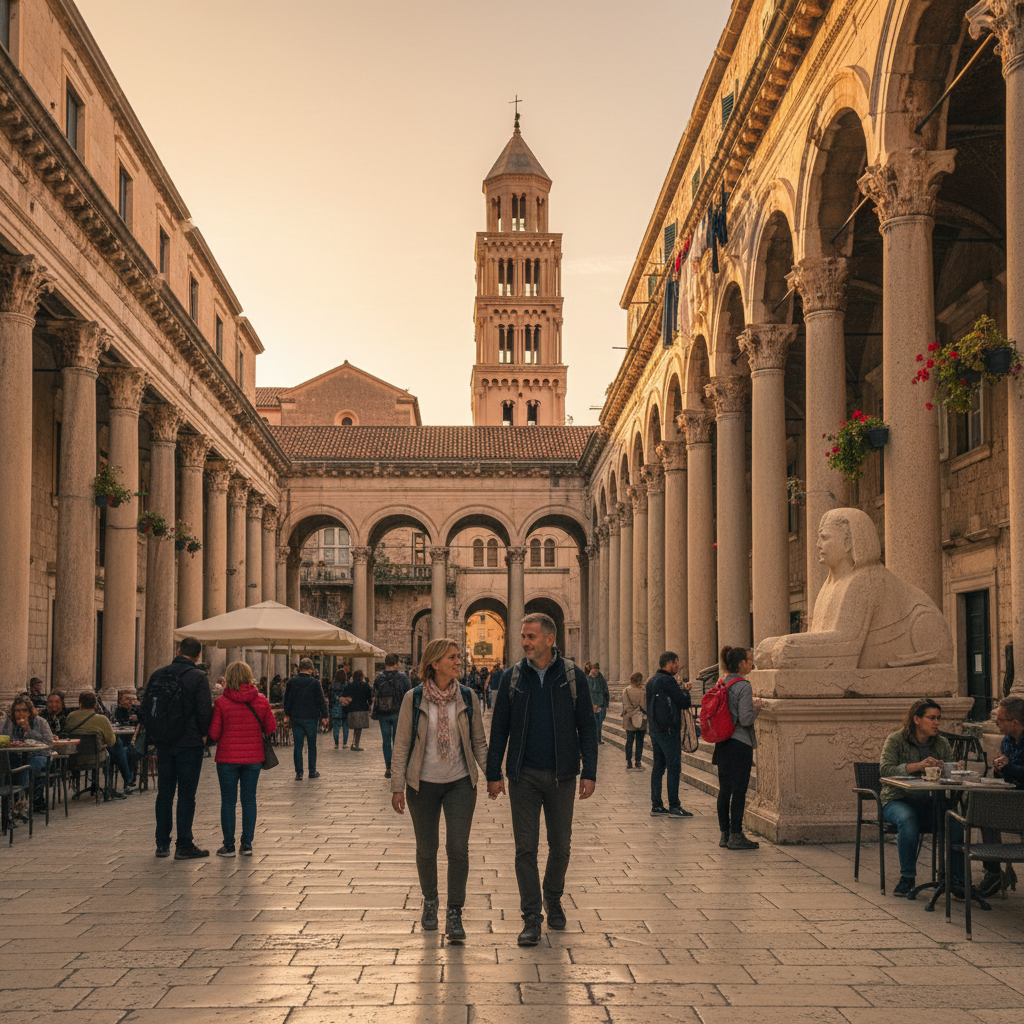
SplitOutdoor Escape Game & Treasure Hunt
Diocletian's Palace, the beating heart of a millennial city
Split is a city where history pulsates on every corner, and the opportunities for exploration are endless! Beyond the unmissable Diocletian's Palace, whose millennia-old walls tell fascinating stories, you can stroll along the lively Riva, get lost in the winding alleys of the Old Port, or climb Marjan Hill for breathtaking panoramic views of the Adriatic. But for those seeking an unusual and memorable activity, why not turn the city itself into a huge playground? An OddballTrip outdoor escape game, a scavenger hunt, or a real-life treasure hunt offers an immersive and fun way to discover Split. It's a unique way to embrace the rich heritage, solve captivating puzzles while exploring the hidden treasures of this vibrant Dalmatian city. Get ready for an adventure that's out of the ordinary and will show you Split in a new light!
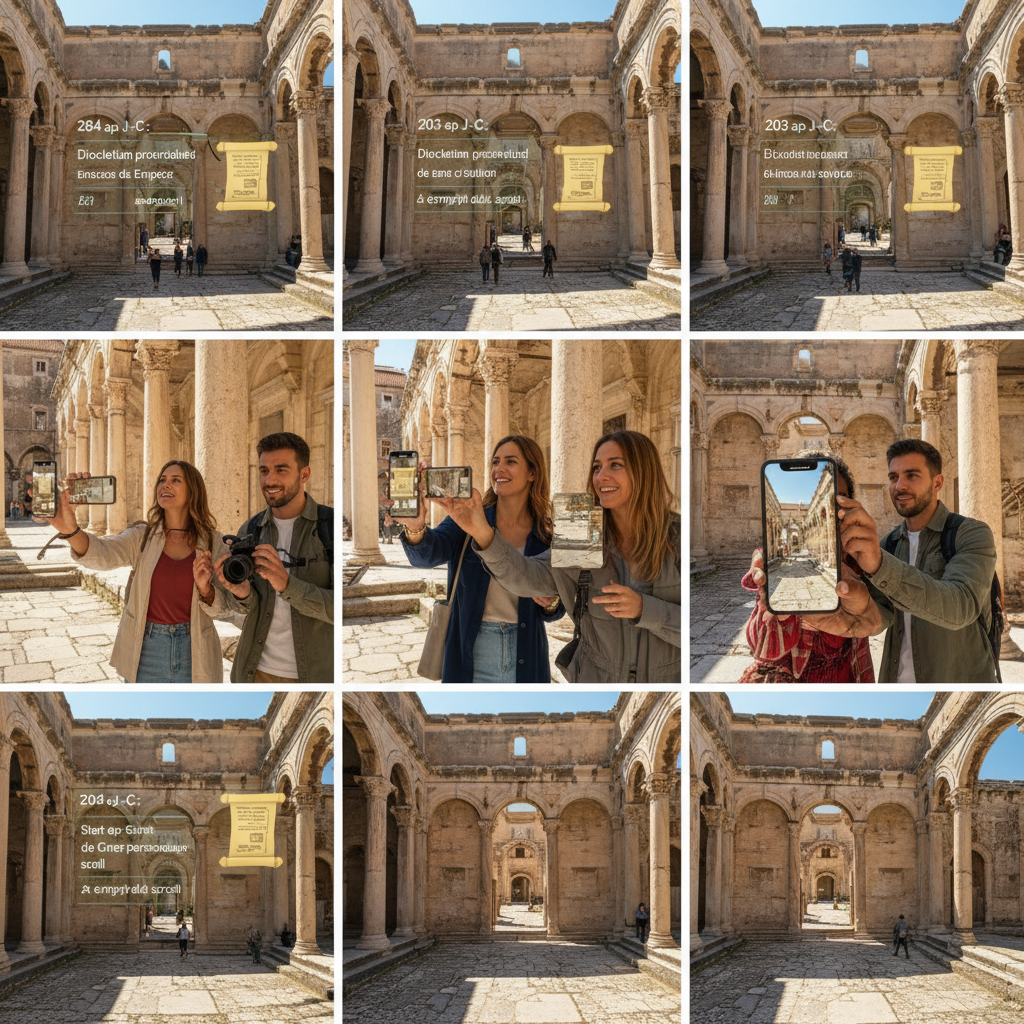
Diocletian's Palace — The Secret Scroll
Uncover the hidden scroll of Emperor Diocletian, concealed within his palace walls during his retirement. Decode ancient clues across Roman ruins to expose a forbidden imperial secret before it vanishes forever.
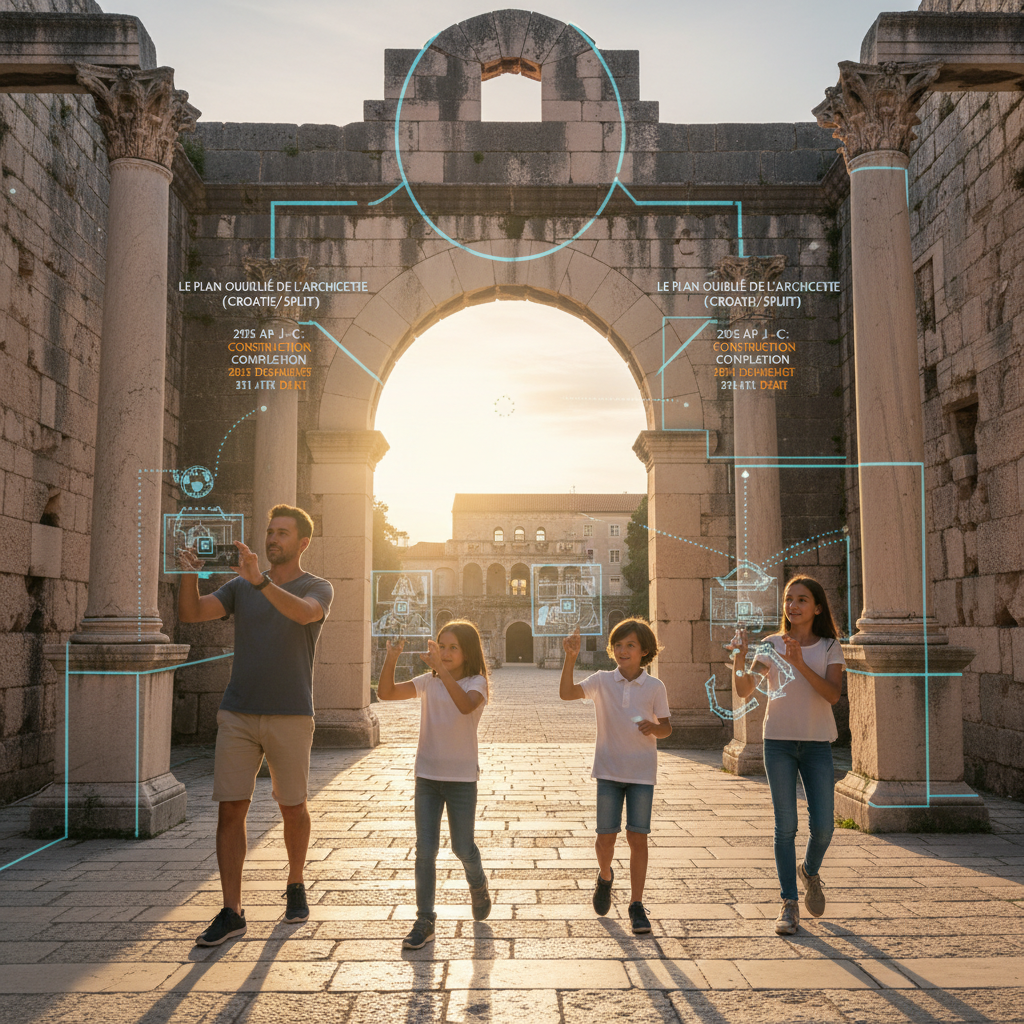
Diocletian's Palace — The Architect's Forgotten Plan
Uncover the secret blueprint hidden by Diocletian's master architect. Decode clues across the palace ruins to reconstruct the forbidden plan that could rewrite Roman history—before it's lost forever.
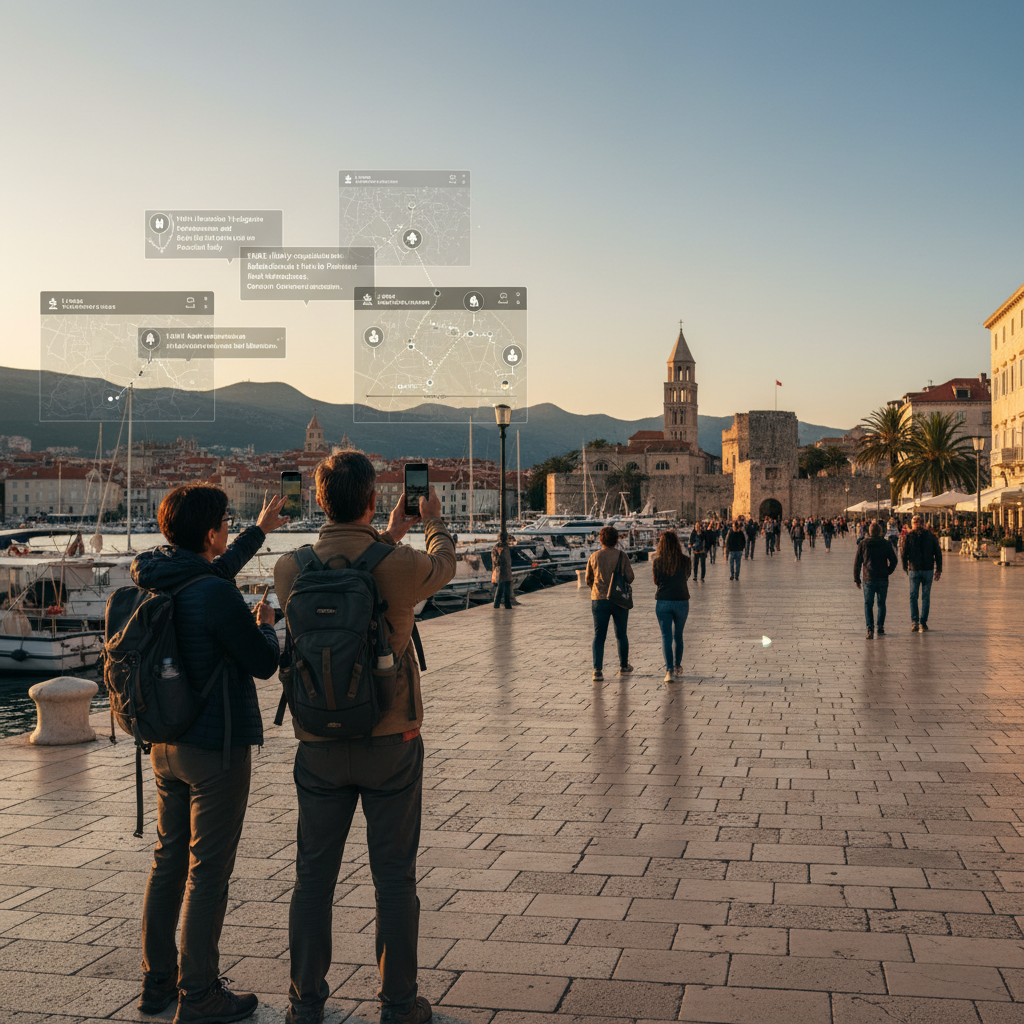
Split — Partisans' Shadow
1941 Split: Uncover the betrayed secrets of the 1st Split Partisan Detachment. Decode their hidden codes, track execution sites, and expose the traitor who doomed 24 heroes to Ustaše blades.
Unusual things to do in Split
Looking for an unusual activity in Split? Forget classic tours and dive into the heart of the city with an original outing. Our games invite you to explore the secret passages of Diocletian's Palace or the lesser-known corners of the old town. It's a fun immersion that blends history, local legends, and stimulating challenges. You don't just visit Split; you experience it, solving puzzles that lead you from discovery to surprise. A truly unique experience for the curious!
Things to do in Split with kids
Split is full of activities for a memorable family outing! Our outdoor escape games are perfectly suited for children and teens aged 8 and up, offering a fun and interactive way to discover the city. It's a real treasure hunt where everyone, from the youngest to the oldest, can actively participate in solving the puzzles. The collaborative aspect strengthens bonds, and the excitement of discovery transforms the visit into an educational and entertaining adventure for the whole family.
Split for couples
For a romantic getaway in Split as a couple, our games offer an intimate and original way to discover the city. Imagine strolling hand in hand through the cobbled streets of Diocletian's Palace, solving puzzles while admiring ancient ruins, and sharing special moments facing breathtaking views of the Adriatic. It's an experience that combines heritage, exploration, and adventure, creating unique memories for two, off the beaten path.
What to do in Split when it rains
Don't let the rain spoil your fun in Split! The beauty of the old town, especially Diocletian's Palace, is that about 80% of our routes take place under arcades, covered passages, or archways. You stay dry while continuing the adventure. It's an excellent option for a rainy day activity, allowing you to enjoy Split's historical charm without worrying about the weather. An ideal solution to explore the city, whatever the conditions.
Where is Split, and where do the routes start?
Starting points of our routes and the places they pass through.
Route starting points
Places in Split
- Peristyle of Diocletian's Palace
- Vestibule of Diocletian's Palace
- East Entrance of the Palace Cellars
- Golden Gate of Diocletian's Palace
- Forecourt of Jupiter Temple
- Facade of Saint Domnius Cathedral (former Mausoleum)
- Riva Promenade (Southern Wall of the Palace)
- People's Square (Pjaca)
- Brass Gate (Porta Aenea)
- Iron Gate (Porta Ferrea)
- The Decumanus (Main East-West Street of the Palace)
- The Cardo (Main North-South Street of the Palace)
- Eastern Wall of Diocletian's Palace (from Hrvojeva Street)
- Western Wall of Diocletian's Palace (from Dioklecijanova Street)
- Cryptoporticus Gallery (view from Peristyle)
- Trg Brace Radic (Fruit Square)
- Riva Promenade
- Marmontova Street
The history of Split
From Roman Palace to Medieval Town
Split's history began in 295 AD when Roman Emperor Diocletian started building his palace. This fortified residence combined imperial apartments with a military garrison. The site was chosen near Salona, the capital of the Roman province of Dalmatia and Diocletian's birthplace. Built over approximately ten years, the palace covered about 30,000 square meters, featuring thick walls, towers, and four monumental gates. This structure was designed for the emperor's retirement, completed around 305 AD.
Around 650 AD, Roman refugees from Salona, destroyed by Avars and Slavs, sought shelter within the palace walls. This influx transformed the imperial residence into a medieval town. Original Roman structures were adapted; Diocletian's mausoleum became the Cathedral of Saint Domnius. For centuries, the city was under the Byzantine Empire and the Kingdom of Croatia, eventually coming under the Republic of Venice in 1420. Venetian rule, which lasted until 1797, connected Split's port to maritime trade routes.
Later Transformations and Modern Identity
After the fall of the Venetian Republic in 1797, Split experienced periods of Austrian and French rule. The 19th century saw development, particularly under Mayor Antonio Bajamonti, who initiated civic projects. In 1918, following the dissolution of the Austro-Hungarian Empire, Split became part of the Kingdom of Serbs, Croats, and Slovenes. The city continued to grow, especially after 1920 when Zadar, the official capital of Dalmatia, became an Italian lugar. In 1991, Split became part of independent Croatia. This continuous evolution means ancient Roman gates still open onto public squares, and former imperial rooms now house homes and businesses.
What to see in Split
- Peristyle of Diocletian's Palace — This central ceremonial courtyard, built around 305 AD, was where Emperor Diocletian appeared before his subjects. Today, it is a public gathering place, surrounded by ancient columns and medieval buildings. Visitors sit on the steps.
- Vestibule of Diocletian's Palace — This circular, domed hall was the formal entrance to the emperor's private apartments. Its open roof allows light to enter, and the acoustics make it a spot for traditional klapa singers.
- Golden Gate of Diocletian's Palace (Porta Aurea) — The most elaborate of the palace's four gates, it was the main landward entrance, facing the road to Salona. It was likely used by Emperor Diocletian upon his retirement in 305 AD. Niches once held statues of the Tetrarchs.
- Cathedral of Saint Domnius (former Mausoleum) — Originally Emperor Diocletian's mausoleum, this octagonal structure was converted into a Christian cathedral. Its bell tower offers views of the Old Town and the Adriatic Sea.
- Riva Promenade (Southern Wall of the Palace) — This waterfront promenade runs along the southern wall of Diocletian's Palace. It is a place to stroll and watch ferries, with the palace as a backdrop.
- People's Square (Pjaca) — This square, west of the Iron Gate, shows Split's medieval expansion beyond the Roman palace walls. It holds historic civic buildings, including the old Town Hall, and is a hub for cafes.
- Marjan Hill — A park and recreational area with walking and cycling paths through pine forests. Viewpoints offer views of Split, the surrounding islands, and the Adriatic Sea. Beaches like Kašjuni and Bene are on its slopes.
When to visit Split
The best times to visit Split are late May to mid-June or September to early October. During these shoulder seasons, the weather is warm enough for swimming (sea temperatures are comfortable through early October), but crowds are smaller than in peak summer, and accommodation prices are lower. Temperatures average between 15°C to 25°C (59°F to 77°F).
July and August are the hottest months, with average highs around 30°C (86°F). This is also peak season, meaning the city is most crowded and expensive.
Winter, from November to March, is the quietest and cheapest time to visit, with few tourists and average temperatures between 5°C to 15°C (41°F to 59°F). Some attractions may have limited hours.
Getting around Split
Split Airport (SPU) is 24 kilometers (15 miles) from the city center. Access the city by airport bus, local bus, taxi, or pre-booked transfer. Within Split, the Old Town, including Diocletian's Palace, is a pedestrian zone, making walking the primary way to explore.
For areas outside the pedestrian zones, local buses connect various parts of the city. Tickets can be purchased from kiosks or on the bus. Parking in Split can be difficult, especially in summer. Paid parking lots are around the city center, but they fill quickly. Consider parking further out and using public transport or walking.
The Green Market (Pazar), outside the eastern wall of Diocletian's Palace, operates daily from early morning until early afternoon, typically closing by 1:00 PM or 2:00 PM. Arrive between 7:30 AM and 9:00 AM for fresh produce. Most vendors at the Pazar accept cash in euros.
Things you probably do not know about Split
Verified details most visitors walk straight past.
- Peristyle of Diocletian's Palace
- Why do locals and visitors sometimes sit on cushions on the Peristyle steps to drink coffee? The Peristyle was designed as a ceremonial courtyard where Emperor Diocletian, celebrated as the living son of Jupiter, would appear before his subjects. The red granite columns emphasized its imperial function, as purple became the imperial color after Diocletian. Today, a cafe places cushions on the ancient steps, allowing people to sit and enjoy coffee at the base of 1,700-year-old columns, a unique modern interaction with ancient heritage.
- Cathedral of Saint Domnius
- What's ironic about the building that now houses Split's main cathedral? The Cathedral of Saint Domnius was originally built as the personal mausoleum for Emperor Diocletian, who was known for persecuting Christians. It's a historical twist that his tomb now serves as a Catholic church, a reversal in architectural history.
- Golden Gate of Diocletian's Palace
- Despite its name, the Golden Gate isn't made of gold. So, where does the 'golden' part come from? The name 'Golden Gate' (Porta Aurea) was bestowed upon it in the 16th century by the Venetians, simply to signify its importance as the grandest and most ceremonial entrance to the palace. Its original Roman name was Porta Septemtrionalis, or 'Northern Gate'.
- Iron Gate of Diocletian's Palace
- What religious symbol once adorned the Iron Gate, and what replaced it? During late antiquity, the gate was adorned with a relief sculpture of Nike, the Roman goddess of victory. However, during the persecutions under Theodosius I, this relief was removed in the 5th century and replaced with a Christian cross, reflecting the shift in religious tides.
- Silver Gate of Diocletian's Palace
- Which significant figure passed through the Silver Gate in the year 2000, connecting ancient history with modern times? In the year 2000, Pope John Paul II passed through the Silver Gate in his Popemobile on his way to visit the Cathedral of Saint Domnius, making it a unique gateway that has welcomed both an emperor and a pope.
- Temple of Jupiter
- What ancient Egyptian artifact stands guard at the entrance to the Temple of Jupiter? A headless ancient Egyptian sphinx, dating from around 1500 BC, is located at the entrance to the Temple of Jupiter. Emperor Diocletian, who had an obsession with Egyptian culture, brought over a dozen sphinxes to his palace, and this is one of the three that still survive in Split today.
Questions about visiting Split
How long should I stay in Split?
To experience Split, including Diocletian's Palace and its immediate surroundings, a stay of 2-3 days is recommended. This allows time for exploring historical sites, enjoying the Riva, and perhaps a half-day trip to Marjan Hill or a nearby beach. For island hopping or more extensive day trips, consider extending your visit to 4-5 days.
What are the best ways to get around Split?
The historic core of Split, including Diocletian's Palace, is a pedestrian-only zone and best explored on foot. For destinations further afield, like Marjan Hill or beaches, the local bus system is efficient and affordable. Taxis and ride-sharing services are also available. Renting a car is useful for exploring the wider Dalmatian region, but navigating and parking within Split can be challenging.
Which neighborhoods are best for staying in Split?
For first-time visitors, staying within or very close to Diocletian's Palace offers immediate access to historical sites and an active atmosphere. Areas like Varoš provide a traditional experience with narrow streets. Bačvice is suitable for beach lovers, while districts slightly further out offer quieter accommodations and often better value, with good public transport links to the center.
What is the typical budget for a trip to Split?
Split can accommodate various budgets. Budget travelers might spend €40-€70 per day on accommodation, food from local markets like Pazar, and public transport. Mid-range budgets of €70-€150 per day could include comfortable lodging, dining at traditional konobas, and some paid attractions. Luxury options can easily exceed €150 per day, with high-end hotels, fine dining, and private tours. Prices are significantly higher in July and August.
Is Split a good destination for families with children?
Yes, Split is family-friendly. Children can explore the ancient palace, run around the Riva, and play on the city's beaches, such as Bačvice, known for its shallow waters and picigin game, or Žnjan, which offers playgrounds and water sports. Marjan Hill provides green spaces for outdoor activities, and many restaurants cater to families.
What local dishes should I try in Split?
When in Split, try Peka, a slow-cooked meat and vegetable dish often prepared under a bell-shaped lid. Fresh seafood is abundant, especially grilled fish and octopus salad. Don't miss Pašticada, a traditional Dalmatian beef stew. For a quick bite, try Soparnik, a savory pie from the Poljica region, or indulge in fritule, small fried doughnuts, for dessert.
Frequently asked questions
How much does an outdoor escape game cost in Split?
Our outdoor escape games in Split are designed to be accessible and fun for everyone. The price is €12 per team, which is excellent value considering the unique experience we offer. This rate covers access to the game for your entire group, regardless of the number of participants (within the recommended limit for a better experience, usually 2 to 6 players). It's an economical and original way to discover the city while having fun.
Is it suitable for children / families?
Absolutely! Our games are designed to be a fantastic activity for the whole family. Children and teens aged 8 and up can fully participate and enjoy solving the puzzles. It's a great opportunity to stimulate their curiosity, teamwork, and observation skills. It's a real-life treasure hunt that transforms historical visits into a fun and educational adventure, where everyone contributes to the success of the mission.
How long does an escape game in Split last?
The duration of our outdoor escape games in Split usually varies between 1 hour 30 minutes and 2 hours 30 minutes. This, of course, depends on your pace, how quickly you solve the puzzles, and how much time you want to take to admire the sites you pass through. The goal is not to rush, but to enjoy the experience and the discovery of the city. You can take breaks whenever you want for a coffee or a photo!
Do I need to book in advance?
No, the beauty of our outdoor escape games is their flexibility! You don't need to book in advance. You can start the game whenever you want, at the time that suits you best, as long as the starting point is accessible. You just need to purchase the game online, and you'll instantly receive all the instructions to start the adventure. It's perfect for spontaneous travelers or those who like to adapt their schedule as they go.
What to visit in Split beyond the escape games?
Split is full of treasures! Beyond our games, don't miss the majestic UNESCO-listed Diocletian's Palace, with its fascinating basements and Saint Domnius Cathedral. Stroll along the lively Riva, explore the fish market and green market for a local immersion. For a breath of fresh air, climb Marjan Hill and enjoy its trails and panoramic views. Nearby beaches, like Bacvice, are also very pleasant.
What is the best season to visit Split?
The best season to visit Split is undoubtedly spring (April-May) or early autumn (September-October). During these periods, the weather is pleasantly mild, ideal for exploring on foot, and the city is less crowded than in mid-summer. The water is already warm enough for swimming in late spring and remains pleasant in early autumn. Summer (June-August) is very hot and very busy, but the atmosphere is vibrant.
Other destinations in Dalmatia
Dubrovnik
The Pearl of the Adriatic, where history meets turquoise sea.
Hvar
Adriatic gem, between history and secret coves.
Knin
Royal fortress, historical heart of Croatia
Korcula
Marco Polo's island, between history and the Adriatic Sea
Nin
Ancient royal capital, between salt and sea
Omis
Pirate city, between sea and canyon
Sibenik
Between medieval fortresses and the Adriatic Sea
Trogir
UNESCO medieval city, jewel of the Adriatic.
Zadar
Between sea organ and ancient ruins, the pearl of the Adriatic
Activities to discover nearby
Guided tours, skip-the-line tickets and local experiences to book in advance.
💡 Optional booking — you can also buy on-site. All links open in a new window, your OddballTrip visit stays preserved.