CagliariOutdoor Escape Game & Treasure Hunt
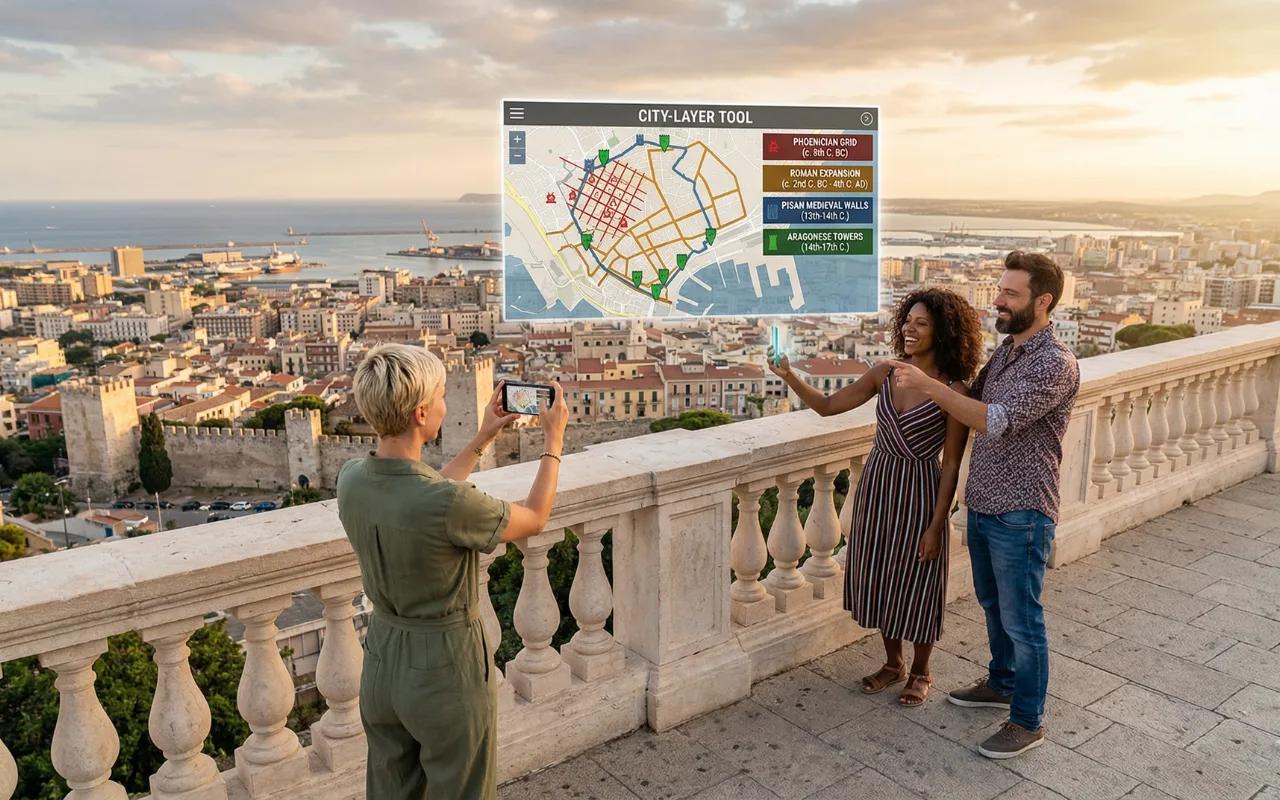
Four civilisations in the four-faced capital
Cagliari, the Sardinian capital, is a multifaceted city where history, culture, and the sea converge. If you're wondering what to do in Cagliari, prepare for a captivating immersion! Stroll through the medieval alleys of the Castello district, admire the breathtaking views from the Bastione di Saint Remy, or get lost in the lively atmosphere of the Marina district with its restaurants and port. Beyond traditional sightseeing, Cagliari lends itself wonderfully to a more interactive discovery. Imagine exploring its secrets by participating in an outdoor escape game, a real-life treasure hunt that transforms the city into your own playground. It's an unusual activity that allows you to see the city from a new perspective, combining exploration and puzzle-solving. Whether you're seeking adventure or simply an original scavenger hunt, Cagliari has surprises in store. It's a fun and memorable way to soak up the Sardinian soul. Here are the games we offer in Cagliari:
Unusual things to do in Cagliari
Looking to spice up your stay with an unusual activity in Cagliari? Beyond the beaches and historical monuments, the city is full of hidden corners and stories to discover in an original way. Our escape games, shown above, offer a playful immersion that goes off the beaten path. Instead of following a guide, you become the protagonists of your own adventure, solving puzzles while exploring iconic neighborhoods like Castello or Stampace. It's an original outing that combines the fun of the game with cultural discovery. Imagine deciphering ancient codes in front of a panoramic view or uncovering the mysteries of a hidden alley. A unique way to experience Cagliari!
Things to do in Cagliari with kids
Cagliari is a fantastic destination for a family vacation, and finding activities that appeal to everyone, from children to teens, is essential. Our urban scavenger hunts, shown above, are an excellent option for discovering the city in a fun way. Generally suitable for ages 8-10 and up (accompanied), they transform heritage discovery into a real adventure. Instead of just visiting, your family collaborates to solve puzzles, search for clues, and unlock hidden secrets in the streets of Cagliari. It's an interactive way to learn about Sardinian history and culture, while creating memorable memories together. An outing that will delight the whole family!
Cagliari for couples
Cagliari offers an ideal romantic setting for a couple's getaway. Imagine yourselves hand in hand, exploring the cobblestone alleys of the Castello district, discovering panoramic sea views from the Bastione di Saint Remy, or sharing an intimate moment in a picturesque café in the Stampace district. For a touch of originality, our games above transform your stroll into a shared adventure. It's a unique way to strengthen your bond, solving puzzles together and discovering the city's hidden secrets as a duo. Away from the crowds, these games invite you to a moment of complicity and discovery, creating unforgettable memories in this charming city.
What to do in Cagliari when it rains
Don't let the rain spoil your discovery of Cagliari! Our escape games are designed to be playable even in uncertain weather. Most of our routes lead you through the charming alleys of the historic center, a good portion of which is sheltered by arcades, covered passages, or buildings. This way, you can continue your treasure hunt and solve puzzles undercover, enjoying the city's unique atmosphere without worrying about the weather. Approximately 80% of the experience takes place under covered areas, ensuring a pleasant and dry activity.
Where is Cagliari, and where do the routes start?
Starting points of our routes and the places they pass through.
Route starting points
Places in Cagliari
- Piazza Yenne & Via Manno
- Torre dell'Elefante & Torre di San Pancrazio
- Cathedral & Roman amphitheatre
- Saint Remy Bastion
- Torre di San Pancrazio
- Santa Maria cathedral
- Marina district
- Tuvixeddu necropolis
The history of Cagliari
From Phoenician Port to Roman Caralis
Cagliari's origins date back to the Neolithic period, with evidence of human settlement for over five millennia. Its location, with a sheltered harbor and fertile plains, made it a site for early civilizations. The city's foundation is attributed to the Phoenicians, who established a trading post between the 8th and 7th centuries BCE. Under Carthaginian rule, from the late 6th century BCE, Cagliari, then known as Karaly, grew. The Tuvixeddu necropolis provides evidence of this period.
In 238 BCE, after the First Punic War, Cagliari came under Roman control and was renamed Caralis. It became the most important city on the island, serving as a naval station and the seat of the Roman governor in the 4th and 5th centuries CE. Roman influence is visible today in structures like the Roman Amphitheatre and parts of the Tuvixeddu necropolis.
Medieval Fortifications and Aragonese Rule
After a period of decline under Vandal rule, followed by Byzantine influence, Cagliari saw the rise of independent Sardinian states known as 'Giudicati'. When the Giudicato of Cagliari ended, the Pisans took control, fortifying the upper part of the city. In 1216, Pisan merchants established the fortified city of Castell di Castro, the precursor to modern Cagliari's Castello district. The Pisans erected defensive structures, including the Torre di San Pancrazio (1305) and the Torre dell'Elefante (1307), which remain landmarks.
In 1326, the Crown of Aragon conquered Cagliari from the Pisans, making it the administrative capital of the newly formed Kingdom of Sardinia. This began nearly four centuries of Spanish rule, which left architectural and cultural impact. The city remained a strategic point in the Western Mediterranean. In 1718, Cagliari and the rest of Sardinia passed to the House of Savoy. The 20th century brought devastation during World War II, with Allied bombings between 1942 and 1943 destroying or severely damaging around 80% of the city and causing over 2,000 deaths.
What to see in Cagliari
- Piazza Yenne & Via Manno — Piazza Yenne is a central square. Via Manno, a main shopping street, connects the lower town to the Castello district.
- Torre dell'Elefante & Torre di San Pancrazio — These two Pisan towers, built in the early 14th century, were part of Cagliari's medieval defensive system. The Torre dell'Elefante offers views of the city, port, and sea.
- Cagliari Cathedral (Santa Maria Cathedral) — This cathedral in the Castello district has a history of transformations. Originally built in the 13th century in Pisan-Romanesque style, it has later Gothic, Baroque, and Neo-Romanesque additions. Inside, see the 12th-century pulpit by Master Guglielmo, originally from Pisa Cathedral, and the mausoleum of Aragonese King Martin I of Sicily.
- Roman Amphitheatre — Carved into a hillside, this Roman amphitheater, dating from the 2nd century CE, hosted gladiatorial contests and public spectacles. Visitors can walk through its remains.
- Bastione di Saint Remy — This neoclassical bastion, built between 1896 and 1902, offers terraces with views over the city, port, and Gulf of Cagliari. It connects the Castello district with the lower Stampace and Villanova neighborhoods.
- Marina District — This district by the port has narrow streets, colorful buildings, and restaurants and shops. It was historically a hub for trade and maritime activity.
- Tuvixeddu Necropolis — The largest Punic necropolis in the Mediterranean, Tuvixeddu was used for burials from the late 6th century BCE to the 3rd century CE. Visitors can explore ancient tombs carved into the limestone hill.
When to visit Cagliari
The best times to visit Cagliari are May, June, September, and October. During these shoulder seasons, temperatures are suitable for exploring, ranging from 20-28°C, and the sea is warm enough for swimming, reaching 19-25°C. Crowds are also smaller than in peak summer.
July and August are the hottest months, with average daily highs reaching 32-33°C. These months can be crowded, especially August. Many locals take their holidays then, and accommodation prices can be at their highest. Winter (January-March and November-December) offers lower prices and fewer tourists, with mild daytime temperatures around 10-17°C, but some coastal hotels and beach restaurants may be closed. November is typically the wettest month.
Getting around Cagliari
Cagliari Elmas Airport (CAG) is about 7 km from the city center. A train connects the airport to Cagliari station, running from 5:00 AM to 9:00 PM every 20 minutes. The journey takes about 7 minutes and costs €1.30. Taxis cost around €25 for a 15-minute ride.
The city center is walkable, especially the Castello district, though it has steep, cobbled streets. Cagliari has a public transport system managed by CTM, including buses and a light rail (metro) line. Tickets can be purchased at newsstands, tobacconists, CTM points, or via the CTM BusFinder app. A 90-minute bus ticket costs €1.30 in advance or €1.80 on board. Children under 6 travel free. Buses generally operate until 9:30 PM, with some night lines in summer. Parking in the city center can be difficult; consider parking outside central areas and using public transport.
Things you probably do not know about Cagliari
Verified details most visitors walk straight past.
- Torre dell'Elefante
- Why does a medieval tower in Cagliari have a small elephant carved into its facade? The small elephant sculpture on the Torre dell'Elefante's facade is a symbol of the Republic of Pisa, which built the tower in 1307. The elephant was part of Pisa's coat of arms, marking their dominion over the city.
- Cagliari Cathedral (Santa Maria Cathedral)
- What unusual items were once displayed on the facade of Cagliari's main cathedral? The original Pisan pulpit, sculpted by Master Guglielmo in the 12th century for Pisa Cathedral, was brought to Cagliari in 1312. During a Baroque renovation in the 17th century, it was divided into two parts and placed on either side of the main entrance.
- Tuvixeddu Necropolis
- What surprising dual purpose did a large cavity near the Tuvixeddu necropolis serve over centuries? A cavity located near the Tuvixeddu necropolis was used by both Carthaginians and Romans as a water reservoir. During World War II, it provided shelter to the city's population from bombings, and after the war, it was inhabited by the homeless.
- Bastione di Saint Remy
- What happened to the Bastione di Saint Remy during World War II? The Bastione di Saint Remy was severely damaged during the Allied bombings of Cagliari in 1943. Along with many other parts of the city, it was torn apart by bombs, becoming almost unrecognizable.
- Cagliari
- Which famous South American capital city shares a surprising historical connection with a hill in Cagliari? The city of Buenos Aires, Argentina, was named after the Sanctuary of Our Lady of Bonaria in Cagliari. During the siege of Castell di Castro (Cagliari's Castello district) in the 14th century, the Aragonese built a stronghold on the Colle di Bonaria, which gave its name to the South American city.
Questions about visiting Cagliari
How many days should I spend in Cagliari?
Two full days are generally sufficient to explore Cagliari's city center, including its historic districts, museums, and nearby Poetto Beach. If you wish to include day trips to archaeological sites like Nora or Su Nuraxi di Barumini, or to enjoy more beach time, consider extending your stay to three or four days.
What are the best neighborhoods to stay in Cagliari?
The Castello district is suitable for history and views, though it is hilly. The Marina district is active with restaurants and close to the port. Stampace and Villanova offer a mix of historic character and local life, with easier access to the lower city. Each provides a different atmosphere and accessibility to attractions.
Is Cagliari suitable for families with children?
Yes, Cagliari is family-friendly. Children can explore the medieval towers, the Roman Amphitheatre, and Poetto Beach. The Molentargius-Saline Regional Park, with its pink flamingos, is also an attraction for families.
What is the typical budget for a trip to Cagliari?
Cagliari can accommodate various budgets. Accommodation prices vary, with lower rates in the off-season. Public transport is affordable, and many historical sites offer reasonable entry fees. Eating at local trattorias and markets can keep food costs down. Expect higher prices during peak summer months.
How easy is it to get around Cagliari on foot and by public transport?
Cagliari's city center is walkable, particularly the Castello district, though it involves steep climbs. The public transport system, operated by CTM, is efficient, with buses covering the entire city and a light rail connecting the center to Monserrato. Tickets are inexpensive and can be bought at various points or via an app.
What should I avoid when visiting Cagliari?
Avoid visiting in August if you dislike large crowds and high temperatures, as it is peak season with average highs of 33°C. The hilly nature of the Castello district means comfortable shoes are necessary. Be aware that some smaller shops and businesses may close for a siesta in the early afternoon.
Frequently asked questions
How much does an outdoor escape game cost in Cagliari?
The price for our outdoor escape games in Cagliari is very affordable and designed for groups. It is €12 per team, not per person! This means that if you come with several people, the cost per player significantly decreases. Whether you're with family, friends, or as a couple, this single price per team makes the activity accessible to everyone. It's an excellent option for an original and economical outing, allowing you to fully enjoy the city without breaking the bank. The price includes access to the game, the puzzles, and the adventure through the streets of Cagliari.
Is it suitable for children / families?
Absolutely! Our outdoor escape games in Cagliari are designed to be a fantastic activity for the whole family. The routes are crafted to stimulate the curiosity and team spirit of participants of all ages. We generally recommend a minimum age of 8 to 10 years old for children to fully participate in solving the puzzles, always accompanied by adults. It's a fun and interactive way to discover the city together, where everyone can contribute, from the youngest to the oldest. An excellent opportunity to create memorable family memories!
How long does an escape game in Cagliari last?
The duration of our outdoor escape games in Cagliari generally varies between 1 hour 30 minutes and 2 hours 30 minutes. This, of course, depends on your pace, how quickly you solve the puzzles, and the time you take to admire the magnificent landscapes and monuments of the city. The goal is not to rush, but to enjoy the experience! You are free to take breaks, grab a coffee, or stroll around. It's your adventure, at your own pace, combining game and tourist discovery.
Do I need to book in advance?
No, not at all! One of the great advantages of our outdoor escape games in Cagliari is their flexibility. You don't need to book in advance. You can purchase the game directly on our website and start your adventure whenever you want, even at the last minute. This is perfect for spontaneous travelers or those who like to decide on their activities as they go. All you need is your charged smartphone and an internet connection to start the game. Enjoy the freedom to discover Cagliari at your own pace and on your own schedule!
What to visit in Cagliari beyond the escape games?
Cagliari is full of treasures to explore after or before our escape games! Don't miss the historic Castello district, perched on a hill, offering spectacular views and home to Santa Maria Cathedral and the Royal Palace. The Bastione di Saint Remy is a must-see for its panoramas. Then head down to the lively Marina district, with its seafood restaurants and port. Stroll through the colorful alleys of Stampace and Villanova. For a touch of nature, Poetto beach is magnificent. And for ancient history enthusiasts, the Roman amphitheater is impressive.
What is the best season to visit Cagliari?
Cagliari is pleasant to visit almost all year round, but the shoulder seasons are often the most popular. Spring (April-May) and autumn (September-October) offer mild and sunny weather, ideal for exploring the city on foot and enjoying our escape games without the intense summer heat. Temperatures are perfect for strolling, and crowds are less dense. Summer (June-August) is hot and very sunny, perfect for the beach, but can be intense for urban activities. Winter is mild and sometimes rainy, but the city retains its charm.
Other destinations in Sardinia
More cities in Italy
Palermo
Normans, Arabs, Byzantines — the city of three crowns
Rome
Porta Magica, catacombs and the Popes' Passetto
Civita di Bagnoregio
The dying city perched on a tuff bridge
Naples
Napoli Sotterranea, Dracula and the skull cult
Siena
The Contrade war and the world's oldest bank
Paestum
The world's best-preserved Greek temples
Florence
Medici, Templars and Palazzo Vecchio alchemists
Syracuse
Archimedes' city and the Ear of Dionysius