VolterraOutdoor Escape Game & Treasure Hunt
City of winds and Etruscan haruspices
Welcome to Volterra, the city of winds and Etruscan soothsayers! Nestled in the heart of Tuscany, this millennial city invites you on a fascinating journey between history and breathtaking landscapes. What to do in Volterra? Start by strolling through the magnificent Piazza dei Priori, admire the Palazzo dei Priori, and explore the remains of the Roman Theater, silent witnesses to a glorious past. But Volterra is also an exceptional playground for modern explorers! If you're looking for an unusual activity, an outdoor escape game, a treasure hunt, or a clue-solving adventure are perfect for discovering its secret alleys and hidden panoramas in a fun and immersive way. Get ready to solve puzzles while soaking in the unique atmosphere of this Tuscan gem. Our courses await you to transform your visit into an unforgettable adventure!
Unusual things to do in Volterra
Want to go off the beaten path in Volterra? Beyond the classic museums and panoramas, our outdoor escape games offer an unusual and thrilling activity. Imagine transforming the city into a huge playground, where every alley and monument can hide a clue. It's the perfect opportunity to spice up your visit, stimulate your team spirit, and discover Volterra from a new angle, away from the crowds. An urban treasure hunt that combines adventure, culture, and fun, ideal for those seeking a memorable and original experience.
Things to do in Volterra with kids
Volterra is a fantastic destination for families, and our outdoor escape games prove it! If you're looking for things to do with family in Volterra, our clue-solving games are designed to entertain both young and old. It's a fun and interactive way to explore the city, share special moments, and create unforgettable memories. Children love solving puzzles and feeling like real explorers, while parents appreciate the cultural dimension and active discovery of heritage. A family adventure that combines fun, learning, and discovery!
Volterra for couples
For a romantic getaway in Volterra, our outdoor escape games add an original touch. Forget traditional guided tours and enjoy a unique experience as a couple. Hand in hand, explore the charming corners of the Etruscan city, solve puzzles together, and strengthen your bond while discovering breathtaking views. It's an intimate and fun way to share an adventure, laugh, and collaborate. An activity that promises memorable memories and moments of complicity in the heart of one of Tuscany's most beautiful cities.
What to do in Volterra when it rains
What to do in Volterra on a rainy day? Our outdoor escape games are, as their name suggests, primarily designed to be played outdoors. However, Volterra is full of fascinating museums, such as the Guarnacci Etruscan Museum, or alabaster artisan workshops where you can take shelter. If the weather is uncertain, bring an umbrella and a raincoat for our routes, because the adventure doesn't wait! The experience remains just as immersive, even under a gray sky, adding a special atmosphere to your treasure hunt.
Where is Volterra, and where do the routes start?
Starting points of our routes and the places they pass through.
Route starting points
Places in Volterra
- Etruscan gate
- Funerary urns
- Archaeological park
- Roman theatre
- Piazza dei Priori
- Volterra cathedral
- Porta Diana
- Le Balze cliffs
The history of Volterra
From Etruscan Velathri to Roman Volaterrae
Volterra's history begins as Velathri, one of the twelve major cities of the Etruscan League. By the 6th century BCE, the Etruscans had established a civilization in central Italy. Velathri, with an estimated population of 25,000 around 300 BCE, was a significant center, dominating the Tyrrhenian coast from Piombino to Luni. This was partly due to minerals extracted from the nearby Colline Metallifere (Metalliferous Hills). The Etruscan walls, with parts dating back to the 4th and 3rd centuries BCE, show this era.
Volterra supported Rome during the Second Punic War in 205 BCE. It acquired Roman citizenship after the civil wars between Gaius Marius and Sulla in 81–80 BCE, when it became Volaterrae. The city was besieged by Sulla's troops for an extended period, surrendering in 80 BCE. The Roman presence is marked by the Roman Theatre, built in the Augustan period at the end of the 1st century BCE, financed by the Caecina family.
Medieval Struggles and the Alabaster Industry
After the fall of the Roman Empire, Volterra experienced decline. During Longobard rule, it became a 'gastaldato' dependent on the emperor. The 10th century saw a downturn when Hungarian troops, called to assist in a war, instead sacked the city, leaving it in ruins. Volterra did not regain its Etruscan size after this event.
In the 12th century, Volterra became a free commune. Its independence was challenged when it fell under the Medici family of Florence in 1361. The city's traditional industry, the extraction and artistic manufacture of alabaster, which the Etruscans had used for funerary urns since the 3rd century BCE, saw a revival in the mid-1500s. Volterran artists began using alabaster for sacred artworks for local churches. By the 1800s, workshops multiplied, with the alabaster trade active between 1850 and 1870.
What to see in Volterra
- Piazza dei Priori — This is Volterra's main square. It contains the Palazzo dei Priori, the oldest communal palace in Tuscany, built between 1208 and 1257. Also present is the Palazzo Pretorio with its "Tower of the Pig."
- Roman Theatre — Discovered in the 1950s, this theatre was built in the Augustan period, late 1st century BCE. It seated around 3,500 spectators. Visitors can see the remains of the stage (scaenae frons) and seating (cavea).
- Volterra Cathedral (Cattedrale di Santa Maria Assunta) — Rebuilt around 1120 after an earthquake and expanded in the 13th century. The cathedral has a Romanesque façade and an interior with a coffered ceiling from the 16th century. Inside, see the ciborium by Mino da Fiesole (1471) and a wooden sculpture of the Deposition (1228).
- Guarnacci Etruscan Museum — This museum has a collection of Etruscan art, including over 600 cinerary urns, many carved from local alabaster. It displays Volterra's Etruscan heritage.
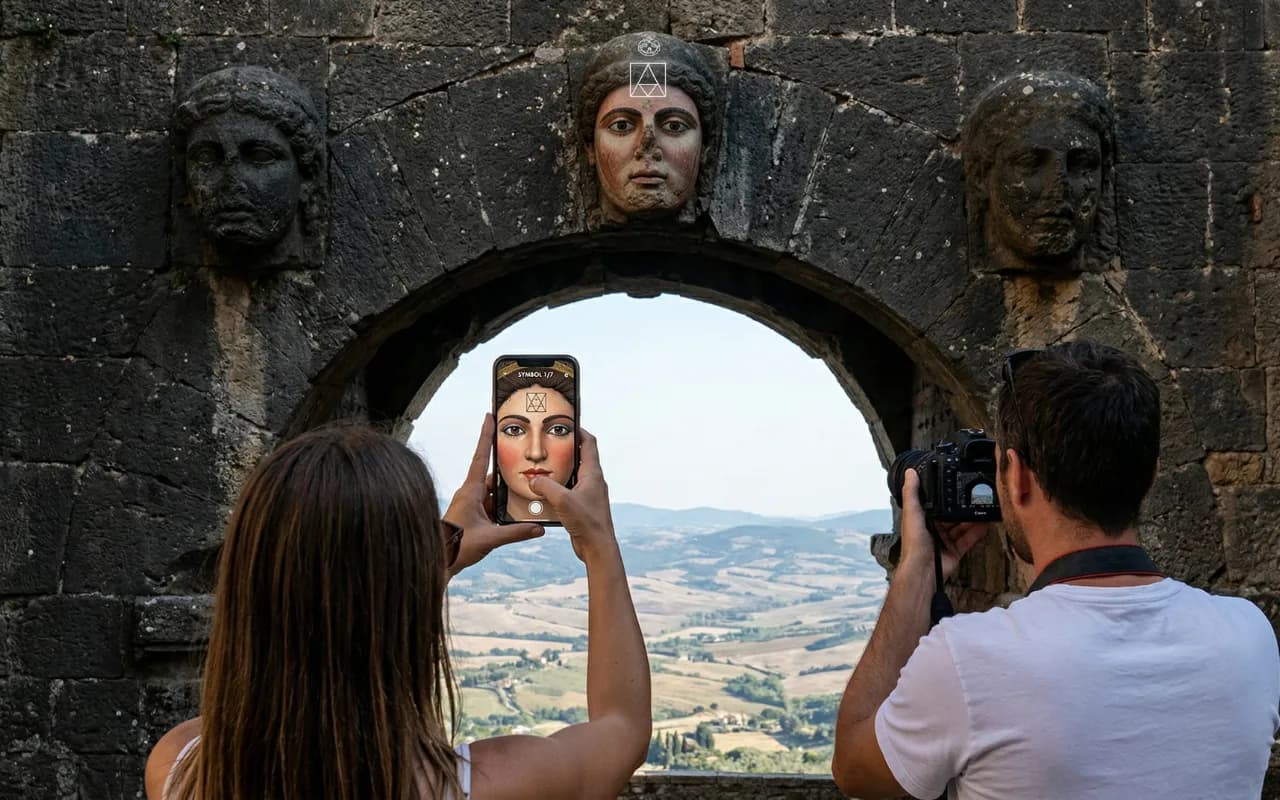
- Porta all'Arco — One of Volterra's Etruscan gateways, dating from the 4th century BCE. It features faded sculptures of human heads. It shows the city's historical roots.
- Le Balze cliffs — Located west of the city, these geological formations offer views. They are a result of erosion, which continues to reshape the landscape around Volterra.
When to visit Volterra
Visit Volterra in late spring (April to June) and early autumn (September to October). During these times, the weather is generally pleasant, with average daytime temperatures ranging from 29°C in June to 20°C in October. The countryside is green. Crowds are typically smaller than in summer. July and August are the warmest months, with average highs around 30°C, and can be busy, especially during the Volterra AD 1398 medieval festival in August. Some artisan workshops may close for holidays in August.
Avoid January and February if cold weather is a concern, as these are the chilliest months, with average lows around 3-5°C, and chances of rain or snow.
Getting around Volterra
Volterra is a hilltop town; walking is the main way to explore its historic center. The town center has restricted traffic (ZTL - Limited Traffic Zone). Parking is available in paid lots outside the city walls, such as Porta Fiorentina, Gioconovo, and Piazza Martiri della Libertà, which is near the bus station. Some free parking is at Docciola, though it involves many steps to reach the town.
Volterra does not have a train station. The closest one is Volterra Saline – Pomarance, about 10 kilometers away, connected by bus (line 780). Larger railway stations are in Cecina and Pontedera, also with bus connections. From cities like Florence, Siena, or Pisa, take a bus, often with a change in Colle di Val d'Elsa or Pontedera.
The weekly market in Volterra is on Saturday mornings. From November to April, it is in Piazza dei Priori; from May to October, it moves to Vallebuona, near the Roman Theatre.
Things you probably do not know about Volterra
Verified details most visitors walk straight past.
- Roman Theatre
- What unusual feature did the Roman Theatre of Volterra have to keep spectators comfortable? The theatre was equipped with a 'velarium,' a large tent-like awning that could be extended over the seating area to provide shade for the audience during performances.
- Volterra Cathedral
- The Volterra Cathedral's interior features columns that aren't quite what they seem. What's their secret? The 22 columns dividing the nave are covered in plaster, skillfully painted to simulate rose-colored granite, a detail from a 16th-century renovation.
- Palazzo Pretorio
- One of the towers in Piazza dei Priori has a curious nickname. What is it, and why? The Palazzo Pretorio features an ancient tower known as 'The Tower of the Pig' because of a stone pig sculpture placed on it.
- Porta all'Arco
- This ancient Etruscan gate has some weathered sculptures. What do they depict? The Porta all'Arco, dating back to the 4th century BCE, still bears faded sculptures of human heads, though their original meaning is lost to time.
- Alabaster workshops
- Volterra's famous alabaster industry has a unique origin story for its raw material. Where does this special stone come from? The alabaster worked in Volterra, particularly the chalky kind, was formed in the Miocene period from calcium sulfate sedimentation in seawater, with deposits found in the subsoil of Castellina Marittima.
Questions about visiting Volterra
How many days should I spend in Volterra?
Most visitors find one to two days sufficient to explore Volterra's main attractions, including its historic center, museums, and Roman Theatre. An overnight stay is recommended to experience the town after day-trippers leave.
What is Volterra known for?
Volterra is known for its Etruscan, Roman, and medieval history, seen in its ancient city gates, archaeological sites, and Roman theatre. It is also known for its alabaster craftsmanship, with many workshops displaying traditional stone carving.
Is Volterra suitable for families with children?
Volterra offers a historical experience for families. Children might enjoy exploring the ancient walls, the Roman Theatre, and the medieval streets. The Volterra AD 1398 medieval festival in August, where the town dresses in 14th-century garb, is particularly family-friendly.
How can I get around Volterra?
Volterra's historic center is a ZTL (Limited Traffic Zone), so the best way to get around is on foot. The town is compact, and walking allows you to discover its narrow, stone streets and hidden corners.
What is the typical budget for a visit to Volterra?
Volterra can be explored on a moderate budget. Entrance fees for major attractions can be managed with a Volterra Card, which offers combined access to several sites. Dining options range from casual eateries to more upscale restaurants.
Are there any specific local customs or closing times to be aware of?
Like many Italian towns, Volterra observes a midday break, often referred to as a 'siesta,' when some shops and businesses may close for a few hours, typically between 1 PM and 4 PM. It is always a good idea to check specific opening hours.
Frequently asked questions
How much does an outdoor escape game cost in Volterra?
Our outdoor escape games in Volterra are designed to be accessible and offer excellent value for money. The price is only €12 per team, not per person! This means you can share this exciting adventure with your friends or family at a very affordable cost. A single purchase is enough to unlock hours of entertainment and urban discovery.
Is it suitable for children / families?
Absolutely! Our clue-solving games are perfectly suited for families and children. We generally recommend a minimum age of 8 to 10 years for children to fully participate in solving the puzzles, always accompanied by adults. It's a wonderful way to turn a simple walk into an educational and fun adventure for all ages.
How long does an escape game in Volterra last?
The duration of our escape game routes in Volterra is generally 1.5 to 2 hours. However, one of the great advantages of our games is flexibility: you can play at your own pace, take breaks to admire the scenery, grab a coffee, or visit a monument. The adventure adapts to your desires!
Do I need to book in advance?
While our games are available online and instantly accessible, we recommend planning your purchase in advance, especially if you have a specific date and time in mind. This gives you peace of mind. However, thanks to our digital system, you can also decide to play spontaneously and buy your game a few minutes before starting!
What to visit in Volterra beyond the escape games?
Volterra is full of treasures! After exploring the city with our games, don't miss the Guarnacci Etruscan Museum to delve into ancient history, the Roman Theater for its impressive ruins, and of course, the magnificent Piazza dei Priori. Stroll through the alabaster artisan workshops and taste local specialties for a complete immersion.
What is the best season to visit Volterra?
Spring (April-May) and autumn (September-October) are ideal for visiting Volterra, with mild temperatures and beautiful light. Summer (June-August) is also very pleasant but can be hotter and more crowded. Winter offers a quieter and more authentic atmosphere, although some days can be cool and rainy.
Other destinations in Tuscany
Florence
Medici, Templars and Palazzo Vecchio alchemists
Siena
The Contrade war and the world's oldest bank
San Gimignano
The medieval Manhattan and its 14 rival towers
Abbadia San Salvatore
At the foot of Mount Amiata, between ancient abbey and wild nature
Pitigliano
The tuff town, suspended between Etruscan and medieval history
Populonia
Where Etruscan ruins meet the Tyrrhenian Sea
More cities in Italy
Bologna
Hidden canals, leaning towers and the world's oldest university
Civita di Bagnoregio
The dying city perched on a tuff bridge
Rome
Porta Magica, catacombs and the Popes' Passetto
Venice
Alchemy, Kabbalah and Arsenal of the Serenissima's spies
Turin
Alchemy, Templars and witches in the esoteric capital
Naples
Napoli Sotterranea, Dracula and the skull cult
Activities to discover nearby
Guided tours, skip-the-line tickets and local experiences to book in advance.
💡 Optional booking — you can also buy on-site. All links open in a new window, your OddballTrip visit stays preserved.