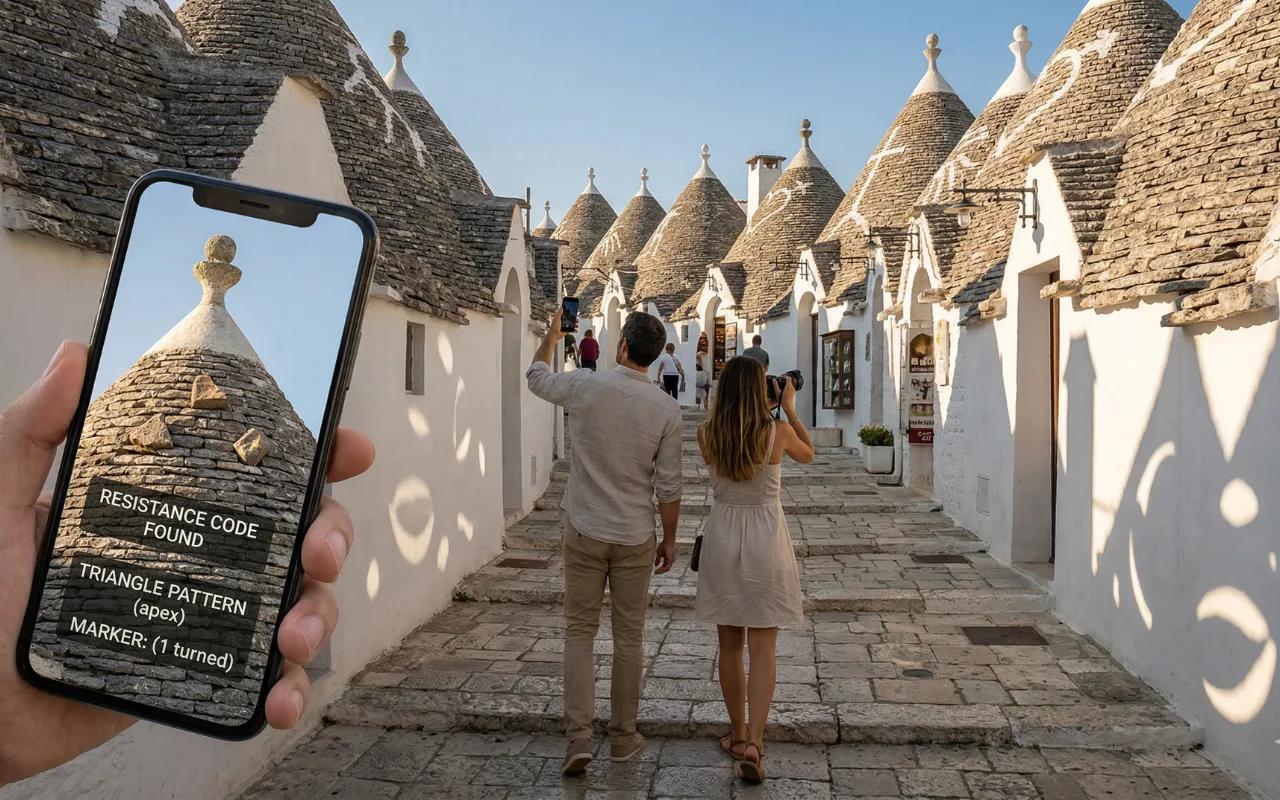
AlberobelloOutdoor Escape Game & Treasure Hunt
The trulli and the fiscal rooftop conspiracy
Welcome to Alberobello, a fairytale town in Puglia, Italy, famous for its trulli, unique conical-roofed dwellings. Stroll through Rione Monti, a UNESCO World Heritage site, where every alley reveals a new perspective on these dry-stone houses. Explore the more authentic Aia Piccola district, or admire the imposing Trullo Sovrano, the only two-story trullo. But beyond mere contemplation, how about embarking on a real adventure? OddballTrip offers an innovative and captivating way to discover Alberobello: an outdoor escape game. Transform your visit into a life-sized treasure hunt, a scavenger hunt full of mysteries and puzzles to solve. It's an unusual activity guaranteed to spice up your stay. Ready to explore the secrets of the trulli in a totally immersive and fun way? Our games await you for an unforgettable experience!
Unusual things to do in Alberobello
Looking for an unusual activity in Alberobello? Our outdoor escape games are designed to offer you a truly unique experience. Far from traditional guided tours, you'll dive into the heart of the city, its alleys and trulli, transforming every corner into a clue, every facade into a mystery. It's an urban treasure hunt where local history and culture blend with adventure. Explore the secrets of Alberobello in a fun and interactive way, challenging your observation skills and teamwork. A unique way to discover this enchanting town!
Things to do in Alberobello with kids
Alberobello is a wonderful destination for families, and our outdoor escape games are the perfect activity for all ages. Forget screens and embark together on a thrilling adventure through the trulli! The games are designed to be accessible and fun for children (generally from 8 years old), while still challenging adults' ingenuity. It's a fantastic opportunity to strengthen family bonds, develop teamwork, and discover the city in an educational and entertaining way. Create unforgettable memories solving puzzles in the heart of this UNESCO site!
Alberobello for couples
Looking for a romantic and original getaway in Alberobello? Our outdoor escape games offer a unique way to share a special moment as a couple. Off the beaten path, you'll explore the charming alleys and iconic trulli hand in hand, solving puzzles and challenges together. It's the perfect opportunity to have fun, communicate, and strengthen your bond while discovering the city's hidden treasures. A two-person adventure that promises laughter, surprises, and memorable souvenirs in this enchanting setting.
What to do in Alberobello when it rains
What to do in Alberobello if rain decides to show up? Our escape games are primarily outdoor activities, meaning they are less suitable in bad weather. However, if you're equipped with an umbrella and a raincoat, the adventure can still be attempted by the most adventurous! For those who prefer to stay dry, Alberobello offers some indoor options like visiting the Trullo Sovrano or exploring local craft shops. Don't forget to check the weather before embarking on our games to fully enjoy the experience!
Where is Alberobello, and where do the routes start?
Starting points of our routes and the places they pass through.
Route starting points
Places in Alberobello
- Monti district
- Trullo Sovrano (only two-storey trullo)
- Aia Piccola & Belvedere
- Sant'Antonio da Padova church
- Siamese trullo
- Territorial Museum
- Casa Pezzolla
- Santa Lucia belvedere
The history of Alberobello
The Origins of the Trulli: A Tax Evasion Tactic
Alberobello's trulli houses, with their conical roofs, date back to the 15th century. These dry-stone structures were built to avoid taxes imposed by the Kingdom of Naples on permanent dwellings. The local Counts of Conversano, who governed the region, supported this building method. Since the trulli were constructed without mortar, they could be quickly dismantled when tax inspectors were expected, making the houses appear temporary and thus avoiding the levies.
This practice was used in 1644, when, according to tradition, the casedde (as the trulli were then known) were quickly demolished, their stones scattered, and residents temporarily dispersed before a royal inspection. Once the inspectors left, settlers returned and rebuilt their homes using the same dry-stone technique. In 1797, Alberobello gained independence from feudal rule. Ferdinand IV, the Bourbon King of Naples, granted it royal town status, allowing the use of mortar in construction. The Casa d'Amore, built in 1797, is considered the first "modern" house in Alberobello, marking this shift away from purely dry-stone trulli construction.
From Rural Shelters to UNESCO Heritage
While trulli were initially field shelters, storehouses, or permanent dwellings for agricultural laborers, their concentration in Alberobello grew. Scattered rural settlements existed in the area around 1000 AD, gradually forming the villages of what are now the Aia Piccola and Monti districts. By the mid-16th century, the Monti district contained about forty trulli. The settlement expanded in 1620 when Count Gian Girolamo Guercio ordered the construction of a bakery, mill, and inn. By the late 18th century, the community had grown to over 3,500 people. The town's architectural landscape led to parts of Alberobello being designated as heritage monuments between 1909 and 1936. In 1996, Alberobello's trulli were recognized as a UNESCO World Heritage Site, noted as an example of vernacular architecture and a preserved historic urban landscape.
What to see in Alberobello
- Rione Monti — This district contains over 1,000 trulli on a hillside. Many have been converted into shops, cafes, and restaurants.
- Aia Piccola — A residential district with approximately 590 trulli. Many trulli here are still inhabited by families, offering a view of local life.
- Trullo Sovrano — The only two-story trullo in Alberobello. Visitors can enter to see the interior layout and construction of these homes. There is an entry fee.
- Sant'Antonio da Padova Church — This church, built in the trullo style, stands at the top of Rione Monti. It shows how traditional architecture was adapted for religious structures.
- Territorial Museum, Casa Pezzolla — This museum is a complex of 15 communicating trulli. It provides information on the history, culture, and daily life within these dwellings.
- Siamese Trullo — A trullo with two conical roofs and two entrances. Its configuration makes it a photo stop.
- Santa Lucia Belvedere — This viewpoint offers a view over the Rione Monti district, showing the number and conical roofs of the trulli across the hillside.
When to visit Alberobello
The best times to visit Alberobello are during the shoulder seasons: early May through late June, or late August through late October. Temperatures are warm, ranging from 19-24°C (66-75°F), suitable for walking. Light at dawn and dusk is good for photography, and there are fewer tourists than in summer.
Avoid July and August. These are the hottest and busiest months. Daytime highs can reach 33°C (91°F) with heat from the limestone. Tour buses arrive between 10 AM and 2 PM, making the Rione Monti district crowded. While trullo walls offer some coolness inside, the outdoor experience is less enjoyable.
Getting around Alberobello
Alberobello is explored on foot. The town is about 45 minutes by car from Bari and an hour from Lecce. For train travel, the Ferrovie del Sud Est regional line connects Alberobello to Bari (about 1.5 hours) and Taranto. The train station is a 10-minute walk from the trulli area.
If arriving by car, arrive before 9 AM, especially in high season, to find parking. Free white-lined parking spots are near the trulli area and the train station. Paid parking is available on main approach roads, with Zone B offering daily passes for around €8.00, close to the monumental trulli areas. Parking meters are multilingual and require a license plate number.
The weekly market in Alberobello is on Thursdays, from 7:30 AM to 12:30 PM, with the food section on Via Barsento. Many local shops may close on Thursday afternoons.
Things you probably do not know about Alberobello
Verified details most visitors walk straight past.
- Trulli roofs
- Have you ever noticed the symbols painted on some *trulli* roofs? These white ash markings often bear mythological or religious symbols, including pre-Christian, solar, Jewish, or pagan cult designs. Their purpose was traditionally believed to ward off evil influences or bad luck.
- Trulli construction
- Why are the *trulli* built without mortar, a technique that seems less stable? The dry-stone construction, using local limestone, allowed the *trulli* to be quickly dismantled. This was a clever way for residents to avoid property taxes imposed by the Kingdom of Naples on permanent structures, as a disassembled house could be claimed as temporary.
- Trullo pinnacles
- What is the small stone ornament at the very top of a *trullo*'s conical roof? This decorative element is called a pinnacle (*pinnacolo*). Each *trullo* can have a different pinnacle, serving as a unique finishing touch and, in some beliefs, a protective symbol.
- Trulli interiors
- How did *trulli* manage to stay cool in summer and warm in winter without modern insulation? The thick limestone walls of the *trulli*, typically between 0.80 and 1.50 meters, provide natural insulation. This design keeps the interiors noticeably cooler during Puglia's hot summers and warmer in the colder months.
- Trulli and water collection
- How did *trulli* residents collect water in this dry region? Projecting eaves at the base of the conical roofs divert rainwater through a channelled slab into a cistern located beneath the house. Digging these sub-floor cisterns also provided the initial stones for construction.
- Trulli expansion
- If a family living in a *trullo* needed more space, how would they expand their home? Instead of building upwards, families would typically construct a second *trullo* adjacent to the first and then create an opening in the shared wall to connect the two structures, effectively expanding their living area horizontally.
Questions about visiting Alberobello
How long should I stay in Alberobello?
For the town itself, two to three hours is enough to see the main *trulli* districts, viewpoints, and Trullo Sovrano. To experience Alberobello without crowds, especially in the early morning or evening, consider staying one or two nights. This also allows time for meals and day trips to nearby Valle d'Itria villages like Locorotondo or Martina Franca.
Is Alberobello suitable for families with children?
Yes, Alberobello is a place for families. The *trulli* houses offer a unique atmosphere that children often enjoy. The town is small and pedestrian-friendly, making it easy to explore. Many *trulli* have been converted into shops selling local crafts and souvenirs, which can be engaging for younger visitors.
What is the typical budget for a visit to Alberobello?
Alberobello can be affordable by Italian standards. Most *trulli* sights and viewpoints are free, though Trullo Sovrano has a small entry fee of about €2.50-€3. Accommodation in a basic *trullo* B&B starts around €70-€90 per night. Meals in the Rione Monti district can be 30-40% more expensive than in the modern part of town. A mid-range daily budget, including accommodation, food, and activities, could be around $130 per person.
How do I get around Alberobello?
Alberobello is best explored on foot. The main *trulli* districts, Rione Monti and Aia Piccola, are compact and easily walkable. The town center is also pedestrian-friendly. If you arrive by car, parking is available on the outskirts, and from there, it's a short walk to the main attractions.
Which are the main districts or neighborhoods to visit in Alberobello?
The two primary districts to visit are Rione Monti and Aia Piccola. Rione Monti is the larger and more commercial area, with shops, restaurants, and hotels in *trulli*. Aia Piccola is quieter and more residential, showing how locals live in *trulli*. Both provide distinct experiences of Alberobello's architecture.
What local specialties should I try in Alberobello?
In Alberobello, look for Puglian culinary items. These include handmade *orecchiette* pasta, often served with turnip tops, grilled *bombette* (pork rolls stuffed with cheese), *burrata* cheese, and the local Pasqualino sandwich filled with tuna, capers, salami, and cheese. The fresh produce at the Thursday market is also available.
Frequently asked questions
How much does an outdoor escape game cost in Alberobello?
Our escape games in Alberobello are offered at a unique and very affordable price of €12 per team. This rate is fixed, regardless of your group size (up to a maximum of 6 players for an optimal experience), making it an economical and friendly activity. It's excellent value for money for an immersive treasure hunt and a fun discovery of the city.
Is it suitable for children / families?
Absolutely! Our outdoor escape games are perfectly suited for families and children aged 8 and up. The puzzles are designed to be stimulating without being overly complex, encouraging collaboration and observation. It's a great way to involve younger participants in discovering Alberobello, transforming the visit into an interactive adventure.
How long does an escape game last in Alberobello?
The duration of our escape games in Alberobello is flexible and depends on your pace. On average, allow between 1 hour 30 minutes and 2 hours to complete the game. You are free to take breaks, take photos, or stop for an ice cream. The goal is to enjoy the experience and the beauty of the city at your leisure.
Do I need to book in advance?
No, flexibility is one of OddballTrip's great advantages! There's no need to book in advance. You can purchase your game online whenever you want and start the adventure immediately or later. The game is accessible 24/7, allowing you to play according to your desires and schedule.
What to visit in Alberobello beyond the escape games?
Beyond our games, Alberobello is full of treasures. Don't miss getting lost in the alleys of Rione Monti and Aia Piccola to admire the trulli. Visit the Trullo Sovrano, the only two-story trullo, or the Church of Sant'Antonio. Explore local craft shops and taste Puglia's specialties in the many restaurants.
What is the best season to visit Alberobello?
The best season to visit Alberobello is spring (April-May) or autumn (September-October). The weather is mild and pleasant, ideal for walking and enjoying our outdoor escape games. Summer (July-August) can be very hot and crowded with tourists, while winter is quieter but potentially cooler and wetter.
More cities in Italy
Paestum
The world's best-preserved Greek temples
Naples
Napoli Sotterranea, Dracula and the skull cult
Rome
Porta Magica, catacombs and the Popes' Passetto
Syracuse
Archimedes' city and the Ear of Dionysius
Palermo
Normans, Arabs, Byzantines — the city of three crowns
Civita di Bagnoregio
The dying city perched on a tuff bridge
Siena
The Contrade war and the world's oldest bank
Florence
Medici, Templars and Palazzo Vecchio alchemists
Activities to discover nearby
Guided tours, skip-the-line tickets and local experiences to book in advance.
💡 Optional booking — you can also buy on-site. All links open in a new window, your OddballTrip visit stays preserved.