EphesusOutdoor Escape Game & Treasure Hunt
Temple of Artemis, Library of Celsus and cradle of Christianity
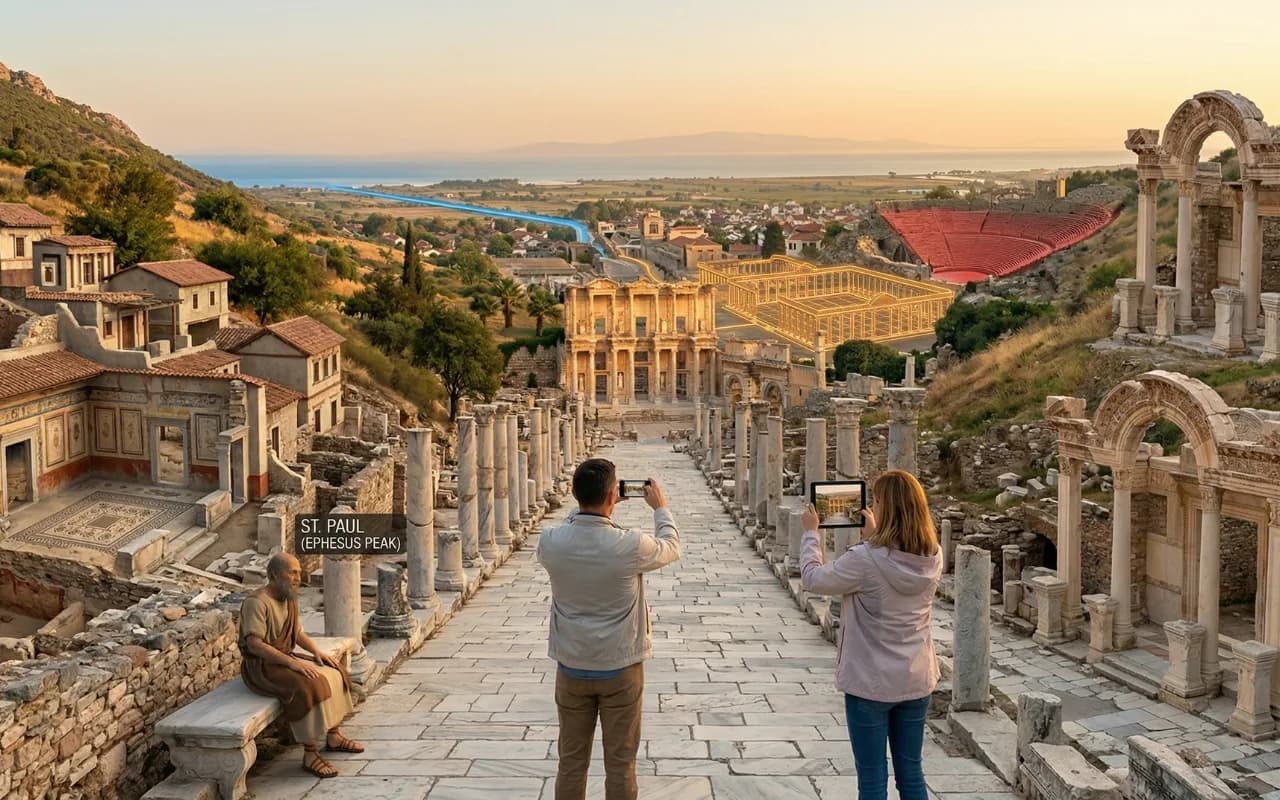
Ephesus, a majestic ancient Roman city on Turkey's Aegean coast, invites you on an unforgettable journey through time. Known for its Temple of Artemis, one of the Seven Wonders of the Ancient World, and the impressive Celsus Library, this city is a true open-air museum. Stroll along Curetes Street, admire the Grand Theater where Saint Paul is said to have preached, and feel the vibrant history with every step. But Ephesus is also a destination for modern explorers! For an unusual activity that combines discovery and adventure, our outdoor escape games offer a unique experience. Transform your visit into a life-sized treasure hunt, a real scavenger hunt that will lead you through the city's secrets. Get ready to solve puzzles while exploring ancient wonders, a fun and immersive way to discover Ephesus. Our routes await you for a memorable adventure.
The Temple of Artemis
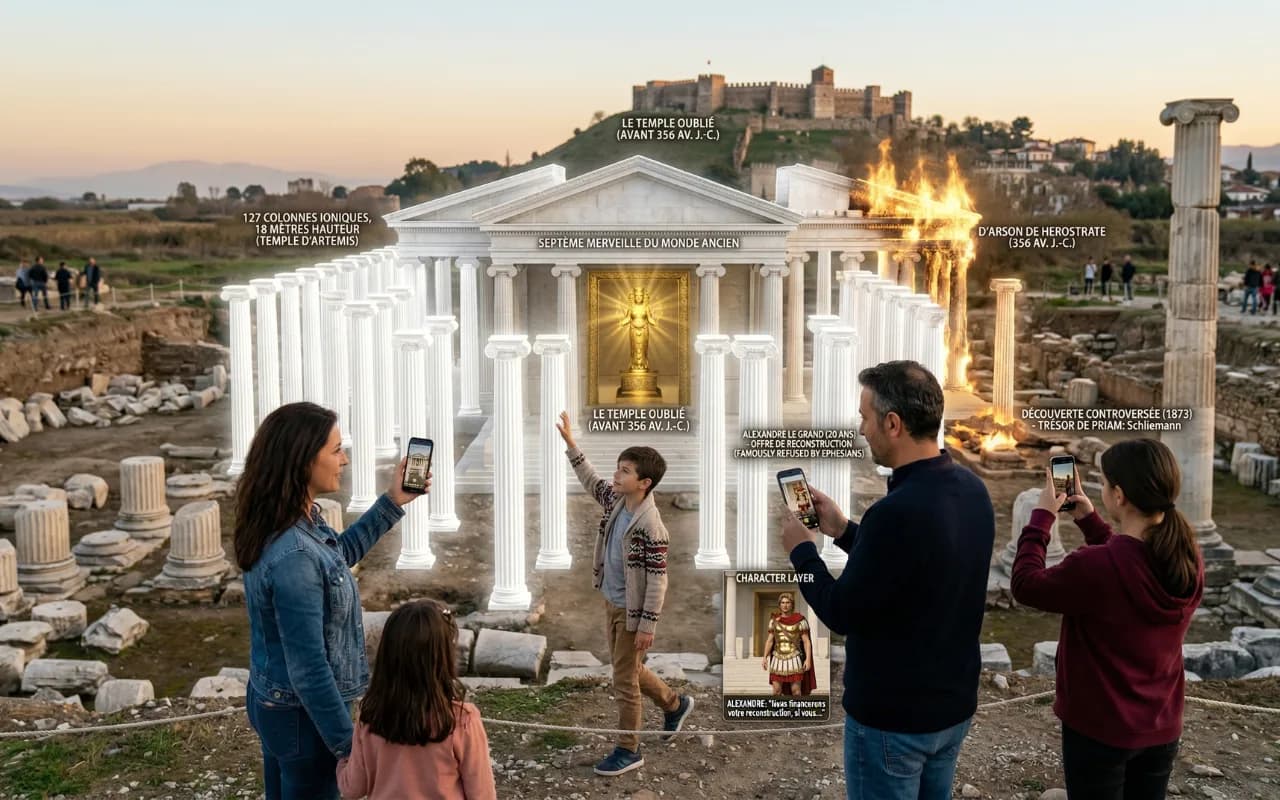
The seventh wonder of the ancient world rises from its ashes
The Library of Celsus
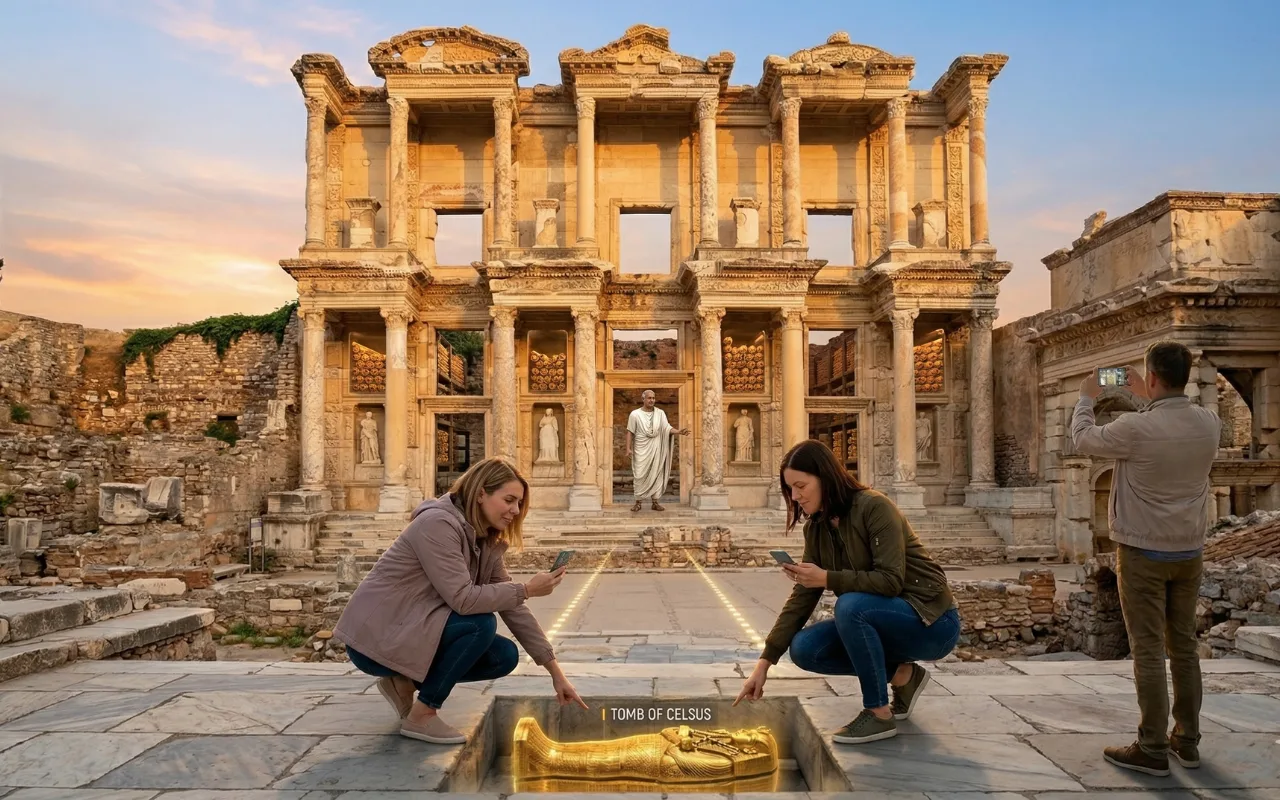
Twelve thousand scrolls of knowledge and a secret tomb
The Christians of Ephesus
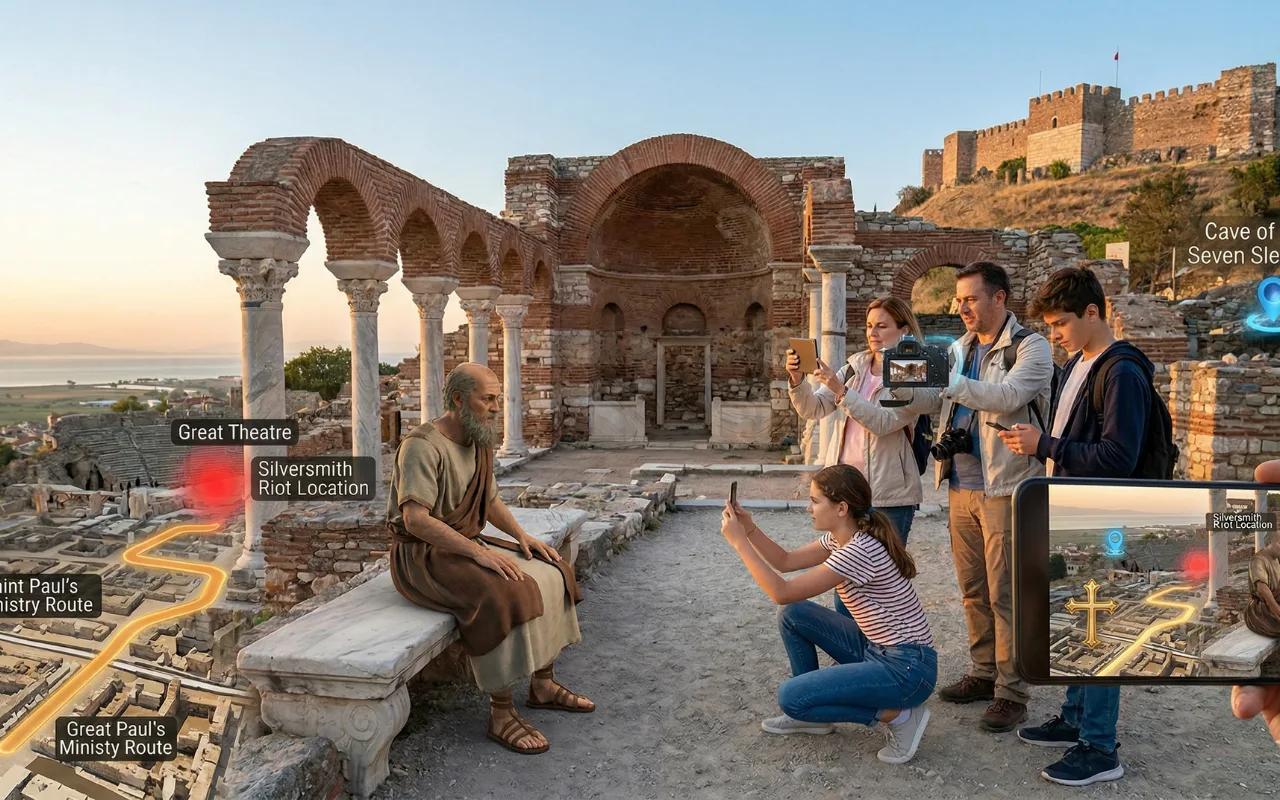
From Saint Paul to the Virgin Mary — cradle of Eastern Christianity
Unusual things to do in Ephesus
Ephesus is full of stories and mysteries, and our outdoor escape games are the ultimate unusual activity to uncover them. Far from traditional guided tours, you immerse yourself in a captivating scavenger hunt that turns the city into your playground. Imagine solving ancient riddles in front of the Celsus Library or deciphering hidden codes near the Grand Theater. It's an interactive treasure hunt that awakens your senses and spirit of adventure. Our routes above promise a unique experience, combining culture, history, and adrenaline, for a truly extraordinary discovery of Ephesus.
Things to do in Ephesus with kids
Discovering Ephesus as a family becomes a thrilling adventure thanks to our outdoor escape games. Forget the boredom of long visits and transform the exploration of ancient ruins into an exciting scavenger hunt. Children will love searching for clues and solving puzzles, while parents will appreciate sharing moments of togetherness and playful learning. It's a treasure hunt that stimulates everyone's curiosity and allows you to immerse yourself in history in an interactive way. Our routes above are designed to offer fun for all generations, making a visit to Ephesus memorable for the whole family.
Ephesus for couples
For a romantic and original getaway in Ephesus, our outdoor escape games are the ideal option. Share unique moments by embarking on a scavenger hunt for two, exploring ancient ruins hand in hand while solving puzzles. It's an intimate and interactive way to discover the city, away from the crowds, creating your own memories. Imagine deciphering mysteries together in front of the majestic Celsus Library, strengthening your complicity with each challenge overcome. Our routes above offer a romantic treasure hunt that promises laughter, challenges, and discoveries, for an unforgettable experience in Ephesus as a couple.
What to do in Ephesus when it rains
Ephesus is a beautiful city, but what to do if rain comes calling? Our escape games are mostly outdoor, which means they are not the ideal option for heavy rain. However, for a light shower or cloudy weather, a waterproof jacket and an umbrella will be enough to enjoy our routes above. If the weather is truly capricious, we suggest exploring local museums, such as the Ephesus Archaeological Museum in Selçuk, or taking shelter in a charming café. Wait for the sun to return for your outdoor treasure hunt!
Where is Ephesus, and where do the routes start?
Starting points of our routes and the places they pass through.
Route starting points
Places in Ephesus
- Basilica of St John
- İsa Bey Mosque
- Cave of the Seven Sleepers
- Great Theatre
- Council Church
- Arcadian Way
- Byzantine fortress of Ayasuluk
- Meryemana
- Artemision site
- Marshy basin around the temple
- Selçuk Archaeological Museum
- Upper entrance to Ephesus site
- Ephesus Odeon
- Curetes Street
- Nymphaeum of Trajan
- Library of Celsus façade
- Library basement
- Marble Street
The history of Ephesus
From Ionian Settlement to Roman Metropolis
Ephesus's origins trace back to the Neolithic period, around 6000 BCE, with early inhabitants at Çukuriçi Mound. The city as it developed began to take shape around 1000 BCE when Ionian Greek colonists, led by the Athenian prince Androklos, settled on Ayasuluk Hill. It became a significant port city, located on the Aegean coast. By the 7th century BCE, a Temple of Artemis, dedicated to an Anatolian mother goddess, stood at the city's center.
Ephesus experienced periods of Lydian and Persian rule before being liberated by Alexander the Great in the 4th century BCE. Following his death, his general Lysimachos refounded the city around 290 BCE, implementing a grid plan designed by Hippodamos of Miletus. In 133 BCE, Asia Minor was incorporated into the Roman Empire, and Ephesus was designated as the capital of the new province of Asia. Under Roman rule, particularly during the reign of Emperor Augustus in the early 1st century AD, Ephesus developed as a center for art, culture, and philosophy, reaching a population of 200,000 citizens and 25,000 slaves by the 2nd century AD. The city saw extensive construction, with marble buildings and statues adorning its streets.
The Decline and Abandonment
The prosperity of Ephesus began to lessen due to a combination of geographical and historical factors. The Küçük Menderes River (anciently known as the Cayster River) gradually silted up the harbor, pushing the coastline westward and cutting off the city's access to the Aegean Sea. Despite repeated dredging efforts, the harbor eventually became impassable for large vessels by the 7th century AD. Natural disasters, such as an earthquake in 614 AD, also caused widespread damage. The city was further impacted by Gothic raids in 263 AD and Arab raids from 654 AD onwards. These events, coupled with shifting trade routes and the rise of other cities like Smyrna (modern-day Izmir), led to a gradual decline. By the 15th century, the marble city was largely abandoned, with its remaining inhabitants moving to Ayasuluk Hill, where the modern town of Selçuk now stands.
What to see in Ephesus
- Library of Celsus — This two-story facade, reconstructed in the 1970s, was built in 110 CE and served as a tomb for Tiberius Julius Celsus Polemaeanus, a Roman senator and governor of Asia. It once held over 12,000 scrolls.
- Great Theatre — This theatre dates back to the 3rd century BCE and was expanded during the Roman Imperial period. It held 24,000 spectators and was used for performances, gladiatorial contests, and public assemblies.
- Terrace Houses — These residential complexes on the slopes of Bülbüldağ show the daily lives of wealthy Ephesians during the Roman era. You can see mosaics, frescoes, and marble paneling.
- Basilica of St. John — The ruins of this basilica on Ayasuluk Hill mark the traditional burial site of John the Apostle. The current structure dates primarily from the 6th century AD, built during the reign of Emperor Justinian I.
- Temple of Hadrian — This Corinthian temple, dedicated to Emperor Hadrian in the 2nd century AD, features carvings, including a relief depicting the founding of Ephesus. It stands on Curetes Street.
- Artemision site — Little remains of the Temple of Artemis, one of the Seven Wonders of the Ancient World. The site near modern-day Selçuk holds historical significance. The temple was completed around 550 BCE.
- İsa Bey Mosque — Constructed in 1374–75, this mosque on Ayasuluk Hill is an example of Seljuk architecture and was partly built using marble from ancient Ephesus.
When to visit Ephesus
The best time to visit Ephesus is during spring (April-May) or autumn (September-October). During these seasons, temperatures are mild, ranging from 15-25°C (59-77°F), making it comfortable for exploring the open-air ruins. The countryside blooms in spring, and autumn offers clear light for photography. Crowds are generally smaller than in peak summer.
Avoid visiting in July and August, as these months bring heat, with daytime highs often reaching 34°C (93°F) or more. The white marble of the ruins reflects sunlight, making it feel hotter, and cruise ship crowds are at their maximum. Winter (November-March) is cooler and quieter, with temperatures between 5-15°C (41-59°F), but it is also the wettest season.
Getting around Ephesus
Ephesus is near the modern town of Selçuk in İzmir Province, Turkey. The closest airport is Izmir Adnan Menderes Airport (ADB), about 60 kilometers away, a 40 to 50-minute drive. From Izmir, you can take a train from Izmir Basmane station to Selçuk, a journey of about 90 minutes.
In Selçuk, minibuses (dolmuş) run frequently to the Ephesus archaeological site. The ancient city itself is explored on foot. The site has two main entrances. It is often recommended to start from the upper entrance (Magnesia Gate) and walk downhill towards the lower entrance (Harbour Gate). Parking is available at both entrances. The town of Selçuk has local markets.
Things you probably do not know about Ephesus
Verified details most visitors walk straight past.
- Library of Celsus
- Have you ever wondered about the secret passages behind the Library of Celsus? The Library of Celsus, while a grand facade, actually contained a hidden tunnel that connected directly to a nearby brothel. This allowed patrons to discreetly visit the establishment without public scrutiny, highlighting a less academic side of ancient Ephesian life.
- Great Theatre
- What role did the Great Theatre play beyond entertainment, especially for early Christians? The Great Theatre was not only a venue for plays and gladiatorial contests but also a significant public forum. It was here that the silversmith Demetrius incited a riot against St. Paul and his followers, fearing that the spread of Christianity would diminish the worship of Artemis and their trade in silver shrines.
- Curetes Street
- What unusual feature can you spot on the columns along Curetes Street? Many of the columns lining Curetes Street, the main thoroughfare of Ephesus, are mismatched. This is because after repeated earthquakes, particularly the one in 17 AD and others in the 3rd and 4th centuries, the city was rebuilt using available materials, sometimes salvaged from other damaged structures, leading to a patchwork appearance.
- Public Latrines
- How did wealthy Ephesians stay warm while using the public latrines? In the public latrines of Ephesus, which were quite communal, wealthy citizens had a clever way to stay comfortable. They would send their slaves ahead of them to sit on the marble seats, warming them up before their masters arrived.
- Temple of Artemis
- What unique event coincided with the birth of Alexander the Great and the destruction of the Temple of Artemis? The Temple of Artemis, one of the Seven Wonders of the Ancient World, was set ablaze in 356 BCE by an arsonist named Herostratus, who sought fame. Remarkably, this event is said to have occurred on the very same night that Alexander the Great was born.
- Ephesus Archaeological Museum (in Selçuk)
- Beyond grand statues, what everyday objects in the Ephesus Museum reveal the ancient Ephesians' sense of time? The Ephesus Archaeological Museum in Selçuk displays sundials and water clocks, which were used by Ephesians to tell time. Possessing a water clock at home was a clear indicator of a family's wealth, as most people woke with the sun and went to bed shortly after sunset.
Questions about visiting Ephesus
How much time should I allocate to visit Ephesus?
To appreciate the main archaeological site of Ephesus, including the Library of Celsus, Great Theatre, and Terrace Houses, plan for at least 3-4 hours. If you wish to visit nearby attractions like the Basilica of St. John, Isa Bey Mosque, and the Ephesus Archaeological Museum in Selçuk, a full day is recommended.
What is the best way to get around the Ephesus archaeological site?
The Ephesus archaeological site is explored on foot. The main path is a gentle downhill slope if you start from the upper entrance (Magnesia Gate) and proceed towards the lower entrance (Harbour Gate). Wear comfortable shoes, as you will be walking on ancient marble streets and uneven terrain.
Are there guided tours available for Ephesus?
Yes, many guided tours are available for Ephesus, often departing from nearby towns like Selçuk or Kuşadası, and even from Izmir. A knowledgeable guide can provide historical context and insights into the ruins, enhancing your understanding of this ancient city.
Is Ephesus suitable for visitors with children?
Ephesus can be an engaging experience for children, especially those interested in history and ancient civilizations. The vastness of the site and the structures can spark their imagination. However, be prepared for a lot of walking in open areas with limited shade, so bring water and snacks.
What is the local currency and how should I budget for a visit?
The local currency in Turkey is the Turkish Lira (TRY). For a visit to Ephesus, budget for entrance fees, transportation to and from the site, and any food or drinks. Prices for meals and souvenirs in Selçuk are generally reasonable, but it is good to have some cash for smaller purchases.
Can I visit Ephesus if I'm arriving by cruise ship?
Yes, many cruise lines offer shore excursions to Ephesus from the port of Kuşadası, which is about 20 kilometers away. These tours typically include transportation and a guided visit to the main archaeological site. If you prefer to explore independently, taxis and minibuses are available from the port to Ephesus.
Frequently asked questions
How much does an outdoor escape game cost in Ephesus?
Our outdoor escape games in Ephesus are designed to be accessible and fun. The price is €12 per team, regardless of the number of players (within the recommended limit). It's a single price for game access, making it very economical if you come with a group of friends or family. This price includes app access, puzzles, and progress tracking. Get ready for a memorable adventure without breaking the bank!
Is it suitable for children / families?
Absolutely! Our routes are an excellent activity for the whole family. The puzzles are designed to be stimulating without being too difficult, allowing children to actively participate in the treasure hunt. It's a fun way to learn the history of Ephesus and develop teamwork. We generally recommend active participation from age 8, but younger children can also enjoy searching for clues with adult help. An adventure everyone will enjoy!
How long does an escape game last in Ephesus?
The duration of our escape games in Ephesus generally varies between 1h30 and 2h30, depending on the chosen route and your pace of play. This is the estimated time to solve all the puzzles and fully enjoy the experience without rushing. You are free to take breaks, take photos, or get a drink along the way. The advantage of an outdoor game is this flexibility, allowing you to discover the city at your leisure while having fun!
Do I need to book in advance?
No, booking is not necessary for our outdoor escape games in Ephesus! You can start your adventure whenever you want. Simply download the OddballTrip app, choose your route in Ephesus, and launch it. It's ideal for a spontaneous decision or to fit your travel schedule. No need to worry about fixed times or slots. Buy the game, and the adventure begins at your signal!
What to visit in Ephesus beyond the escape games?
Ephesus is a historical treasure! Beyond our fun routes, don't miss the majestic Celsus Library, the Grand Theater, Curetes Street, and the Terrace Houses. The site of the Temple of Artemis, though barely visible today, remains an iconic place. Nearby, the House of the Virgin Mary and St. John's Basilica in Selçuk are important religious sites. For a local touch, explore the charming village of Şirince. Ephesus offers a deep immersion into antiquity and early Christianity.
What is the best season to visit Ephesus?
The best season to visit Ephesus and fully enjoy our outdoor escape games is spring (April-May) or autumn (September-October). Temperatures are pleasant, ideal for walking and exploring the ruins without the oppressive summer heat. You'll also avoid the summer crowds, making your experience more serene. Summer (June-August) is very hot, and winter (November-March) can be rainy and cool. Remember to bring water and a hat if you come during high season!
Other destinations in Aegean
Izmir
Cosmopolitan Smyrna — Levantine bazaar and memory of the Great Fire
Pergamon
Alexandria's rival — the Altar of Zeus and the birthplace of parchment
Pamukkale
Cotton terraces and gate to the underworld — Hierapolis the sacred city
Bodrum
The Mausoleum of Halicarnassus — the wonder that named all tombs
Marmaris
Pearl of the Aegean coast, between sea and fortress
Sardis
Where Croesus's gold forged history
More cities in Turkey
Çanakkale
From the Trojan War to Gallipoli — 4,000 years of battles
Bursa
First Ottoman capital — silk, sultans and imperial mosques
Antalya
Pearl of the Turkish Riviera
İznik
Council of Nicaea and sultan's tiles — where history forged doctrine
Istanbul
From Byzantium to the Ottomans — 10 escape games across two continents
Activities to discover nearby
Guided tours, skip-the-line tickets and local experiences to book in advance.
💡 Optional booking — you can also buy on-site. All links open in a new window, your OddballTrip visit stays preserved.