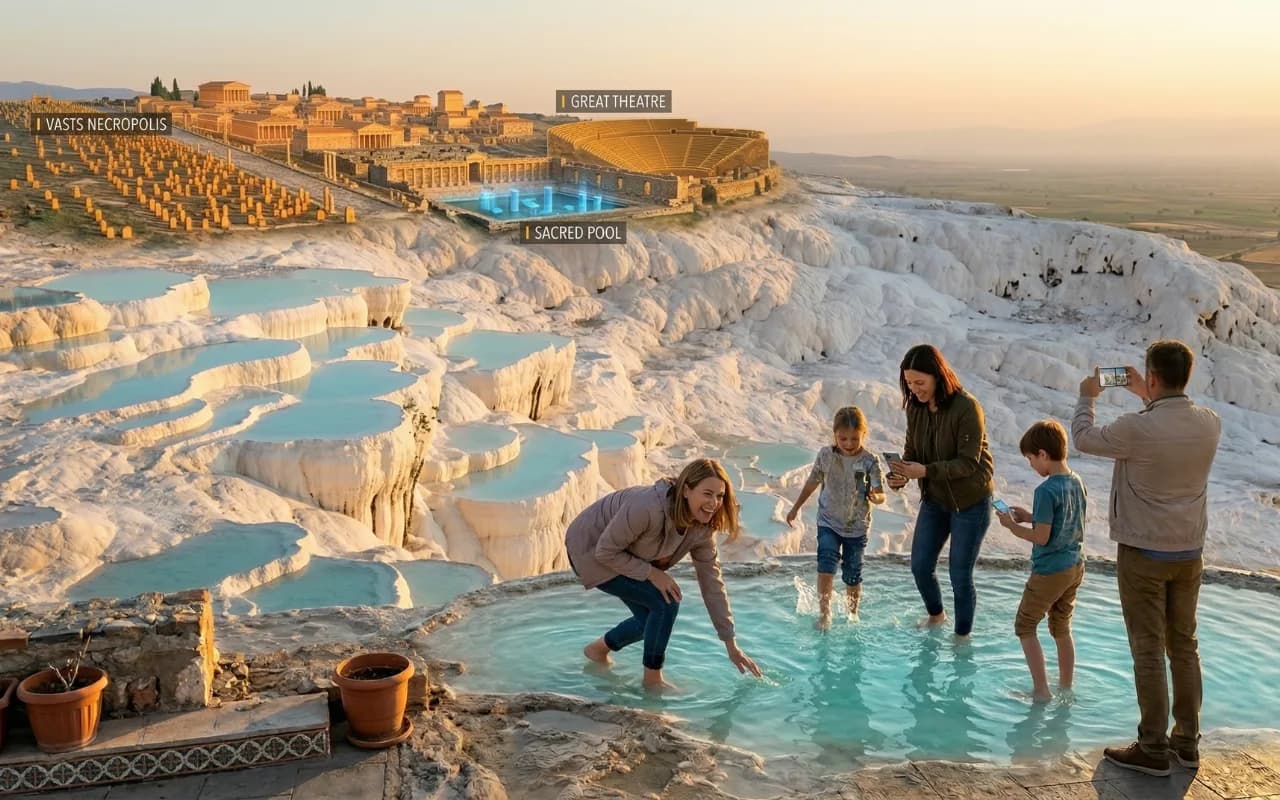
PamukkaleOutdoor Escape Game & Treasure Hunt
Cotton terraces and gate to the underworld — Hierapolis the sacred city
Welcome to Pamukkale, Turkey's "cotton fortress," a place where nature sculpts landscapes of unreal beauty! Globally renowned for its spectacular terraces of immaculate white travertine, Pamukkale is also the gateway to the ancient city of Hierapolis, with its impressive Roman theater and the mythical Cleopatra's Pool. But beyond these historical and natural wonders, the city offers numerous possibilities for an unusual and memorable activity. If you're looking for an original way to discover its secrets, our outdoor escape games invite you to transform your exploration into a true adventure. Imagine solving puzzles amidst these breathtaking landscapes, participating in a life-sized treasure hunt or a captivating scavenger hunt. Get ready for a fun and cultural immersion that will reveal Pamukkale from a totally new angle. Discover without further delay the routes we have crafted for you.
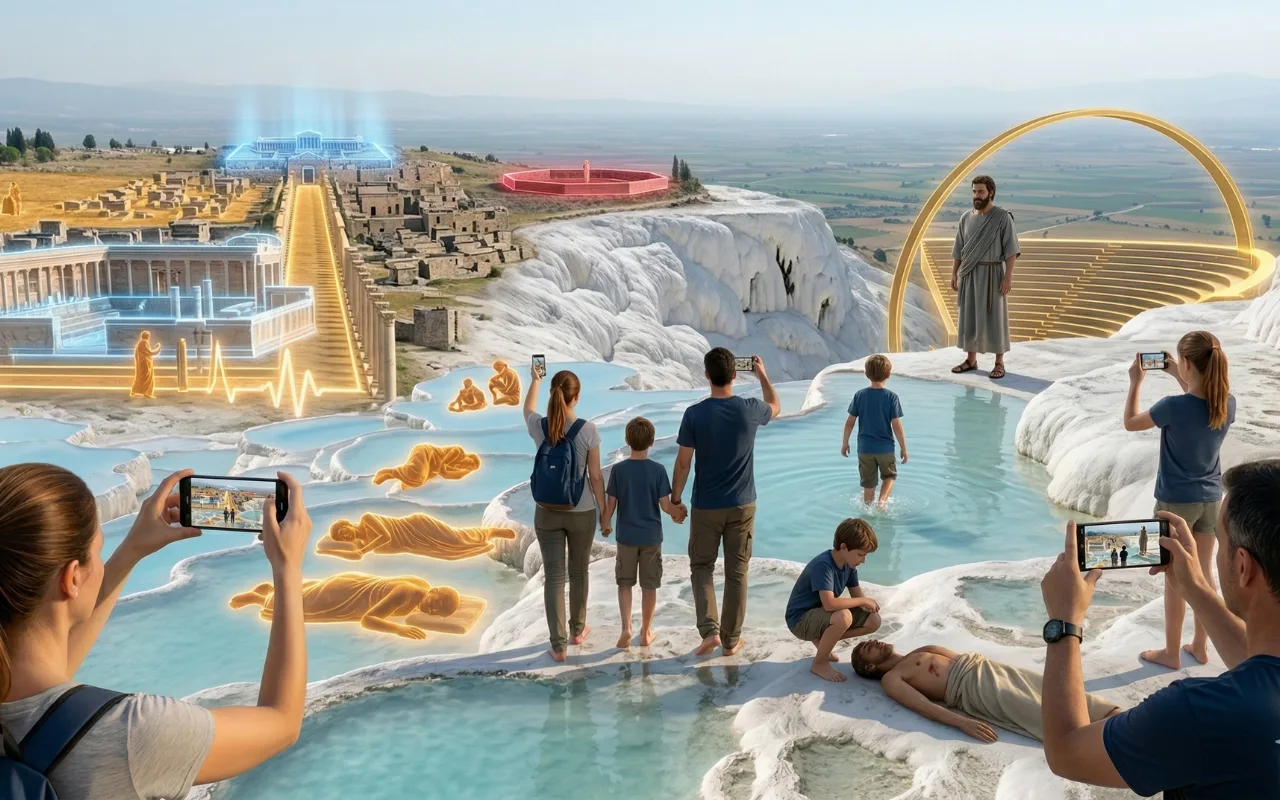
The Cotton Terraces
Hierapolis — the white spa city on the travertine cliff
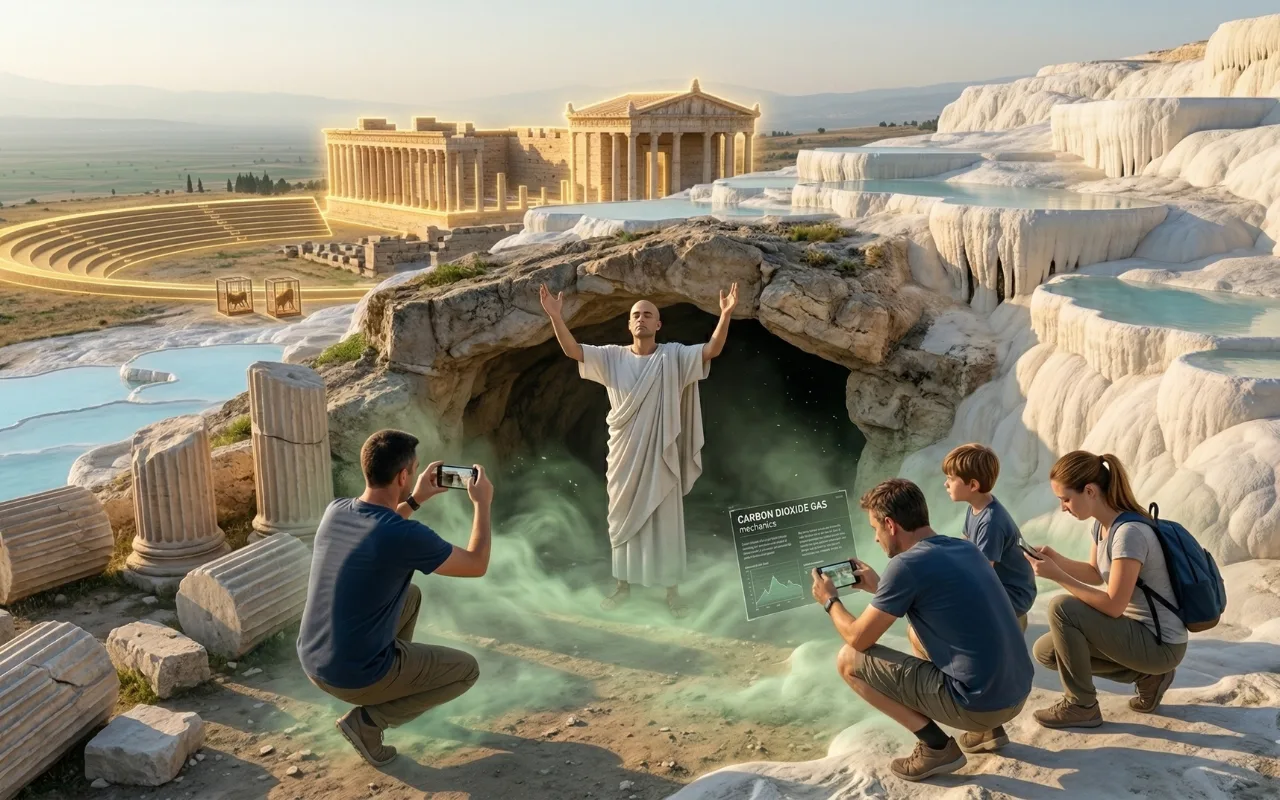
The Plutonium of Hierapolis
The gate to the underworld — where priests defied death
Unusual things to do in Pamukkale
Pamukkale is inherently an unusual destination, but our outdoor escape games add another layer of originality to your visit. Forget traditional guided tours and dive into an interactive adventure where the city becomes your playground. Our scavenger hunts are designed to help you discover iconic places and hidden corners in a fun and stimulating way. It's the perfect opportunity to combine cultural exploration with an intellectual challenge, transforming a simple stroll into a real treasure hunt. A memorable experience guaranteed, far from the beaten path!
Things to do in Pamukkale with kids
Pamukkale is a fantastic destination for families, and our outdoor escape games are the ideal activity to create unforgettable memories together. Suitable for various ages, these scavenger hunts transform city discovery into a thrilling adventure for both young and old. Children will love searching for clues and solving puzzles, while parents will appreciate the cultural aspect and the beauty of the landscapes. It's an excellent way to foster collaboration and team spirit, all while exploring the wonders of Pamukkale in an active and fun way.
Pamukkale for couples
For a romantic getaway in Pamukkale, our outdoor escape games offer a charming alternative to traditional tours. Imagine holding hands, solving puzzles together amidst the travertine terraces or the ancient ruins of Hierapolis. It's an activity that strengthens bonds, stimulates communication, and creates unique moments of complicity. Away from the crowds, you'll share laughter, challenges, and the satisfaction of discovering the city's secrets as a pair. An original and memorable way to spice up your couple's stay.
What to do in Pamukkale when it rains
While Pamukkale is primarily an outdoor destination, what if the weather isn't cooperating? Our escape games are designed to be played outdoors. In case of light rain, a good jacket is often enough to enjoy the adventure. However, for heavy downpours, they might be less suitable. We advise checking the weather before starting. If the weather is truly capricious, you can always explore the Hierapolis Museum or local restaurants while waiting for a break in the weather for our routes.
Where is Pamukkale, and where do the routes start?
Starting points of our routes and the places they pass through.
Route starting points
Places in Pamukkale
- Travertine terraces
- Cleopatra's Pool
- Roman baths
- Roman theatre
- Octagonal martyrium
- Northern necropolis
- North gate of Hierapolis
- Plutonium cave
- Temple of Apollo foundations
- Sacrificial enclosure before the cave
- Stands facing the Plutonium
- Sacred fountain
- Main street of Hierapolis
- Necropolis
- Ritual cavity
The history of Pamukkale
From Phrygian Cult Site to Roman Spa Town
The history of Pamukkale is connected with the ancient city of Hierapolis, which sits atop the white travertines. The site was originally a Phrygian cult center for the Anatolian mother goddess Cybele, with a temple likely built in the early 7th century BCE. Hierapolis itself was founded in the 2nd century BCE by the Attalid kings of Pergamon, possibly by Eumenes II. The city's name, meaning "Holy City," might derive from Hiera, the wife of Telephos, the founder of Pergamon, or from the numerous temples present. The hot springs were recognized for their therapeutic properties early on, leading to the development of a spa town where doctors prescribed the waters for various ailments.
Earthquakes, Rebuilding, and a Christian Center
In 133 BCE, Hierapolis, along with the Pergamene kingdom, was bequeathed to Rome, becoming part of the Roman province of Asia. The city grew under Roman rule, reaching its peak in the 2nd and 3rd centuries CE. Hierapolis is in a seismically active area and was repeatedly struck by earthquakes. Major quakes in 17 CE and 60 CE almost completely destroyed the city, requiring extensive rebuilding under emperors like Tiberius and Nero. Much of the preserved ancient buildings visible today date from the period after these disasters. Hierapolis also became an important center for Christianity, partly due to the martyrdom of St. Philip, one of Jesus' apostles, who is believed to have been crucified here in 80 CE.
What to see in Pamukkale
- Travertine Terraces, Pamukkale — These white, calcium-rich mineral formations cascade down the hillside, creating a landscape of petrified waterfalls and terraced basins. Visitors can walk barefoot on designated paths through the warm, shallow pools.
- Hierapolis Ancient City — A Greco-Roman thermal spa city above the travertines. Its ruins offer a view into a former metropolis.
- Roman Theatre — This preserved theatre, built in the 2nd century CE under Emperor Hadrian and later renovated under Septimius Severus, could seat around 15,000 spectators. Its stage reliefs depict myths and emperors.
- Cleopatra's Pool (Antique Pool) — Swim among submerged Roman columns and ancient stones in this thermal pool, whose water maintains a consistent 36°C (97°F).
- Northern Necropolis — One of the largest ancient cemeteries in Turkey, featuring over 1,200 tombs, including sarcophagi and monumental structures, showing ancient burial practices.
- Martyrium of St. Philip — This octagonal building, constructed in the 5th century CE, commemorates the martyrdom of St. Philip the Apostle, who is believed to have been crucified in Hierapolis in 80 CE.
When to visit Pamukkale
The best time to visit Pamukkale is during spring (April-May) and autumn (September-October). During these months, temperatures are between 15°C and 28°C, making it comfortable for walking the travertines and exploring Hierapolis, and crowds are smaller. The light in the mornings and late afternoons is also suitable for photography.
Avoid visiting in July and August, as temperatures can reach 35°C to 40°C, and the site becomes crowded with peak-season tourists. While winter (November-March) offers fewer crowds and the thermal waters remain warm, air temperatures are colder, there's a higher chance of rain, and daylight hours are shorter.
Getting around Pamukkale
Pamukkale is in Denizli Province, approximately 18 km north of Denizli city. Most independent travelers arrive in Denizli by bus or train. From Denizli Otogar (bus station), minibuses (dolmuş) to Pamukkale run every 15-20 minutes from the lower level at Gate 76. The ride takes about 30 minutes and drops you in Pamukkale village.
Pamukkale village is small and walkable. The archaeological site of Hierapolis and the Travertine Terraces are also explored on foot. You are required to walk barefoot on the travertine terraces to protect the calcium formations. Parking is available near the entrances to the site. While there are cafes near the entrance, it is advisable to bring your own water, especially during warmer months, as there is uphill walking.
Things you probably do not know about Pamukkale
Verified details most visitors walk straight past.
- Plutonium Cave, Temple of Apollo
- Why was a cave dedicated to Pluto, the god of the underworld, located beneath the Temple of Apollo, the god of light and healing? The Plutonium cave in Hierapolis was believed to be a 'gate to hell' due to the toxic gases emanating from deep within the earth. Ancient priests would use this cave for rituals, interpreting the will of the gods through the reactions of animals to the lethal fumes, while they themselves remained unharmed, possibly due to a natural immunity or specific breathing techniques.
- Roman Theatre
- The grand Roman Theatre of Hierapolis, with its impressive capacity, wasn't the first theatre on this site. What happened to its predecessor? The current Roman Theatre, built in the 2nd century CE, replaced an earlier Hellenistic theatre. This older structure, located in the northern part of the city, was almost completely destroyed by a devastating earthquake in 60 CE, and its building materials were reused in the construction of the Roman replacement.
- Cleopatra's Pool
- The Cleopatra's Pool, with its submerged columns, looks like a deliberate design. But how did those ancient ruins end up at the bottom of a thermal spring? The structures around the thermal pool collapsed during the great earthquake of 60 AD. Instead of clearing the debris, the fallen columns and stone carvings were left in place, creating the unique, historic appearance of the mineral baths today.
- Northern Necropolis
- Wandering through the vast Necropolis, you might notice many sarcophagi scattered and even broken. What force caused such widespread disarray in this ancient burial ground? Hierapolis is in an active seismic zone, and numerous earthquakes throughout its history have tumbled sarcophagi from their pedestals and scattered them across the necropolis. Many also bear signs of grave robbers.
- Travertine Terraces, Pamukkale
- The white terraces of Pamukkale are often called the "Cotton Castle." But how did this unique landscape get its name? The Turkish name "Pamukkale" literally translates to "cotton castle," a fitting description for the striking white formations that resemble soft, cotton-like cascades, formed by calcium-rich mineral waters flowing down the hillside over thousands of years.
- Hierapolis
- Hierapolis was a spa town in antiquity, attracting visitors seeking healing. But what other industry flourished here, benefiting from the very same hot springs? Beyond its reputation as a healing center, Hierapolis's hot springs were also used for scouring and drying wool. The city's economy flourished partly due to its textile factories, which began operating in the 2nd century BCE.
Questions about visiting Pamukkale
How much time should I allocate to visit Pamukkale and Hierapolis?
Most visitors find that 4 to 5 hours is sufficient to explore both the Travertine Terraces and the ancient city of Hierapolis. This allows time to walk the terraces, visit the Roman Theatre, the Necropolis, and potentially swim in Cleopatra's Pool.
Is it possible to visit Pamukkale with children?
Yes, Pamukkale can be a visit for children. The travertine pools offer an unusual experience. However, be prepared for walking, often barefoot on wet surfaces, and ensure children stay hydrated, especially in warmer months.
What are the transportation options within Pamukkale?
Pamukkale village is small enough to explore on foot. To reach the archaeological site from Denizli, frequent minibuses (dolmuş) are available. Once at the site, you'll be walking between the various ruins and the terraces. Taxis are also an option for getting around the local area.
What is the average budget for a day trip to Pamukkale?
The entrance fee to Pamukkale, which includes access to the travertine pools and Hierapolis, can fluctuate. Beyond that, consider costs for food and drinks, as well as any optional activities like swimming in Cleopatra's Pool, which typically has a separate fee.
Are there any specific rules for walking on the travertine terraces?
Yes, to protect the calcium formations, visitors are required to walk barefoot on the travertine terraces. Shoes can damage the surfaces, so you'll need to carry them or leave them in designated areas. It's also important to stick to marked paths.
What are the best neighborhoods to stay in near Pamukkale?
Most visitors choose to stay in Pamukkale village, which is directly beneath the archaeological site and within walking distance of the entrances. Alternatively, the larger city of Denizli offers more accommodation and dining options, with easy minibus access to Pamukkale.
Frequently asked questions
How much does an outdoor escape game cost in Pamukkale?
Our outdoor escape games in Pamukkale are designed to be accessible and offer excellent value. The price is just €12 per team, not per person! This means you can share the adventure with your friends or family without breaking the bank. It's an economical and fun way to discover the city, transforming a simple walk into an interactive and memorable experience. A minimal investment for maximum fun and cultural discoveries.
Is it suitable for children / families?
Absolutely! Our escape games are perfectly suited for families and children. They are designed to stimulate the curiosity and team spirit of all participants, regardless of age. We generally recommend active participation from 8 years old, but younger children can always help search for clues under adult supervision. It's an excellent activity to spend quality time together, solve puzzles, and explore Pamukkale in a fun and educational way.
How long does an escape game in Pamukkale last?
The duration of our outdoor escape games in Pamukkale is flexible, but on average, allow between 1.5 and 2.5 hours to complete a route. This will depend on your pace, your observational skills, and your ability to solve puzzles. The advantage is that you play at your own tempo: you can take breaks to admire the scenery, grab a coffee, or visit a monument along the way. It's your adventure, and you decide its rhythm!
Do I need to book in advance?
No, one of the great advantages of our outdoor escape games is that they do not require any prior booking! Once you have your game, you can start it whenever you want, at a time that suits you. This is ideal for spontaneous travelers or those who prefer not to be constrained by fixed schedules. You purchase the game online and instantly receive instructions to start the adventure. Total flexibility is guaranteed!
What else to visit in Pamukkale beyond the escape games?
Pamukkale is full of treasures to explore! Of course, the famous white travertine terraces are an absolute must-see, offering natural pools of thermal water. Just above lies the ancient Greco-Roman city of Hierapolis, with its impressive Roman theater, necropolis, and the famous Plutonium (the gate to the underworld). Don't miss Cleopatra's Ancient Pool, where you can swim among submerged Roman columns. These sites blend perfectly with our scavenger hunts, enriching your overall experience.
What is the best season to visit Pamukkale?
The best season to visit Pamukkale and fully enjoy our outdoor escape games is spring (April-May) or autumn (September-October). During these periods, the weather is pleasantly mild, ideal for walking and exploring without the intense summer heat. Summer (June-August) can be very hot, making outdoor activities more tiring. Winter is cooler and can sometimes be rainy but offers a quieter atmosphere.
Other destinations in Aegean
Ephesus
Temple of Artemis, Library of Celsus and cradle of Christianity
Izmir
Cosmopolitan Smyrna — Levantine bazaar and memory of the Great Fire
Pergamon
Alexandria's rival — the Altar of Zeus and the birthplace of parchment
Bodrum
The Mausoleum of Halicarnassus — the wonder that named all tombs
Marmaris
Pearl of the Aegean coast, between sea and fortress
Sardis
Where Croesus's gold forged history
More cities in Turkey
Antalya
Pearl of the Turkish Riviera
Bursa
First Ottoman capital — silk, sultans and imperial mosques
İznik
Council of Nicaea and sultan's tiles — where history forged doctrine
Çanakkale
From the Trojan War to Gallipoli — 4,000 years of battles
Istanbul
From Byzantium to the Ottomans — 10 escape games across two continents
Activities to discover nearby
Guided tours, skip-the-line tickets and local experiences to book in advance.
💡 Optional booking — you can also buy on-site. All links open in a new window, your OddballTrip visit stays preserved.