LagosOutdoor Escape Game & Treasure Hunt
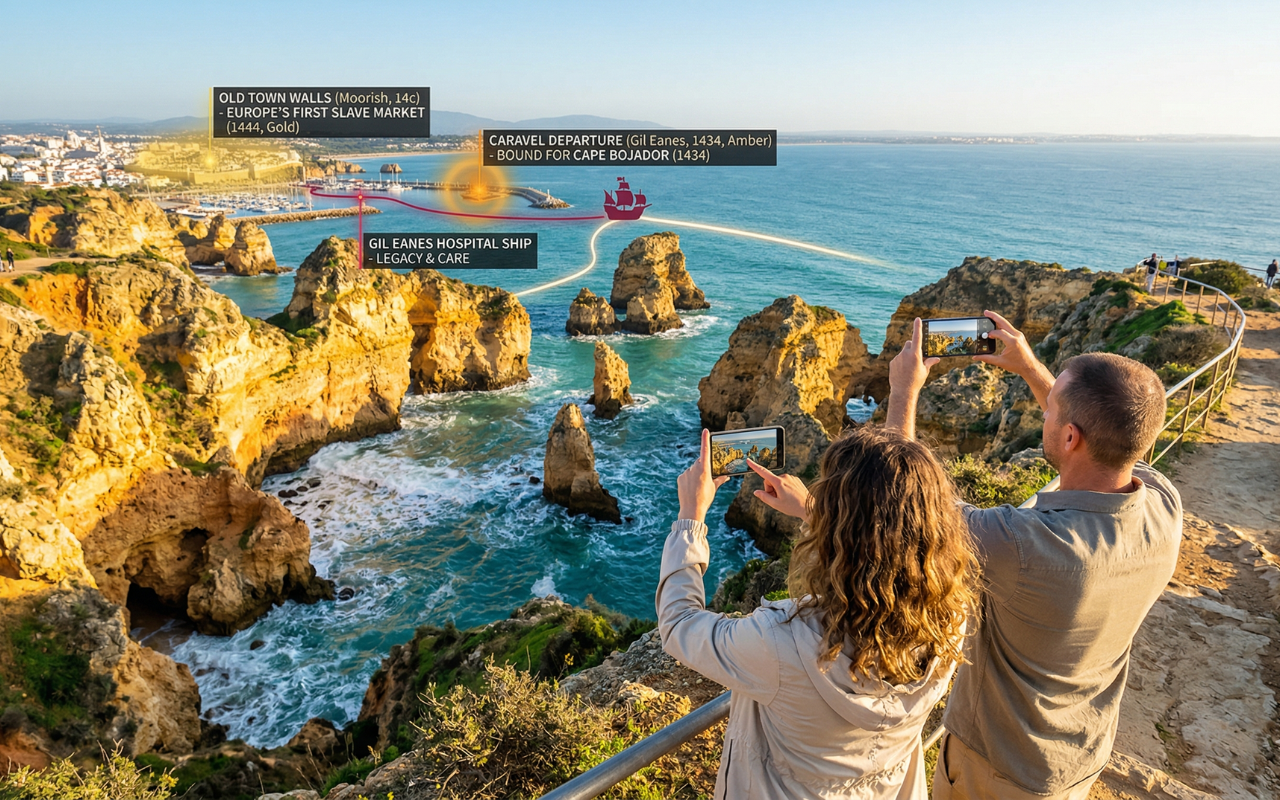
Gil Eanes's port — golden cliffs and first slave market
What to do in Lagos, this Algarve gem where history meets breathtaking landscapes? Far from the usual clichés, Lagos invites you to a deeper exploration, an adventure that goes beyond its famous beaches. Imagine strolling through the charming Centro Histórico, with its cobbled streets and colorful buildings, before marveling at the golden cliffs of Ponta da Piedade, sculpted by time and the ocean. For an unusual activity, why not embark on an outdoor escape game? This real-life treasure hunt will have you discovering the city's secrets in a fun and interactive way, turning every street corner into a clue. It's a true scavenger hunt awaiting you, where Lagos' maritime history blends with the adrenaline of the investigation. Whether you're seeking culture, nature, or a unique experience, Lagos has something to surprise you at every turn.
Unusual things to do in Lagos
For an unusual activity in Lagos, step off the beaten path and dive into the city's hidden soul. Beyond popular beaches like Praia Dona Ana, explore the sea caves of Ponta da Piedade by kayak or boat, a unique experience at sunrise. But for an original outing that combines discovery and entertainment, our outdoor escape game invites you to solve puzzles outdoors, transforming historic streets and lively squares into a huge playground. It's a different and memorable way to soak up the local atmosphere, away from the crowds, by searching for clues hidden in Lagos' architecture or legends.
Things to do in Lagos with kids
What to do with family in Lagos so that both young and old have an unforgettable memory? The city abounds with options. Besides beach days or dolphin watching boat trips, our outdoor escape game is a perfect activity for families with children and teens. Designed to be fun and accessible, it allows the youngest (from 6-8 years old accompanied) to actively participate in the treasure hunt, while older kids will enjoy the puzzles and collaborative aspect. It's a fantastic way to discover Lagos together, develop teamwork, and create precious memories, away from screens and in the fresh air.
Lagos for couples
Lagos as a couple ensures a romantic getaway where every moment turns into a memory. Stroll hand in hand through the cobbled streets of the Centro Histórico, discover secret squares, and admire the traditional architecture. At sunset, the views from Ponta da Piedade, with its golden cliffs ablaze with the last rays, offer a breathtaking spectacle, ideal for an intimate moment. To spice up your stay, embark on our treasure hunt as a couple: an original way to discover Lagos' heritage, share laughs, and solve puzzles together, thus strengthening your bond.
What to do in Lagos when it rains
What to do in Lagos on a rainy day? Don't panic, even if the sun is less present, the city retains its charm. Our outdoor escape game is an excellent option because about 80% of the route takes place under arcades, covered passages, or in sheltered areas of the Centro Histórico. You can continue your adventure without getting soaked, exploring the city's secrets protected from the rain. It's the perfect opportunity to visit the Mercado Municipal to taste local flavors, or to take refuge in a typical café to enjoy a Portuguese pastry.
Where is Lagos, and where do the routes start?
Starting points of our routes and the places they pass through.
Route starting points
Places in Lagos
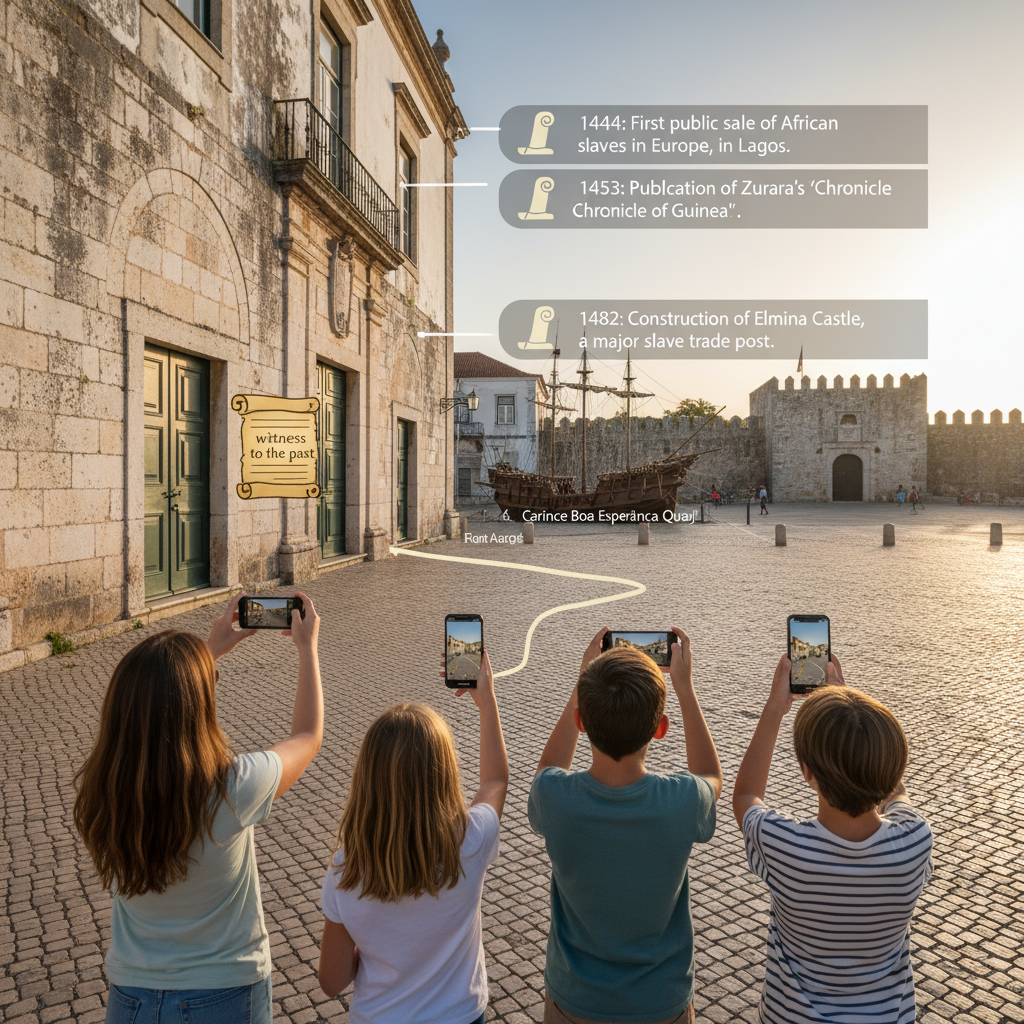
- Old Slave Market (exterior)
- Caravel Boa Esperança Quay
- Prince Henry Square
- São Gonçalo Gate Wall
- Santa Maria Church (exterior)
- Ponta da Bandeira Fort (exterior)
- Lagos Fishing Dock (historic port area)
- Lagos Ciência Viva Center (exterior)
The history of Lagos
From Ancient Settlements to Roman Rule
Lagos has a history spanning over 4,000 years. Traditions suggest its founding around 1899 BCE by King Brigo, who established fortified settlements. The name Lacobriga, referring to a Celtic settlement, is thought to derive from his name and the surrounding lakes. Phoenicians arrived around 935 BCE, attracted by the region's gold and silver, establishing trade networks. Later, the Carthaginians developed Lacobriga into a significant settlement, using its bay for fishing and agriculture, and recruiting Celtic tribesmen during the Punic Wars against the Romans.
The Romans conquered Lacobriga in the 2nd century BCE, integrating it into the province of Lusitania. Under Roman administration, it developed as a center for agriculture and fishing. Evidence of Roman presence, including silver coins and building foundations, has been found around Monte Molião and Fonte Coberta. The foundations of the bridge leading to Meia Praia are Roman, and the area was known for salting fish and producing garum, a Roman condiment.
The Age of Discoveries and the 1755 Earthquake
After the Roman Empire's decline, Lagos was occupied by Visigoths and then Byzantines. In the 8th century, the Moors conquered the Iberian Peninsula, renaming the town Zawaia and developing it into a center for trade and culture. King Afonso III of Portugal captured Lagos from the Moors in 1249, incorporating it into Portuguese territory.
The 15th century was a pivotal era for Lagos as it became a primary hub for the Portuguese Age of Discovery. Prince Henry the Navigator, who often resided in Lagos, used the city's shipyards to build his caravels. In 1415, a fleet departed from Lagos to conquer Ceuta in Morocco, initiating Portugal's overseas expansion. In 1444, Lagos hosted the first sale of enslaved Africans to Europeans, becoming a significant slave-trading center. From 1576 until 1755, Lagos served as the capital of the Algarve. This period ended with the 1755 earthquake and tsunami, which destroyed much of the city and led to the capital's relocation to Faro.
What to see in Lagos
- Ponta da Piedade — These golden cliffs and sea caves are a natural feature of Lagos. Walk along the clifftop paths for views or take a boat tour to navigate through the sea arches and into the grottoes.
- Centro Histórico de Lagos — The old town is defined by its 16th-century walls, cobbled streets, and whitewashed buildings. It is a place to walk through small squares and find traditional restaurants.
- Forte da Ponta da Bandeira — This 17th-century fortress guards the harbor entrance. Climb its ramparts for views over Lagos bay.
- Igreja de Santo António — This church has an elaborate Baroque interior, with gilded woodwork, azulejo tiles, and a painted ceiling.
- Mercado Municipal — Lagos' covered market is where locals buy fresh fish and produce. Visit in the morning to see regional specialties and the day's catch.
- Praia da Batata & Praia dos Estudantes — These beaches are next to the fortress. From Praia da Batata, you can walk along the water past rock formations to reach Praia dos Estudantes, which has a bridge connecting two rock formations.
When to visit Lagos
The best time to visit Lagos is during the shoulder seasons: May, June, September, and October. Temperatures range from 20-27°C (68-81°F), and crowds are smaller than in peak summer. The sea is warmest in September and early October, suitable for swimming.
Avoid July and August if you prefer fewer crowds and lower prices, as Lagos is at its busiest. While the weather is consistently hot, around 29-33°C (84-91°F), strong northerly winds, known as "Nortada," can make cliff-side spots feel cooler. Winter (November to March) brings milder daytime temperatures of around 16°C (61°F) and is the wettest period, particularly December, though sunny days occur between showers.
Getting around Lagos
Lagos is accessible via Faro Airport (FAO), approximately 90 km (56 miles) away. You can reach Lagos by train from Faro, or by bus from various locations across the Algarve. The historic center is walkable, with most main sights within reach on foot. The town's hills are manageable. For exploring further, such as the Ponta da Piedade headland, walking paths are available, or boat tours depart from the Marina de Lagos. Parking is available, with a large area near Ponta da Piedade. The Mercado Municipal is best visited in the morning for fresh produce and fish. Some smaller resorts in the Algarve may have limited operations during the low season (November-March).
Things you probably do not know about Lagos
Verified details most visitors walk straight past.
- Old Slave Market (Mercado de Escravos)
- What grim distinction does Lagos hold regarding the transatlantic slave trade? In 1444, Lagos hosted the first recorded sale of enslaved Africans to Europeans, making it a significant center for this trade during the Age of Discovery.
- Santa Maria Church (Igreja de Santa Maria)
- What unique modern artwork can be found behind the altar of the Church of Santa Maria, contrasting with traditional Portuguese church decor? Behind the high altar of the Igreja de Santa Maria, you'll find "The Mural of the Battling Angels," a contemporary painting in vivid oranges, pinks, and purples, depicting a celestial battle, a striking contrast to the typical gold-leaf altarpieces found in other Portuguese churches.
- São Gonçalo Gate Wall (Porta de São Gonçalo)
- Who is São Gonçalo, and why is he particularly significant to Lagos? São Gonçalo is Saint Gonçalo of Lagos, a fisherman who became an Augustinian preacher, born in Lagos in 1360. A well-preserved statue of him can be found inside the Igreja de Santa Maria.
- Ponta da Bandeira Fort (Forte da Ponta da Bandeira)
- What historical event in 1587 severely damaged Lagos, including its fortifications? In 1587, Francis Drake inflicted heavy damage on Lagos, including its fortifications, during a raid, just a few years after King Dom Sebastião's disastrous crusade departed from the city.
- Lagos Fishing Dock (historic port area)
- Before the Age of Discoveries, what ancient delicacy was a major industry in the Lagos area, highly prized by the Romans? During the Roman period, the principal industry in the Lagos area was salting fish and making garum, a special Roman condiment that was so highly prized it was shipped directly to Rome.
- Prince Henry Square (Praça Infante Dom Henrique)
- What significant military campaign, marking the beginning of Portugal's overseas expansion, was launched from Lagos in the 15th century? In 1415, a large fleet departed from Lagos under the command of the 21-year-old Infante Dom Henrique (Prince Henry the Navigator) to seize Ceuta in Morocco, setting the stage for the Portuguese Age of Discovery.
Questions about visiting Lagos
How many days should I spend in Lagos?
For a good experience without rushing, plan for at least three days in Lagos. This allows time to explore the historic center, enjoy the beaches, take a boat trip to Ponta da Piedade, and maybe even a day trip to a nearby village like Burgau or Sagres.
What are the best neighborhoods to stay in Lagos?
The Centro Histórico (Old Town) is suitable for those who want to be close to historical sites, restaurants, and nightlife. For beach access, areas near Meia Praia offer beachside restaurants. The area around Ponta da Piedade is suitable for coastal views and quieter stays.
Is Lagos suitable for families with children?
Yes, Lagos is suitable for families. Beyond the beaches, there are boat trips to the grottoes of Ponta da Piedade, and attractions like Lagos Zoo are nearby. Many beaches, such as Meia Praia, are extensive and offer space for children to play.
How can I get around Lagos?
Lagos' historic center is compact and can be explored on foot. For longer distances, local buses connect different parts of the town and nearby beaches. Taxis and ride-sharing services are also available. For day trips, trains and buses connect Lagos to other Algarve towns.
What is the typical budget for a trip to Lagos?
Lagos can accommodate various budgets. Accommodation prices vary, with peak season (July-August) being the most expensive. Eating out can be affordable at traditional Portuguese restaurants, while boat tours and activities have a range of prices. Traveling in the shoulder seasons (May, June, September, October) can offer better value.
What are the local market days in Lagos?
The Mercado Municipal is a daily covered market where locals shop for fresh fish, meat, fruits, and vegetables. It is best to visit in the morning to experience the atmosphere and see the freshest catch and regional specialties.
Frequently asked questions
How much does an outdoor escape game cost in Lagos?
An outdoor escape game in Lagos with OddballTrip.com is offered at the very affordable price of €12 per team. This single rate covers access to the game for your entire group, whether it consists of 2, 3, 4, or even 5 players. It's an economical and entertaining solution to discover the city, much more advantageous than many other individual tourist activities. The price includes access to the application, puzzles, and the complete adventure, with no hidden fees. Get ready for a memorable treasure hunt without breaking the bank!
Is it suitable for children / families?
Absolutely! Our outdoor escape games are designed to be a fantastic activity for the whole family. Children from 6-8 years old can actively participate, especially if accompanied by adults who guide them. The puzzles are varied, combining observation, logic, and a bit of local culture, which appeals to both teens and parents. It's an excellent way to spend quality time together, work as a team, and create precious memories while exploring Lagos in a fun and interactive way.
How long does an escape game in Lagos last?
The duration of an OddballTrip escape game in Lagos generally varies between 1 hour 30 minutes and 2 hours 30 minutes. This primarily depends on your team's pace, your ability to solve puzzles quickly, and the time you take to admire the magnificent landscapes and monuments you'll encounter along the way. There's no time pressure; you're free to take breaks, take photos, or stop for a refreshment. The goal is to enjoy the adventure at your own pace.
Do I need to book in advance?
No, one of the great advantages of our outdoor escape game is its flexibility. You don't need to book in advance. Once you've purchased the game online, you can start it whenever you want, 24/7. This allows you to adapt the activity to your travel schedule, weather conditions, or simply your mood. All you need is your charged smartphone and the installed app to start the adventure whenever you feel like it.
What to visit in Lagos beyond escape games?
Lagos is full of treasures beyond our games! Don't miss the cliffs and grottoes of Ponta da Piedade, accessible by boat or kayak for spectacular views. The Centro Histórico is a charming labyrinth of cobbled streets, baroque churches like Igreja de Santo António, and lively squares. Beaches like Praia Dona Ana and Praia do Camilo are famous for their beauty. You can also visit the Mercado Municipal for a local immersion, or the Forte da Ponta da Bandeira for its maritime history.
What is the best season to visit Lagos?
The best season to visit Lagos depends on your preferences. Spring (April-May) and autumn (September-October) offer mild temperatures, fewer crowds, and are perfect for exploring the city and its surroundings without the intense summer heat. The summer months (June-August) are ideal for beach lovers and water activities, but the city is busier and prices may be higher. Winter is mild but can be rainy, offering a calmer atmosphere for cultural exploration.
Other destinations in Algarve
Faro
Gateway to the Algarve — Gothic cathedral, Ria Formosa and sacred bones
Sagres
The end of the ancient world — Henry the Navigator's fortress on Cape Saint Vincent
Tavira
The town of 37 churches — Roman bridge, bluefin tuna and Ria Formosa
Silves
Algarve's ancient Moorish capital
More cities in Portugal
Setúbal
Port of Fernão Mendes Pinto — first European in Japan
Alentejo
Lands of cork oaks, flavors and ancient history
Évora
Roman temple, bone chapel and Jesuit university in the heart of the Alentejo
Lisbon
From Belém to Alfama — 8 escape games across the city of Discoveries