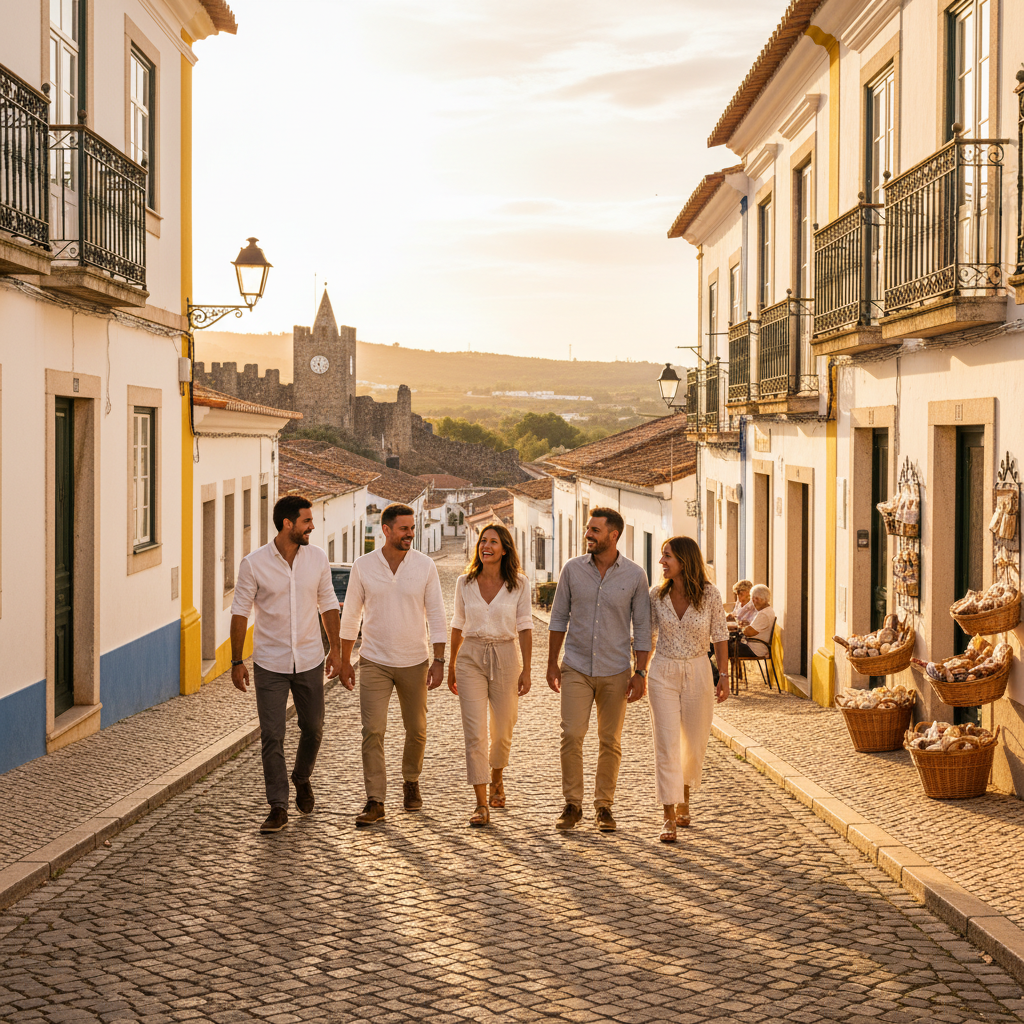
AlentejoOutdoor Escape Game & Treasure Hunt
Lands of cork oaks, flavors and ancient history
The Alentejo, a vast region of Portugal, invites you to a deep exploration of its heritage and landscapes. If you're wondering what to do in Alentejo, know that this land of cork oaks and olive trees is full of treasures. Start with Évora, a UNESCO-listed city, where the majestic Roman Temple of Évora and the impressive Chapel of Bones tell millennia of history. Stroll through its whitewashed streets, soak in its unique atmosphere. For a more playful immersion, why not embark on an outdoor escape game? It's an unusual activity that transforms discovery into a real-life scavenger hunt. Imagine solving riddles while exploring the secrets of Évora or another picturesque village like Monsaraz, offering breathtaking views of the countryside. It's an original way to experience a treasure hunt, blending adventure and culture. Beyond the monuments, Alentejo is also an invitation to slow down, taste local wines, and encounter an authentic culture. A memorable experience awaits you, far from the crowds, in the heart of timeless Portugal.
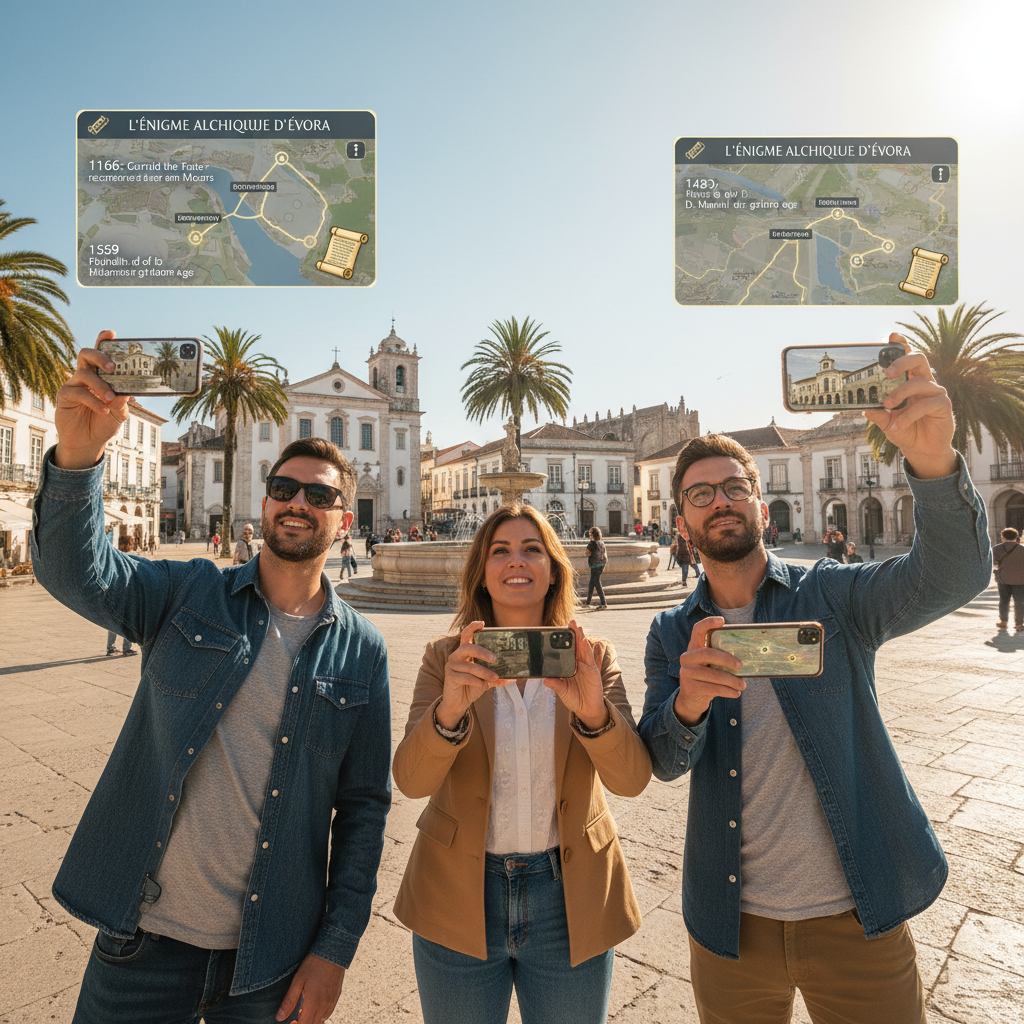
Évora — Alchemical Enigma
Uncover the hidden formula of the Philosopher's Stone! A reclusive alchemist from the 15th century sealed his ultimate secret in Évora's stones. Decode symbols in architecture and monuments to reclaim it before dark forces do.
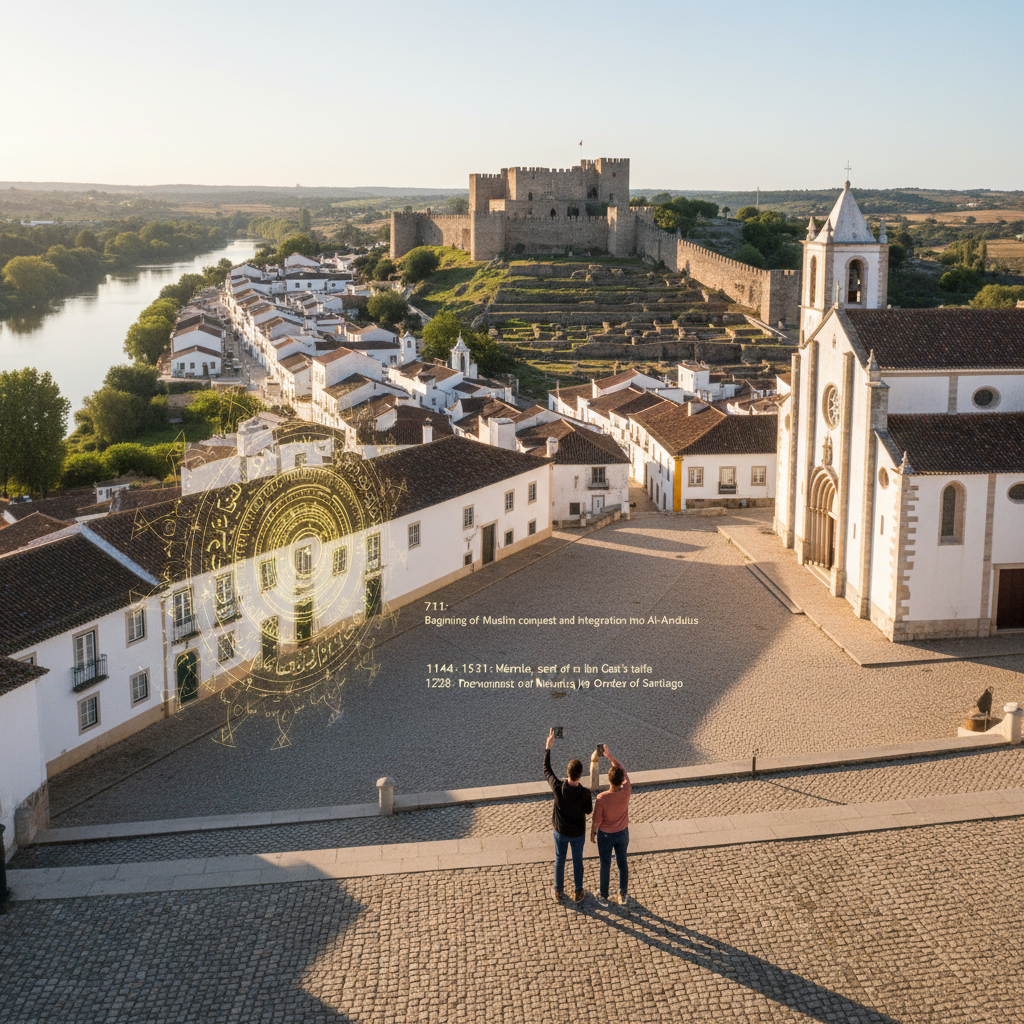
Mértola — The Moorish Labyrinth Conspiracy
Uncover the Moorish labyrinth of Mértola: decipher hidden codes in ancient walls, expose a 12th-century conspiracy that sealed a forbidden secret beneath the town's streets. Solve the maze before it claims another victim.
Unusual things to do in Alentejo
Alentejo is the ideal playground for an unusual activity. Beyond classic visits, imagine deciphering mysteries in the streets of Évora or exploring the moon-like landscapes of Marvão, transformed into a game scene. An original outing could be an outdoor escape game that takes you through megalithic sites, such as the Almendres Cromlech, solving puzzles inspired by local history. It's a unique way to connect with the soul of this region, between ancient heritage and wild nature. Let yourself be surprised by an adventure that goes off the beaten path, where each clue brings you closer to the well-kept secrets of Alentejo.
Things to do in Alentejo with kids
What to do with family in Alentejo? This region offers memorable experiences for all ages. An outdoor escape game is a fantastic option for families with children and teens, generally accessible from 8-10 years old. It's a playful activity that stimulates cooperation and observation, transforming the discovery of Évora or another village into a collective adventure. Imagine your children turned into young detectives, solving riddles while learning history interactively. Away from screens, it's an opportunity to create precious memories together, laugh, and share unique moments in the heart of Portuguese heritage. An original way to visit and have fun as a family.
Alentejo for couples
Alentejo as a couple promises a romantic and authentic getaway. Stroll hand in hand through Évora's winding alleys, discover hidden patios, and share a glass of local wine under the starry sky. For a touch of adventure, an outdoor escape game can transform your walk into an intellectual game of seduction, solving puzzles together while exploring the heritage. Imagine the breathtaking views from Monsaraz's ramparts at sunset, a perfect moment for togetherness. Alentejo invites you to slow down, disconnect, and reconnect as a couple, amidst gently rolling landscapes and villages steeped in history. An intimate and memorable experience awaits you.
What to do in Alentejo when it rains
What to do in Alentejo on a rainy day? Don't worry, even in the rain, Alentejo retains its charm. Our outdoor escape games are designed so you can enjoy the adventure, as approximately 80% of the route takes place under arcades, covered passages, or sheltered by monuments. This means you can explore Évora's historic streets, for example, without getting soaked. It's the perfect opportunity to dive into history and puzzles while staying dry, enjoying a unique experience protected from the elements.
Where is Alentejo, and where do the routes start?
Starting points of our routes and the places they pass through.
Route starting points
Places in Alentejo
- Giraldo Square
- Roman Temple of Évora
- Évora Cathedral (Facade)
- Cadaval Palace
- Public Garden (Bandstand)
- Chapel of Bones (Facade)
- Água de Prata Aqueduct (Inner street)
- University of Évora (Colégio do Espírito Santo)
- Town Hall Square
- Mértola Main Church (Facade)
- Mértola Castle (Outer walls)
- Alcáçova (Archaeological Site)
- Islamic Museum Core (Facade)
- Rua da Judiaria (Old Jewish Quarter)
- Mértola Pier (Guadiana River Quay)
- Moinho Viewpoint (Viewpoint)
The history of Alentejo
From Roman Liberalitas Iulia to Moorish Martulah
Évora's history spans over five millennia, with early settlements dating to the 6th century BCE. The Celtici, a tribal confederacy, established Évora as their regional capital, naming it Ebora. The Romans arrived in the 2nd century BCE, developing Évora into a strategic stronghold due to its wheat and silver resources and its position on a trade route to Rome. It was known as Liberalitas Iulia during this period, a name granted due to municipal privileges bestowed by Julius Caesar. The Roman Temple of Évora, built in the 1st century CE, stands as a structure from this era, originally dedicated to Emperor Augustus.
In the 8th century, Évora came under Moorish rule, becoming known as Jabura or Martulah, a period that lasted until 1165. The city was reconquered by Christian forces in a surprise attack led by Geraldo Sem Pavor (Gerald the Fearless) in September 1165, and it came under the rule of King Afonso I of Portugal in 1166. Mértola, another town in the Alentejo, also experienced Roman and Moorish occupation. Initially called Myrtilis Julia by the Romans, it became a river port. After the Muslim invasion, it was known as Martulá and, for a brief period in the 11th century, was the capital of a small independent Islamic emirate, the Taifa of Mértola. Mértola was conquered from the Moors in 1238 by Paio Peres Correia, commander of the Order of Santiago.
Renaissance and Decline
By the 15th and 16th centuries, Évora developed as a cultural and artistic center, favored by Portuguese kings who often resided there. King João III, who reigned during Portugal's period of power, made Évora his home. The city's bishopric, founded in the 5th century, was elevated to an archbishopric in the 16th century. The University of Évora, the second-oldest in Portugal, was founded in 1559 by Cardinal Infante Dom Henrique and Pope Paul IV, and initially run by the Society of Jesus (Jesuits). However, the university was closed in 1759 when the Jesuits were expelled from Portugal by the Marquis of Pombal, leading to a period of decline for Évora. The university was reopened in 1973.
What to see in Alentejo
- Roman Temple of Évora — This 1st-century CE temple, dedicated to Emperor Augustus, features Corinthian columns on a stone base. It is one of the Roman ruins in Portugal.
- Évora Cathedral (Sé de Évora) — This Romanesque-Gothic cathedral, consecrated in honor of the Assumption of the Virgin Mary, began construction in 1186 and was largely completed by 1250. It is the largest medieval cathedral in Portugal, with an octagonal belfry and an 18th-century main altar made of pink, black, and white marble.
- Cadaval Palace (Palácio dos Duques de Cadaval) — Dating to the 14th century, this palace was built upon Roman-Visigothic walls of Évora's ancient castle. It shows Mudejar, Gothic, and Manueline styles, and includes the pentagonal Torre das Cinco Quinas.
- Chapel of Bones (Capela dos Ossos) — Located next to the Church of São Francisco, this 16th-century chapel has interior walls and pillars adorned with the bones and skulls of an estimated 5,000 people. It was created by Franciscan friars as a memento mori.
- Água de Prata Aqueduct — Built in the 16th century, this aqueduct still carries water into Évora. Sections of it can be walked, and it integrates with the city, with houses and shops built into its arches in some areas.
- University of Évora (Colégio do Espírito Santo) — Founded in 1559, this is Portugal's second-oldest university. The main building, the Colégio do Espírito Santo, features cloisters, blue-and-white azulejos, and historical lecture halls.
- Mértola Main Church (Igreja de Nossa Senhora da Anunciação) — Originally a mosque built in the 12th century during the Islamic occupation, this church retains elements of its Muslim past, including four horseshoe arch doors and a mihrab, a feature in Portuguese churches.
- Mértola Castle — Built during the medieval period over older Roman and Muslim fortifications, the castle was rebuilt in the 13th century after the Portuguese conquest. Its keep tower, built in 1292, now houses a museum.
When to visit Alentejo
The best times to visit Évora and the Alentejo region are spring (April to June) and autumn (September to October). During these months, temperatures range from 18°C to 25°C (64°F to 77°F), suitable for walking. The landscape is green in spring, and autumn brings colors and harvest festivals. Crowds are generally smaller than in the summer months.
Summer (July and August) can be hot, with temperatures often above 30°C (86°F), making sightseeing uncomfortable. Many locals go on holiday, and some smaller businesses might have reduced hours. Winter (November to March) is cooler and can be rainy, though sunny days occur. Tourist numbers are lower, but some attractions might have shorter opening hours.
Getting around Alentejo
Évora is accessible by car, located about 1.5 to 1.75 hours east of Lisbon. The historic center is mostly pedestrian, with narrow, stone streets. Driving and parking inside the city walls can be difficult due to limited space.
For parking, use the public parking lots outside the city walls. An option is near the Água de Prata Aqueduct, northeast of the old town, a short walk from the historic center. Paid street parking is available in some areas, typically charged Monday to Friday from 8:30 AM to 7:30 PM and Saturdays from 9:00 AM to 2:00 PM. Parking meters accept cards or cash. Public transport within Évora is limited; walking is the most practical way to get around.
Things you probably do not know about Alentejo
Verified details most visitors walk straight past.
- Roman Temple of Évora
- How did a Roman temple survive for centuries, even after the fall of the Roman Empire? The Roman Temple of Évora was preserved because it was incorporated into the medieval Évora Castle. Its columns were walled up with masonry, and from the 14th century until 1836, the enclosed structure was used as a municipal slaughterhouse, which protected its ancient stones from being dismantled.
- Chapel of Bones (Capela dos Ossos)
- What is the true meaning behind the chilling inscription above the entrance to the Chapel of Bones? The inscription, "Nós ossos que aqui estamos, pelos vossos esperamos" (We bones that are here, await yours), was intended by the Franciscan friars in the 17th century to be a spiritual reminder of the transience of human life and the inevitability of death, encouraging contemplation on mortality rather than simply being macabre.
- Évora Cathedral (Sé de Évora)
- What unique architectural feature makes Évora Cathedral stand out among Portuguese cathedrals? Évora Cathedral is notable for its medieval dome surrounded by six small turrets, a design considered unique in Portugal. Its exterior also features two cone-topped, battlemented square towers dating from around 1200.
- Mértola Main Church (Igreja de Nossa Senhora da Anunciação)
- What surprising element reveals the former identity of Mértola's main church? The Mértola Main Church was originally a mosque built in the 12th century. It still retains elements of its Muslim past, including four horseshoe arch doors and a mihrab, a prayer niche indicating the direction of Mecca, which is a rare detail in Portuguese churches.
- Cadaval Palace (Palácio dos Duques de Cadaval)
- What dramatic event unfolded within the walls of the Cadaval Palace in the 15th century? On May 29, 1483, Fernando II, the third Duke of Bragança, was arrested within the Cadaval Palace on the orders of King João II, accused of conspiracy, and subsequently beheaded in the Praça do Giraldo.
- University of Évora (Colégio do Espírito Santo)
- Why was Évora's historic university closed for nearly two centuries? The University of Évora, founded in 1559 and run by the Jesuits, was closed in 1759 as a consequence of the Marquis of Pombal's decree to expel and banish the Jesuits from Portugal. It was only reopened in 1973.
Questions about visiting Alentejo
How long should I spend in Évora?
Évora's historic center is compact and many of its main sights are within walking distance. A half-day is sufficient to see the highlights, but a full day or an overnight stay allows for a more relaxed exploration of its Roman ruins, medieval churches, and streets.
What is the best way to get around Évora?
The best way to explore Évora's historic center is on foot. The narrow, stone streets are not ideal for cars, and many key attractions are close to each other. For areas outside the city walls, a car or taxi would be necessary.
Is Évora suitable for families with children?
Yes, Évora can be interesting for families. Children might find the historical aspects, such as the Roman Temple and the castle walls, engaging. The Public Garden offers green space for play. The Chapel of Bones, while unique, might be too intense for very young or sensitive children.
What is the typical budget for a day in Évora?
A moderate budget for a day in Évora might range from €50 to €100 per person, covering entrance fees to attractions (typically €2-€5 per site), a meal at a local restaurant, and perhaps some souvenirs. Accommodation costs would be additional.
Are there any specific cultural considerations or customs to be aware of in Évora?
In Portugal, it's customary to greet people with 'Bom dia' (good morning), 'Boa tarde' (good afternoon), or 'Boa noite' (good evening). Tipping is appreciated in restaurants and cafes, usually around 5-10% if service isn't included. Many shops and businesses may close for a siesta in the afternoon, especially in smaller towns in the Alentejo.
What are the main neighborhoods or areas to explore in Évora?
The main area to explore is within the ancient city walls, which encompasses the historic center. Key areas include Praça do Giraldo, the area around the Roman Temple and Cathedral, and the streets leading to the Chapel of Bones. For a different atmosphere, Mértola offers a distinct riverside and castle experience.
Frequently asked questions
How much does an outdoor escape game cost in Alentejo?
Our outdoor escape games in Alentejo offer an unforgettable adventure at a very affordable price. The cost is only €12 per team, regardless of the number of participants (up to 6 players per team for a better experience). This unique price per team makes the activity very economical, especially if you come with a group of friends or family. It's an excellent option for an original and fun outing that won't break the bank. Imagine the pleasure of solving puzzles and discovering the city for the price of a coffee per person! Great value for money for cultural immersion and guaranteed entertainment.
Is it suitable for children / families?
Absolutely! Our outdoor escape games in Alentejo are perfectly suited for families and children. We generally recommend a minimum age of 8 to 10 years for the youngest to fully participate in solving the puzzles. It's a fantastic activity to stimulate their observation skills and logic, while exploring the city in a fun way. Teens love the challenge and the interactive aspect. It's a great opportunity to share a moment of togetherness as a family, where everyone can contribute to advancing the adventure. An outing that will surely please all family members!
How long does an escape game in Alentejo last?
The duration of our outdoor escape games in Alentejo generally varies between 1h30 and 2h30, depending on the chosen route and your pace of play. Some very fast groups may finish a little earlier, while others prefer to take their time to admire the landscapes and monuments, which is perfectly fine. The important thing is to enjoy the experience at your leisure. We advise you to plan half a day to be comfortable, including game time and a few breaks for photos or refreshments. It's an ideal duration for an activity that is neither too short nor too long, leaving you time to discover other facets of Alentejo afterwards.
Do I need to book in advance?
Yes, it is highly recommended to book your outdoor escape game in advance, especially if you are visiting Alentejo during high season or weekends. Although our games are flexible and constantly available via your smartphone, booking guarantees the availability of your chosen route and allows us to send you all necessary instructions beforehand. This ensures a smooth and wait-free experience on the day. Furthermore, it allows you to plan your day optimally and avoid any disappointment. A little tip: book a few days in advance to secure your ideal slot and start the adventure calmly!
What to visit in Alentejo beyond escape games?
Alentejo is full of wonders beyond our escape games! Don't miss Évora, a UNESCO World Heritage site, with its Roman Temple and Cathedral. Explore the Chapel of Bones for a unique experience. Venture into perched medieval villages like Monsaraz or Marvão, offering incredible panoramic views. Wine lovers will appreciate the numerous cellars and vineyards for tastings. The Vicentina coast, to the west, offers wild beaches and breathtaking landscapes. And for history enthusiasts, megalithic sites like the Almendres Cromlech are fascinating. Alentejo is an invitation to discovery, blending history, nature, and gastronomy.
What is the best season to visit Alentejo?
The best season to visit Alentejo depends on what you're looking for! Spring (April-May) and autumn (September-October) are ideal. Temperatures are mild, landscapes are green and blooming, and it's perfect for exploring cities, vineyards, and playing our outdoor escape games without the intense summer heat. Summer (June-August) is very hot, ideal if you plan to spend a lot of time at the beach on the Vicentina coast or by a pool. Winter (November-March) is cooler and quieter, perfect for a more authentic experience and fireside wine tastings. Each season has its charm!
Other destinations in Centre
Coimbra
The oldest university in the Portuguese-speaking world — fado and black gowns
Tomar
City of the Templars — Charola and Convento de Cristo
Aveiro
The Venice of Portugal — moliceiros, Art Nouveau and salt
Óbidos
The fortress-town given as a dowry — white ramparts and ginjinha
Viseu
City of Viriathus — Lusitanian hero against Rome
Batalha
Where Portuguese independence was born
Fátima
A renowned pilgrimage site and spiritual haven
More cities in Portugal
Évora
Roman temple, bone chapel and Jesuit university in the heart of the Alentejo
Monsaraz
The sentinel village above Lake Alqueva — menhirs and stars
Setúbal
Port of Fernão Mendes Pinto — first European in Japan
Lisbon
From Belém to Alfama — 8 escape games across the city of Discoveries
Sintra
Byron's "glorious Eden" — romantic palace and Moorish castle
Cascais
The fishing village where the Portuguese monarchy ended
Activities to discover nearby
Guided tours, skip-the-line tickets and local experiences to book in advance.
💡 Optional booking — you can also buy on-site. All links open in a new window, your OddballTrip visit stays preserved.