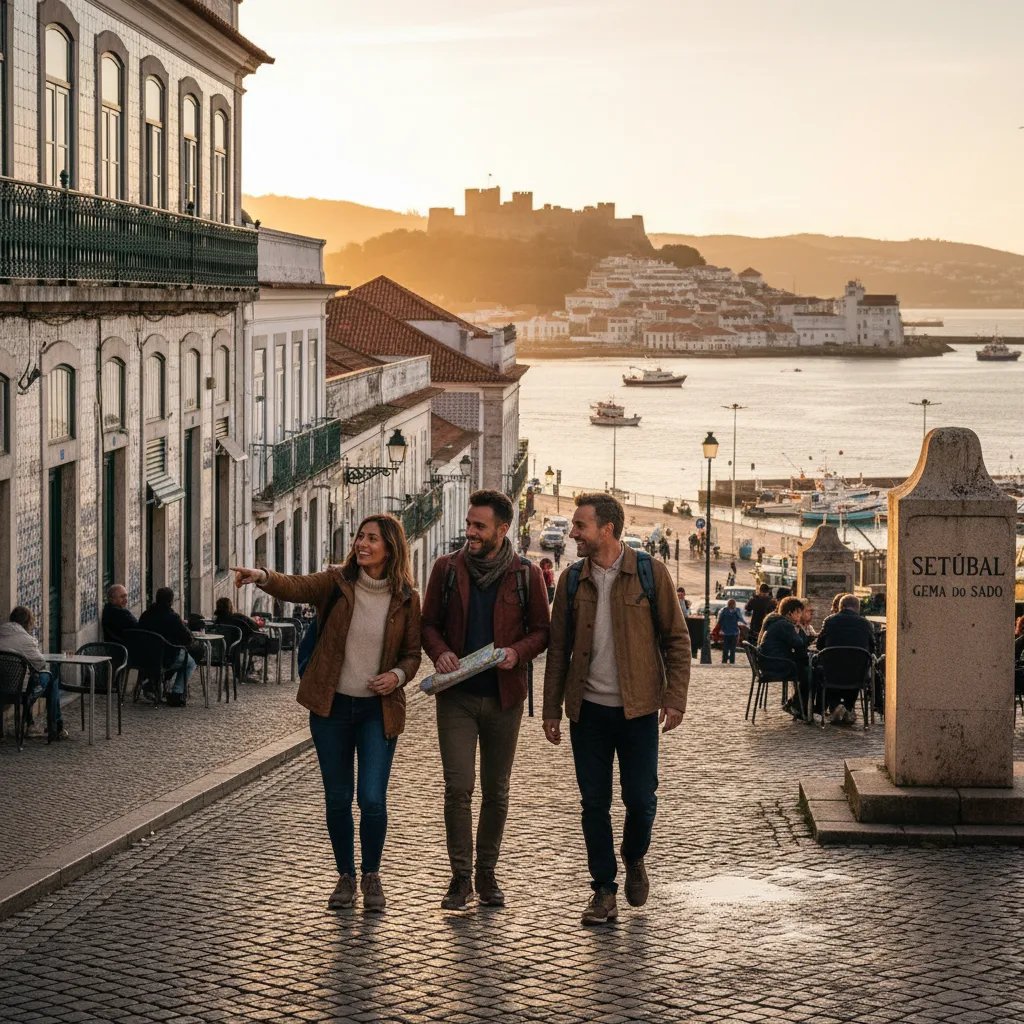
SetúbalOutdoor Escape Game & Treasure Hunt
Port of Fernão Mendes Pinto — first European in Japan
What to do in Setúbal? Dive into the heart of this authentic Portuguese city, nestled on the Sado estuary and at the foot of the Arrábida Natural Park. Setúbal offers a fascinating blend of maritime history, fishing traditions, and stunning natural landscapes. Begin your exploration at the vibrant Mercado do Livramento, renowned for its azulejos and fresh produce, before losing yourself in the narrow streets of the historic center up to Praça de Bocage. Don't miss the majestic São Filipe Fortress for breathtaking panoramic views. For an unusual and immersive activity, embark on an OddballTrip.com outdoor escape game. This life-sized treasure hunt will lead you to discover Setúbal's secrets while solving puzzles, transforming your visit into a true treasure hunt. It's an original and fun way to explore the city, off the beaten path, and create memorable memories.

Unusual things to do in Setúbal
For an unusual activity in Setúbal, the OddballTrip.com outdoor escape game is the ultimate original outing. Far from classic guided tours, this experience immerses you in the heart of the city in a fun and interactive way. It's a modern treasure hunt that invites you to solve puzzles while exploring emblematic places and hidden corners. Whether you're looking for mystery or simply a new way to discover Setúbal, this unique adventure guarantees laughter and unexpected discoveries, making your stay a truly one-of-a-kind experience.
Things to do in Setúbal with kids
What to do with family in Setúbal? Our outdoor escape games are perfectly suited for a fun and educational outing with children aged 8-10 and up (accompanied). Thanks to an intuitive GPS application, the whole family actively participates in solving puzzles and discovering clues scattered throughout the city. It's a wonderful opportunity to combine cultural exploration and entertainment, where everyone, from the youngest to the oldest, can contribute. Transform a simple visit into a memorable collective adventure, strengthening family bonds while exploring Setúbal's heritage.
Setúbal for couples
For a romantic getaway in Setúbal as a couple, our treasure hunts offer an intimate and collaborative experience. Away from the crowds, stroll through the city hand in hand, solving puzzles together and discovering charming places you wouldn't have seen otherwise. It's an activity that stimulates communication and collaboration, perfect for strengthening your bond while exploring the beauty of Setúbal. Imagine wandering along the estuary at sunset after deciphering the last mystery. An original outing that promises unforgettable memories for your duo.
What to do in Setúbal when it rains
What to do in Setúbal on a rainy day? While our escape games are primarily outdoors, Setúbal offers charming alternatives. The Mercado do Livramento, with its magnificent azulejos, is a must-see covered visit. You can also explore the Convento de Jesus or the Setúbal Museum. If the weather allows for a light shower, be aware that some routes of our games may pass through arcades or galleries, offering partial shelter and an original touch to your urban treasure hunt.
Where is Setúbal, and where do the routes start?
Starting points of our routes and the places they pass through.
Route starting points
Places in Setúbal
- Igreja de Jesus
- Praça do Bocage
- Casa do Corpo Santo
- São Filipe Fort
- Former Perienes cannery
- Livramento covered market
- Fishermen's quay
- Statue of Hanno the elephant
The history of Setúbal
From Roman Port to Fishing Hub
Setúbal's history is connected with the Sado Estuary. From the 1st to 4th centuries AD, it was known as Cetóbriga, a Roman commercial center with a fish-processing industry. Archaeological remains show this ancient industry on the waterfront, with salted fish and fermented fish sauces like garum exported across the Roman Empire. The Roman ruins of Tróia, across the estuary, were once the largest fish-salting center in the Roman Empire.
After the Roman period, the region was under Islamic rule from the 8th to the 12th centuries. Setúbal later developed under the Order of Santiago, receiving its first municipal charter in 1249. Fishing, salt production, and commerce were the pillars of the growing settlement. In the 15th century, Setúbal became a seasonal residence for royalty and nobility. Its port played a role in Portugal's Age of Discoveries, with King Afonso V departing from here to conquer Alcácer Ceguer. The city was elevated to city status in 1860 during the reign of Pedro V.
The Canning Industry
The 19th and 20th centuries saw Setúbal become Portugal's most active fishing town, particularly for sardines. The fish-canning industry, which began in 1854, reshaped the city's employment, neighborhoods, and waterfront. At its peak, Setúbal had about 400 fish-preserving factories, providing employment, especially for women who made up most of the factory workforce. None of these factories are still operating today, but the city's identity remains connected to its maritime heritage and fishing traditions.
What to see in Setúbal
- Igreja de Jesus — This church, begun in 1490, is an early example of the Manueline style. Inside, it has twisted columns and stone vaulting made from Arrábida breccia, supporting spiral-ribbed ceilings. The adjacent convent houses the Museu de Setúbal, displaying art from the late Middle Ages, Renaissance, and Baroque periods.
- Praça do Bocage — This central square is named after Manuel Maria Barbosa du Bocage, a Portuguese poet born in Setúbal in 1765. It is a pedestrianized area with tiled squares and narrow alleys.
- Casa do Corpo Santo — Built in 1714 next to a section of Setúbal's 14th-century wall, this building was associated with the Brotherhood of Navigators. It now houses the Museum of Baroque, featuring 18th-century paintings on the ceilings and gilded wood in its chapel, along with Baroque tiles.
- São Filipe Fort — Constructed in 1582 during the reign of King Philip II of Spain (Philip I of Portugal), this irregular polygonal fort with six bastions was designed to defend the coast. It offers views over the city and the Sado Bay. Inside, there is a chapel with blue and white tiles by Policarpo de Oliveira Bernardes, depicting scenes from the life of Saint Philip.
- Mercado do Livramento — This covered market, opened in 1930, has hand-painted tile murals at its entrance and back wall. It is a place for locals to buy fresh fish, seafood, fruits, vegetables, and regional products.
- Fishermen's Quay, Setúbal Harbour — The fishing port is central to Setúbal's identity. Here, daily activity involves fishermen bringing in their catches, supplying the market and local restaurants.
When to visit Setúbal
The period from mid-May to early October is suitable for outdoor activities in Setúbal. For hot-weather activities like beaches and pools, late June to early September is ideal, with July and August being the warmest months, averaging around 29-30°C (84-86°F). During summer, a sea breeze offers some relief, but shade in the old town can be limited.
Spring (March to May) and autumn (September to November) offer mild temperatures, fewer crowds, and conditions for exploring historic sites. Early September still has warm enough sea temperatures for swimming, and autumn is suitable for wine enthusiasts as vineyards begin their harvest. Winter (December to February) is mild, with temperatures rarely dropping below 10°C (50°F), but rainfall is more frequent. This low season means fewer crowds and lower accommodation rates, making it suitable for cultural visits.
Avoid July and August if you prefer to avoid intense heat and large crowds, as it is peak season for beaches and ferries can be full.
Getting around Setúbal
Setúbal is about 50 kilometers (31 miles) southeast of Lisbon. It is reachable by train from Lisbon's Oriente, Entrecampos, or Roma-Areeiro stations, with the journey taking about one hour. Buses also connect Lisbon and Setúbal from Praça de Espanha.
The city center is largely pedestrianized, making it suitable for exploration on foot. Comfortable shoes are recommended, especially for sites like São Filipe Fort, which involves uphill streets. Public transport is available, but many attractions are within walking distance. The Mercado do Livramento is open Tuesday to Sunday from 7:30 AM to 2 PM; mornings offer a full selection. Many local restaurants source their fish from here.
Parking is available in various areas, but walking is often the easiest way to navigate the old town. Setúbal is known for choco frito (fried cuttlefish), a local specialty available at a tasca away from the waterfront for an authentic experience.
Things you probably do not know about Setúbal
Verified details most visitors walk straight past.
- Igreja de Jesus
- What architectural detail in the Igreja de Jesus marks a significant turning point in Portuguese art? The church's twisted columns and spiral-ribbed vaulting, made from local Arrábida breccia, are considered some of the earliest expressions of the Manueline style, a distinctive Portuguese late Gothic architectural form.
- São Filipe Fort
- Who was the fortress initially attributed to, and who was the actual designer? For many years, the São Filipe Fort was attributed to Philip Terzi, but it was actually designed by Captain Fratino in 1583, with an irregular polygonal plan resembling a six-pointed star.
- Mercado do Livramento
- What unexpected feature can you find decorating the walls of Setúbal's main market? The Mercado do Livramento is famous not only for its fresh produce but also for the extensive and lively hand-painted tile murals that adorn its entrance and back wall, depicting scenes related to local life and trade.
- Casa do Corpo Santo
- What historical group was originally associated with the Casa do Corpo Santo? The Casa do Corpo Santo was built in 1714 and served as the headquarters for the Brotherhood of Navigators, whose patron saint, Saint Pedro Gonçalves Telmo (known as Corpo Santo), was the protector of shipwrecked people.
- Sado Estuary
- What ancient industry made the Sado Estuary a crucial economic hub in Roman times? During the Roman period, the Sado Estuary was home to the highest concentration of fish-salting industries in the entire Roman Empire, producing salted fish and *garum* (fermented fish sauce) for export.
- Setúbal's Canning Industry
- Which demographic group played a particularly significant role in Setúbal's historic fish-canning factories? Women formed a significant part of the factory workforce in Setúbal's fish-canning industry, which transformed the city's economy and employment during the 19th and 20th centuries.
Questions about visiting Setúbal
How long should I spend in Setúbal?
A full day is often recommended to explore Setúbal's main attractions, including the Mercado do Livramento, Igreja de Jesus, and São Filipe Fort. If you plan to take a ferry across the estuary to the Tróia Peninsula or explore the Arrábida Natural Park, consider extending your stay to two days.
What is the best way to get around Setúbal?
Setúbal's historic center is largely pedestrianized and best explored on foot. Many key sights are within walking distance of each other. For destinations further afield, such as São Filipe Fort on the western hill, local buses or a taxi might be more convenient.
What is Setúbal known for gastronomically?
Setúbal is particularly known for its *choco frito*, a dish of fried cuttlefish. You will find it served in many local restaurants and *tascas*. The city is also known for its fresh seafood, available at the Mercado do Livramento, and for the sweet Moscatel de Setúbal wine produced in the region.
Is Setúbal a good destination for families with children?
Yes, Setúbal offers several family-friendly activities. Children might enjoy exploring the São Filipe Fort, visiting the Mercado do Livramento, or taking a dolphin-watching tour in the Sado Estuary. The nearby Arrábida Natural Park also provides opportunities for outdoor activities and beaches.
What are the local market days in Setúbal?
The main Mercado do Livramento is open Tuesday to Sunday from 7:30 AM to 2 PM. Mornings are generally the busiest and best time to experience the market's atmosphere and widest selection of fresh produce and seafood.
What is the average budget needed for a day in Setúbal?
Setúbal can be a relatively affordable destination. Expect to pay around €70-€110 per night for mid-range hotels during spring and autumn, with prices increasing to €120-€160 in summer. Dining at local *tascas* for specialties like *choco frito* can be budget-friendly. Public transport costs are generally low, and many attractions are free or have modest entrance fees.
Frequently asked questions
How much does an outdoor escape game cost in Setúbal?
An OddballTrip.com outdoor escape game in Setúbal is a very accessible activity. The price is generally €12 per team, not per person, making it ideal for groups of friends or families. This rate includes access to the game application, puzzles, clues, and customer support if needed. It's an excellent option for a quality activity without breaking the bank, offering great value for an immersive and memorable experience in the city.
Is it suitable for children / families?
Absolutely! Our escape games are designed to be fun and engaging for all ages. They are perfectly suited for families with children from 8-10 years old, provided they are accompanied by an adult. The use of a GPS application makes the experience interactive and easy to follow. The puzzles are varied and stimulate logic, observation, and collaboration, allowing everyone to contribute to the adventure. It's a great way to spend quality time as a family, discover Setúbal together, and create shared memories.
How long does an escape game last in Setúbal?
The duration of an OddballTrip.com escape game in Setúbal generally varies between 1h30 and 2h30, depending on the chosen route and your pace of play. Some groups like to take their time to admire the sights and solve puzzles calmly, while others prefer to tackle the challenge more quickly. You are free to take breaks whenever you wish. The goal is to offer you a flexible and enjoyable experience, adapted to your desires for discovery and adventure.
Do I need to book in advance?
For OddballTrip.com escape games in Setúbal, advance booking is not strictly mandatory as the games are always available via our app. However, we highly recommend it, especially if you plan to play during peak tourist season or on weekends. This ensures better organization and allows you to start your adventure without waiting, with complete peace of mind. A reservation also guarantees you receive all necessary instructions for an optimal experience.
What to visit in Setúbal beyond escape games?
Beyond our treasure hunts, Setúbal is full of treasures to explore. Don't miss the majestic Forte de São Filipe, offering breathtaking views of the city and the estuary. Stroll through the historic center and visit the Convento de Jesus, a remarkable example of Manueline architecture. For nature lovers, the Arrábida Natural Park and the Sado Estuary are must-sees, perfect for dolphin watching or a day at the beach. And of course, the vibrant Mercado do Livramento is a sensory experience not to be missed.
What is the best season to visit Setúbal?
The best season to visit Setúbal and fully enjoy its charms, including our outdoor escape games, is spring (April to June) and early autumn (September to October). During these periods, the climate is mild and sunny, ideal for outdoor activities, without the intense summer heat or crowds. Summer (July-August) is also very pleasant, especially if you want to enjoy the beaches, but the city is more lively.
More cities in Portugal
Alentejo
Lands of cork oaks, flavors and ancient history
Évora
Roman temple, bone chapel and Jesuit university in the heart of the Alentejo
Óbidos
The fortress-town given as a dowry — white ramparts and ginjinha
Tomar
City of the Templars — Charola and Convento de Cristo
Monsaraz
The sentinel village above Lake Alqueva — menhirs and stars