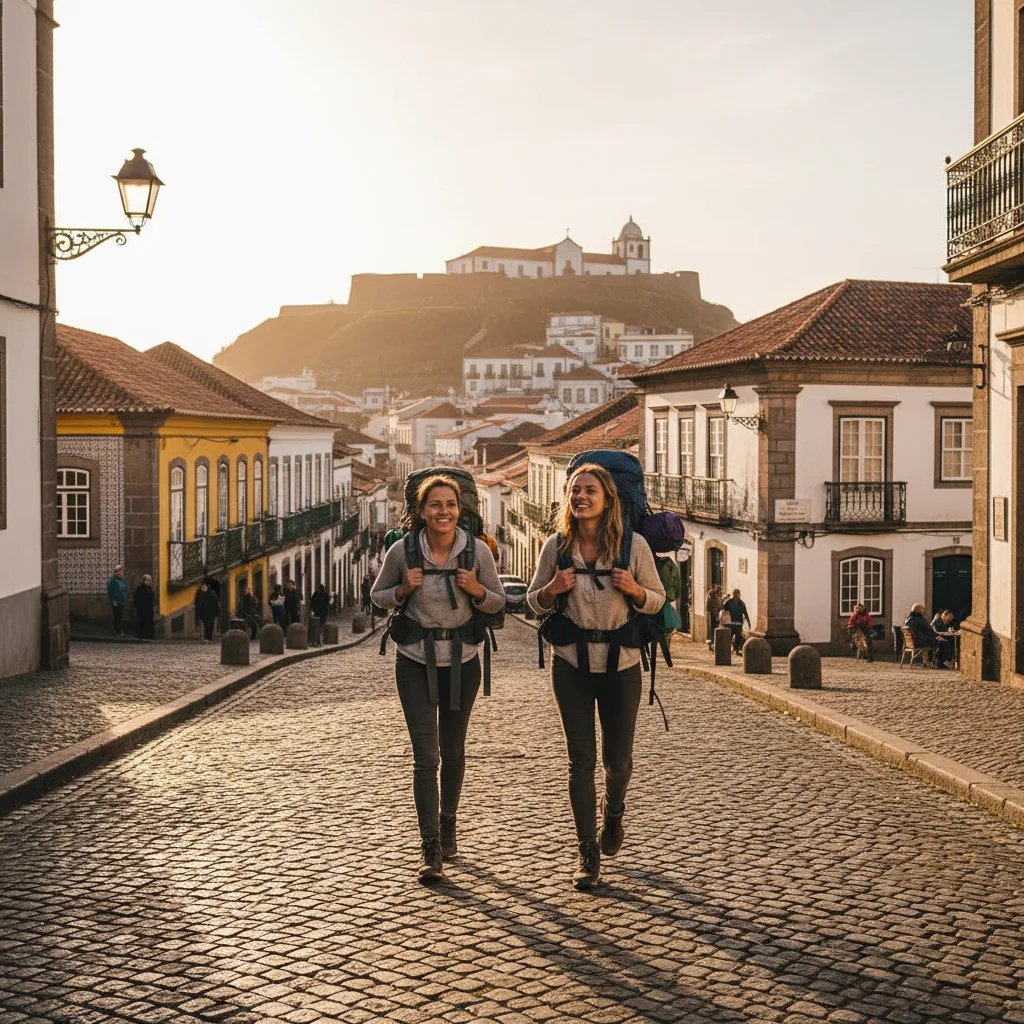
Angra do HeroísmoOutdoor Escape Game & Treasure Hunt
UNESCO and Atlantic stopover — Terceira's heroic city
Angra do Heroísmo, the first capital of the Azores and a UNESCO World Heritage site since 1983, unveils unique Renaissance heritage in the heart of the Atlantic. What to do in Angra do Heroísmo? Discover this historic city differently through our outdoor escape game: a scavenger hunt that turns your exploration into a captivating investigation. The trail winds between the Cathedral of the Holy Saviour, the colourful facades of Rua Direita and the fortifications of Monte Brasil, revealing the secrets of this former Portuguese navigators' stopover. This unusual activity leads you from baroque palaces to volcanic ramparts, turning every cobbled street into an urban treasure hunt playground. Here's the trail we offer to unlock the mysteries of Angra do Heroísmo:
Angra do Heroísmo — The Galleon's Chests
Uncover the hidden chests of a sunken galleon from the Carreira da Índia. Decode clues across forts and churches to claim the lost gold before rivals seize it.
Angra do Heroísmo — António's Secret Maps
Uncover the eight hidden maps of António Prior do Crato, scattered across Angra do Heroísmo. Decipher their codes to expose his secret plan to reclaim the Portuguese throne from Spanish usurpers.
Landmarks of Angra do heroismo
Monuments and sites covered by our escape games across the city.
Unusual things to do in Angra do Heroísmo
Among the unusual things to do in Angra do Heroísmo, our outdoor puzzle trail reveals the hidden treasures of this Renaissance city lost in the middle of the Atlantic. Explore the underground passages of Monte Brasil fortifications, decipher the masonic symbols carved on palace facades along Rua da Sé, or follow the traces of ancient navigators through the cobbled streets of the historic centre. The riddles unveil what standard guides skip: the mysterious orientation of certain churches, the weathered inscriptions of former convents, the secret passages between noble residences. The perfect original outing to discover the secret soul of this Azorean pearl.
Things to do in Angra do Heroísmo with kids
What to do with the family in Angra do Heroísmo? Our outdoor escape game is suitable from age 10 and turns the discovery of the UNESCO historic centre into an adventure for the whole family. Kids hunt for clues on the colourful facades, teens decipher puzzles linked to the Azores' maritime history, while parents soak up the unique Renaissance architecture. The GPS-guided trail avoids steep slopes and favours the shaded pedestrian streets of the city centre. An original kids' activity that combines culture and play, perfect for a teen-friendly outing that beats traditional museums and rounds off a discovery of Terceira island.
Angra do Heroísmo for couples
Angra do Heroísmo for couples lives in its cobbled streets with pastel facades, its secret gardens overlooking the bay and its terraces facing Monte Brasil. Our outdoor trail, perfect for a couples outing or a romantic getaway, turns a 2-hour walk into a shared investigation through this Atlantic Renaissance pearl. The unexpected romantic activity: decoding a baroque inscription together, getting lost in the meanders of the UNESCO historic centre, ending with a sunset from the ramparts. An original way to discover this Azorean city beyond the standard tourist circuits, between ocean and history.
What to do in Angra do Heroísmo when it rains
What to do in Angra do Heroísmo when it rains? Contrary to popular belief, the outdoor escape game stays perfectly playable in light rain: 70% of the trail winds under the Renaissance arcades of Rua Direita, the covered galleries of Palácio dos Capitães Generais and the vaulted passages of former convents. A wet-weather activity that reveals another face of the UNESCO city — when the volcanic cobblestones shine under Atlantic rain and colourful facades reflect in puddles, offering a unique atmosphere to this Azorean pearl.
Where is Angra do Heroísmo, and where do the routes start?
Starting points of our routes and the places they pass through.
Route starting points
Places in Angra do Heroísmo
- Old Square
- Bettencourt House
- College Church
- Palace of the Captains General
- São João Baptista Fortress
- Cathedral of the Most Holy Savior
- Memory Hermitage
- Memory Hill
- Praça Velha
- Rua da Sé
- São Francisco Convent
- Alto da Memória
- Misericórdia Church
The history of Angra do Heroísmo
A Mid-Atlantic Port
Angra do Heroísmo was founded around 1478. Its location in the mid-Atlantic made it the most important city in the Azores. It served as a stopover for Portuguese fleets traveling between Europe, Africa, Brazil, and the East Indies during the Age of Exploration. This role in maritime trade brought wealth and shaped the city's Renaissance urban planning. In 1534, Angra became the first city in the Azores and the seat of the Diocese of Angra.
Conflict and Recognition
The city's history includes periods of conflict. During the Portuguese succession crisis in the late 16th century, Angra was a stronghold against Spanish occupation from 1580 to 1583. It served as the de facto capital of Portugal under António I, Prior of Crato. In the 19th century, Angra played a role in the Liberal Wars. The city repelled a Miguelist attack in the Battle of Praia da Vitória on August 11, 1829. Queen Maria II granted the city the title "do Heroísmo" (of Heroism) in 1837, changing its name to Angra do Heroísmo, in recognition of its citizens' loyalty. The city experienced a major earthquake on January 1, 1980, which damaged its historic center. It was rebuilt within four years, preserving its pre-earthquake form. In 1983, the historic center of Angra do Heroísmo was designated a UNESCO World Heritage site, for its preservation of Renaissance urban planning and its historical significance in Atlantic navigation.
What to see in Angra do Heroísmo
- São João Baptista Fortress — This 16th-century fortress, also known as Monte Brasil Fortress, was built by the Spanish between 1593 and 1636 from volcanic rock. It offers views of the city, the bay, and the Cabras Islets. Inside, dungeons are carved into the rock, and the Igreja de São João Baptista church commemorates the Restoration of Independence.
- Palace of the Captains General (Palácio dos Capitães-Generais) — Originally a Jesuit college authorized by King D. Sebastião in 1572, this 18th-century Baroque palace became the residence of the Captain-General in 1766. It features Baroque interiors, including the Room of the Kings, with oil portraits of the House of Braganza monarchs.
- Cathedral of the Most Holy Savior (Sé Catedral) — The largest church in the Azores, built in the 16th century, is an example of Mannerist architecture. Its interior combines Baroque altarpieces with cedar wood ceilings. The tower is asymmetrical due to various building phases over two centuries.
- Alto da Memória — This 19th-century monument, built on the site of the 15th-century Castelo dos Moinhos, offers a view over Angra's Bay, Forte de São Sebastião, and Monte Brasil. It commemorates the arrival of King Pedro IV during the Portuguese Civil War.
- Convent of São Francisco — Dating to around 1470, this former Franciscan convent and its Church of Our Lady of the Guide now house the Angra do Heroísmo Museum. The museum's collections cover Azorean material culture from the 15th century onward, including sacred art, weaponry, and navigation instruments.
- Praça Velha — The main square of Angra do Heroísmo is a central point for exploring the city. Its 16th-century urban grid, with colorful facades, reflects the city's Renaissance heritage.
When to visit Angra do Heroísmo
The best time to visit Angra do Heroísmo is from June to September. Temperatures range from 22°C to 26°C (72-79°F), and rainfall is lower. July and August are the warmest, with sea temperatures peaking, suitable for swimming in natural lava pools. This period also has most festivals and tourada à corda (bullfighting with a rope) events. For fewer crowds and lower prices, consider May or October. The weather remains good, and volcanic sites are open. Avoid January, February, March, April, and December if you prefer drier, warmer conditions, as these months are cooler and rainier, with December being the wettest.
Getting around Angra do Heroísmo
Angra do Heroísmo is served by Terceira (TER) Airport, 15.8 km (9.8 miles) away. You can reach the city from the airport by bus (Mobi Azores operates a bus from Aeroporto das Lajes to Angra - Bailão three times a day, taking about 52 minutes and costing €3-€5) or by taxi (around 17-18 minutes for €26-€32). The historic center is compact and best explored on foot. There are slopes, particularly around Rua da Sé and towards Alto da Memória. Parking in the city center can be scarce and requires payment. For exploring the rest of Terceira Island, renting a car is recommended as public transport outside the main cities has low frequency and does not reach all attractions.
Things you probably do not know about Angra do Heroísmo
Verified details most visitors walk straight past.
- Palace of the Captains General
- What grand event once took place in the 'Room of the Kings' within the Palace of the Captains General? In 1832, King Pedro IV hosted a splendid ball in the Room of the Kings to celebrate the birthday of his daughter, Maria II of Portugal.
- São João Baptista Fortress
- Beyond its impressive walls, what unique feature can be found within the São João Baptista Fortress? The fortress contains dungeons carved directly into the volcanic rock, offering a glimpse into its long defensive history.
- Convent of São Francisco
- Before becoming a museum, what diverse roles did the Convent of São Francisco play in Angra do Heroísmo's history? After the extinction of religious orders in Portugal in 1834, the convent served as a seminary and later housed the Liceu de Angra do Heroísmo, a public school.
- Alto da Memória
- What earlier fortification stood on the site of the Alto da Memória monument? The Alto da Memória obelisk was built over the ruins of Castelo dos Moinhos, a 15th-century fortress, which was the first of its kind on the island.
- Cathedral of the Most Holy Savior (Sé Catedral)
- Why does Angra do Heroísmo's grand Cathedral have an asymmetrical tower? The Cathedral's tower is asymmetrical due to successive building phases over two centuries, reflecting its long construction history.
- Angra do Heroísmo's colorful facades
- What is the reason behind the distinctive brightly colored trim on many of Angra do Heroísmo's white buildings? The traditional civil architecture of Angra features bright colored trim (often blue, green, or red) against a white background, along with wrought-iron balconies and guillotine-style sash windows, creating its recognizable atmosphere.
Questions about visiting Angra do Heroísmo
How many days are enough to visit Angra do Heroísmo?
One full day is sufficient to explore the historic center of Angra do Heroísmo, including its main squares, palaces, and the cathedral. If you wish to hike Monte Brasil, add another half day. For exploring the entire Terceira Island, a stay of two to three nights, or ideally three to four full days, is recommended.
What are the best ways to get around Angra do Heroísmo?
The historic center of Angra do Heroísmo is best explored on foot due to its compact nature and pedestrian-friendly areas. For travel outside the city to other parts of Terceira Island, renting a car is recommended as public transport can be infrequent and does not cover all tourist attractions. Taxis are also available.
What is the typical budget for a trip to Angra do Heroísmo?
Angra do Heroísmo offers options for different budgets. Accommodation, dining, and activity costs are generally reasonable, especially outside the peak summer months. Public transport is a budget-friendly option for airport transfers and limited island travel, while car rentals offer more flexibility for exploring.
Which neighborhood is best to stay in Angra do Heroísmo?
Staying within the historic center of Angra do Heroísmo is often recommended. This area provides the best concentration of restaurants, interesting accommodation options, and easy walking access to many of the city's main attractions.
Is Angra do Heroísmo suitable for families with children?
Angra do Heroísmo offers a historical and cultural experience that can be engaging for families. The compact city center is walkable, and attractions like the São João Baptista Fortress and Monte Brasil provide outdoor exploration. The island of Terceira also has natural pools and other activities suitable for children.
What are the local market days in Angra do Heroísmo?
Specific local market days for Angra do Heroísmo are not explicitly detailed. However, local markets typically offer fresh produce and regional products. It is advisable to inquire locally upon arrival for the most current market schedules.
Frequently asked questions
How much does an outdoor escape game in Angra do Heroísmo cost?
Our outdoor escape game in Angra do Heroísmo costs €12 per team (1 phone). For larger groups, budget €19 for 2 phones and €25 for 3. A single price to discover this UNESCO Azorean pearl in a fun and original way.
Is the Angra do Heroísmo escape game suitable for children?
Yes, our trail in Angra do Heroísmo is suitable from age 10. The puzzles are built for group play: kids spot architectural details on colourful facades, teens crack codes linked to maritime history, adults connect it all to Renaissance heritage. The GPS guides step by step through the secure historic centre.
How long does the escape game in Angra do Heroísmo last?
Expect about 2 hours to discover Angra do Heroísmo's historic centre through our treasure hunt. The game is self-guided: no fixed start time, play at your own pace. Perfect to fit a morning or afternoon between visits around Terceira island.
Do I need to book in advance for Angra do Heroísmo?
Online booking isn't mandatory but is recommended in high season (June-September) when tourist numbers peak in the Azores. You receive an activation code by email instantly — no expiry date, use it whenever you want.
What else to see in Angra do Heroísmo beyond the escape game?
Angra do Heroísmo, a UNESCO site, hides three must-sees: the Cathedral of the Holy Saviour with its unique azulejos, the Palácio dos Capitães Generais (former seat of Azorean power), and the Monte Brasil fortifications offering panoramic bay views. Our trail naturally incorporates these Renaissance gems into a playful discovery of the Azores' first capital.
When is the best time to visit Angra do Heroísmo?
Spring (April-June) and autumn (September-October) are ideal: mild temperatures, golden light on Renaissance facades, fewer tourists than summer. Summer remains pleasant thanks to Atlantic trade winds. In winter, the Azorean climate stays mild and the historic centre's arcades allow outdoor games even on overcast days — perfect for year-round activity.
More cities in Portugal
Funchal
The fennel city — Columbus, Churchill and the Atlantic levadas
Cascais
The fishing village where the Portuguese monarchy ended
Sintra
Byron's "glorious Eden" — romantic palace and Moorish castle
Óbidos
The fortress-town given as a dowry — white ramparts and ginjinha
Lisbon
From Belém to Alfama — 8 escape games across the city of Discoveries
Setúbal
Port of Fernão Mendes Pinto — first European in Japan