
WhitbyOutdoor Escape Game & Treasure Hunt
Birthplace of Dracula and Gothic legends
Whitby, the birthplace of Dracula and gothic legends, is far more than just a coastal town in Yorkshire. It's a destination where history, mystery, and natural beauty converge, offering a plethora of unique experiences. If you're wondering "what to do in Whitby," prepare to be enchanted. Start by exploring the winding narrow streets leading to the picturesque harbour, where fishing boats rub shoulders with sailboats. Climb the famous 199 Steps to reach the iconic Whitby Abbey, a majestic ruin that dominates the town and offers breathtaking views of the North Sea. Don't miss the Captain Cook Memorial Museum, tracing the history of the renowned explorer. For a truly immersive and unusual activity, embark on an OddballTrip outdoor escape game. It's a captivating scavenger hunt, a real urban treasure hunt that will lead you to discover Whitby's secrets in a fun and interactive way, through its monuments and legends. An original way to experience the town's gothic and maritime spirit.
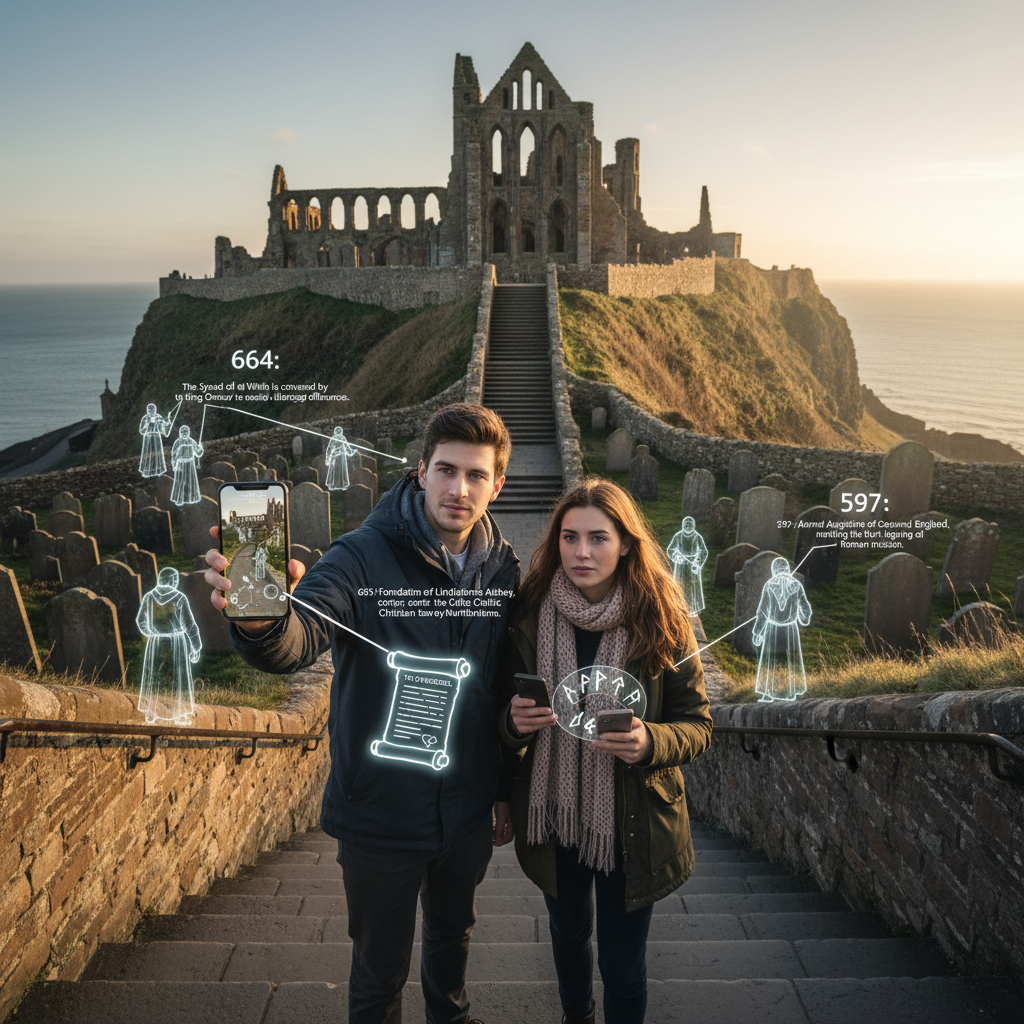
Whitby Abbey — The Hidden Vote That Split Christendom
Decipher the secret alliances and hidden votes that decided whether Celtic or Roman Christianity would rule Britain. Uncover what really happened behind closed doors at the 664 Synod.
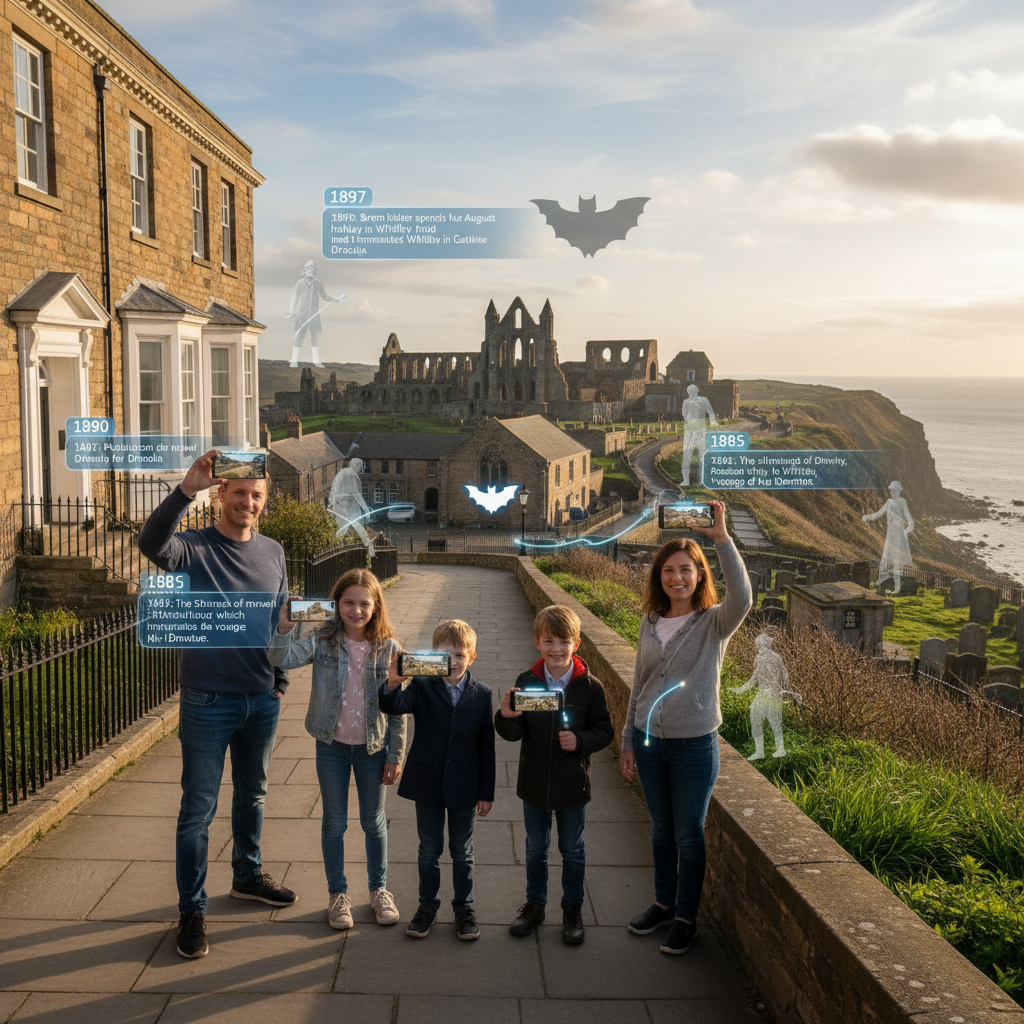
Whitby — Dracula's Arrival
Solve the mystery of Dracula’s arrival in Whitby by tracking the clues left in the abbey ruins, the 199 steps, and the town’s gothic landmarks.

Lyme Regis — Unearth the Jurassic Conspiracy
Decipher Mary Anning's hidden field notes and expose the scientific conspiracy that stole her discoveries. Solve the mystery of the stone dragons before the tide erases the truth.
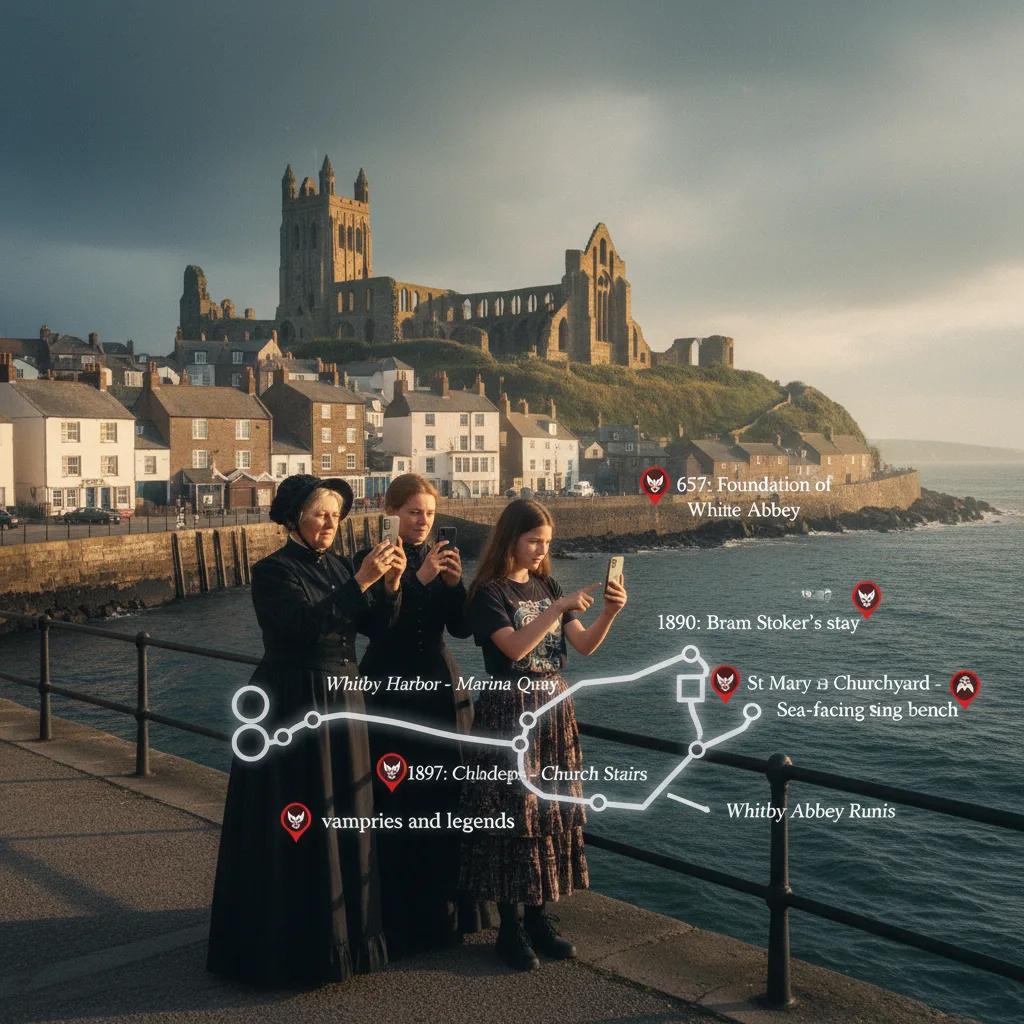
Whitby — Dracula's Demoiselle Curse
Uncover the curse of the Demoiselle that inspired Dracula's first victim. Follow Lucy Westenra's ghostly trail through Whitby's haunted cliffs, deciphering clues from the shipwreck to expose the vampire's dark secret before it claims another soul.
Unusual things to do in Whitby
For an unusual activity in Whitby, immerse yourself in its unique atmosphere. Beyond the classics, the town is full of hidden gems. Join a ghost or Dracula-themed guided tour for a thrilling and original experience. Wander through the gothic curiosity and amber shops along Church Street, where every window tells a story. An excellent original outing is undoubtedly our OddballTrip scavenger hunt, which transforms the town into a huge playground. Solve puzzles while exploring hidden nooks, secret passages, and legend-infused places, far from the beaten path. It's an interactive and memorable way to experience Whitby's mysterious spirit.
Things to do in Whitby with kids
Looking for "what to do in Whitby with family"? The town is a fantastic playground for children and teens. After a morning searching for fossils on the beach or building sandcastles, why not embark on an OddballTrip adventure? Our outdoor escape games are designed to be fun and accessible from ages 8-10, with adult participation. It's an excellent way to stimulate children's curiosity while exploring the town. Every family member, from the youngest to teens, will find their role in this interactive treasure hunt, transforming the visit into a shared and memorable experience.
Whitby for couples
Whitby offers a wonderful setting for a romantic getaway. Imagine yourselves hand in hand, exploring the cobbled narrow streets of the old town, discovering artisan shops and cozy cafes. Climb together to Whitby Abbey at sunset for a spectacular view of the coast and the illuminated town, an unforgettable intimate moment. Our OddballTrip scavenger hunt can also be a charming activity for "Whitby as a couple." It's a unique way to collaborate, solve puzzles together, and share laughs while discovering the most picturesque corners and secret stories of the town. An adventure to share that strengthens bonds.
What to do in Whitby when it rains
Don't let the weather spoil your visit to Whitby! If you're wondering "what to do in Whitby on a rainy day," know that our OddballTrip escape game is surprisingly well-suited. Approximately 80% of our routes take place under arcades, covered passages, or near shelters, allowing you to play comfortably. You can also take refuge in the town's many museums, like the Captain Cook Memorial Museum, or art galleries. Cozy tea rooms are perfect for warming up with a hot drink. Whitby remains charming even in the rain, offering a mysterious atmosphere conducive to exploration.
Where is Whitby, and where do the routes start?
Starting points of our routes and the places they pass through.
Route starting points
Places in Whitby
- At the foot of the 199 Steps
- External viewpoint of Whitby Abbey ruins
- The 199 Steps to St Mary's Church
- St Mary's Church graveyard (external view)
- Whitby Pier
- Public garden or esplanade in front of the Abbey
- Whitby Market Place
- Whitby War Memorial
- 6 Royal Crescent
- Panoramic view of Whitby Abbey ruins from West Cliff
- St Mary's Church graveyard (view from main entrance)
- View of Whitby harbour from East Pier
- Facade of Whitby Library
- Whitby Swing Bridge
- Statue of William Scoresby
- Whitby Beach - East section near lighthouse
- Church Street - Former jet workshops
- St Mary's Church - South porch
The history of Whitby
From Anglo-Saxon Monastery to Viking Raids
Whitby's story begins in 657 AD, when King Oswiu of Northumbria founded a double monastery for men and women on the East Cliff, known then as Streoneshalh. Abbess Hild, a grand-niece of the first Christian King of Northumbria, Edwin, led this religious centre. In 664 AD, the Synod of Whitby took place here, resolving differences between Celtic and Roman Christian practices, particularly the method of calculating Easter, and shaping the future of the English Church. The monastery operated for two centuries until Viking raiders sacked and destroyed it around 867 AD, leaving the site desolate for hundreds of years. The name 'Whitby' itself is thought to derive from the Old Norse "Hvítabýr," meaning "White Settlement," likely given by these Viking settlers.
Maritime and Industrial Development
After the Norman Conquest, a new Benedictine monastery was founded on the headland around 1078. The Gothic church, whose ruins stand today, began construction in 1220. By the Middle Ages, Whitby was a fishing port, primarily for herring. The town's economy grew in the 18th century. Whitby became a shipbuilding and whaling port, with local shipbuilders crafting vessels from English oak. The whaling industry began in 1753 and peaked in the early 1800s, with up to 55 whaling ships operating from the harbour. These ships traveled to Arctic waters, bringing back whale oil for lamps and baleen for manufacturing, contributing to the town's Georgian architecture. Whitby's shipbuilding gained recognition when Captain James Cook's HMS Endeavour, built by Thomas Fishburn in Whitby, departed in 1768 for his first voyage of exploration to the Pacific. The town also saw growth in the alum industry in the late 16th century, using local shale to produce this chemical for fabric dyeing and leather tanning.
Victorian Era and Jet Industry
The 19th century brought changes. The whaling industry declined by 1837, and shipbuilding moved elsewhere. However, the Victorian era saw Whitby develop as a seaside resort, with new terraces built on the West Cliff. This period also marked the peak of the Whitby Jet industry. Jet, a fossilised driftwood formed during the Jurassic period, has been used as a gemstone for at least 5,500 years. Following the death of Prince Albert in 1861, Queen Victoria's preference for jet mourning jewellery led to increased demand. By the 1870s, there were over 200 jet factories in Whitby, employing around 1,500 people, making Whitby Jet a known gemstone.
What to see in Whitby
- Whitby Abbey — Explore the ruins of the 13th-century Benedictine abbey on the East Cliff. You can see the remaining Gothic arches and walls, which have stood for centuries despite erosion and shelling in 1914 during World War I.
- St Mary's Church — Next to Whitby Abbey, this ancient parish church shows Whitby's past with its box pews and a three-decker pulpit. The churchyard offers views of the town and harbour.
- The 199 Steps — Climb these steps, also known as Jacob's Ladder, connecting the old town to St Mary's Church and Whitby Abbey. Each step is numbered, and the ascent offers views.
- Whitby Harbour — Observe the fishing boats and pleasure craft. The harbour has been a centre of activity for centuries, from its early days as a herring port to its whaling and shipbuilding prominence.
- Captain Cook Memorial Museum — In the 17th-century house on Grape Lane where James Cook lived during his apprenticeship, this museum details his early life and voyages, featuring models of his ships, including the HMS Endeavour.
- Whitby Market Place — Find stalls offering products, vintage items, and fresh produce. The market operates on Tuesdays, Saturdays, and Sundays, currently at Dock End and Quay Road due to restorations at the Old Town Hall.
- West Cliff — Walk along the West Cliff for views of Whitby Abbey, the harbour, and the North Sea. This area also features the Whalebone Arch, a reminder of Whitby's whaling history, and the Captain Cook statue.
When to visit Whitby
The best time to visit Whitby for warm-weather activities is from early July to late August, when temperatures are warmest and days are longest. This is peak season, with events like the Whitby Regatta and Whitby Folk Week in August, meaning larger crowds and higher accommodation prices. Late spring (March to May) and early autumn (September to November) offer a quieter experience with pleasant weather and fewer crowds, though spring can bring sea fog. September is noted for quieter streets and good autumn light on the abbey ruins. The Goth Weekends in late April/early May and late October bring a distinct atmosphere and can be busy. Winter (December to February) is the quietest, with cold, dark days and some museums potentially closed, but also offers Christmas events and empty sands. Avoid visiting in mid-August if you prefer to avoid the largest crowds, as this is when the Whitby Regatta takes place, filling the town.
Getting around Whitby
Whitby is accessible by car, though parking requires planning. Several pay-and-display car parks are available, including Abbey Headland Car Park, Church Street Car Park, and Endeavour Wharf Car Park, with varying rates and capacities. Some car parks, like Pavilion Drive, operate seasonally from March to October. On-street parking is often limited to three hours, with winter overnight restrictions from November 1 to April 15. For those staying overnight, it is advisable to check parking options with your accommodation. The town is best explored on foot, with many attractions concentrated around the harbour and cliffs. The Whitby Outdoor Market takes place on Tuesdays, Saturdays, and Sundays, currently at Dock End and Quay Road. Whitby also has a railway station, connecting it to the North Yorkshire Moors Railway, a heritage steam line.
Things you probably do not know about Whitby
Verified details most visitors walk straight past.
- Whitby Abbey
- Did you know that the ruins of Whitby Abbey were once hit by German shells? In 1914, during World War I, the German High Seas Fleet shelled Whitby, causing damage to the west front of the abbey ruins. These damages were later repaired.
- Whitby Whalebone Arch
- The Whalebone Arch on West Cliff has a surprisingly recent history of replacement. The first Whitby Whalebone Arch was erected in 1853. The most recent real whale jawbones, donated from Alaska, were installed in 2003 but were removed on September 1, 2026, due to deterioration from coastal weather. They are being replaced by a bronze replica.
- Captain Cook Memorial Museum (Grape Lane)
- Captain James Cook's connection to Whitby runs deeper than just his famous voyages. During his apprenticeship as a merchant navy seaman with the Walker family in Whitby, James Cook lived with them in their house on Grape Lane, which is now the Captain Cook Memorial Museum.
- Whitby Jet
- The popularity of Whitby Jet was significantly boosted by a royal trend. Following the death of Prince Albert in 1861, Queen Victoria's choice to wear jet mourning jewellery led to a massive increase in demand for Whitby Jet, making it a highly fashionable gemstone during the Victorian era.
- The Penny Hedge
- Whitby has a unique annual tradition that dates back to a medieval act of penance. The 'Planting of the Penny Hedge' ceremony takes place yearly on Ascension Eve and dates from 1159. It is said to be a penance imposed on local noblemen who killed a hermit.
Questions about visiting Whitby
How long should I spend in Whitby?
To experience Whitby's main attractions, including the Abbey, St Mary's Church, the Captain Cook Memorial Museum, and a stroll through the town and harbour, a stay of two to three days is recommended. This allows time to explore at a relaxed pace.
What is the best way to get around Whitby?
Whitby is a compact town, and many of its key sights are within walking distance, especially around the harbour and up to the Abbey. For attractions further afield or to explore the surrounding North York Moors, local buses or the heritage railway are options. Parking is available but can be busy, especially in peak season.
Is Whitby suitable for families with children?
Yes, Whitby offers many family-friendly activities. Children can enjoy climbing the 199 Steps, exploring Whitby Abbey, playing on West Cliff Beach, taking boat trips from the harbour, and visiting Pannett Park with its play area. There are also amusement arcades on Pier Road.
What are the local market days in Whitby?
The Whitby Outdoor Market currently operates on Tuesdays, Saturdays, and Sundays. Due to ongoing restorations at the historic Market Place, the market is temporarily located at Dock End and Quay Road, offering a variety of products, vintage items, and fresh produce.
What kind of budget should I plan for a trip to Whitby?
Whitby can cater to various budgets. Accommodation prices vary with the season, with summer being the most expensive. Eating out ranges from affordable fish and chips to more upscale restaurants. Many attractions, like walking the cliffs or exploring the town, are free, while museum entry fees are moderate.
Are there any specific local customs or things to be aware of in Whitby?
While there are not many strict customs, be aware that Whitby is known for its Goth Weekends, which occur twice a year (late April/early May and late October). During these times, the town will be particularly busy and have a unique atmosphere. Booking accommodation well in advance for these periods is essential.
Frequently asked questions
How much does an outdoor escape game cost in Whitby?
An OddballTrip outdoor escape game in Whitby is offered at a single price of €12 per team. This rate is fixed, regardless of the number of players in your group (we recommend 2 to 6 people for an optimal experience). It's a very affordable and fun option to discover the city differently, much cheaper than a classic guided tour or other group activities. Once the game is purchased, it's yours, and you can start it whenever you wish, with no time constraints.
Is it suitable for children / families?
Absolutely! Our outdoor escape games are designed to be a fantastic activity for the whole family. The puzzles are clever but accessible, stimulating logic and observation skills. We recommend active participation for children aged 8-10 and older, but younger ones can also have fun searching for clues with adult help. It's a great way to spend quality time together, challenge your brains, and create memorable experiences while exploring Whitby.
How long does an escape game in Whitby last?
The duration of an OddballTrip outdoor escape game in Whitby typically ranges between 1h30 and 2h30. This depends on your pace of play, your ability to solve puzzles, and the time you take to admire the sights you encounter. The advantage is that you play at your own pace: you can take breaks for a coffee, visit a shop, or simply enjoy the town's atmosphere. It's a flexible and customizable experience.
Do I need to book in advance?
No, not at all! One of the great advantages of our outdoor escape games is their flexibility. You don't need to book a specific time slot. Once you've purchased the game online, you receive immediate access and can start your adventure whenever you wish. Whether it's morning, afternoon, weekday, or weekend, the experience is ready to begin at your convenience. This is ideal for last-minute plans or adapting to Whitby's changing weather.
What to visit in Whitby beyond the escape games?
Whitby is full of treasures to explore! After your scavenger hunt, don't miss the imposing Whitby Abbey, which offers spectacular panoramic views. Descend the 199 Steps to stroll through the lively harbour and discover the Captain Cook Memorial Museum. The narrow streets of the old town are perfect for treasure hunting in curiosity and amber shops. And of course, a walk on the beach to look for fossils or simply enjoy the sea air is a must-do.
What is the best season to visit Whitby?
Whitby is charming all year round, but each season offers a different ambiance. Summer (June-August) is ideal for enjoying the beaches and long sunny days, although the town is busier. Spring and autumn (April-May, September-October) offer milder temperatures, fewer crowds, and a more mysterious atmosphere, perfect for gothic legends. Even winter has its charm, with dramatic landscapes and cozy pubs. Our games can be played regardless of the season.
Other destinations in Yorkshire
Fountains Abbey
Cistercian jewel in the heart of Yorkshire
Haworth
Home of the Brontë sisters and mysterious moors
Hull
Port city, rich in history and culture
Malham Cove
A spectacular natural limestone amphitheatre
Richmond
A Norman castle in the heart of the Yorkshire Dales
Rievaulx
Dive into the history of Cistercian monks in a beautiful valley
Skipton
Gateway to the Dales and its medieval castle
York
Roman, Viking, and medieval city, between walls and legends.
More cities in England
Durham
Medieval city, between castle and cathedral
Vindolanda
Roman fort at the edge of the Empire
Hadrian's Wall
In the footsteps of Roman legions
Lincoln
At the heart of medieval England
Lindisfarne
The sacred island of Celtic monks
Manchester
Cradle of innovation and music
Activities to discover nearby
Guided tours, skip-the-line tickets and local experiences to book in advance.
💡 Optional booking — you can also buy on-site. All links open in a new window, your OddballTrip visit stays preserved.