
ManchesterOutdoor Escape Game & Treasure Hunt
Cradle of innovation and music
Manchester, a vibrant city in the North of England, is a kaleidoscope of experiences waiting to be discovered. If you're wondering what to do in Manchester, prepare for an immersion into a blend of industrial history and cultural modernity. Stroll through the historic Castlefield district, with its canals and repurposed warehouses, or lose yourself in the buzzing atmosphere of the Northern Quarter, a cradle of music and street art. For an unusual activity, why not embark on an outdoor escape game? It's a fantastic way to transform your visit into a real treasure hunt, a life-sized scavenger hunt that will make you explore the city from a new angle. Whether you're looking for museums like MOSI, shopping at the Trafford Centre, or simply a walk along the Irwell, Manchester promises memorable moments.
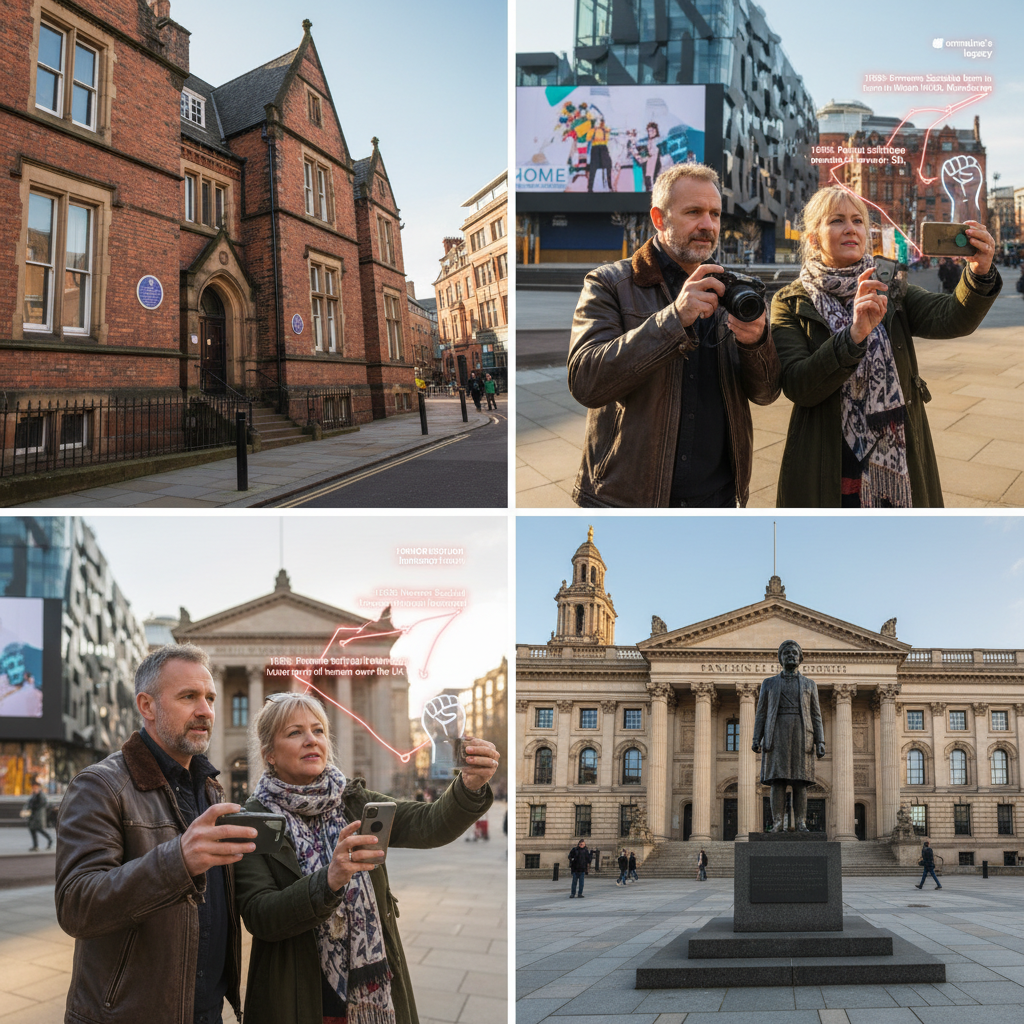
Manchester — The Suffragette's Hidden Code
Uncover the secret code Emmeline Pankhurst left behind in Manchester’s suffragette landmarks and expose the conspiracy that tried to erase her movement.

St Peter's Field — Uncover the Truth of Peterloo
Decipher the hidden accounts of the 1819 Peterloo Massacre. Uncover suppressed testimonies, decode radical pamphlets, and expose the conspiracy of silence that buried the truth for two centuries.
Unusual things to do in Manchester
For an unusual activity in Manchester, step off the beaten path and dive into the city's creative soul. Beyond the classic museums, explore the independent galleries of the Northern Quarter, hunt for rare vinyl records, or catch a surprise concert in a historic pub. An original outing could be to participate in a craft beer brewing workshop, a deeply rooted tradition here. But to truly spice up your day, an outdoor escape game offers a unique adventure, combining urban exploration and puzzle-solving, transforming the streets of Manchester into your own playground.
Things to do in Manchester with kids
If you're looking for what to do with family in Manchester, the city is full of options for all ages. Children and teens will love the Science and Industry Museum (MOSI) with its interactive exhibits, or the National Football Museum, perfect for football enthusiasts. For a fun activity that stimulates teamwork, an outdoor escape game is perfect. Generally suitable for children aged 8-10 and up when accompanied by adults, it transforms city exploration into a thrilling adventure, where everyone can contribute to the treasure hunt. It's an excellent way to create lasting memories together.
Manchester for couples
Manchester, a cradle of innovation, also offers romantic moments for couples. Away from the hustle and bustle, explore the cobbled streets of Castlefield, its picturesque canals and historic bridges, perfect for a hand-in-hand stroll. Admire the architectural heritage of the city's Victorian quarter, or find a viewpoint to contemplate the city lights at dusk. End your day with an intimate dinner in one of the many independent restaurants in the Northern Quarter, or enjoy a show at the Royal Exchange Theatre. Manchester reveals its sweetest charm to those who take the time to explore it together.
What to do in Manchester when it rains
Don't let gloomy weather spoil your Manchester exploration! The city is perfectly equipped for rainy days. Our outdoor escape games are designed to be playable even in drizzle, as about 80% of the route takes place under covered passages, historic arcades, or near shelters. It's a great option to stay dry while enjoying the adventure. You can also take refuge in one of the many free museums or explore the massive Trafford Centre shopping complex.
Where is Manchester, and where do the routes start?
Starting points of our routes and the places they pass through.
Route starting points
Places in Manchester
- Pankhurst Centre (Former home of Emmeline Pankhurst)
- Tony Wilson Place
- St Peter's Square
- Facade of Manchester Central Library
- Facade of the former Chamber of Commerce
- Statue of Queen Victoria
- Facade of Manchester Art Gallery
- St John's Gardens
- Peterloo Memorial
- Upper Mosley Street
- Facade of the original Manchester Guardian building
- Crown Square
- Facade of Manchester Town Hall
- Facade of the People's History Museum
The history of Manchester
From Roman Fort to Medieval Market Town
The history of Manchester begins around 79 AD, when the Roman general Agricola ordered the construction of a fort named Mamucium (or Mancunium) on a sandstone bluff near the confluence of the rivers Medlock and Irwell. This fort protected Roman interests and served as a garrison for auxiliary cohorts. The name "Mamucium" is thought to derive from a Celtic term for a "breast-like hill" or the River Medlock. Fragments of the Roman fort, originally a turf and timber structure, are visible in the Castlefield area today. The Roman presence in Manchester likely ended around the 3rd or 4th century.
During the Middle Ages, Manchester evolved into a manorial township. The Domesday Book of 1086 records Manchester within the hundred of Salford. By the 13th century, it had become a market town, receiving its market charter in 1301. Flemish weavers settled in the town in the 1300s, contributing to the region's wool and linen production. In 1421, Thomas de la Warre founded a collegiate church, which later became Manchester Cathedral. Chetham's Library, which opened in 1653, is the oldest free public reference library in the UK.
The Engine of the Industrial Revolution
Manchester's transformation occurred during the Industrial Revolution, beginning in the 18th century. The city became a center for textile manufacturing, particularly cotton, earning it the nicknames "Cottonopolis" and "Warehouse City" in the Victorian era. The expansion of textile production led to a population increase and made Manchester the world's first industrialised city. This era saw the construction of canal networks, such as the Bridgewater Canal in 1761, which provided coal for the growing city. The Manchester Ship Canal, completed in 1894, further solidified Manchester's industrial position by transforming the inland city into Britain's third-busiest port, allowing ocean-going cargo ships to bypass Liverpool and sail directly to Manchester. Manchester was granted city status in 1853.
The city was also a center of political and economic reform in the 19th century, home to Manchester Liberalism and the Anti-Corn Law League. The first Trades Union Congress was held here in 1868, and Manchester was a crucial center for the Suffragette Movement.
What to see in Manchester
- Castlefield Roman Fort — See the reconstructed gateway and ramparts on their original foundations, showing Manchester's origins as the Roman fort of Mamucium, established around 79 AD.
- Manchester Cathedral — See the collegiate church founded in 1421 by Thomas de la Warre, an example of medieval architecture that has evolved through centuries.
- John Rylands Library — See the Neo-Gothic architecture of this library, completed in 1900, which houses a collection of rare books and manuscripts.
- Manchester Town Hall — See the Victorian Neo-Gothic building designed by Alfred Waterhouse and completed in 1877, known for its carvings and the Manchester Murals by Ford Madox Brown in the Great Hall.
- Free Trade Hall — See the Renaissance-style facade of this building on Peter Street, constructed between 1853 and 1856 to commemorate the repeal of the Corn Laws and built on the site of the Peterloo Massacre.
- Manchester Art Gallery — See a collection of British and international art within a complex of buildings, including the former Royal Manchester Institution, a Greek Neo-Classical building designed by Charles Barry in the 1820s.
- Pankhurst Centre — Visit the former home of Emmeline Pankhurst and her daughters, a site in the history of the Suffragette Movement, offering information on their fight for women's voting rights.
When to visit Manchester
The best time to visit Manchester is from May to September. During these months, temperatures are moderate, ranging from 15°C to 22°C, suitable for exploring the city on foot. July and August are the busiest months due to school holidays and various festivals, so expect more people and potentially higher accommodation prices. Spring (March to May) and autumn (September to November) offer milder temperatures and fewer tourists. Manchester has humidity and frequent drizzles year-round. Winter (December to February) is cold and damp, with temperatures between 2°C and 8°C, and more rain or snowfall. The Christmas markets add a festive element, but outdoor sightseeing is less comfortable.
Getting around Manchester
Manchester Airport (MAN) connects to the city centre by train, tram (Metrolink), and bus services. Trains from the airport arrive at Manchester Piccadilly station. Within the city, the Bee Network provides an integrated system of buses and trams. The yellow Bee Network buses are frequent and cover extensive routes. The Metrolink tram system navigates the city centre and surrounding areas. Free bus services operate across Manchester city centre, with routes typically starting and ending at Piccadilly train station. For payment, contactless cards are accepted on most buses, and the Bee Network app allows for ticket purchases covering both buses and trams. Walking is suitable for the compact city centre, but public transport is useful for longer distances. Parking in the city centre can be difficult and expensive, so consider using public transport or park-and-ride options.
Things you probably do not know about Manchester
Verified details most visitors walk straight past.
- St John's Gardens
- What lies beneath the peaceful St John's Gardens today? The gardens are the former site of St John's Church, built in 1769 and demolished in 1931. More than 22,000 bodies are buried in the vicinity, including John Owens, founder of Owens College.
- Free Trade Hall
- This building has a connection to a pivotal moment in music history. In 1976, the Lesser Free Trade Hall hosted two Sex Pistols concerts that, despite a small audience, are credited with inspiring the formation of bands like Joy Division and Buzzcocks, and influencing The Smiths.
- Manchester Ship Canal
- How did an inland city become a major port? The Manchester Ship Canal, opened in 1894, was a massive undertaking that allowed ocean-going vessels to sail 40 miles inland, transforming Manchester into Britain's third-busiest port and bypassing Liverpool's port charges.
- St Peter's Square
- The Peterloo Memorial marks a tragic event, but what was the original purpose of the Free Trade Hall, also on this site? The Free Trade Hall, built between 1853 and 1856, was constructed on St Peter's Fields, the site of the 1819 Peterloo Massacre. It was built to commemorate the repeal of the Corn Laws in 1846.
- Manchester Central Library
- This circular library has a unique architectural detail that reflects its purpose. The design of Manchester Central Library, completed in 1934, was inspired by the Pantheon in Rome, featuring a large domed reading room that evokes a sense of grandeur and knowledge. Its classical style was a departure from the prevalent Victorian Gothic architecture of the city.
Questions about visiting Manchester
How do I get around Manchester?
Manchester has an integrated public transport network called the Bee Network, comprising buses and Metrolink trams. Free bus services also operate within the city centre, connecting key attractions and transport hubs. Walking is also a viable option for exploring the compact central area.
How many days should I spend in Manchester?
To experience Manchester's main historical sites, cultural attractions, and districts like the Northern Quarter, a stay of 2 to 3 days is generally recommended. This allows for a good balance of sightseeing and experiencing the city's atmosphere.
Which are the best neighbourhoods to visit in Manchester?
For history and architecture, explore the city centre around St Peter's Square and Albert Square. The Northern Quarter is known for its independent shops and street art, while Castlefield offers a look into Manchester's Roman and industrial past with its canals and repurposed warehouses.
What is the best time of year to visit Manchester?
The ideal time to visit Manchester is from May to September, when temperatures are mild and the city hosts outdoor events and festivals. Spring and early autumn offer pleasant weather with fewer crowds.
Is Manchester an expensive city to visit?
Compared to London, Manchester generally offers a more affordable experience for accommodation, dining, and attractions. However, prices can increase during peak tourist season (June-August) and around major events or holidays.
Is Manchester suitable for visiting with children?
Yes, Manchester offers several family-friendly attractions, including the Museum of Science and Industry, the National Football Museum, and Heaton Park with its animal centre and playgrounds. Many museums have interactive exhibits designed for younger visitors.
Frequently asked questions
How much does an outdoor escape game cost in Manchester?
An outdoor escape game in Manchester offers excellent value for money for a group activity. The average cost is around €12 per team, making it very affordable when the price is split among participants. This single team price, not per person, includes access to the digital scavenger hunt, the puzzles to solve, and the complete adventure through the city. It's a fun and economical way to discover Manchester, ideal for families, friends, or colleagues looking for an original outing.
Is it suitable for children / families?
Absolutely! Our outdoor escape games are designed to be accessible and fun for the whole family. While younger children (under 8) might need a bit more help with some puzzles, the game is perfectly suitable for children aged 8-10 and up, especially when accompanied by adults. It's a fantastic activity to strengthen family bonds, stimulate logic and observation, and transform a simple visit into a memorable treasure hunt through the streets of Manchester.
How long does an escape game in Manchester last?
The duration of an outdoor escape game in Manchester typically ranges between 1h30 and 2h30. This mainly depends on your team's pace, your ability to solve puzzles quickly, and the time you wish to spend exploring the locations between each step. There is no imposed time limit, so you are free to take breaks to admire a monument, grab a coffee, or simply enjoy the city's atmosphere. It's a flexible adventure, at your own pace.
Do I need to book in advance?
No, the beauty of our outdoor escape games is their flexibility! It's generally not necessary to book in advance. You can purchase your game online whenever you want and start the adventure immediately or at any time that suits you. This is perfect for a last-minute decision or to adapt to a busy travel schedule. Once the game is purchased, you receive the instructions and can start your treasure hunt whenever you like, without time constraints.
What to visit in Manchester beyond escape games?
Manchester is full of fascinating sites! Beyond our scavenger hunts, don't miss the Science and Industry Museum (MOSI) for its industrial history, or the vibrant Northern Quarter with its independent shops and street art. Stroll through the historic Castlefield district, its canals, and repurposed warehouses. Football fans will appreciate the National Football Museum and the stadiums of Old Trafford or the Etihad Stadium. For a touch of greenery, Heaton Park offers vast spaces. The city is a rich blend of culture, history, and modernity.
What is the best season to visit Manchester?
Manchester can be visited all year round, with each season having its charm. Spring (April-May) and autumn (September-October) offer milder temperatures and fewer crowds, ideal for exploring the city on foot. Summer (June-August) is warmer and suitable for outdoor festivals, but also busier. Winter (November-March) can be cool and rainy, but the city lights up for Christmas and museums offer a warm refuge. Our escape games are playable all year, even in the rain thanks to our partially covered routes.
More cities in England
Haworth
Home of the Brontë sisters and mysterious moors
York
Roman, Viking, and medieval city, between walls and legends.
Nottingham
On the trail of Robin Hood, between legends and mysteries
Ironbridge
Birthplace of the Industrial Revolution
Lincoln
At the heart of medieval England
Ludlow
Medieval gem on the Welsh borders
Activities to discover nearby
Guided tours, skip-the-line tickets and local experiences to book in advance.
💡 Optional booking — you can also buy on-site. All links open in a new window, your OddballTrip visit stays preserved.