DinantOutdoor Escape Game & Treasure Hunt
Between Meuse and Citadel, cradle of brass and Walloon history.
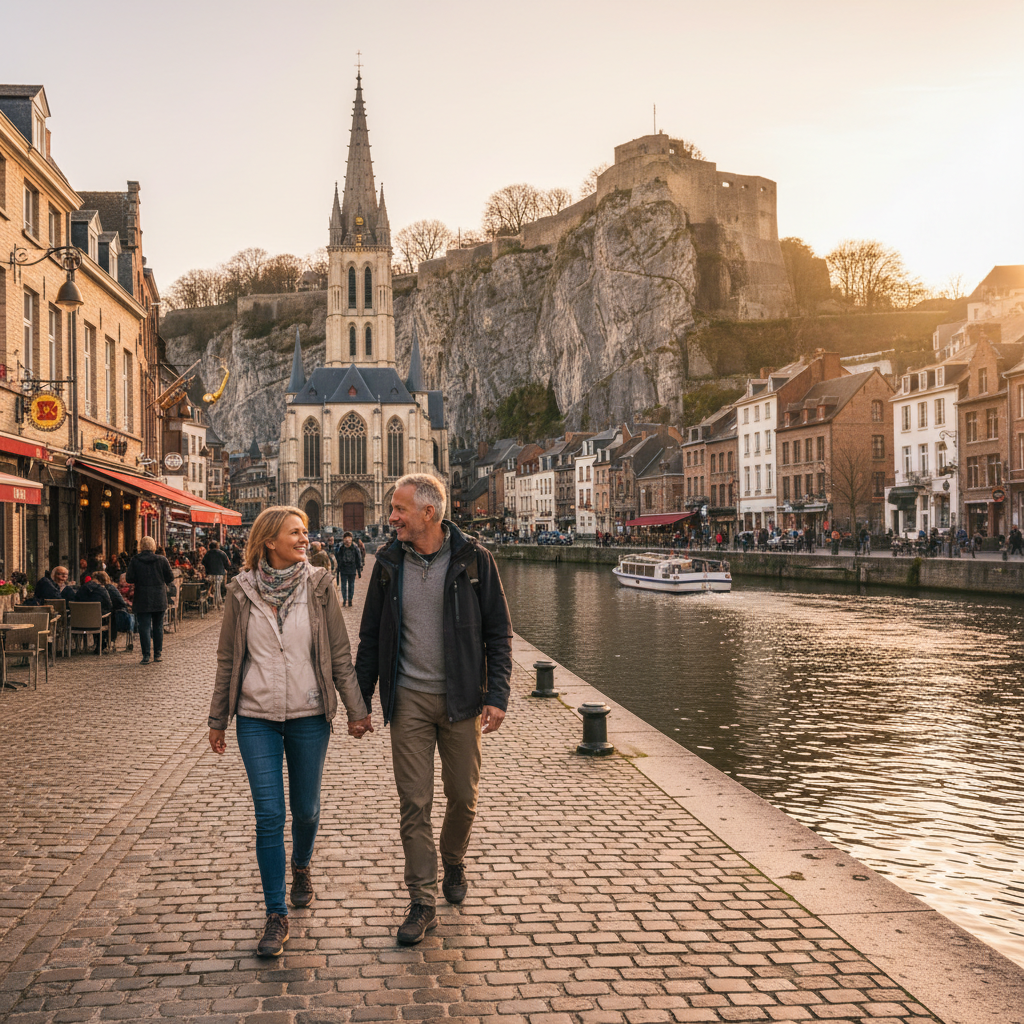
What to do in Dinant? This pearl of Wallonia, majestically nestled between steep cliffs and the calm waters of the Meuse, is an invitation to wonder and adventure. Beyond its famous Citadel, offering breathtaking panoramic views, and the magnificent Collegiate Church of Our Lady, whose bulbous bell tower is iconic, Dinant is full of treasures to discover. Stroll along the quays, explore the picturesque alleys, or visit the House of Mr. Sax, birthplace of the saxophone. For a truly memorable experience, why not embark on an outdoor escape game? It's an unusual activity that transforms the city into a giant playground, inviting you to solve puzzles during a captivating treasure hunt. Imagine a life-sized scavenger hunt, where every street corner reveals a clue, allowing you to see Dinant from a new and fun angle.

Unusual things to do in Dinant
For an unusual activity in Dinant, step off the beaten path! Beyond classic tours, the city offers unique experiences. Imagine exploring Dinant not just as a tourist, but as a detective. An outdoor scavenger hunt plunges you into the heart of its history and legends, turning every monument into a clue. It's an original outing that combines cultural discovery with the thrill of adventure. You can also dare to kayak down the Lesse for a different perspective of the surrounding nature, or explore the nearby Caves of Han for a fascinating underground immersion. Dinant knows how to surprise!
Things to do in Dinant with kids
Dinant is an ideal destination for a memorable family day out. Forget boring visits; here, fun is guaranteed! Our outdoor scavenger hunts are designed to captivate young and old alike, from 8 years old. It's a playful activity where children and teens transform into explorers, solving puzzles while discovering the city. Imagine the joy of your kids deciphering a code in front of the Citadel or searching for a clue near the Rocher Bayard. It's an interactive and stimulating way to create unforgettable memories, where teamwork is key. An adventure that the whole family will love!
Dinant for couples
Dinant offers an idyllic romantic setting for a couple's getaway. Imagine yourselves hand in hand, strolling along the Meuse quays at sunset, the Citadel lights twinkling above. Explore the cobblestone alleys of the historic center, discovering charming nooks and breathtaking views of the city and its surroundings. Share an intimate moment tasting a Dinant couque or sipping a drink on a terrace with a view. The city's rich heritage, its magnificent landscapes, and the peaceful atmosphere create a perfect backdrop to strengthen your bonds and forge precious memories. An invitation to romance and discovery for two.
What to do in Dinant when it rains
Even in the rain, Dinant retains its charm and offers options. Fortunately, our outdoor escape game is designed to minimize inconvenience: approximately 80% of the route takes place under arcades, covered passages, or near shelters, allowing you to enjoy the adventure almost dry. If the downpour persists, a visit to the Citadel, with its indoor museums, or the House of Mr. Sax offer cultural refuges. You can also take shelter in a cozy café for a hot drink. The rain won't spoil your exploration!
Where is Dinant, and where do the routes start?
Starting points of our routes and the places they pass through.
Route starting points
Places in Dinant
- House of Mr. Sax
- Collegiate Church of Our Lady of Dinant
- Charles de Gaulle Bridge (the giant saxophones)
- Adolphe Sax Street (northbound)
- Quai des Croisiers (facade of old building)
- Statue of Adolphe Sax
- Bayard Rock (view from N97 road)
- Citadel access path (lower part)
The history of Dinant
Dinant's Medieval Prosperity and Conflicts
Dinant's history is connected to the Meuse River, a trade route since ancient times. The town's name, from the Celtic "Divo-Nanto," means "Sacred Valley." By the early Middle Ages, Dinant was a fortified settlement known for its brass metalwork, called "dinanderie." This craft produced objects like aquamaniles, candlesticks, and altar furniture, exported across the Meuse Valley and the Rhineland.
In the 11th century, Dinant became one of the 23 "bonnes villes" (principal cities) of the Prince-Bishopric of Liège. The town's wealth led to conflicts with neighboring powers, particularly the Duchy of Burgundy. In 1466, Charles the Bold, Duke of Burgundy, sacked Dinant in retaliation for a rebellion. Much of the town was destroyed, and many inhabitants were killed. Surviving craftspeople moved to cities like Liège and Mézières, contributing to their economic growth.
Rebuilding and 20th-Century Challenges
After the 1466 destruction, Dinant rebuilt slowly. The Citadel of Dinant, first built in the 11th century, was expanded between the 16th and 18th centuries for defense against French, Spanish, and Austrian forces. The 19th century brought industrial growth in metalworking and brewing. Adolphe Sax, inventor of the saxophone, was born here in 1814.
The 20th century brought further destruction. In August 1914, during the First World War, German forces killed over 600 civilians and destroyed much of the town. This event is a significant part of Belgian history. Dinant was rebuilt, symbolizing Belgian endurance. The Citadel, rebuilt by the Dutch between 1818 and 1821, served as a defensive stronghold in both World Wars.
What to see in Dinant
- Citadel of Dinant — This structure stands 100 meters above the Meuse River. Originally an 11th-century fortress, the current building was largely constructed by the Dutch between 1818 and 1821. It houses a museum with military artifacts and exhibits, including recreated wartime trenches.
- Collegiate Church of Our Lady of Dinant (Collégiale Notre-Dame de Dinant) — This 13th-century Gothic church replaced a Romanesque church destroyed by a rockfall in 1227. Its 16th-century pear-shaped bell tower is a distinctive feature.
- Maison de Monsieur Sax — This is the birthplace of Adolphe Sax, who invented the saxophone in Dinant in 1814. The house is a museum dedicated to his life and invention.
- Charles de Gaulle Bridge — This bridge displays saxophone sculptures, celebrating Adolphe Sax's invention and Dinant's musical connection.
- Bayard Rock (Rocher Bayard) — This needle-shaped rock formation, about 35 meters high, stands along the Meuse. A narrow passage was cut through it in the 17th century by Louis XIV's French army, later widened for traffic.
- Quai des Croisiers — Walk along the quays of the Meuse to see the facades of old buildings, reflecting Dinant's history as a river trade hub.
When to visit Dinant
The best time to visit Dinant for outdoor activities is from May to September. Temperatures are generally comfortable, with average highs from 19°C to 23°C in July. May, June, and July offer the most sunshine. Precipitation occurs year-round but is lower in April and May.
To avoid larger crowds, consider visiting in March or from December to March, though these months are cooler. Winters in Dinant are cold and often cloudy, with average lows around 1°C in January. December is usually the wettest month. Avoid winter months if extensive outdoor exploration is planned.
Getting around Dinant
Dinant is accessible by train from major Belgian cities. From Brussels Airport (BRU), a train journey to Dinant takes about 1 hour and 46 minutes with transfers, costing €17 to €27. Charleroi Brussels South (CRL) is about 54.1 km away, with train connections taking about 2 hours 19 minutes via Charleroi-Central and Namur.
The city center is compact and walkable. For parking, Interparking Centre on Rue Grande offers access to the town hall and main sites. On-street parking has colored zones: Red Zone (up to 3 hours, €1/hour), Orange Zone (up to 8 hours, €1/hour), and Yellow Zone (up to 8 hours, €1.50 for 2 hours). Green zones and parking outside paid hours are free.
Things you probably do not know about Dinant
Verified details most visitors walk straight past.
- Collegiate Church of Our Lady of Dinant
- What caused the distinctive pear-shaped bell tower of the Collegiate Church to be rebuilt in the 20th century? The original Romanesque church collapsed in 1227 due to falling rocks from the adjacent cliff. The current Gothic structure, built in the 13th and 14th centuries, had its onion dome completely destroyed during World War I and was reconstructed in 1924.
- Bayard Rock
- How did a massive rock formation by the Meuse get its name and unique split? Legend says the magical horse Bayard, carrying the four sons of Aymon, split the rock with a powerful hoof kick to escape Charlemagne's troops. Historically, the French army of Louis XIV cut a three-meter passage through it in the 17th century during the Nine Years' War.
- Citadel of Dinant
- Beyond its military history, what unique feature can visitors experience at the Citadel? The Citadel offers visitors the chance to walk through recreated wartime trenches, providing an immersive experience of its role in various conflicts, including World War I.
- Rue Adolphe Sax
- What unexpected connection does Dinant have to the world of music? Dinant is the birthplace of Adolphe Sax, who invented the saxophone in the 19th century. His legacy is celebrated throughout the city, including colorful saxophone sculptures on the Charles de Gaulle Bridge.
- Quai des Croisiers
- What ancient industry made Dinant prosperous and led to its unique local term? In the Middle Ages, Dinant was famous for its brassware production, known as "dinanderie." This craft involved creating finely cast and finished objects from a silvery brass alloy, exported across Europe.
Questions about visiting Dinant
How long should I plan to stay in Dinant?
A good itinerary length for Dinant is one to two days to explore key highlights such as the Dinant Citadel, the Collegiate Church of Our Lady, and the Maison de Monsieur Sax. This allows time to absorb the city's atmosphere and perhaps enjoy a river cruise.
What are the best ways to get around Dinant?
Dinant's city center is compact and easily explored on foot. For reaching the Citadel, you can either take a cable car from near the Collegiate Church or climb the 408 steps. Boat trips on the Meuse River are also a popular way to see the scenic beauty.
Is Dinant suitable for visiting with children?
Yes, Dinant offers several family-friendly activities. Children often enjoy exploring the Citadel and its interactive exhibits, as well as the cable car ride. Boat trips on the Meuse River and nearby attractions like the Caves of Han or Dinant Evasion Adventure Park are also popular.
What is the typical budget for a day in Dinant?
While specific daily budget figures are not readily available, Dinant offers a range of options. Accommodation, dining, and activity costs can vary. Parking is available in paid zones, and train travel is a convenient option. Consider local eateries for more budget-friendly meals.
Are there any specific local customs or closing times to be aware of in Dinant?
While there aren't specific 'siesta' customs, it's always a good idea to check the opening hours of smaller shops and restaurants, especially outside of peak tourist season, as some might have limited hours or close on certain days, such as Mondays.
Which neighborhoods are best for staying in Dinant?
Most of Dinant's attractions are concentrated along the Meuse River and around the city center, making this area convenient for accommodation. Staying near the Collegiate Church or the Charles de Gaulle Bridge puts you within easy walking distance of many sights and dining options.
Frequently asked questions
How much does an outdoor escape game cost in Dinant?
Our outdoor escape games in Dinant are designed to be accessible and fun for everyone. The price is €12 per team, not per person! This means that if you come with several people (up to 6 players per team), the cost per participant is very advantageous. This unique rate gives you access to a complete adventure, including the scenario, puzzles, and necessary materials to explore the city in a completely new way. It's an excellent option for a controlled budget while enjoying a memorable group activity.
Is it suitable for children / families?
Absolutely! Our outdoor escape games are perfectly suited for families and children, generally from 8 years old, provided an adult is present to guide the team. The playful and interactive aspect of the game captivates young minds, transforming the discovery of Dinant into a real treasure hunt. It's a fantastic opportunity to strengthen family bonds, develop teamwork, and stimulate everyone's curiosity. The puzzles are designed to be fun and accessible, encouraging collaboration between all generations.
How long does an escape game in Dinant last?
The duration of our outdoor escape games in Dinant is flexible and depends on your team's pace. On average, allow between 1h30 and 2h30 to complete the adventure. This time includes solving puzzles, moving between points of interest, and of course, moments to admire Dinant's magnificent landscapes. You are completely free to take breaks, have a drink, or visit a monument along the way. The goal is to have fun and enjoy the city at your leisure, without any imposed time constraints.
Do I need to book in advance?
No, not at all! One of the great advantages of our outdoor escape games is their flexibility. You don't need to book in advance. Once you have access to the game, you can start the adventure whenever you want, on the day of your choice, and at the time that suits you best. This is ideal for those who like spontaneity or want to adapt to the day's weather. All you need is your charged smartphone and the installed app, and you're ready to explore Dinant!
What to visit in Dinant beyond escape games?
Dinant is full of iconic sites to discover! A must-see, the Citadel of Dinant offers breathtaking views of the Meuse and the city, accessible by cable car or on foot. Just below, the Collegiate Church of Our Lady of Dinant, with its Gothic architecture and unique bell tower, is a masterpiece. Don't forget the Rocher Bayard, a legendary rock needle. For music lovers, the House of Mr. Sax pays tribute to the creator of the saxophone. And of course, a boat trip on the Meuse or tasting the famous Dinant couque are experiences not to be missed. The city is an open-air museum!
What is the best season to visit Dinant?
Dinant is charming in all seasons, but spring (April-May) and autumn (September-October) are often considered the best times. In spring, nature awakens, temperatures are mild, and gardens bloom, offering an idyllic setting for walks and outdoor activities. Autumn, meanwhile, adorns the landscapes with flamboyant colors, creating a magical atmosphere. Summer is also very pleasant for enjoying terraces and water activities, although it can be busier. Winter offers a calmer and sometimes magical atmosphere under the snow, ideal for a more intimate visit.
Other destinations in Wallonia
Arlon
Belgium's oldest city, rich in Gallo-Roman heritage.
Bastogne
At the heart of the Battle of the Bulge
Bouillon
In the Ardennes heart, tracing Godfrey's steps and his mighty castle
Chimay
Between Trappist beer, castle, and Ardennes nature
Durbuy
The world's smallest city, nestled in the Ardennes
Huy
Between Meuse and Citadel, a millennial history to explore
Lessines
Between porphyry and hospital heritage
Liege
The Ardent City, between the Meuse and its hills
Marche-en-Famenne
In the heart of Famenne, between history and Ardennes nature
Namur
Walloon capital, between Meuse and Sambre
Philippeville
Fortified city between caves and legends
Redu
The book village in the heart of the Ardennes
Rochefort
Caves, castles, and Trappist beers: adventure in the Ardennes
Saint-Hubert
European Capital of Hunting and Nature
Soignies
Where blue stone meets a thousand years of history
Spa
The water city, source of well-being and adventures
Spontin
Its medieval castle, springs, and legends
Thuin
Medieval city, UNESCO belfry and hanging gardens
Villers-la-Ville
Where Cistercian monks left their centuries-old mark
Waterloo
Where Napoleon faced his final defeat