GhentOutdoor Escape Game & Treasure Hunt
Medieval gem with a thousand canals
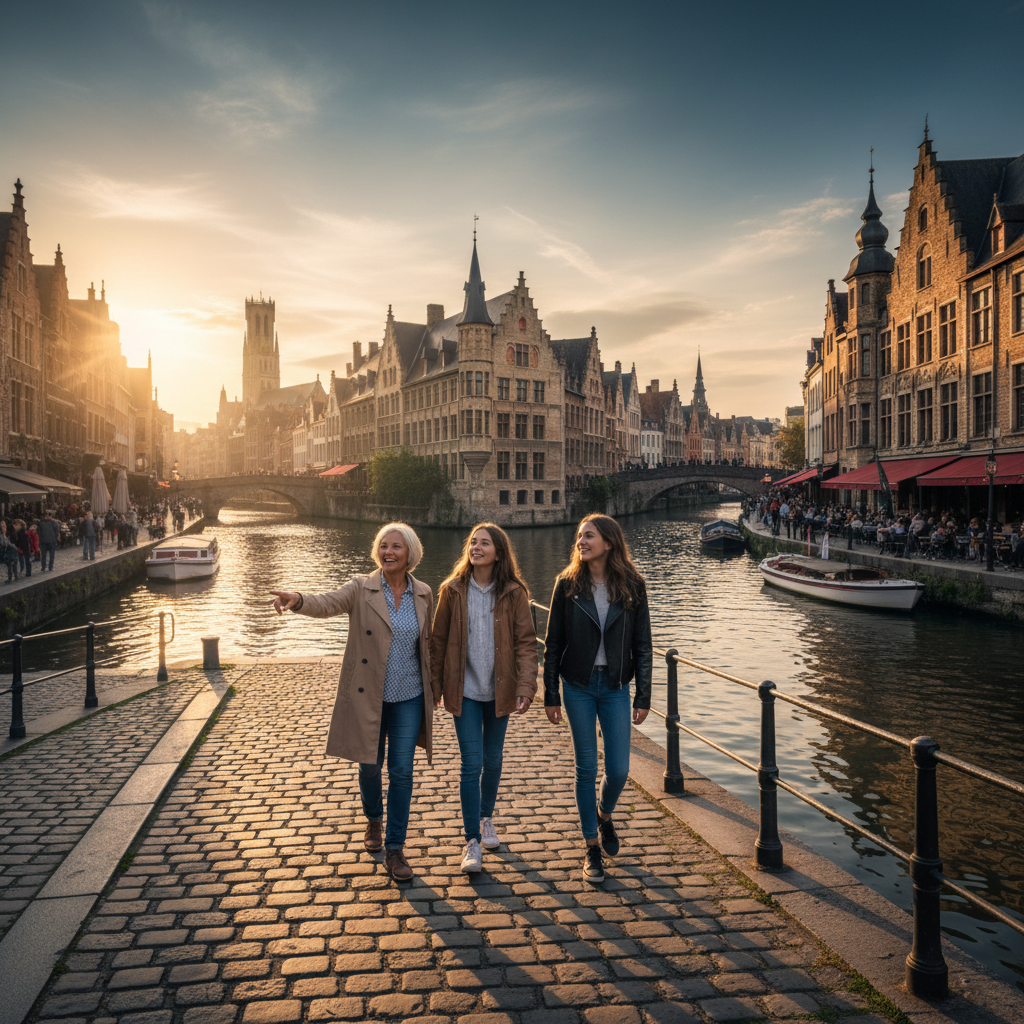
Ghent, a medieval jewel with a thousand canals, is a city that invites exploration and wonder. If you're asking yourself what to do in Ghent, prepare for a total immersion in its history and vibrant culture. Beyond its historic facades and cobblestone streets, the city is full of activities for all tastes. Start by strolling along the Graslei and Korenlei, these iconic quays that offer picturesque views, before getting lost in the medieval Patershol district, a labyrinth of charming streets. For an unusual activity, why not embark on an outdoor escape game? It's a fantastic way to discover the city from a new angle, transforming your visit into a real treasure hunt or a large-scale scavenger hunt. Whether you're looking for heritage, gastronomy, or adventure, Ghent will captivate you.

The Ghent Altarpiece — Decode the Mystic Lamb's Secret
Decipher the hidden symbols in Van Eyck's masterpiece before Nazi forces destroy it. Uncover the alchemical code that saved Ghent's greatest treasure during WWII.
Ghent — Charles Quint's Rope
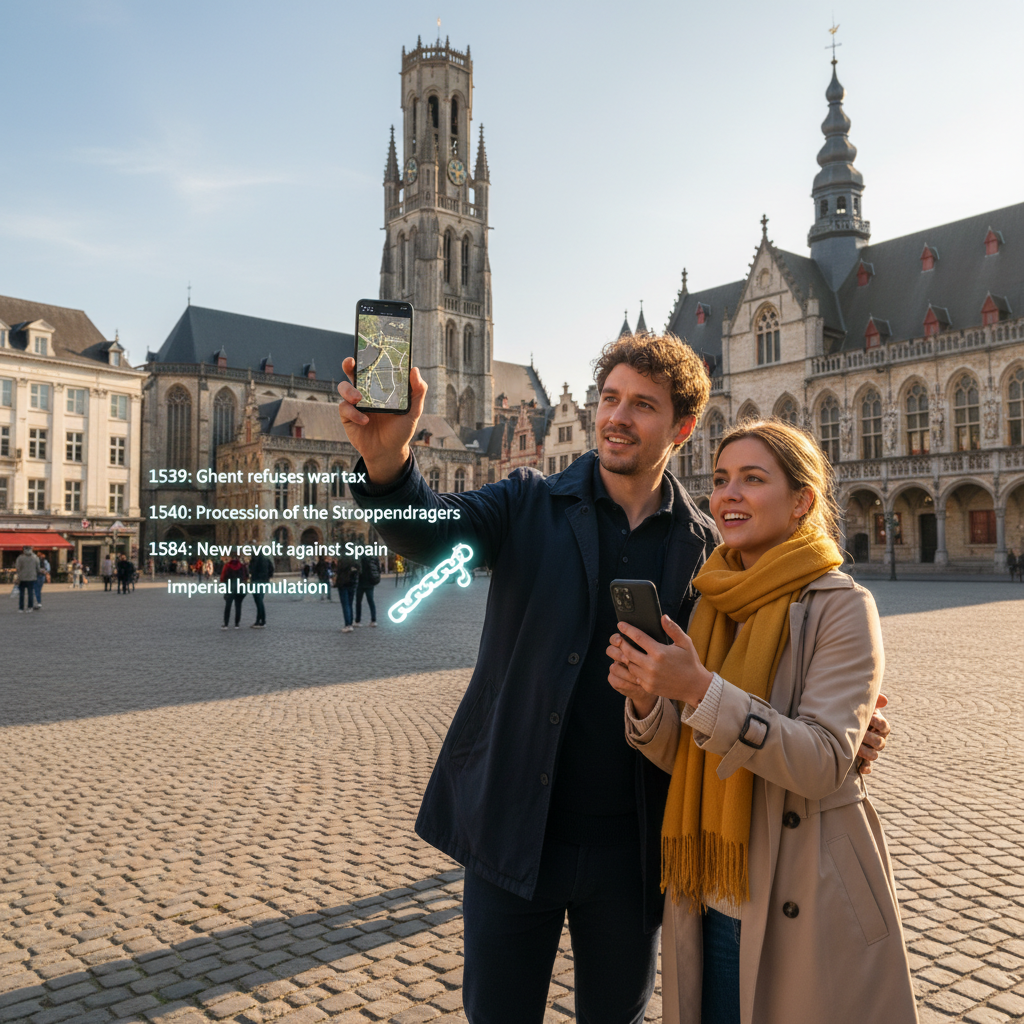
Uncover the secret code hidden by Ghent's rebels before Charles Quint's 1540 reprisal. Decode their defiance etched in landmarks to expose the truth behind the noose of humiliation.
Unusual things to do in Ghent
Looking for an unusual activity in Ghent that goes off the beaten path? Beyond traditional museums, the city offers unique experiences. Dive into the world of street art by following the "Werregarenstraatje" route, an alley entirely dedicated to constantly evolving graffiti, a true open-air gallery. Or explore the hidden "beguinages," UNESCO-listed havens of peace, offering a timeless interlude. For an original outing that combines discovery and challenge, an outdoor escape game allows you to solve puzzles while moving through historic neighborhoods, transforming the city itself into a playground. It's a memorable and interactive way to uncover Ghent's secrets.
Things to do in Ghent with kids
What to do in Ghent with the family to entertain both young and old? The city is full of fun options. An outdoor escape game is an excellent idea, as it's designed to be accessible from the age of 8-10, with puzzles adapted for children and teens. It's a collaborative adventure where everyone contributes, stimulating teamwork and curiosity. Beyond games, a boat trip on the canals offers a different perspective of the city, while a visit to the Gravensteen Castle, with its knights and ramparts, transports imaginations. Ghent promises memorable moments for the whole family, combining fun and cultural discovery.
Ghent for couples
Ghent for couples guarantees a romantic and memorable getaway. Stroll hand in hand through the cobblestone alleys of the Patershol district, where every corner seems to tell a story. Let yourself be charmed by the breathtaking views from St Michael's Bridge, offering a panorama of the city's three iconic towers. For a touch of intimacy, explore the secret passages and hidden courtyards, true treasures of Ghent's heritage. A candlelight dinner by a canal, followed by a nocturnal stroll where lights reflect on the water, will create unforgettable memories. Ghent is a city that invites romance and discovery for two.
What to do in Ghent when it rains
What to do in Ghent on a rainy day without spoiling your fun? Good news: our outdoor escape games are designed so that 80% of the route takes place under arcades, covered passages, or near shelters, allowing you to enjoy the adventure even in a downpour. Beyond our games, the city offers many refuges. The Museum of Fine Arts (MSK) or the S.M.A.K. (Museum of Contemporary Art) are excellent cultural options. You can also warm up in one of the city's many cozy cafes, savoring a waffle or a hot chocolate.
Where is Ghent, and where do the routes start?
Starting points of our routes and the places they pass through.
Route starting points
Places in Ghent
- Castle of the Counts
- Korenlei Square
- Weavers' Street
- St. Bavo Cathedral (exterior)
- Ghent Belfry
- Ghent Town Hall
- St. Michael's Bridge
- St. Pharailde Square
- Freedom Square
- Old Cloth Hall
- St. Nicholas Church
- Belfry and Cloth Hall
- Van Pottelsberghe House
- Former palace of the Counts of Flanders
- Friday Market Square
The history of Ghent
From Roman Settlement to Medieval City
Ghent's origins are a Roman settlement at the confluence of the Scheldt and Leie rivers. This location, suitable for trade, also exposed it to Viking raids between the 8th and 11th centuries. The city developed as a trading post in the 10th century, following the foundation of St. Bavo Abbey around 630 AD by Saint Amand. By the Middle Ages, Ghent was one of Europe's largest and wealthiest cities, due to its textile industry. The city imported wool from England to meet demand. This wealth funded the construction of many buildings still standing, such as the Cloth Hall, which began in 1425 and served as the central marketplace for inspecting and trading woolen cloth.
Industrial Transformation and Civic Resistance
While the cloth trade declined by the late 15th century, Ghent adapted by shifting its economy towards shipping along the Lys and Scheldt rivers. The city experienced growth during the Industrial Revolution in the 19th century, becoming a pioneer in Europe, particularly in textiles. Lieven Bauwens, a local industrialist, brought a 'Mule Jenny' spinning machine from England around 1800, starting Ghent's transformation. Factories, including sugar refineries and cotton mills, were built, and by 1860, industrial activity expanded to the city's outskirts. This industrialization led to a tripling of the population, with many moving from the countryside for factory jobs, resulting in crowded working-class neighborhoods. The city's spirit of resistance, seen throughout its history against various rulers, also led to the creation of the first modern Belgian trade unions, addressing working conditions. Today, Ghent's industrial heritage is visible in its cityscape, with many former mills repurposed, contributing to its blend of medieval and modern character.
What to see in Ghent
- Castle of the Counts (Gravensteen) — This 12th-century moated castle, built by Philip of Alsace, Count of Flanders, shows medieval defensive architecture. Visitors can walk along its ramparts, explore the keep, and see the torture museum inside.
- Korenlei Square and Graslei — These quays along the Leie River are lined with medieval guild houses. The architecture reflects the wealth of the trade guilds that operated here, with details like stepped gables and facades.
- St. Bavo Cathedral (Sint-Baafskathedraal) — This Gothic cathedral houses the Adoration of the Mystic Lamb altarpiece by the Van Eyck brothers, completed in 1432. The cathedral also contains stained-glass windows and Baroque elements.
- Ghent Belfry (Belfort) — This 91-meter-tall, 14th-century belfry is a UNESCO World Heritage site. It served as a watchtower and housed the city's alarm bells. An elevator goes to the top for views of the city and the carillon of 54 bells.
- Ghent Town Hall (Stadhuis) — This building combines architectural styles. The right wing, built between 1519 and 1539, is Late Gothic. The left wing, constructed from 1595 to 1618, features Renaissance elements with Doric, Ionic, and Corinthian columns.
- St. Nicholas Church (Sint-Niklaaskerk) — This early 13th-century church is an example of Scheldt Gothic style, characterized by its use of blue-gray Tournai stone and a single large tower above the crossing. The central tower served as an observation post and held town bells before the Belfry was built.
- St. Michael's Bridge (Sint-Michielsbrug) — Built between 1905 and 1909, this stone arch bridge offers a view of Ghent's three medieval towers (St. Nicholas Church, the Belfry, and St. Bavo Cathedral) in a single glance. It features a bronze statue of Saint Michael the Archangel at its center.
When to visit Ghent
Ghent has a temperate, rainy climate, with an average of 130 rainy days per year, often light drizzle. The period from May through September is suitable for outdoor activities and canal tours. July is the warmest month, with average daytime highs around 24°C (75°F). The city sees more visitors during June-August, especially during the Gentse Feesten in July. To avoid the largest crowds, consider April-May and September-October, when temperatures are milder and accommodation prices may be lower. The coldest month is January, with daytime highs around 6°C (43°F) and overnight lows near 1°C (35°F). December is the wettest month. Many outdoor terraces and canal tours operate less frequently or close during the colder, wetter months.
Getting around Ghent
Ghent does not have its own airport, but Brussels Airport (Zaventem) is less than an hour away by train. The city is connected by train to Belgian cities like Brussels and Antwerp. The historic center is walkable, with most major attractions accessible on foot. Public transport, operated by De Lijn, includes trams and buses. A single ride costs €3 if paying contactless. A 10-trip ticket costs €17, and a 24-hour day pass is €7.50. The Ghent CityCard, for 48 or 72 hours, includes public transport and museum entry. Taxis are available, with a base fare around €2.70, and Uber operates. For parking, use underground car parks on the periphery of the city center, as much of the historic area is pedestrianized. Ghent has various markets: Friday mornings, the Vrijdagmarkt has local delicacies; the Groentenmarkt has an organic market. Sunday mornings, a flower market is on Kouter square and a book market along the Ajuinlei.
Things you probably do not know about Ghent
Verified details most visitors walk straight past.
- Ghent Belfry
- What happened to Roeland, the bell of Ghent, and where can you still find a piece of it? Roeland, a giant bell cast in 1315, was destroyed by Charles V in 1540 as punishment for Ghent's defiance. Portions of its metal were later used by Pieter Hemony, a 17th-century Dutch bell-founder, to cast 37 of the 54 bells that now form the Belfry's carillon. The massive Triomphante, cast in 1659-1660 to replace Roeland, now rests in a small park at the foot of the Belfry, still bearing a crack it sustained in 1914.
- Old Cloth Hall (Lakenhalle)
- Why does the Cloth Hall, a symbol of Ghent's medieval wealth, appear incomplete, and what unusual function did part of it serve for centuries? Construction of the Cloth Hall, which began in 1425, was halted after only seven of the planned eleven bays were completed, due to a decline in the cloth trade. From 1742 until 1902, its crypt was used as the city prison, accessible through the Mammelokker, a Rococo-style annex added in 1741.
- St. Nicholas Church (Sint-Niklaaskerk)
- This prominent church has a unique central tower. What was its unexpected civic purpose before the Belfry was built? The central lantern tower of St. Nicholas Church, a distinctive feature of the Scheldt Gothic style, was not only designed to bring light into the interior but also served as an observation post and housed the town bells until the neighboring Belfry of Ghent was constructed.
- Ghent Town Hall (Stadhuis)
- Why does Ghent's Town Hall look like two different buildings stitched together? The Town Hall is a complex of structures built over centuries, reflecting changing architectural tastes. The right wing, built between 1519 and 1539, is a flamboyant Late Gothic masterpiece, while the left wing, constructed from 1595 to 1618, exhibits a distinct Renaissance style.
- Castle of the Counts (Gravensteen)
- During the height of the Industrial Revolution, how was this medieval castle repurposed in a way that would shock its original inhabitants? In the early 19th century, during Ghent's industrial boom, the Castle of the Counts, a medieval fortress, was repurposed to accommodate workshops, a spinning mill, and even workers' houses.
- St. Michael's Bridge (Sint-Michielsbrug)
- What significant event in Ghent's history spurred the construction of the current St. Michael's Bridge? The current stone arch bridge, built between 1905 and 1909 and designed by Louis Cloquet, replaced an older drawbridge. It was conceived as a monumental structure in preparation for the 1913 World's Fair, which Ghent hosted, to showcase the city's civic confidence to international visitors.
Questions about visiting Ghent
How many days are enough to visit Ghent?
Two days are generally sufficient to see Ghent's main attractions and experience its atmosphere without rushing. This allows for exploring the historic center, visiting the castle, and enjoying the canals. If you wish to delve deeper into museums or take day trips to nearby cities like Bruges or Brussels, three days would be ideal.
What is the best way to get around Ghent?
Ghent's historic center is very compact and best explored on foot. Most major sights are within walking distance. For longer distances, the city has an efficient public transport system of trams and buses operated by De Lijn. Renting a bicycle is also a popular option.
What is the typical budget for a day in Ghent?
On average, visitors spend about $163 USD (€144) per day in Ghent. This typically includes around $69 (€60) for meals, $22 (€19) for local transportation, and $143 (€123) for a hotel room. Budget travelers might manage on about $55 (€47) per day, while a mid-range budget is closer to $130 (€112).
Is Ghent a good destination for families with children?
Ghent offers several attractions suitable for families. The Gravensteen Castle, with its medieval history, can be engaging for children. Boat tours on the canals provide a different perspective of the city. The pedestrian-friendly center also makes it easy to explore with kids.
What are the best neighborhoods to stay in Ghent?
The historic city center is the most popular area to stay, offering easy access to major landmarks, restaurants, and shops. Staying near the Graslei and Korenlei provides handsome views, while the Patershol district offers a appealing, labyrinthine atmosphere with many eateries.
What local foods should I try in Ghent?
When in Ghent, be sure to try local specialties such as *waterzooi* (a creamy chicken or fish stew), *Gentse stoverij* (beef stew made with beer), and of course, Belgian waffles and fries with mayonnaise. The city also holds a wide selection of Belgian beers.
Frequently asked questions
How much does an outdoor escape game cost in Ghent?
Our outdoor escape games in Ghent are designed to be accessible and offer excellent value. The price is €12 per team, regardless of the number of participants (within the recommended limit of 2 to 6 players per team for an optimal experience). This single team rate makes the activity very affordable, especially if you come in a group. It's a minimal investment for hours of entertainment, discovery, and intellectual challenges in the heart of the beautiful city of Ghent. No hidden fees, just an exciting adventure waiting for you!
Is it suitable for children / families?
Absolutely! Our outdoor escape games are perfectly suited for families and children from 8-10 years old. The puzzles are designed to be stimulating without being overly complex, encouraging collaboration between generations. It's a fantastic activity to spend quality time together, where everyone, from the youngest to teens and adults, can contribute. The playful aspect of the scavenger hunt and the discovery of the city make it a memorable experience for the whole family, much more interactive than a simple visit.
How long does an escape game in Ghent last?
The duration of an outdoor escape game in Ghent generally varies between 1 hour 30 minutes and 2 hours 30 minutes, depending on your pace and your ability to solve the puzzles. We encourage participants to take their time, admire the scenery, and fully enjoy the experience without rushing. There is no strict timer, which allows you to take breaks if you wish for a drink or a photo. It's a flexible adventure, designed to adapt to your desire for discovery and play.
Do I need to book in advance?
For our outdoor escape games, booking is not mandatory but highly recommended, especially if you have a specific date or time in mind. This ensures availability and better organization for your adventure. You can usually book online a few days or even a few hours before your departure. However, if you are spontaneous, it is often possible to start the adventure quickly. Simply check availability on our website before you set off for a hassle-free experience.
What to visit in Ghent beyond the escape games?
Beyond the excitement of our escape games, Ghent is full of treasures to explore. Don't miss the majestic Ghent Belfry for panoramic views, the Gravensteen Castle which will immerse you in medieval history, and St. Bavo's Cathedral, home to the famous Ghent Altarpiece. Stroll along the picturesque quays of Graslei and Korenlei, get lost in the charming Patershol district with its cobblestone streets and restaurants. Ghent is a city that invites discovery around every corner, harmoniously blending history, art, and modern life.
What is the best season to visit Ghent?
Ghent is a charming city in all seasons, but each offers a different atmosphere. Spring (April-May) and autumn (September-October) are often considered the best times, with mild temperatures and fewer crowds. The autumn colors are magnificent, and spring sees the city come alive. Summer (June-August) is ideal for enjoying terraces and outdoor events, although it is busier. Even in winter, with its Christmas markets and illuminations, Ghent has a special charm, and our games are playable all year round!
Other destinations in Flanders
Antwerp
Diamonds, Flemish art and millennial port
Bruges
The Venice of the North, medieval jewel of Flanders
Diest
Princely and fortified city, where history meets Brabant nature.
Geraardsbergen
Discover the original Manneken Pis and the mythical Wall.
Herentals
Medieval gates guarding the secrets of the Kempen
Ieper
At the heart of the Great War's history
Kortrijk
Where history meets water, Flanders' golden past
Leuven
Leuven, where beer, knowledge, and history intertwine
Lier
Lier, city of beguinages and historic clockwork.
Mechelen
City of carillons and religious capital
Ostend
Belgium's Queen of the Beaches
Sint-Truiden
Between ancient abbey and blossoming orchards
Tongeren
Belgium's oldest city, following the footsteps of the Romans.
Activities to discover nearby
Guided tours, skip-the-line tickets and local experiences to book in advance.
💡 Optional booking — you can also buy on-site. All links open in a new window, your OddballTrip visit stays preserved.