Santana and the Wild NorthOutdoor Escape Game & Treasure Hunt
Traditional houses and breathtaking northern landscapes.
Welcome to Santana and the wild north of Madeira, a region where tradition blends with exuberant nature. If you're wondering what to do in Santana and the wild north, prepare for an authentic immersion. Start by strolling among the iconic Casas Típicas de Santana, these charming triangular houses with thatched roofs that are a true emblem of the island. Beyond this picturesque village, the wild north invites you to explore dramatic coastal landscapes and lush forests. For an unusual activity, why not embark on an outdoor escape game? It's an original way to discover the region's secrets. Imagine a life-sized treasure hunt that leads you through hidden paths and breathtaking viewpoints, turning your visit into a real scavenger hunt. It's the perfect opportunity to combine exploration and entertainment, with family or friends, and create memorable souvenirs off the beaten path.
Unusual things to do in Santana and the Wild North
For an unusual activity in Santana and the wild north, let yourself be tempted by adventure. Beyond classic hikes, our outdoor escape game offers an original outing, a truly playful immersion. Imagine solving puzzles while exploring the hidden corners of Santana, discovering local legends and unknown panoramas. It's a unique way to appropriate the territory, much more than a simple visit. You won't just be spectators, but the actors of your own story, deciphering the mysteries held by the majestic landscapes of northern Madeira.
Things to do in Santana and the Wild North with kids
What to do with family in Santana and the wild north? Our outdoor escape game is a fantastic option for families with children and teens. Designed to be accessible from the age of 8-10 accompanied by adults, it transforms the discovery of the region into a fun and interactive adventure. Instead of just observing, the whole family participates in a life-sized treasure hunt, where everyone contributes to solving the puzzles. It's a stimulating and fun way to spend time together, share laughs, and create unforgettable memories while exploring the wonders of Santana.
Santana and the Wild North for couples
Santana and the wild north as a couple offers a romantic and authentic setting. Away from the hustle and bustle, you can get lost hand in hand in Santana's picturesque streets, admiring the charm of the Casas Típicas. The outdoor escape game can become an intimate and complicit activity, a treasure hunt for two, where each solved puzzle strengthens your connection. Imagine sharing breathtaking ocean views from secluded viewpoints, or strolling along coastal paths, discovering together the natural and cultural heritage of this wild and preserved region, for unforgettable moments.
What to do in Santana and the Wild North when it rains
What to do in Santana and the wild north on a rainy day? Don't worry, even under a grey sky, the adventure continues! Our outdoor escape game in Santana is designed to keep you sheltered from the weather. Indeed, about 80% of the route takes place under arcades, covered passages, or inside traditional structures, allowing you to fully enjoy the experience without getting wet. It's an ideal solution for a fun and immersive activity, even when the weather is capricious, and to discover the city in a different way.
Where is Santana and the Wild North, and where do the routes start?
Starting points of our routes and the places they pass through.
Route starting points
Places in Santana and the Wild North
- Santana Typical Houses
- Guindaste Viewpoint
- Accessible section of Levada do Rei (near São Jorge)
- Madeira Theme Park (exterior)
- Ribeiro Frio (Levada do Furado access)
- Santana Mother Church (exterior)
- Rocha do Navio Viewpoint
- Queimadas Forest Park
The history of Santana and the Wild North
Early Settlement and Agricultural Development
Santana, a municipality on Madeira's northern coast, was formally established by royal decree on June 4, 1552. The town is named after its patron saint, Santa Ana (Saint Anne), in whose honor a church was built in 1689. Early settlers, some from Portugal's Minho region, brought farming techniques suited to the rainy northern climate. The volcanic soil and rainfall made Santana an agricultural region, producing crops like wheat, potatoes, sweet potatoes, and sugar cane.
Isolation and Architectural Development
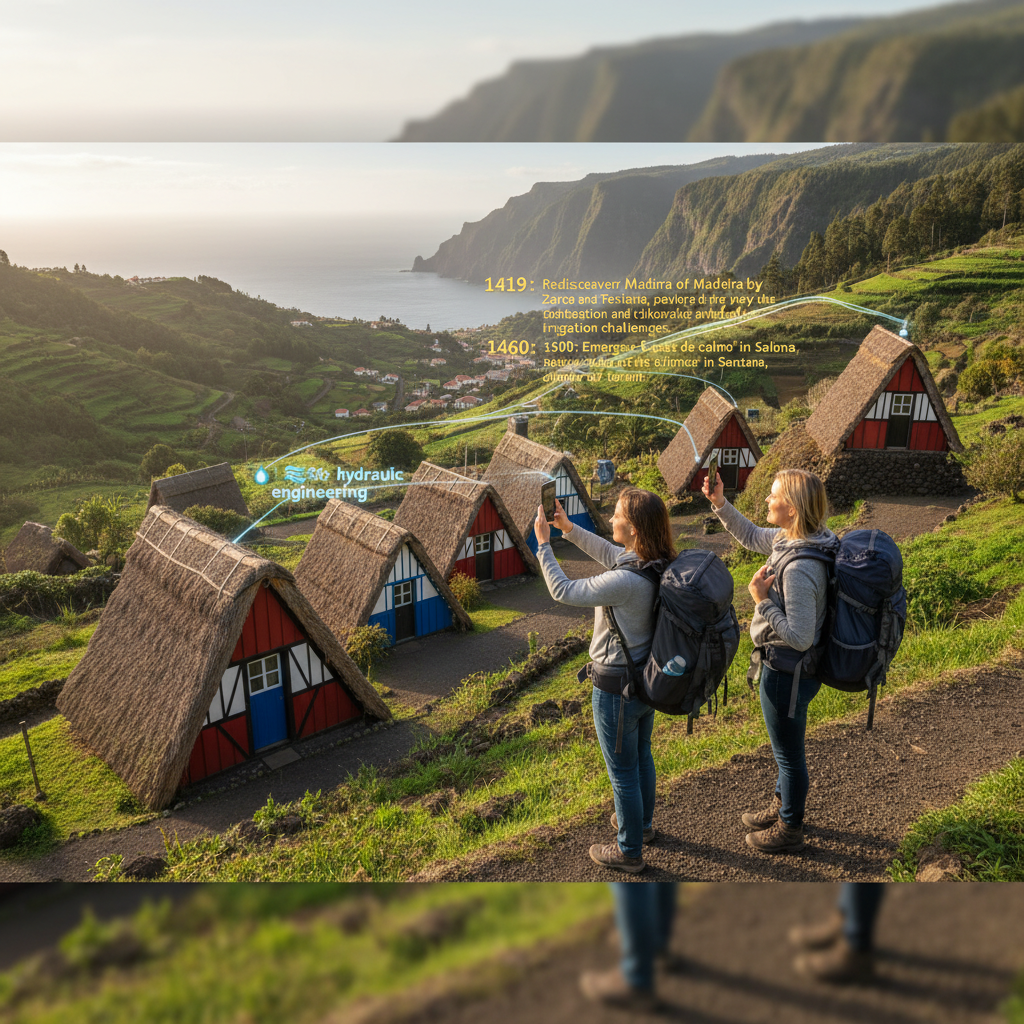
For centuries, Santana's mountainous terrain and steep cliffs resulted in its isolation from the rest of Madeira. This self-reliance fostered the development of distinctive cultural traits, including its triangular, thatched-roof houses, known as casas de colmo or palheiros. These homes, built from local materials like wood and straw, provided basic comfort and protection against the humid climate. The steep pitch of the roofs, sometimes almost 60 degrees, allowed rainwater to run off quickly and provided space for an attic to store agricultural products. While originally widespread across Madeira, these traditional houses are now primarily preserved in Santana as a symbol of the island's agricultural heritage. In 1835, Santana was granted the status of vila (small town) and became an independent district. On January 1, 2001, Santana was elevated to city status. In 2011, the entire municipality of Santana was designated a UNESCO Biosphere Reserve, recognizing its balance between environmental conservation, sustainable development, and local culture.
What to see in Santana and the Wild North
- Santana Typical Houses (Casas Típicas de Santana) — Several preserved triangular houses with thatched roofs are located in the town center. Some house craft shops or tourist information.
- Guindaste Viewpoint — This viewpoint offers views of the Atlantic Ocean and the northern coastline. Waves can be seen breaking against the cliffs below.
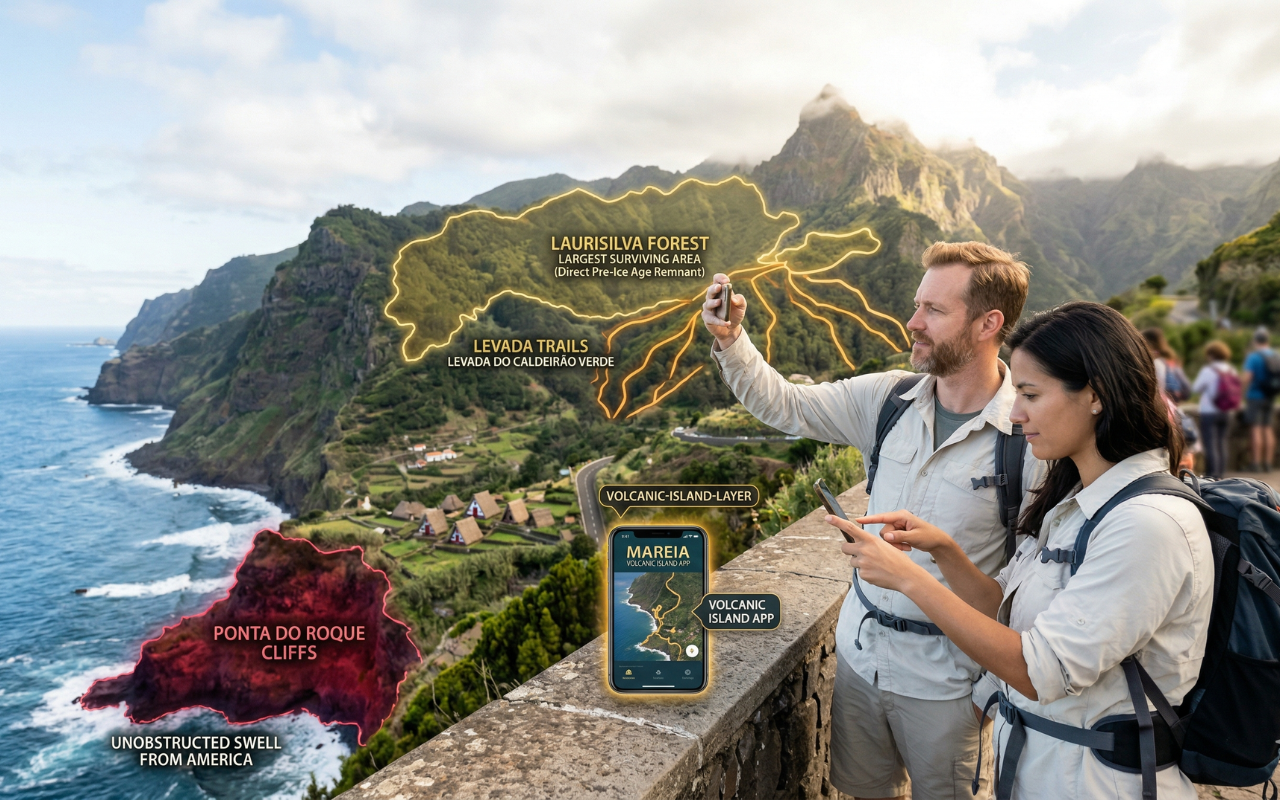
- Levada do Rei (PR18) — This levada walk follows an ancient irrigation channel through a Laurissilva forest, a UNESCO World Heritage site. The path is relatively flat and suitable for observing Madeira's ecosystem, including endemic flora and birdlife.
- Madeira Theme Park — This 7-hectare park provides an interactive way to learn about Madeira's history, culture, and traditions. It includes exhibits, craft demonstrations, botanical gardens, and replicas of historic buildings.
- Ribeiro Frio — This village is a starting point for several levada walks. It is known for its freshwater fish nursery where trout are bred for repopulating the island's streams. Visitors can observe the trout pools.
- Santana Mother Church (Igreja Matriz de Santana) — Dedicated to Saint Anne, this church was built in 1689. Its interior features a main altarpiece with statues of St. Joachim and St. Ana. The church has assimilated various styles over the centuries.
- Rocha do Navio Viewpoint — This viewpoint offers views of the coast and small offshore islets. A cable car descends to the Rocha do Navio Nature Reserve, where traditional farmland and ocean views are found.
- Queimadas Forest Park — This park is a starting point for hiking trails, including the Levada do Caldeirão Verde. It contains diverse flora and fauna within the laurel forest and features the Casa de Abrigo das Queimadas, a cottage open to visitors.
When to visit Santana and the Wild North
Santana is a year-round destination. For outdoor activities and pleasant weather, mid-June to mid-September is suitable. Temperatures average between 19°C and 26°C, with more sunshine and less rainfall, making it suitable for hiking. July is typically the clearest month, while August is the warmest, with average highs of 24°C.
Spring (March to May) and autumn (September and October) offer conditions for hiking with milder temperatures and fewer crowds. The cloudiest and wettest months are typically December and January, with average maximum temperatures around 15-16°C, which is less suitable for extensive outdoor exploration.
Getting around Santana and the Wild North
Santana is on the north coast of Madeira, approximately 20 minutes from Madeira Airport (FNC) and 40 minutes from Funchal by car. Public transport is limited; renting a car or joining a guided tour is recommended for exploring the region. Walking around the main town of Santana is manageable, particularly near the Núcleo de Casas Típicas de Santana. Parking is generally available near main attractions.
Bus lines 56 and 103 connect to Santana's town center. Santana hosts a farmers' market in front of the town hall every Friday, Saturday, and Sunday from 9:30 AM to 6:00 PM, selling local produce. Daily stalls selling regional fruit and local sweets are located next to the traditional houses. Arriving early on market days is advisable for parking.
Things you probably do not know about Santana and the Wild North
Verified details most visitors walk straight past.
- Santana Typical Houses (Casas Típicas de Santana)
- Have you ever wondered why Santana's traditional houses are so distinctly triangular with their thatched roofs almost reaching the ground? This unique design wasn't just for aesthetics. The steep pitch of the roof, sometimes nearly 60 degrees, was crucial for quickly shedding the abundant rainwater and providing natural insulation, keeping the interiors cool in summer and warm in winter.
- Levada do Rei
- The name 'Levada do Rei' translates to 'King's Levada.' But which king is it named after, and why? The Levada do Rei is believed to be named after King D. Carlos I of Portugal, who visited Madeira in the late 19th century. Some sources also suggest it could refer to King D. Manuel II, the last king of Portugal, and its construction was an arduous process taking over 20 years.
- Ribeiro Frio
- Ribeiro Frio literally means 'cold stream.' But beyond its refreshing name, what historical role did this seemingly small village play for Madeira? Ribeiro Frio was a vital hub in Madeira's historic irrigation system. Some of the island's oldest levadas, like the Levada do Furado, constructed in the 18th century, run through this valley, channeling water from the rainy north to the drier agricultural lands in the south.
- Santana Mother Church (Igreja Matriz de Santana)
- The Santana Mother Church is dedicated to Saint Anne, but its architectural style tells a story of more than just devotion. While dedicated to Saint Anne, the church's structure has assimilated a mix of styles over the centuries, reflecting the various influences and periods of renovation it has undergone since its initial construction in 1689.
- Rocha do Navio Viewpoint
- Beyond the views, what makes the area around Rocha do Navio a protected natural reserve? Rocha do Navio is part of a nature reserve that protects not only its coastal landscapes but also traditional farmland and the marine ecosystem, making it a significant area for both natural beauty and local heritage.
- Queimadas Forest Park
- Queimadas Forest Park is a starting point for hikes, but it also contains a cottage that offers a glimpse into the past. Within Queimadas Forest Park, you'll find the Casa de Abrigo das Queimadas, a cottage-like home that is open to visitors. This traditional building provides insight into the rural architecture and lifestyle of the region.
Questions about visiting Santana and the Wild North
How long should I spend in Santana?
Most travelers find 20 to 40 minutes sufficient to see the main attractions like the traditional houses. If you plan to hike a levada or visit the Madeira Theme Park, a full day or even several days are recommended to fully explore the municipality and its natural surroundings.
Is Santana suitable for families with children?
Yes, Santana is suitable for families. Children often enjoy the traditional houses, easy nature walks, the cable car at Rocha do Navio, and the interactive exhibits at the Madeira Theme Park, which focuses on the island's culture and history.
What is the best way to get around Santana and the wild north?
While public transport exists, it is limited. Renting a car is recommended for flexibility and to explore the various viewpoints and hiking trails. Guided tours are also an option if you prefer not to drive.
What kind of budget should I plan for a visit to Santana?
Santana can be visited on a moderate budget. Entrance fees for attractions like the Madeira Theme Park are reasonable, and there are local restaurants offering traditional Madeiran food. Accommodation ranges from rural lodgings to hotels.
Are there any local markets in Santana?
Yes, Santana has a farmers' market located in front of the town hall, open every Friday, Saturday, and Sunday from 9:30 AM to 6:00 PM, selling local produce. Additionally, there are daily stalls near the traditional houses offering regional fruits and sweets.
What are the main neighborhoods or parishes in Santana?
The municipality of Santana comprises six parishes: Santana (the main town), Faial, São Jorge, São Roque do Faial, Arco de São Jorge, and Ilha. Each offers unique landscapes and points of interest, from coastal areas to mountainous terrains.
Frequently asked questions
How much does an outdoor escape game cost in Santana and the wild north?
Our outdoor escape games in Santana and the wild north are designed to be accessible and fun for everyone. The price is €12 per team, making it very affordable, especially if you come with a group of friends or family. This single team rate allows you to enjoy the adventure without worrying about the exact number of participants (within the recommended limit for a better experience, usually 2 to 6 players). It's excellent value for money for an activity that combines discovery, game, and outdoor exploration, offering you a memorable experience at a controlled cost.
Is it suitable for children / families?
Absolutely! Our outdoor escape games are perfectly suited for families and children. We recommend a minimum age of about 8 to 10 years old for the youngest to fully participate in solving the puzzles, always accompanied by adults. It's a fantastic activity to stimulate children's and teens' curiosity, encouraging them to observe, think, and interact with their environment. The playful format of an outdoor treasure hunt allows everyone to find their place and contribute to the adventure, thus creating precious memories for the whole family.
How long does an escape game last in Santana and the wild north?
The duration of our outdoor escape games in Santana and the wild north is designed to be a complete experience without being too long. Generally, allow between 1h30 and 2h00 to complete the course. This estimate includes the time needed to solve all the puzzles, but also to enjoy the landscapes and the atmosphere of the place. The pace is free, you can take your time to admire the Casas Típicas or the ocean views. It's an ideal duration for an activity that easily fits into a day of discovering the region.
Do I need to book in advance?
No, one of the great advantages of our outdoor escape games is their flexibility. There's no need to book in advance! You can purchase your game directly on our website and start the adventure whenever you want. This approach gives you complete freedom to organize your day in Santana and the wild north without time constraints. Whether you decide to play on a whim or after exploring other attractions, your game is ready to be launched as soon as you are. It's the perfect solution for a spontaneous and hassle-free activity.
What to visit in Santana and the wild north beyond escape games?
Beyond the excitement of our escape games, Santana and the wild north are full of treasures. Don't miss the iconic Casas Típicas de Santana, unique traditional houses. Also explore the Santana Theme Park to learn more about Madeira's culture and history. For nature lovers, hiking trails along the levadas offer spectacular views of the wild coast and lush forest, such as the Vereda do Pico Ruivo if you're up for a good walk. The Miradouro da Rocha do Navio also offers a breathtaking panorama. It's a region rich in natural and cultural discoveries.
What is the best season to visit Santana and the wild north?
Santana and the wild north of Madeira can be visited all year round thanks to the island's mild climate. However, the spring months (April to June) and autumn (September to October) are often considered the most pleasant. During these periods, temperatures are mild, nature is lush, and there are fewer crowds than in mid-summer. Summer (July-August) is also excellent, although busier. Even in winter, temperatures remain mild, but there may be more rain, which, as mentioned, doesn't prevent you from enjoying our outdoor escape game. Each season offers its own charm.
Other destinations in Madeira
Funchal
The fennel city — Columbus, Churchill and the Atlantic levadas
Câmara de Lobos
The village Churchill painted — Madeira wine and Cabo Girão cliffs
São Vicente
Volcanic caves and Madeira's wild north coast
Porto Santo
The golden island, fine sand beaches and crystal clear waters.
More cities in Portugal
Sagres
The end of the ancient world — Henry the Navigator's fortress on Cape Saint Vincent
Lagos
Gil Eanes's port — golden cliffs and first slave market
Silves
Algarve's ancient Moorish capital
Cascais
The fishing village where the Portuguese monarchy ended
Faro
Gateway to the Algarve — Gothic cathedral, Ria Formosa and sacred bones
Sintra
Byron's "glorious Eden" — romantic palace and Moorish castle
Lisbon
From Belém to Alfama — 8 escape games across the city of Discoveries