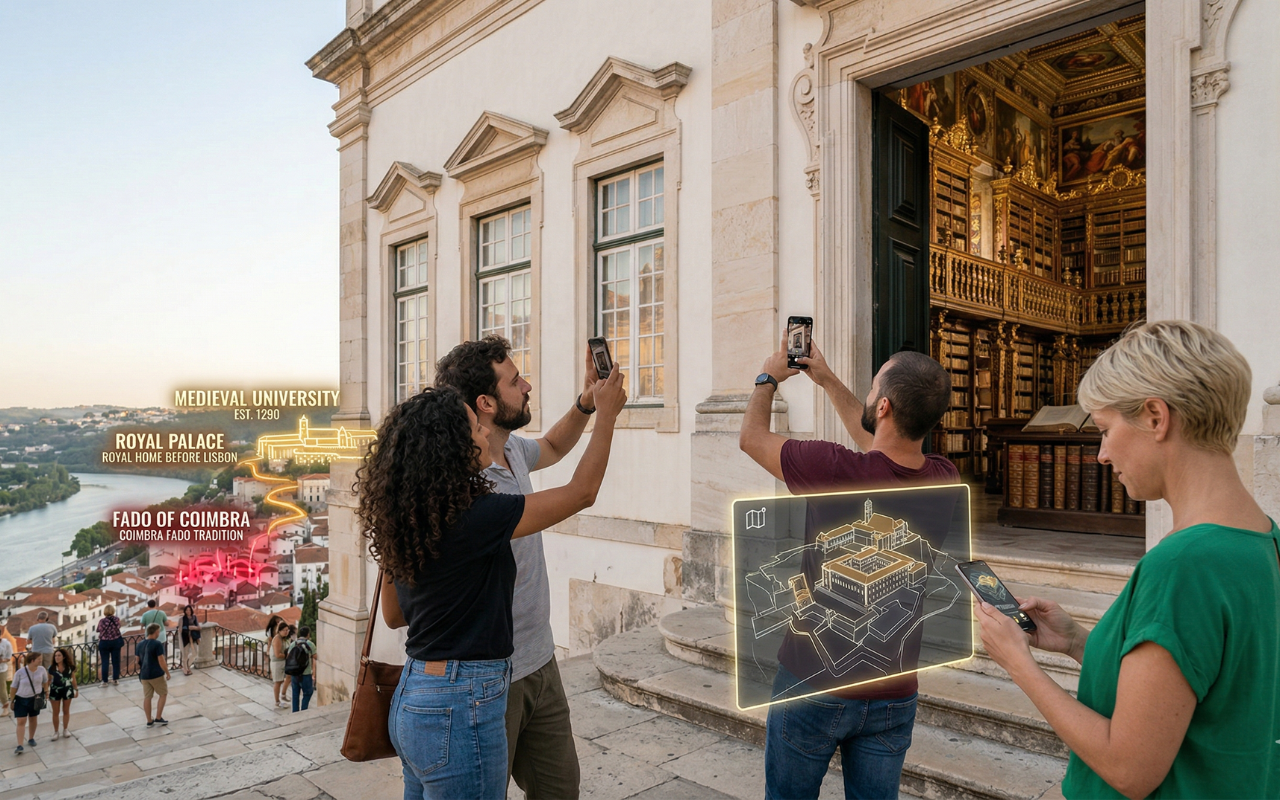
CoimbraOutdoor Escape Game & Treasure Hunt
The oldest university in the Portuguese-speaking world — fado and black gowns
Welcome to Coimbra, a city where history whispers around every corner and adventure awaits! If you're wondering what to do in Coimbra, prepare to be enchanted. Beyond its famous University perched on the Alta hill, a UNESCO World Heritage site, the city is full of treasures. Stroll through the medieval streets of Almedina, discover the majestic Sé Velha (Old Cathedral), or let yourself be carried away by the melancholic melodies of Coimbra Fado. For a truly unique experience, embark on an OddballTrip.com outdoor escape game. It's an original and captivating scavenger hunt to explore the city, transforming your visit into a real treasure hunt. This unusual activity will show you Coimbra from a new perspective, blending riddles with cultural discoveries.
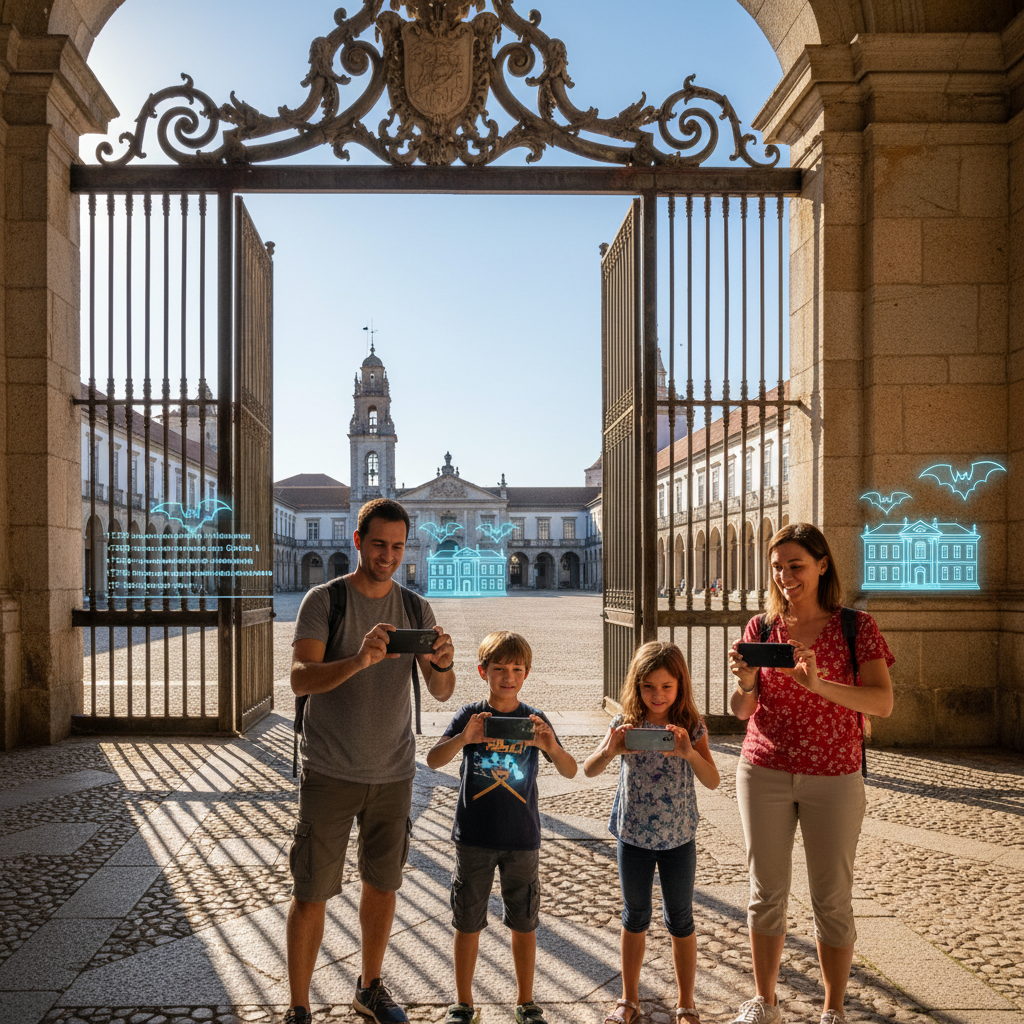
Joanine Library — Guardians' Secret
Uncover the dark secret of the Joanine Library's bat guardians and the hidden medieval prison beneath. Solve the ancient code to expose what the scholars concealed from King John V.

Coimbra — Inês's Posthumous Secret
Uncover the posthumous conspiracy behind Inês de Castro's forbidden love and cursed crowning. Decode clues across Coimbra's tear-stained sites to expose her assassins before the final judgment.[1]
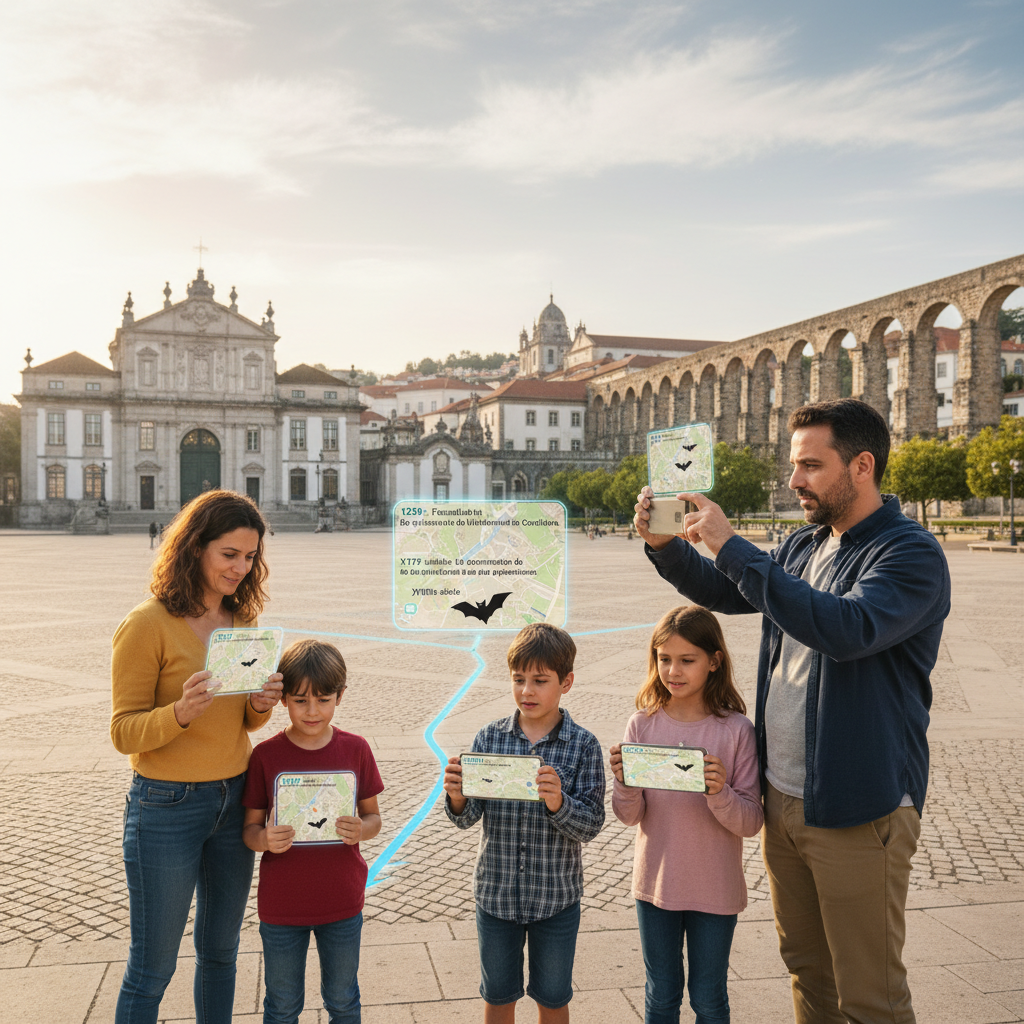
Coimbra — The Bat Legion's Codex
Uncover the secret codex guarded by the Bat Legion, Coimbra's nocturnal protectors. Decipher ancient clues across university landmarks to expose their hidden legacy before it's lost forever.
Unusual things to do in Coimbra
For an unusual activity in Coimbra, delve into the city's student soul by attending a 'Serenata Monumental' or exploring the traditions of Queima das Fitas if you visit at the right time. Beyond classic tours, an original outing involves discovering the student 'repúblicas,' communal houses rich in history and anecdotes. Or why not take a night stroll to admire the illuminations of the University and the Mondego River, offering a magical and different perspective of the city. Our outdoor escape games perfectly fit into this quest for memorable and off-the-beaten-path experiences.
Things to do in Coimbra with kids
Coimbra is a fantastic playground for the family! If you're looking for what to do in Coimbra with family, don't miss Portugal dos Pequenitos, a theme park where children can explore miniature replicas of Portuguese monuments. Our scavenger hunts are perfectly suited for children aged 8 and up, and teenagers, turning city exploration into a fun adventure. It's an activity that stimulates teamwork and curiosity, allowing the whole family to have fun together while learning about Coimbra's history and legends. An excellent way to create unforgettable memories.
Coimbra for couples
Coimbra offers an idyllic setting for a romantic couple's getaway. Let yourself be charmed by the narrow, winding streets of Alta and Almedina, which lead to breathtaking views of the city and the Mondego River from Penedo da Saudade or the University terrace. Share an intimate moment listening to Coimbra Fado in a cozy tavern, or stroll hand-in-hand along the riverbanks at sunset. Our outdoor escape games are an original way to strengthen your bond, solving puzzles together while exploring the rich heritage of the student city.
What to do in Coimbra when it rains
Don't let the rain spoil your exploration of Coimbra! Our outdoor escape games are designed to be playable even in rainy weather, as approximately 80% of the route takes place under arcades, covered passages, or near shelters. This means you can continue your scavenger hunt protected from the elements while enjoying the city's charm. It's an excellent option for a fun and cultural activity that doesn't depend on the weather, allowing you to discover Coimbra without constraints. Also consider the many museums and the Joanina Library for dry breaks.
Where is Coimbra, and where do the routes start?
Starting points of our routes and the places they pass through.
Route starting points
Places in Coimbra
- Porta Férrea (Iron Gate)
- Pátio das Escolas (Courtyard of Schools)
- University Tower
- Via Latina (Exterior Arches)
- Jardim da Manga (Exterior of Santa Cruz Monastery)
- Largo da Portagem
- Almedina Arch
- Façade of the Joanine Library
- Santa Clara Bridge
- Sé Velha de Coimbra (Old Cathedral - Façade)
- Paços da Universidade (Former Royal Palace - Exterior)
- Jardim da Sereia (Santa Cruz Park)
- Mosteiro de Santa Clara-a-Velha (Exterior Ruins)
- Quinta das Lágrimas (Boundary Wall or Public Surroundings)
- Praça do Comércio
- Republic Square
- Botanical Garden (Main Entrance)
- Aqueduct of São Sebastião (Garden Arches)
The history of Coimbra
From Roman Aeminium to Moorish Kulūmriyya
Coimbra's origins trace back to a Roman settlement, Aeminium, established around the 1st century BCE on a strategic hill above the Mondego River. This location supported trade between coastal areas and inland mountains. Remnants of this Roman past, including parts of an aqueduct and cryptoporticus, remain visible.
In 714 CE, the Moors conquered Coimbra, renaming it Kulūmriyya. For over 300 years, it functioned as a commercial hub, connecting the Christian north with the Islamic south of the Iberian Peninsula. During this period, the Moors constructed an 80-meter-long alcázar, a fortified palace. Its foundations lie beneath the current Paço das Escolas and Porta Férrea of the University. The Almedina Arch, a gateway, also has Moorish origins, though it underwent reconstruction in the 14th century.
The Birth of a Kingdom and a University
The Christian Reconquista saw Coimbra recaptured in 1064 by King Ferdinand the Great. Its position made it a point of contact between Muslim and Christian cultures. Coimbra rose to national prominence in 1139 when Afonso Henriques declared the independence of the County of Portugal and made Coimbra the capital of the new kingdom. It served as the capital for over a century, until 1255, when the capital moved to Lisbon. This period left the city with royal and religious monuments.
The University of Coimbra, one of the oldest continuously operating universities in the world, was founded in 1290. It was initially established in Lisbon and permanently moved to Coimbra in 1537 by order of King D. João III. The university became a center of learning and culture, attracting scholars and influencing Portuguese intellectual life for centuries. In 2013, the university's historical buildings were designated a UNESCO World Heritage site.
What to see in Coimbra
- University of Coimbra (Alta and Sofia) — This site includes historic buildings of one of Europe's oldest universities, a UNESCO World Heritage site since 2013. The campus offers views over the city and displays architectural examples from various periods of Portuguese art.
- Biblioteca Joanina — This Baroque library, built between 1716 and 1723, contains thousands of rare books and manuscripts. It is known for its ornate woodwork.
- Sé Velha de Coimbra (Old Cathedral) — A Romanesque cathedral from the 12th century, it has a fortress-like exterior and interior carvings. It is an example of Romanesque architecture in Portugal.
- Mosteiro de Santa Cruz — This monastery is the burial place of Portugal's first two kings, Afonso Henriques and Sancho I. It contains Manueline art.
- Machado de Castro National Museum — Housed in the former Archbishop's Palace, this museum features a collection of art. Beneath it, visitors can explore the cryptoporticus of Aeminium, a network of underground Roman galleries from the 1st century AD that supported the Roman forum.
- Jardim Botânico (Botanical Garden) — One of Portugal's oldest and largest botanical gardens, established in the 18th century. It contains tropical greenhouses, fountains, and bamboo.
- Arco de Almedina — This medieval Gothic archway, with Moorish origins and 14th-century reconstructions, served as a defensive structure and a checkpoint, marking a main gateway to the city's upper town.
When to visit Coimbra
The best times to visit Coimbra are during spring (mid-April to mid-June) and autumn (mid-September to early October). Temperatures range from 9°C to 20°C in April and 13°C to 22°C in October, suitable for walking tours. The city is less crowded than in peak summer. Summer (June to August) brings hot weather, with average daily highs in August around 28°C to 31°C. While there are festivals, including Coimbra's Medieval Fair in June, the city can feel less active when students are on holiday. Winter (December to February) is mild but rainy, with average lows around 8-11°C and highs of 14°C. Avoid August if you prefer fewer crowds and cooler temperatures.
Getting around Coimbra
Coimbra is accessible by train and bus. The closest international airports are Porto (OPO), 110 km away, and Lisbon (LIS), 210 km away. From Lisbon Airport, take the Metro or a taxi to Gare do Oriente or Sete Rios for train or bus connections to Coimbra. From Porto Airport, take the Metro to Campanhã railway station for trains to Coimbra.
Within Coimbra, the city is explored on foot, though its hilly topography can be challenging. The local bus network, SMTUC, operates from approximately 6:00 to 00:00. Taxis, Uber, and Bolt are also available. For drivers, parking in the upper historic areas is not recommended. Use structured parking facilities below the old city. The Mercado Municipal Dom Pedro V garage offers the first 30 minutes free on weekdays and is free on Saturday afternoons from 15:00 to 21:00. ECOVIA Park-and-Ride lots, like Casa do Sal, offer free parking with a €3 bus ticket combo. Street parking is free on Sundays and Portuguese public holidays, and after 13:00 on Saturday afternoons.
Things you probably do not know about Coimbra
Verified details most visitors walk straight past.
- Biblioteca Joanina
- What's protecting the centuries-old books in the ornate Biblioteca Joanina at night? A colony of bats lives behind the bookshelves in the Biblioteca Joanina. They emerge at night to eat insects, acting as a natural pest control system to protect the valuable collection.
- Paços da Universidade (Former Royal Palace)
- The grand University of Coimbra stands on a site with much older, fortified roots. What was here before? The foundations of the Paços da Universidade, including the Porta Férrea, rest on the remnants of an 80-meter-long alcázar, a fortified palace built by the Moors during their rule in Coimbra.
- Jardim da Manga (Exterior of Santa Cruz Monastery)
- Why does the cloister fountain at Santa Cruz Monastery have such an unusual name, 'Jardim da Manga'? The name 'Jardim da Manga' (Garden of the Sleeve) comes from King D. João III, who, upon seeing the initial design, drew a sleeve on the plans to suggest an extension for the garden. The cloister and fountain were then built according to his suggestion.
- Almedina Arch
- The Almedina Arch looks distinctly medieval, but its name reveals a much older influence on Coimbra. What does 'Almedina' mean? The name 'Almedina' comes from Arabic, meaning 'the city'. This highlights Coimbra's history under Islamic rule from 711 to 1064 AD, when the arch served as a crucial gateway.
- Jardim da Sereia (Santa Cruz Park)
- What's the origin of the name 'Jardim da Sereia' (Garden of the Mermaid) for Santa Cruz Park? The Jardim da Sereia gets its name from a statue of a mermaid (sereia) that once adorned a fountain within the garden, though the original statue is no longer there.
- Sé Velha de Coimbra (Old Cathedral)
- The Sé Velha has a surprisingly robust, almost military appearance for a cathedral. Why was it built that way? The Old Cathedral of Coimbra, built in the 12th century, has a fortress-like exterior. This design was common for cathedrals of the Reconquista era, as they often served defensive purposes against potential attacks.
Questions about visiting Coimbra
How many days should I spend in Coimbra?
To experience Coimbra's main attractions, including the University and historical sites, a stay of 2 to 3 days is generally recommended. This allows time to explore at a relaxed pace.
What are the best neighborhoods to stay in Coimbra?
For visitors, the 'Alta' (Upper Town) and 'Baixa' (Lower Town) are central and convenient. The Alta offers proximity to the University and historic sites, while the Baixa provides access to the riverfront, shops, and restaurants. Both areas are walkable.
Is Coimbra a walkable city?
Coimbra is largely walkable, especially its historic center. However, be prepared for steep hills, particularly in the Alta (Upper Town) where the University is located. Comfortable shoes are recommended. Public buses are available for longer distances or to navigate the inclines.
What is the typical budget for a day in Coimbra?
A moderate daily budget for Coimbra could range from €50-€80 per person, covering meals, public transport, and entrance fees to a few attractions. This can vary based on accommodation, dining, and activities.
Is Coimbra suitable for families with children?
Yes, Coimbra can be a destination for families. Beyond the historical sites, attractions like Portugal dos Pequenitos, a miniature park, offer entertainment for younger visitors. The city's parks and riverside areas also provide space for children to play.
What is Coimbra Fado?
Coimbra Fado is a style of fado music, distinct from Lisbon Fado. It is traditionally performed by male students and alumni of the University of Coimbra, often with academic capes, and typically has themes of student life, love, and longing.
Frequently asked questions
How much does an outdoor escape game cost in Coimbra?
Our outdoor escape games in Coimbra are designed to be accessible and fun for everyone. The price is €12 per team, regardless of the number of players (up to 6 people per team for an optimal experience). This single team price makes the activity very economical, especially if you come with a group of friends or family. It's excellent value for money for an unusual activity and an immersive scavenger hunt that will let you discover the city from a new angle, full of riddles and discoveries.
Is it suitable for children / families?
Absolutely! Our outdoor escape games in Coimbra are perfectly suited for families and children aged 8 and up. The puzzles are designed to be stimulating without being overly complex, encouraging collaboration and teamwork. It's a fantastic way to turn a cultural visit into a fun adventure, where everyone, from the youngest to teenagers and adults, can contribute. It's an activity that creates memorable memories and strengthens family bonds while exploring Coimbra's hidden treasures.
How long does an escape game in Coimbra last?
The duration of our outdoor escape games in Coimbra generally ranges from 1 hour 30 minutes to 2 hours 30 minutes, depending on your pace and how quickly you solve the puzzles. This is an ideal length for an activity that doesn't take up the whole day, leaving you time to explore other wonders of Coimbra. You are free to take breaks whenever you want to admire a monument, grab a coffee, or simply soak in the city's atmosphere. The adventure is at your own pace!
Do I need to book in advance?
No, one of the great advantages of our outdoor escape games in Coimbra is that they require no prior booking! You can start your game whenever you want; simply download the app and launch the adventure. This offers complete flexibility to organize your day without constraints. Whether you decide to play on a whim or plan your activity in advance, the choice is yours. It's perfect for spontaneous travelers or those who prefer to adapt to unexpected travel changes.
What to visit in Coimbra beyond the escape games?
Beyond our exciting escape games, Coimbra is full of iconic sites. Don't miss the University of Coimbra, with its magnificent Joanina Library and São Miguel Chapel. Explore the Sé Velha (Old Cathedral) and Sé Nova (New Cathedral). Stroll through the historic Almedina district, descend to the Baixa and the banks of the Mondego River. The Santa Cruz Monastery, the Botanical Garden, and the Portugal dos Pequenitos park are also must-sees. Coimbra offers a rich blend of history, culture, and natural beauty.
What is the best season to visit Coimbra?
Coimbra is pleasant all year round, but spring (April-May) and early autumn (September-October) are often considered the best seasons. Temperatures are mild, ideal for walking and enjoying our outdoor escape games without the intense summer heat or winter cold. Spring is particularly charming with the blooming flowers and the student buzz related to the end of the academic year. Autumn offers beautiful colors and a quieter atmosphere. Summer is also an option, but plan for water and shaded breaks!
Other destinations in Centre
Tomar
City of the Templars — Charola and Convento de Cristo
Aveiro
The Venice of Portugal — moliceiros, Art Nouveau and salt
Óbidos
The fortress-town given as a dowry — white ramparts and ginjinha
Viseu
City of Viriathus — Lusitanian hero against Rome
Alentejo
Lands of cork oaks, flavors and ancient history
Batalha
Where Portuguese independence was born
Fátima
A renowned pilgrimage site and spiritual haven
More cities in Portugal
Activities to discover nearby
Guided tours, skip-the-line tickets and local experiences to book in advance.
💡 Optional booking — you can also buy on-site. All links open in a new window, your OddballTrip visit stays preserved.