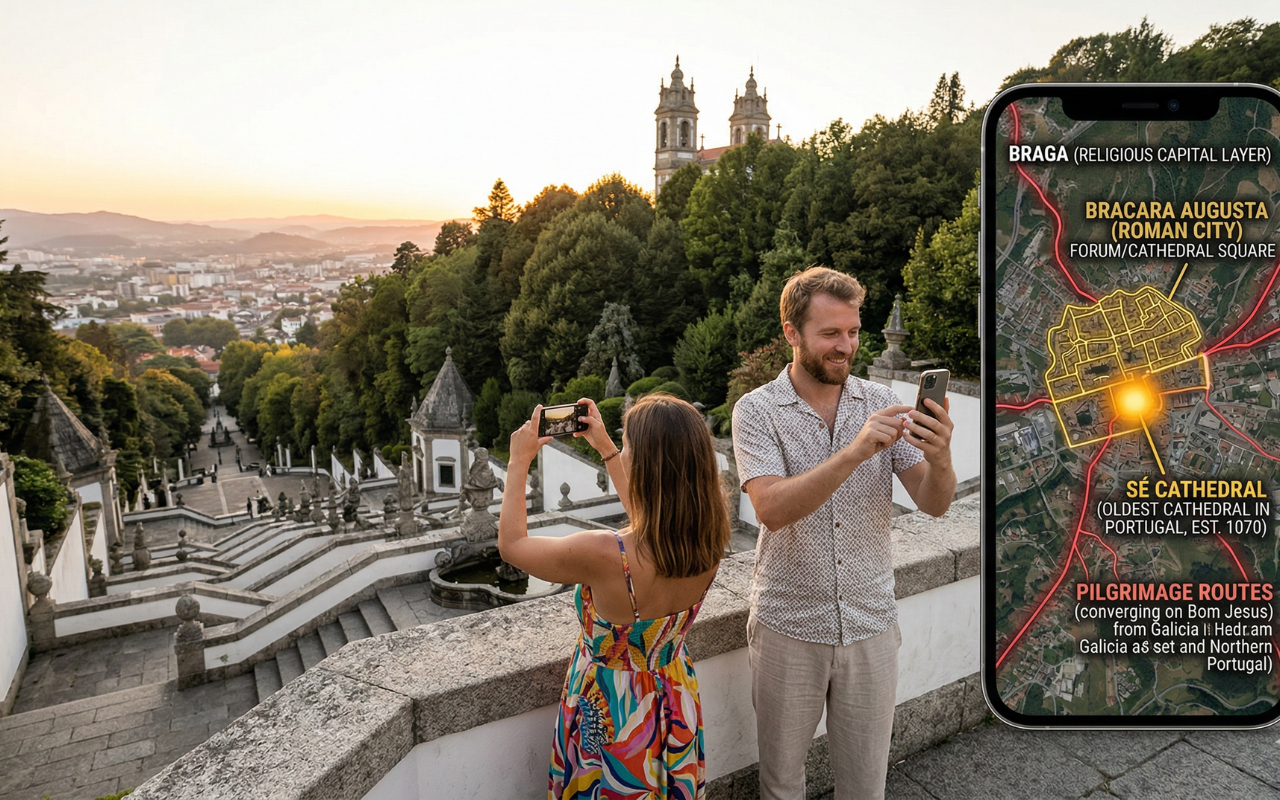
BragaOutdoor Escape Game & Treasure Hunt
The Portuguese Rome — Baroque sanctuaries and 5th-century Suebi
Braga, often dubbed the "Portuguese Rome" due to its impressive religious heritage, is a city that invites exploration. Beyond its numerous churches and the majestic Braga Cathedral (Sé de Braga), the historic center is full of charming narrow streets, lively squares, and lush gardens like Santa Bárbara. It's the perfect place to wander, soak in a unique atmosphere, and journey through centuries of history. To spice up your exploration, why not embark on an unusual activity? An outdoor escape game in Braga will allow you to discover the city from a new perspective, transforming your visit into a real treasure hunt or a large-scale scavenger hunt. It's a fun and immersive way to uncover Braga's secrets while having a great time.
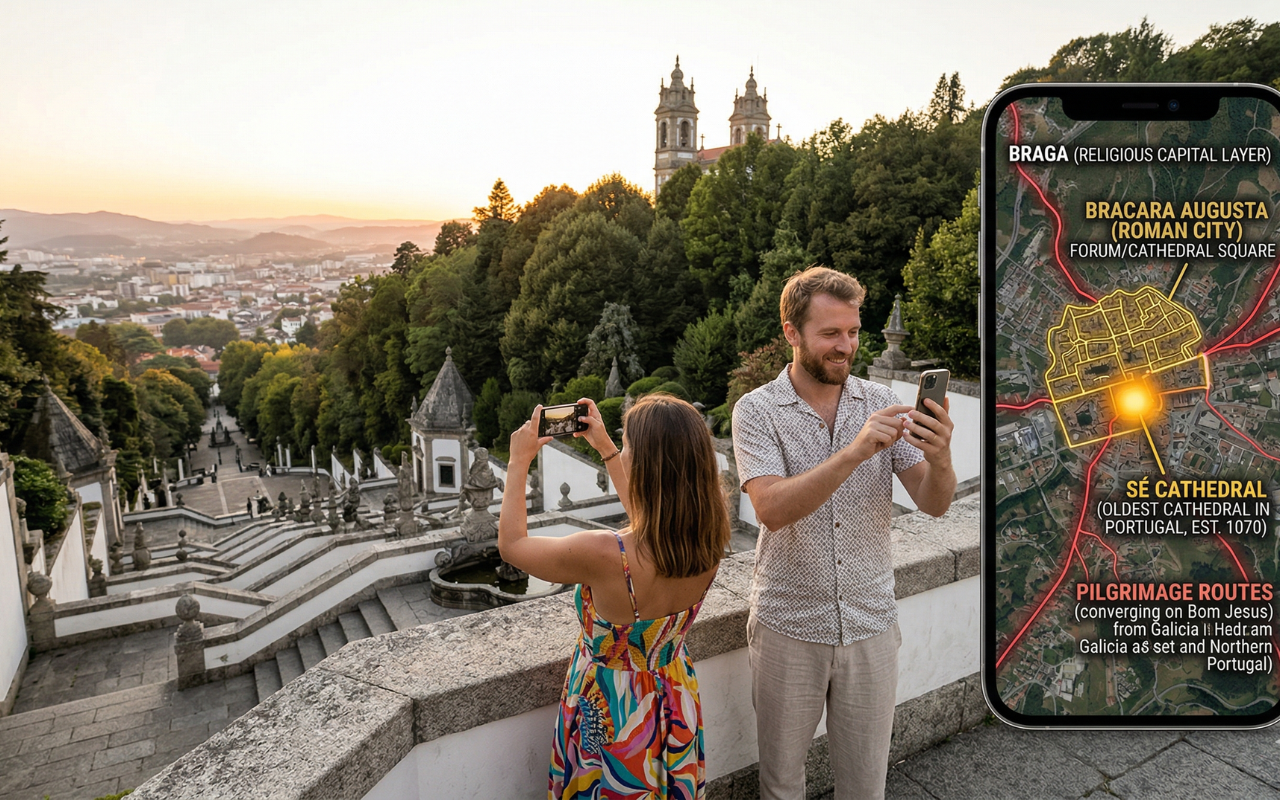
Bracara Augusta — The Bracarenses Enigma
Solve the enigma of the Bracarenses: decipher hidden Roman codes left by Bracara Augusta's elite to guard a lost treasure from barbarian invaders. Uncover their secrets across ancient ruins and walls.
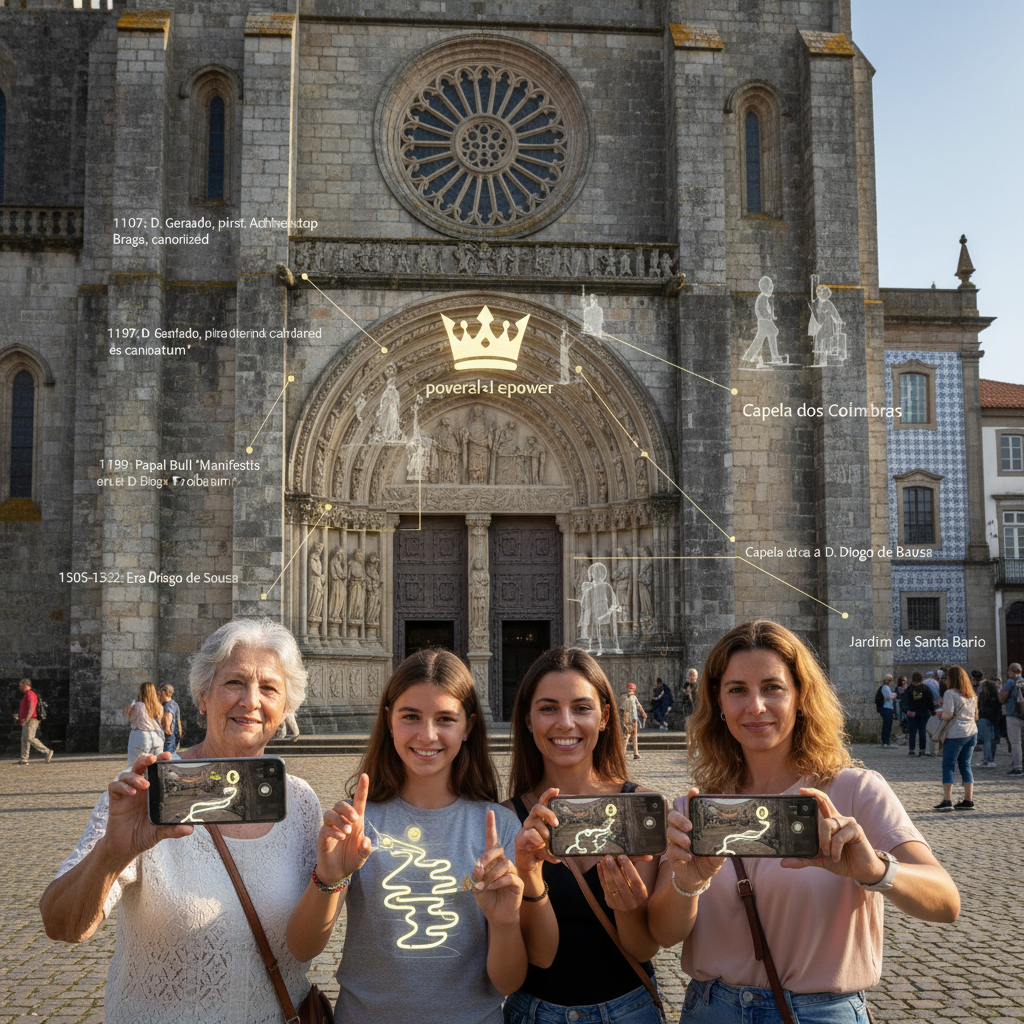
Braga — The Archpriest's Secrets
Uncover the dark conspiracy hidden by Diogo de Sousa, Braga's powerful Archpriest, as you decipher clues across the medieval heart of the city to thwart a sinister plot threatening the Church.[1][4]
Unusual things to do in Braga
For an unusual activity in Braga that goes off the beaten path, let yourself be tempted by an experience where the city becomes your playground. Imagine solving puzzles at the foot of historic monuments or deciphering hidden codes in unexpected corners. Our urban scavenger hunts offer an original outing, combining the excitement of an escape game with Braga's rich cultural heritage. It's a unique way to explore, stimulate your curiosity, and create memorable souvenirs, far from traditional guided tours. An adventure where history comes alive through action!
Things to do in Braga with kids
Braga is a fantastic destination for a family outing. Our outdoor escape games are perfectly suited for children and teens, offering a fun and stimulating activity. From the age of 6-8 (accompanied by adults), youngsters can actively participate in solving puzzles, searching for clues, and helping their parents. It's an excellent opportunity to strengthen bonds, develop teamwork, and learn while having fun. The scavenger hunt aspect makes exploring the city captivating for all ages, transforming every street corner into a new stage of the adventure.
Braga for couples
Braga offers a romantic and intimate setting, ideal for a couple's getaway. Stroll hand-in-hand through the cobbled streets of the historic center, discover secret squares, and admire the baroque architecture. Ascend to the Bom Jesus do Monte sanctuary for breathtaking views of the city and its surroundings, or get lost in the serenity of the Santa Bárbara Garden. Our scavenger hunts can add a touch of adventure and complicity to your stay, allowing you to collaborate to solve mysteries while exploring Braga's rich heritage. A shared experience that strengthens bonds.
What to do in Braga when it rains
Even on a rainy day, Braga retains its charm and offers exploration opportunities. Our outdoor escape games are designed to be playable regardless of the weather. Indeed, a large part of the route in Braga's historic center takes place under protective arcades or covered passages. This allows you to continue your scavenger hunt sheltered, enjoying the atmosphere without getting wet. Moreover, numerous cafes and museums are within easy reach if you wish to take a dry break.
Where is Braga, and where do the routes start?
Starting points of our routes and the places they pass through.
Route starting points
Places in Braga
- Arco da Porta Nova
- Braga Cathedral Facade
- Fonte do Ídolo
- Roman Baths of Alto da Cividade (exterior)
- Roman House of Bracara Augusta (exterior)
- Largo do Paço (ancient forum)
- Jardim de Santa Bárbara
- Praça da República
- Main Portal of Braga Cathedral
- Capela dos Coimbras Facade
- Palácio do Raio (exterior)
- Jardim de Santa Bárbara (Episcopal Palace side)
- Largo Carlos Amarante (Igreja do Pópulo)
- Rua do Souto (ancient street)
- Praça do Município (City Hall)
- Cruz de Pedra (near the ancient wall)
The history of Braga
Roman Foundations and Early Christian Influence
Braga's history began over 2,000 years ago with its founding by the Romans in 16 BCE as Bracara Augusta, named in tribute to Emperor Augustus. It became a significant center, serving as the capital of Gallaecia and a junction for five strategic Roman roads. The city's Roman legacy is present in archaeological traces across the historic center. The Roman Baths of Alto da Cividade, dating to the 2nd century AD, show aspects of daily life in Bracara Augusta.
After the Roman Empire's decline, Braga was controlled by the Suebi in the 5th century and the Visigoths in 585 AD. It was a location where the Visigoths renounced Arian and Priscillianist heresies. The Moors captured Braga in 716 AD, holding it until Ferdinand I, King of Castile and Leon, recaptured it in 1040. From 1093 to 1147, Braga was the seat of the Portuguese court. The city's religious importance is shown by the Braga Cathedral (Sé de Braga), which began construction in the late 11th century and was consecrated in 1089, decades before the Portuguese Kingdom's foundation.
Medieval Development and Ecclesiastical Power
Following its recapture from the Moors, Braga's ecclesiastical power grew. The archbishops of Braga held significant influence, often rivaling the power of the Portuguese monarchy. This period saw the expansion of the Braga Cathedral, which evolved through various architectural styles from Romanesque to Baroque. The city became a major pilgrimage site, reinforcing its religious identity. During the 12th and 13th centuries, Braga developed as an urban center, with markets and artisan workshops contributing to its economy. The construction of defensive walls and gates, such as the Arco da Porta Nova, marked the boundaries of the medieval city. The city's layout from this era still shapes its historic core, with narrow streets and squares that reflect its long development.
What to see in Braga
- Braga Cathedral (Sé de Braga) — Portugal's oldest cathedral, consecrated in 1089, displays architectural styles from Romanesque to Baroque. Inside, there are four chapels, including the Chapel of the Kings, where the parents of King Afonso Henriques are buried.
- Arco da Porta Nova — This gateway, built in 1512 and redesigned in the late 18th century by André Soares, marks an entrance to Braga's historic center. Its western facade is Baroque, with an allegorical figure of Braga, while the eastern side is Neoclassical with a statue of Our Lady of Nazareth.
- Fonte do Ídolo — A 1st-century Roman fountain and rock sanctuary dedicated to Tongoenabiago, a local water god. It is one of the few Roman monuments to survive almost intact and features inscriptions and figures carved into the granite.
- Roman Baths of Alto da Cividade — These excavated ruins, dating from the early 2nd century AD, show a public bathing complex with cold and hot rooms and an area for physical exercise. The site is open for viewing and includes an interactive device explaining the building's evolution.
- Palácio do Raio — An 18th-century Baroque palace designed by André Soares, known for its blue tiled facade and ornate details. Its exterior is an example of the city's Baroque architecture.
- Jardim de Santa Bárbara — A public garden next to the Archbishop's Palace, with flowerbeds and hedges, offering a quiet space in the city center.
- Praça da República — Also known as "Arcada" due to its arcade, this square has been a social center since the Middle Ages. It features historic cafes like Café Vianna and Astória, and was transformed into a public garden in the mid-19th century.
When to visit Braga
The best time to visit Braga is from April to October. During this period, temperatures are between 15°C and 22.2°C, with less humidity and low winds, suitable for outdoor exploration. June to August are the warmest months, with temperatures sometimes over 30°C, and are also the driest with the most sunshine. This is also the busiest time for tourism, and accommodation prices will be higher. April-May and September-early October offer pleasant weather with fewer crowds.
Avoid visiting Braga from December to February. Winter brings temperatures dropping to single digits, increased wind, and a general chill, making outdoor activities less comfortable. December is typically the coldest and wettest month.
Getting around Braga
Braga is accessible from Porto by highway or train. The city's historic center is mostly flat, making it suitable for walking. Many main attractions are within walking distance of each other.
For those arriving by car, paid street parking is available, typically enforced Monday to Saturday from 9 am to 7 pm. Evenings, Sundays, and public holidays usually offer free parking. For longer stays, several car parks are available in and around the city center, such as Parque Avenida Central or iPark Parque São Lázaro.
Public transportation within Braga includes city buses. For a day trip to the Sanctuary of Bom Jesus do Monte, local buses run regularly, though frequency decreases on Sundays and public holidays. Ride-sharing services like Uber and Bolt are also available.
Things you probably do not know about Braga
Verified details most visitors walk straight past.
- Arco da Porta Nova
- What's unusual about Braga's Arco da Porta Nova, a triumphal arch, when you look at it from different sides? The Arco da Porta Nova has distinct architectural styles on its two faces: the western side is Baroque, designed by André Soares, while the eastern side is Neoclassical, featuring a statue of the Virgin Mary.
- Fonte do Ídolo
- Who was the 'Idol' honored at the Fonte do Ídolo, and why is this Roman monument so unique? The Fonte do Ídolo is a sanctuary dedicated to Tongoenabiago, a local god of water, rather than a Roman deity. It's one of the few Roman monuments to survive almost intact, with its original inscriptions and figures carved into the granite.
- Braga Cathedral (Sé de Braga)
- What secret might lie beneath Portugal's oldest cathedral? Historians believe that the Braga Cathedral was built over the foundations of an ancient market or a Roman temple dedicated to Isis, and its walls incorporate parts of a Paleo-Christian Basilica.
- Roman Baths of Alto da Cividade
- What other significant Roman structure was discovered alongside the Roman Baths of Alto da Cividade? In 1999, archaeological remains of a Roman theater were identified on the same site as the baths, though it is not yet fully excavated and not currently possible to visit.
- Palácio do Raio
- What made the Palácio do Raio particularly convenient for guests arriving by carriage in the 17th century? The Palácio dos Biscainhos, a similar Baroque palace nearby, was designed so that carriages could drive directly inside to keep guests dry upon arrival.
- Praça da República
- What is the popular nickname for Praça da República, and what does it refer to? The Praça da República is popularly known as "Arcada," a name that comes from the arcade building constructed in 1715, which replaced an earlier arcade from the time of D. Diogo de Sousa.
Questions about visiting Braga
How many days should I spend in Braga?
For a comprehensive visit, plan for two to three days to explore Braga's main attractions, museums, and sanctuaries without rushing. A single full day allows you to see the historic center, the cathedral, and Bom Jesus do Monte.
What are the best neighborhoods to explore in Braga?
The Sé (Cathedral District) is the historic and spiritual heart of Braga. The Arcada & República Square area is the civic and social center. For a different atmosphere, the University Campus (Gualtar) offers a modern perspective.
What are some typical dishes to try in Braga?
Braga is known for its Minho cuisine. Try *Bacalhau à Braga* (codfish with thinly sliced potatoes and onions), *Rojões à moda do Minho* (braised pork belly with clams), and *Pudim Abade de Priscos* (a rich port wine flan).
Is Braga a good city to visit with children?
Yes, Braga offers several family-friendly activities. Bom Jesus do Monte is a favorite, with its funicular ride, playground, and boating lake. The Biscainhos Museum, housed in a Baroque palace, also offers engaging exhibits.
What are some good day trips from Braga?
Braga is an excellent base for exploring the region. Popular day trips include Guimarães, the birthplace of Portugal and a UNESCO World Heritage site, and the Peneda-Gerês National Park for its natural beauty.
How easy is it to get around Braga on foot?
Braga's city center is notably flat, making it very easy and pleasant to explore on foot. Many of the key historical sites and attractions are located within a compact, walkable area.
Frequently asked questions
How much does an outdoor escape game cost in Braga?
Our outdoor escape games in Braga are offered at a single price of €12 per team, not per person. This pricing model makes the adventure very accessible, whether you're a duo, a family, or a group of friends up to 6 players. It's an economical and original way to discover the city, have fun, and tackle challenges together, without breaking the bank. The price includes access to the game, the puzzles, and support if you need help. A quality activity at an unbeatable price for a memorable experience!
Is it suitable for children / families?
Absolutely! Our outdoor escape games are designed to be a fantastic activity for the whole family. Children from 6-8 years old, accompanied by adults, can actively participate in solving puzzles and searching for clues. It's an excellent opportunity for children and teens to develop teamwork, observation skills, and logic in a fun way. The route is safe, and the scavenger hunt aspect transforms a visit to Braga into a captivating adventure for all ages, far from the boredom of traditional tours.
How long does an escape game in Braga last?
The duration of our outdoor escape games in Braga is flexible and depends on your pace of play, but on average, allow between 1.5 and 2.5 hours to complete the adventure. You are free to take your time, pause to admire a monument, grab a coffee, or simply enjoy the city's atmosphere. There is no strict time limit, allowing you to live the experience at your leisure, without stress. It's an immersive exploration that adapts to your desires.
Do I need to book in advance?
We highly recommend booking your outdoor escape game in Braga in advance, especially if you plan to play during weekends, public holidays, or the high tourist season. This guarantees availability and allows you to choose the time slot that suits you best. However, if you are more spontaneous, it is often possible to book and start playing right away, depending on availability. Online booking is quick and easy, ensuring a smooth experience from your arrival.
What to visit in Braga beyond the escape games?
Braga is full of treasures to explore! Don't miss the majestic Sé de Braga, one of Portugal's oldest cathedrals. The Bom Jesus do Monte sanctuary, with its iconic baroque staircase and panoramic views, is a must-see. Stroll through the charming Santa Bárbara Garden, explore the historic center with its pedestrian streets, shops, and cafes. Visit the Paço Episcopal Bracarense or the D. Diogo de Sousa Museum for an immersion in history. Braga offers a fascinating cultural and architectural richness well beyond our games.
What is the best season to visit Braga?
The best season to visit Braga is undoubtedly spring (April to June) and autumn (September to October). During these periods, the climate is mild and pleasant, ideal for exploring the city on foot and enjoying our outdoor escape games. Gardens are in bloom in spring, and autumn colors are magnificent. Summer (July-August) can be hot, but the city is very lively. Winter is generally mild and rainy, but Braga retains its charm and offers many indoor options. Every season has its appeal!