BesançonOutdoor Escape Game & Treasure Hunt
Vauban citadel and Victor Hugo's birthplace
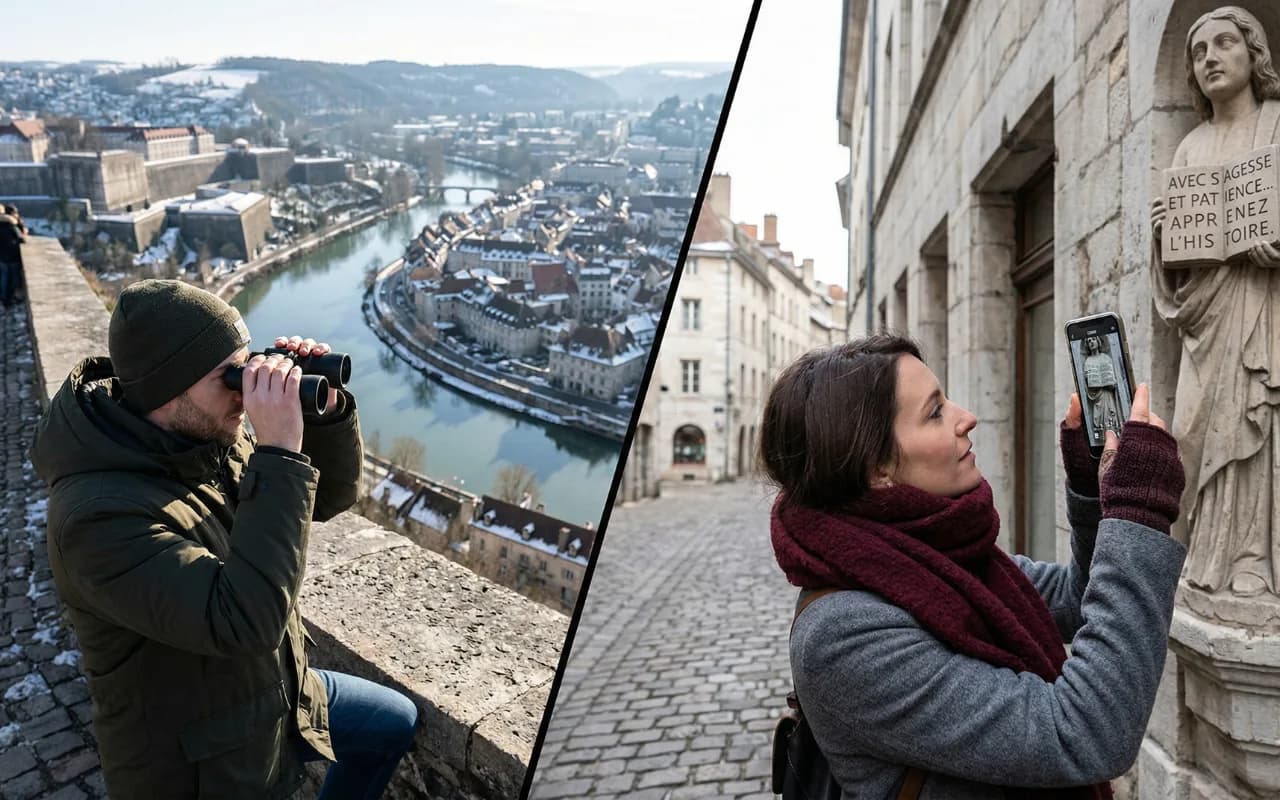
Welcome to Besançon, a city of art and history nestled in lush greenery, famous for its majestic Vauban Citadel and as the birthplace of Victor Hugo! What to do in Besançon during your visit? Let yourself be charmed by 'La Boucle,' the horseshoe-shaped historic center, bordered by the Doubs river, where every cobblestone street tells a story. Stroll along the quays, admire the Renaissance and Baroque architecture, and discover the hidden treasures of this UNESCO World Heritage city. But Besançon is also a fantastic playground for adventurers seeking an unusual activity! Ready to explore the city in a completely new way? Our outdoor escape games invite you to transform your walk into a real treasure hunt or a large-scale scavenger hunt. It's an original and immersive way to discover Besançon while having fun. Get ready for a memorable adventure in the heart of this magnificent city.
Unusual things to do in Besançon
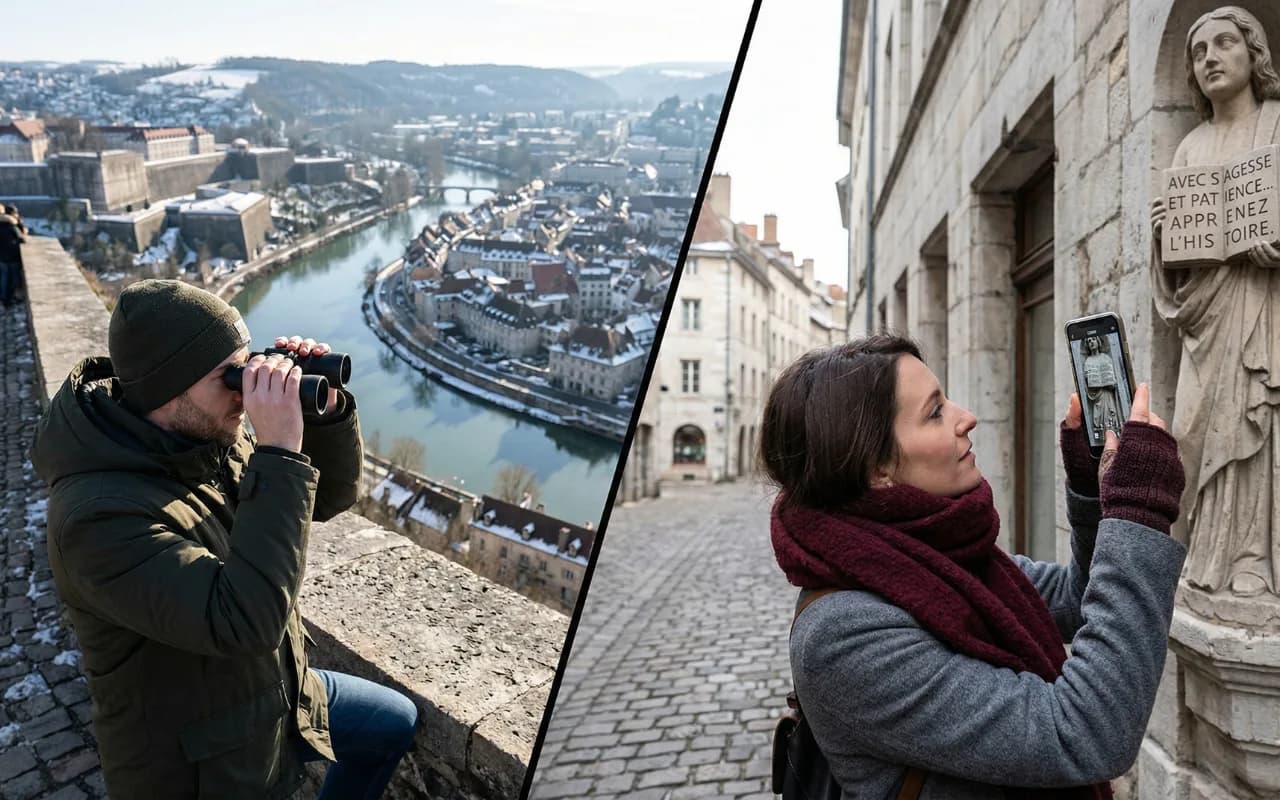
Looking to spice up your stay in Besançon with an unusual activity? Beyond classic visits to the Citadel or the Museum of Fine Arts, our outdoor escape games offer a fun and original immersion. Imagine yourself on a treasure hunt, solving puzzles as a team in the heart of La Boucle, or thwarting a historical plot by exploring secret passages. It's the perfect opportunity to discover Besançon from a new angle, stimulate your mind, and create memorable souvenirs, off the beaten path. Let yourself be surprised by the adventure that awaits you around every corner!
Things to do in Besançon with kids
Besançon is an ideal destination for unforgettable family moments. While the Citadel already offers plenty to amaze both young and old, our outdoor escape games add a fun and interactive dimension to your city exploration. The courses listed above are designed to be accessible to everyone, allowing children to actively participate in solving puzzles. It's a great way to stimulate their curiosity, develop their team spirit, and help them discover Besançon's heritage while having fun. An activity that brings everyone together and guarantees laughter and discoveries for the whole family!
Besançon for couples
For a romantic getaway or an original outing for two, Besançon is full of charm. Beyond hand-in-hand strolls along the Doubs or intimate dinners in the La Boucle district, our outdoor escape games offer a unique experience for couples. Collaborate to solve puzzles, explore the city looking for clues, and share moments of complicity and laughter. It's a stimulating and memorable way to strengthen your bond, discover hidden facets of Besançon, and create unforgettable memories together. An adventure that's out of the ordinary!
What to do in Besançon when it rains
What to do in Besançon when it rains? While it's true that our escape games are mostly outdoor and best enjoyed in the sun, a little shower won't necessarily spoil the adventure! Equip yourself with an umbrella and a raincoat, and the city exploration will only be more picturesque. Otherwise, Besançon is full of museums (Museum of Fine Arts, Victor Hugo's House) and cozy cafes to take shelter. But remember, the spirit of adventure isn't afraid of a few drops!
Where is Besançon, and where do the routes start?
Starting points of our routes and the places they pass through.
Route starting points
Places in Besançon
- Citadel · Entrance and Royal front
- Citadel · Chapel of Saint-Étienne
- Museum of the Resistance · Citadel
- 140 Grande Rue · Victor Hugo's birthplace
- Citadel viewpoint · View over the loop
The history of Besançon
From Roman Vesontio to a Free Imperial City
Besançon's history begins with the Gallic Sequani tribe, who established a fortified settlement here. In 58 BC, Julius Caesar seized the city, then known as Vesontio, during his conquest of Gaul. It became a significant Gallo-Roman town, with remnants like the Porte Noire triumphal arch dating from the 2nd century AD, still visible today.
Following the fall of the Western Roman Empire, Besançon became part of the Holy Roman Empire in 1034. By 1184, Besançon gained autonomy as a Free Imperial City, a status it maintained for nearly four centuries. During this period, the city was governed by a council of elected notables and was largely self-governing. The Dukes of Burgundy acted as protectors, and under Emperor Charles V in the 16th century, Besançon was further fortified and saw the construction of buildings like the Granvelle Palace.
The French Conquest and Vauban's Masterpiece
The 17th century brought upheaval for Besançon. After a brief occupation by French forces in 1668, the city was returned to Spain by the Treaty of Aix-la-Chapelle. However, it was re-captured by Louis XIV's troops in a 27-day siege in 1674, with the King present. The Treaty of Nijmegen in 1678 formally annexed Besançon and the Franche-Comté region to France. Louis XIV then tasked his military engineer, Vauban, with transforming Besançon into a key stronghold for France's eastern defense. Between 1674 and 1688, Vauban redesigned and reinforced the Citadel on Mont Saint-Étienne, a fortress that still dominates the city today and is a UNESCO World Heritage site. This fortification work continued until 1711, shaping the city's silhouette.
What to see in Besançon
- Citadel of Besançon — This 17th-century fortress designed by Vauban offers views of the city and the Doubs River loop. Inside, you will find several museums, including the Museum of Resistance and Deportation.
- Porte Noire — This Roman triumphal arch, dating from the 2nd century AD under Emperor Marcus Aurelius, is the most visible Roman remnant in Besançon. It marked the southern entrance of the Roman city of Vesontio.
- Palais Granvelle — A Renaissance palace built in the 16th century, it now houses the Musée du Temps (Museum of Time), which explores Besançon's watchmaking heritage.
- Cathédrale Saint-Jean — This cathedral shows a mix of architectural styles, reflecting centuries of construction. Its astronomical clock is a feature.
- Battant neighborhood — This historic district was traditionally home to wine growers and offers a different architectural character, with sloping streets and views of the river.
- Place de la Révolution — A square in the city center, surrounded by historic buildings and often hosting markets and events.
When to visit Besançon
The period from late June to early September offers warm weather. During July, the hottest month, average highs reach 24°C, and skies are clearer. May and September also offer pleasant temperatures, with May being the wettest month. Summer is the peak tourist season, with events like the Fête de la Musique in June and Bastille Day celebrations in July.
To avoid crowds, consider visiting in April or October, when the weather is still mild. Winter, from December to February, is cold and wet, with average lows around -0.5°C in January and occasional snow. December is the cloudiest month. Some outdoor attractions or boat tours might have reduced hours or be closed during the colder months.
Getting around Besançon
Besançon is connected by train, with the Besançon-Viotte station a few minutes' walk or tram ride from the city center. The city is walkable, especially the historic center, known as "La Boucle," which sits within a horseshoe bend of the Doubs River. Public transport, including trams and buses, makes it easy to navigate beyond the central loop. For those arriving by car, parking is available on the outskirts of the pedestrianized historic center.
Besançon hosts markets throughout the week. The Marché des Beaux-Arts, a covered market, is open Tuesday through Sunday, with longer hours on Fridays and Saturdays. You can find fresh produce and local cheeses. Weekly open-air markets also take place on various days. Some smaller shops might close for an extended lunch break, a common practice in France.
Things you probably do not know about Besançon
Verified details most visitors walk straight past.
- Porte Noire
- Why is Besançon's ancient Roman triumphal arch called the "Black Gate"? The Porte Noire, built around 175 AD, acquired its name during the Middle Ages. It is believed that centuries of exposure to fire and the elements blackened its limestone, leading to its current designation.
- Besançon Citadel
- The construction of Besançon's Citadel involved a twist of international relations. Vauban initially drew up plans for the Citadel in 1668 when France briefly occupied Besançon. However, the city was returned to Spain. The Spanish then began construction, largely following Vauban's designs, before France re-captured the city permanently in 1674, and Vauban completed his work.
- Museum of the Resistance and Deportation
- The location of the Museum of the Resistance and Deportation within the Citadel is not a coincidence. Between 1941 and 1944, during World War II, the Citadel was used by the German army as a site for executing Resistance fighters. Nearly 100 individuals, mostly Resistance members, were shot there, making it a poignant location for the museum.
- Place Granvelle
- The Palais Granvelle, now home to the Museum of Time, was built by a key figure in the Holy Roman Empire. Nicolas Perrenot de Granvelle, a native of Franche-Comté, served as Chancellor to Emperor Charles V from 1519. He used his influence and wealth to embellish Besançon, commissioning the construction of the Granvelle Palace in the 16th century.
- Besançon's watchmaking heritage
- Besançon's reputation as France's watchmaking capital has roots in a cross-border migration. In the 18th century, unemployed Swiss watchmakers crossed the border into Besançon and established workshops, supported by local nobility. This influx helped the industry flourish, and by the 19th century, Besançon had nearly 400 watchmaking workshops.
- Besançon-Viotte train station area
- Near the train station, you might notice remnants of a bygone mode of transport to the heights of Brégille. In 1913, a private company built a funicular to the Brégille Heights, across the Doubs from the city. Though it closed in 1987, its tracks, stations, and even road signs are still visible today.
Questions about visiting Besançon
How long should I plan to stay in Besançon?
To experience Besançon's main attractions, including the Citadel, the historic center, and a few museums, a stay of 2 to 3 days is generally recommended. This allows for a relaxed pace and time to explore the city's atmosphere.
What are the best ways to get around Besançon?
Besançon is a walkable city, especially its historic center, "La Boucle." For longer distances or to reach areas outside the loop, the city has a public transport system, including trams and buses. You can also explore parts of the city by boat on the Doubs River.
Which neighborhoods should I explore in Besançon?
Beyond the central "Boucle" with its Roman and Renaissance architecture, explore the Battant neighborhood on the right bank of the Doubs, historically known for its winegrowers. The area around Place de la Révolution is also a hub.
Is Besançon a good destination for families with children?
Yes, Besançon offers several family-friendly attractions. The Citadel, with its museums and animals, is a highlight. The city also has parks and green spaces, and during the Christmas market, there are specific activities for children, including Santa's House and a traditional carousel.
What is the typical budget for a visit to Besançon?
Besançon offers options for various budgets. Accommodation ranges from budget-friendly hotels to more upscale choices. Dining can be affordable at local brasseries or markets. Many key attractions, like the Citadel, have entrance fees, but strolling through the historic center is free.
Are there any local customs or closing times to be aware of?
Like many French cities, some smaller shops in Besançon may close for an extended lunch break, typically between 12:30 PM and 2:00 PM. Most major attractions and larger stores will have continuous opening hours. Sunday is generally a quieter day, with fewer shops open.
Frequently asked questions
How much does an outdoor escape game cost in Besançon?
An OddballTrip outdoor escape game in Besançon is offered at a very affordable price of €12 per team. This price applies regardless of your group size, making it an extremely economical and friendly activity. You only need to purchase one game for your entire team, and you're ready to embark on an adventure! It's an excellent option for discovering the city without breaking the bank, while enjoying a fun and memorable experience.
Is it suitable for children / families?
Absolutely! Our outdoor escape games in Besançon are designed to be a quintessential family activity. The puzzles are accessible and stimulating for minds of all ages, and the game encourages collaboration among participants. It's a fantastic way to involve children in discovering the city, developing their observation skills and team spirit. Just plan for a stroller or baby carrier for the youngest if the route is long.
How long does an escape game last in Besançon?
The duration of an outdoor escape game in Besançon generally varies between 1h30 and 2h30. This time includes solving puzzles and discovering the city's various points of interest. However, this duration is indicative, as you are completely free to play at your own pace. You can take breaks, stop to visit a monument, or have a coffee. The goal is to enjoy the experience and the city at your leisure.
Do I need to book in advance?
No, one of the great advantages of our outdoor escape games is that no reservation is necessary! You can purchase your game online at any time and start it whenever you wish. This is ideal for a spontaneous activity or to adapt to the day's weather. Once the game is purchased, you receive a link to access it and can launch it immediately or later, at your convenience. Flexibility guaranteed for your Besançon adventure!
What to visit in Besançon beyond the escape games?
Beyond our scavenger hunts, Besançon is full of treasures. Don't miss the UNESCO-listed Vauban Citadel, with its museums and breathtaking views. Explore La Boucle, the historic heart, with Saint-Jean Cathedral and Victor Hugo's birthplace. Stroll through the Battant district, admire the Astronomical Clock of the Cathedral, or walk along the Doubs river. Every corner offers a new discovery, making Besançon a city rich in heritage and charm.
What is the best season to visit Besançon?
Besançon is pleasant in all seasons, but spring (April to June) and autumn (September to October) offer mild temperatures and beautiful nature, ideal for our outdoor escape games and walks. Summer (July-August) is also very pleasant, with long, sunny days, perfect for enjoying terraces and outdoor activities. Winter can be charming under the snow, but less suitable for outdoor scavenger hunts.
Other destinations in Burgundy-Franche-Comté
Dijon
Palace of the Dukes of Burgundy and royal mustard
Vézelay
Eternal hill and departure point for the Crusades
Cluny
The most powerful abbey in medieval Christendom
Autun
Sister and rival of Rome in Gaul
Auxerre
Carolingian crypt and Chablis vineyards
Tournus
Saint-Philibert abbey and Saône riverside
Lure
Mining town and forgotten Benedictine abbey
Alise-Sainte-Reine
Where Vercingetorix defied Caesar: the echo of Alesia still resonates
Châtillon-sur-Seine
In the heart of Burgundy, between ancient treasures and vineyards.