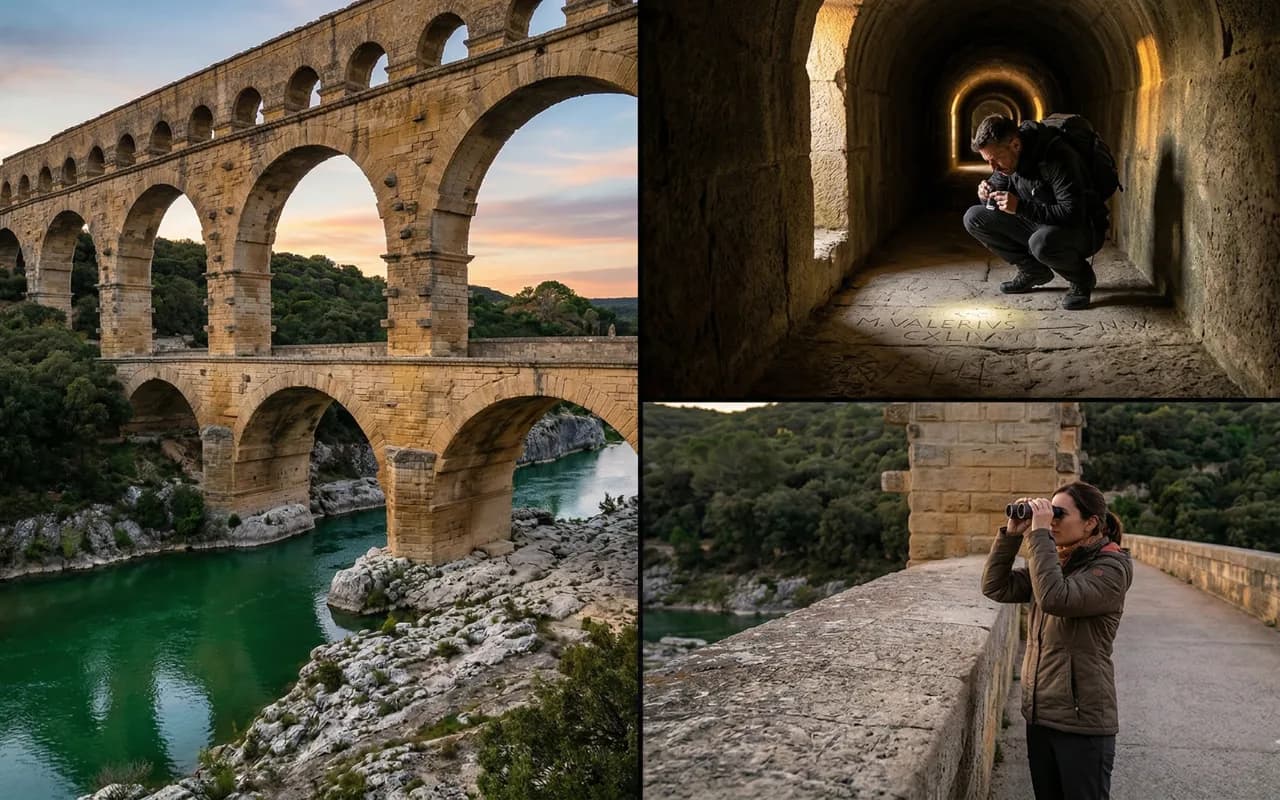
Pont du GardOutdoor Escape Game & Treasure Hunt
Monumental Roman aqueduct in the Gardon gorges
The Pont du Gard, a majestic Roman aqueduct nestled in a green setting, is much more than a simple historical monument; it's a gateway to unforgettable adventures in the heart of Provence. Beyond admiring this ancient engineering marvel and enjoying refreshing swims in the Gardon river, the region offers activities for all tastes. Stroll through charming surrounding villages, explore hiking trails with breathtaking views, or visit the Pont du Gard Museum for a complete immersion in its history. But for those seeking a truly unique experience, the Pont du Gard is also the ideal playground for an outdoor escape game. Imagine yourself on a treasure hunt or scavenger hunt, solving puzzles outdoors, with the aqueduct as a spectacular backdrop. It's an unusual activity that combines discovery, reflection, and fun. Ready to transform your visit into a thrilling adventure? Discover our games that will make you explore the beauty of the site in a completely new way.
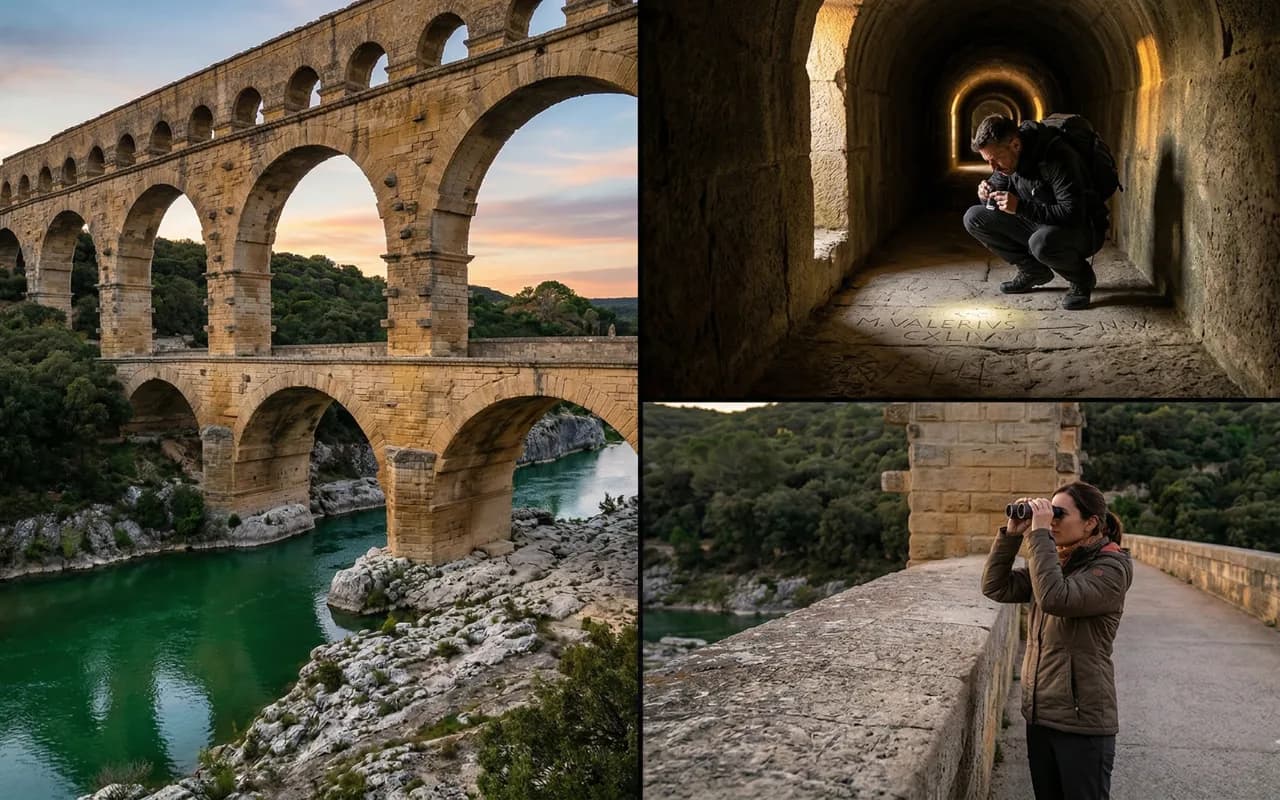
Unusual things to do in Pont du Gard
Looking to spice up your visit to the Pont du Gard with a touch of originality? Our outdoor escape games are the ultimate unusual activity that will make you see this iconic site from a new perspective. Far from the beaten path, you'll embark on an immersive adventure where the Roman aqueduct and the sublime landscapes of the Gardon gorges become the backdrop for your own story. It's a fun and interactive way to discover the region's secrets, stimulate your team spirit, and create memorable souvenirs, all while enjoying the great outdoors. A unique experience guaranteed!
Things to do in Pont du Gard with kids
The Pont du Gard is a fantastic destination for families, and our outdoor escape games add an adventurous dimension that children (and parents!) will love. Forget classic, boring tours; here, the whole family participates in a life-sized treasure hunt. The courses listed above are designed to be accessible and stimulating for all ages, transforming the discovery of the site into an exciting game. It's the perfect opportunity to collaborate, solve puzzles together, and create unforgettable family memories in the heart of an exceptional heritage site.
Pont du Gard for couples
For a romantic getaway that's out of the ordinary at Pont du Gard, our outdoor escape games offer a unique experience to share as a couple. Imagine yourselves hand in hand, exploring the surroundings of the aqueduct, solving puzzles and deciphering mysteries together. It's an original way to strengthen your bond, laugh, and help each other in an absolutely sublime setting. Far from clichés, our courses invite you to a complicit adventure, where every challenge overcome becomes a precious memory. An unusual and memorable date awaits you in the heart of Provençal nature.
What to do in Pont du Gard when it rains
Our escape games are primarily outdoor activities, designed to fully enjoy the magnificent setting of the Pont du Gard. If the weather is rainy, the experience might be different, but not impossible! With appropriate gear (umbrellas, raincoats), the adventure continues, even adding an epic touch. However, for a dry immersion, the Pont du Gard Museum offers an excellent alternative. If you're ready to brave a few drops for the adventure, our courses await you!
Where is Pont du Gard, and where do the routes start?
Starting points of our routes and the places they pass through.
Route starting points
Places in Pont du Gard
- Pont du Gard · View from the left bank
- Ancient Roman quarries · Right bank
- Garrigue path · Above the aqueduct
- Medieval chapel · Hill above the Gardon
- Aqueduct viewpoint · Panoramic overlook
The history of Pont du Gard
Roman Construction and Purpose
The Pont du Gard, a Roman aqueduct bridge, was built in the middle of the 1st century AD, likely under Claudius or Nero. Its purpose was to transport fresh water from the Eure spring near Uzès to Nemausus (modern-day Nîmes), a journey of approximately 50 kilometers (31 miles). Nemausus was a growing city, and this aqueduct provided water for its public baths, fountains, and private homes. This enhanced the city's status and the well-being of its estimated 30,000 to 50,000 inhabitants.
The engineering of the Pont du Gard is notable. The aqueduct maintained an average gradient of 25 centimeters per kilometer (1 in 3,000 over its entire length), allowing water to flow by gravity. The bridge stands nearly 49 meters (160 feet) high and stretches 275 meters (902 feet) across the Gardon River. It is the highest Roman aqueduct bridge still standing and the only ancient triple-tiered bridge of its kind.
From Aqueduct to Toll Bridge and Preservation
After about five centuries of use, the Nîmes aqueduct stopped functioning around the beginning of the 6th century, when the region came under the control of the Franks and Visigoths. During the Middle Ages, the Pont du Gard served as a toll bridge for travelers crossing the Gardon River. Local lords and bishops maintained it, charging a levy for passage. This secondary function contributed to its preservation.
The bridge sustained some damage in the 17th century. Restoration campaigns began in the 18th century, with a comprehensive renovation undertaken in 1858 under Napoleon III. In 1985, the Pont du Gard was designated a UNESCO World Heritage Site, recognizing its preservation, historical importance, and architectural design. A major initiative in 2000 aimed to return the monument to its original condition, removing surrounding traffic and buildings.
What to see in Pont du Gard
- The Pont du Gard — Walk across the lower level of this three-tiered Roman aqueduct bridge. The lower two tiers were constructed without mortar. Guided tours provide access to the top level, which carried the water channel.
- View from the Left Bank (Rive Gauche) — This side offers views of the entire structure. The light in the early morning or late afternoon illuminates the limestone.
- Ancient Roman Quarries (Carrières Antiques) — Located about 600 meters downstream on the left bank, these quarries supplied the shelly limestone for the aqueduct. Excavations show Roman quarrying techniques.
- Right Bank (Rive Droite) — This side provides different views of the bridge and access to deeper pools in the Gardon River, used for swimming.
- Garrigue Path (Mémoires de Garrigue trail) — This interpretive trail explores the surrounding Mediterranean scrubland, offering views of the aqueduct and information on local vegetation.
- Pont du Gard Museum — On the left bank, this underground museum displays Roman construction techniques, daily life in Roman Gaul, and the aqueduct's history, with a scale model and exhibits.
When to visit Pont du Gard
The best times to visit the Pont du Gard are spring (April–June) and early autumn (September–October). During these periods, temperatures are mild, and the site has fewer visitors than in summer. The light of late afternoon in autumn is suitable for photography. Summer brings high visitor numbers and heat, often reaching 40°C (104°F), which can make exploration uncomfortable. If visiting in summer, arrive before 9 AM or after 5 PM to avoid midday crowds and heat. Winter has few visitors, and the monument is still visible, though swimming is not possible.
Getting around Pont du Gard
The Pont du Gard is in the Gard department, between Uzès and Remoulins, approximately 25 km from Nîmes and 30 km from Avignon. By car, it is accessible via the D981 or A9 motorway (exit 23 - Remoulins), with signs to the left bank (Vers-Pont-du-Gard) or right bank (Remoulins) parking areas.
Parking is available on both banks, with a fixed fee of €9 per vehicle for the day. Payment is made at automatic kiosks at the reception buildings or exit terminals. Overnight parking for camper vans is not allowed.
Public transport includes trains to Nîmes or Avignon, then a regional bus (Line B21 or shuttle services in high season) to Remoulins, followed by a walk or taxi to the site. Bus services are less frequent outside peak months. The site is pedestrian-friendly; walking shoes are recommended. Access to the Pont du Gard monument is free; charges apply for parking, museum entry, and guided tours.
Things you probably do not know about Pont du Gard
Verified details most visitors walk straight past.
- Pont du Gard (middle tier)
- Why do some stones protrude from the middle tier of the Pont du Gard, seemingly unfinished? These projecting stone blocks were intentionally left in place by the Roman builders. They served as supports for the wooden scaffolding used during construction and were retained to facilitate future maintenance and repairs of the aqueduct.
- Gardon River
- Local legend attributes the Pont du Gard's impossible construction to a pact with the devil. What was the devil's price? The legend claims the devil built the bridge after a mason's repeated failures to tame the Gardon River. In exchange, the devil demanded the first soul to cross the finished bridge. The clever mason, however, sent a hare across first, enraging the devil, who supposedly plastered the animal into the bridge.
- Aqueduct water channel (top tier)
- How did the Roman engineers ensure the water flowed consistently over such a long distance with minimal drop? The Roman surveyors and engineers achieved an astonishing feat of precision: the entire 50-kilometer aqueduct route from Uzès to Nîmes dropped only 12.6 meters (41 feet) in elevation, resulting in a gradient of just 1 centimeter for every 182.4 meters.
- Estel Quarry
- Considering the immense size of the Pont du Gard, how did the Romans transport the tens of thousands of tons of stone needed for its construction? Most of the 50,400 tons of shelly limestone used for the bridge was extracted from the nearby Estel quarry, located less than a kilometer from the construction site. The proximity allowed for efficient transport of the individually numbered blocks, often by boat down the Gardon River.
- Medieval Chapel
- What became of the Pont du Gard after the Roman Empire declined and the aqueduct was no longer in use? During the Middle Ages, the Pont du Gard was repurposed as a toll bridge. Local lords and bishops collected fees from travelers crossing the Gardon River, a function that inadvertently contributed to the monument's preservation over centuries.
Questions about visiting Pont du Gard
How much time should I allocate for visiting the Pont du Gard?
A visit to the bridge and a walk across takes about 1 to 1.5 hours. To include the museum and explore the surrounding paths, allow 3 to 4 hours. If you plan to swim in the Gardon River, add another 2 hours.
Is there an entrance fee for the Pont du Gard?
Access to the Pont du Gard monument and outdoor areas is free. There is a charge for parking (€9 per vehicle), and for entry to the cultural areas like the museum, cinema, Ludo area, and guided tours.
Can I swim in the Gardon River at the Pont du Gard?
Yes, the Gardon River beneath the aqueduct is a place for swimming, especially in summer. Its clear, shallow waters are suitable for swimming, with rocky banks for relaxing. Kayaking is also an activity here.
How do I get to the Pont du Gard by public transport?
You can take a train to Nîmes or Avignon, then catch a regional bus (Line B21 or shuttle services in high season) to Remoulins. From Remoulins, it is a walk or taxi ride to the site. Public transport is less frequent outside of peak season.
Are there dining options available at the Pont du Gard site?
Yes, there are snack bars and a bistro near the visitor center on the left bank. Visitors can also bring their own food and picnic along the riverbanks.
Is the Pont du Gard accessible for people with reduced mobility?
The Pont du Gard site is committed to accessibility. Dedicated parking spaces, easy-access pathways, and free wheelchair rentals are available. The cultural areas and restaurant are equipped with lifts. However, guided visits to the aqueduct's third tier are not suitable due to 80 steps and garrigue paths.
Frequently asked questions
How much does an outdoor escape game cost at Pont du Gard?
An OddballTrip outdoor escape game at Pont du Gard is a very affordable activity, perfect for groups of friends or families. The price is €12 per team, not per person! This means that if you come with 4 or 5 players, the cost per participant is truly minimal. This single team rate makes the experience accessible and encourages group play, allowing you to enjoy an immersive and cultural adventure without breaking the bank. It's an excellent option for quality entertainment on a budget.
Is it suitable for children / families?
Absolutely! Our outdoor escape games at Pont du Gard are designed to be a quintessential family activity. The puzzles are varied, some requiring observation, others logic, allowing everyone, young and old, to contribute. It's a fun way to explore the site, stimulate children's curiosity, and strengthen family bonds. We generally recommend active participation from 8-10 years old, but younger children will also enjoy the treasure hunt aspect and the outdoor stroll.
How long does an escape game at Pont du Gard last?
The duration of our outdoor escape games at Pont du Gard generally varies between 1 hour 30 minutes and 2 hours 30 minutes. This, of course, depends on your pace, your team spirit, and how quickly you solve the puzzles! We encourage you to take your time, enjoy the magnificent landscapes, and fully immerse yourself in the adventure. It's not a race, but an experience of discovery and sharing. So, plan for half a day to be comfortable, including game time and exploring the surroundings of the Pont du Gard.
Do I need to book in advance?
Yes, it is highly recommended to book your outdoor escape game in advance, especially if you plan to come during peak periods such as weekends, school holidays, or the high summer season. Although our games are always available, booking guarantees the availability of your chosen course and allows you to receive all the necessary instructions to properly prepare for your adventure. It's simple, fast, and ensures a smooth, stress-free experience from the moment you arrive at the Pont du Gard.
What to visit at Pont du Gard beyond the escape games?
Beyond our exciting escape games, the Pont du Gard site offers a multitude of activities. Don't miss crossing the aqueduct, swimming in the Gardon river in summer, or having a picnic on its banks. The Pont du Gard Museum and cultural space will immerse you in Roman history and the construction of this monumental work. You can also explore the surrounding hiking trails for breathtaking views of the Gardon gorges, or visit the charming town of Uzès, just a few kilometers away, renowned for its market and duchy.
What is the best season to visit Pont du Gard?
The Pont du Gard is beautiful in all seasons, but spring (April-June) and early autumn (September-October) are often considered the best times. The weather is generally mild and sunny, ideal for enjoying our outdoor escape games and outdoor activities without the summer crowds. Summer (July-August) is perfect for swimming, but it can get very hot. Winter offers a quieter, more contemplative atmosphere, although some water activities are closed. Each season has its charm!
Other destinations in Provence-Alpes-Côte d'Azur
Les Baux-de-Provence
Citadel of Provence's warrior lords
Saintes-Maries-de-la-Mer
Wild Camargue and Romani pilgrimage
Marseille
France's oldest city and Château d'If
Entrevaux
The fortified medieval city, sentinel of the Alps
Fontaine-de-Vaucluse
In the heart of Provence, the mystery of the emerald spring.
Glanum
Journey to the heart of an ancient Provençal city
Hyères
The City of Palms, gateway to the Golden Islands.
Tarascon
In the footsteps of the Tarasque and its castle
Vaison la romaine
More cities in France
Nîmes
The French Rome, between arenas and garrigue
Aigues-Mortes
Medieval crusader city, between ramparts and salt marshes
Vallon-Pont-d'Arc
Chauvet Cave and natural arch of the Ardèche gorges
Montpellier
Medieval medical school and secret old town
Sète
The Venice of Languedoc and Brassens' homeland
Narbonne
Walk the path of Roman Narbo Martius
Lyon
Secret traboules and gastronomy capital
Activities to discover nearby
Guided tours, skip-the-line tickets and local experiences to book in advance.
💡 Optional booking — you can also buy on-site. All links open in a new window, your OddballTrip visit stays preserved.