MarseilleOutdoor Escape Game & Treasure Hunt
France's oldest city and Château d'If
Marseille, the Phocaean city, invites you to an exploration rich in history and flavors. Stroll along the Old Port, admire the boats, and savor an authentic bouillabaisse. Climb up to Notre-Dame de la Garde for breathtaking views of the city and the Mediterranean, or get lost in the colorful alleys of the Panier district, the oldest in France. Marseille is a vibrant city where the sun shines almost all year round, offering an ideal setting for unique adventures. Beyond its iconic sites like the Mucem or the Château d'If, the city is full of activities for all tastes. And what if you were looking for an original way to discover its secrets? Our outdoor escape games are real-life treasure hunts, transforming the city into a playground. It's the perfect opportunity to experience an unusual activity while exploring Marseille differently. Get ready to take on challenges and create unforgettable memories with the game we offer just below.
Unusual things to do in Marseille
Marseille is much more than the Old Port and Notre-Dame de la Garde! For an unusual activity, let yourself be tempted by a kayak trip in the calanques, a visit to the Frioul islands, or even an underwater exploration by diving. But for a truly unique experience that combines discovery and adventure, our outdoor escape game is perfect. It invites you to solve puzzles in the heart of the city, transforming your stroll into a real treasure hunt. It's an original and fun way to discover Marseille's hidden corners, off the beaten path, and to experience memorable moments with friends or family.
Things to do in Marseille with kids
Marseille is a fantastic destination for families! Besides the beaches and Borély Park, your children will love a trip to the Mucem or a ride on the tourist mini-train. But for an unusual activity that is sure to please all ages, our outdoor escape game is ideal. Designed as an interactive treasure hunt, it allows both young and old to collaborate to solve puzzles and discover the city's secrets. It's a great way to spend quality time together, stimulate children's curiosity, and create unforgettable family memories by exploring Marseille in a fun and educational way.
Marseille for couples
Marseille offers an ideal romantic setting for couples, with its sunsets over the Old Port and candlelit dinners in Le Panier. For an out-of-the-ordinary experience for two, why not embark on an urban treasure hunt? Our outdoor escape game is a perfect unusual activity for lovers. It allows you to discover the city hand in hand, solve puzzles together, and share laughter while exploring iconic or hidden places. It's an original and intimate way to strengthen your bond and create memorable memories in Marseille.
What to do in Marseille when it rains
When the Marseille sky turns grey, don't panic! You can still visit the Mucem, the Museum of History of Marseille, or stroll through the galleries of Les Docks. Our outdoor escape games are, as their name suggests, mostly outdoors. If the rain is light, a small shower won't spoil the adventure, but in case of heavy rain, it's better to opt for indoor activities. Remember to check the weather before embarking on our treasure hunt to fully enjoy your urban mystery game!
Where is Marseille, and where do the routes start?
Starting points of our routes and the places they pass through.
Route starting points
Places in Marseille
- Old Port · Quai de la Fraternité
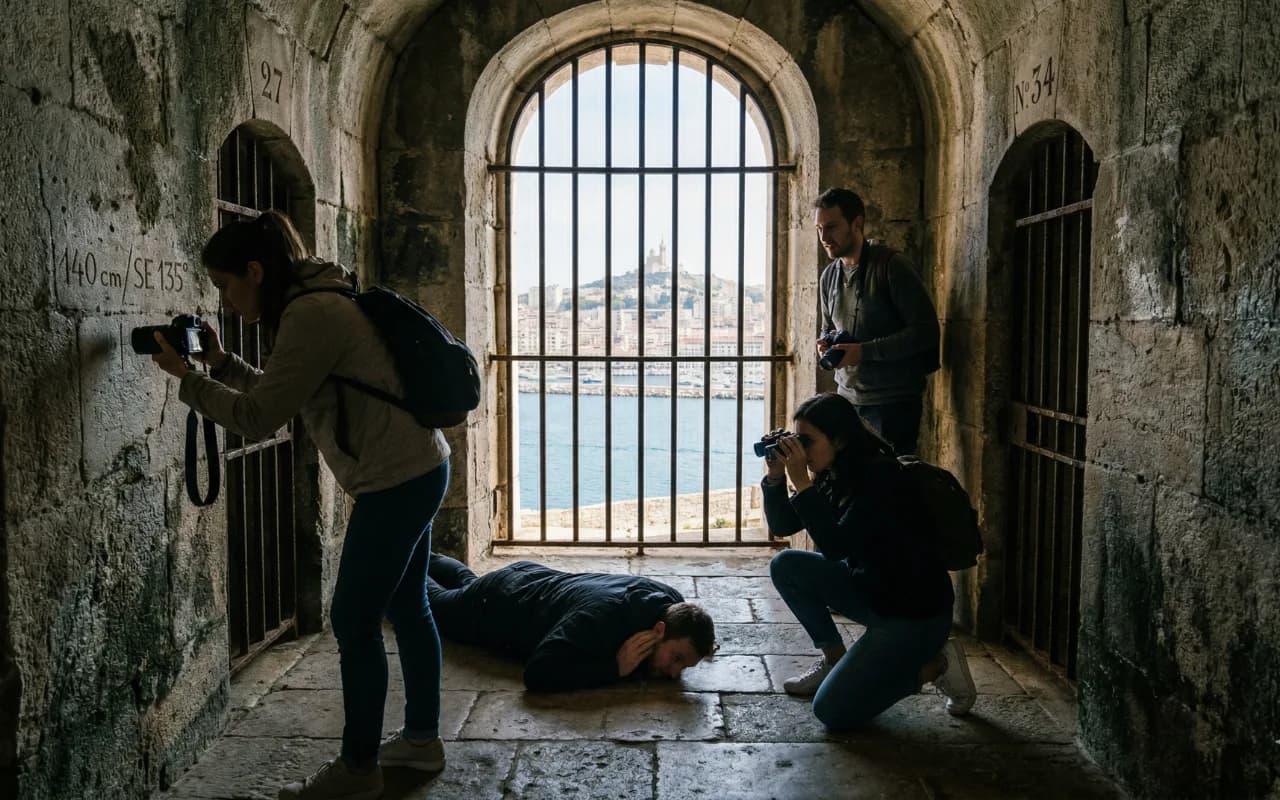
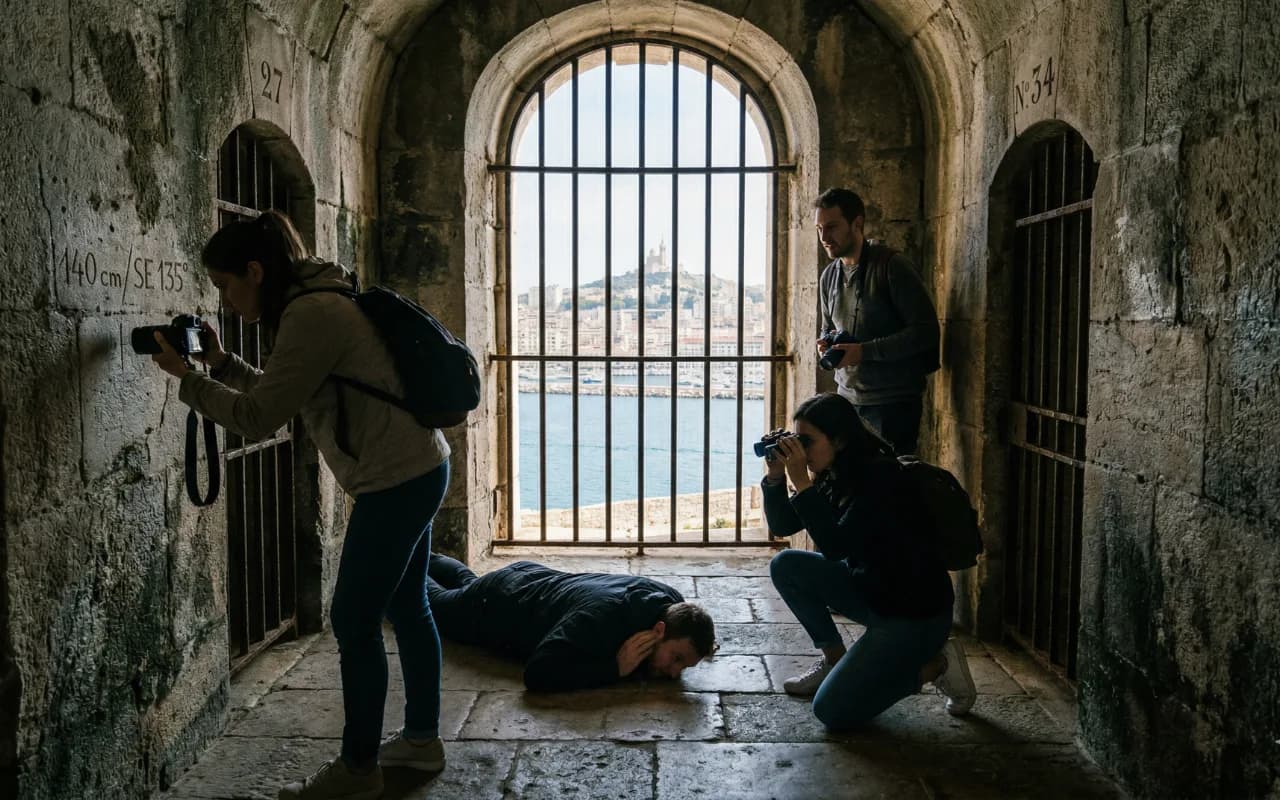
- Château d'If · Prisoner cells
- Fort Saint-Jean · Old Port entrance
- Basilica of Notre-Dame-de-la-Garde · La Garde hill
- Le Panier · Marseille's oldest quarter
The history of Marseille
From Greek Port to Roman City
Marseille's story begins around 600 BC, when Greek settlers from Phocaea landed in the natural harbor of the Lacydon cove, now the Old Port. They established a trading post called Massalia on the northern shore, creating France's oldest city. This location, protected from the sea, allowed Massalia to develop. The city later grew under Roman rule, with evidence of this past still visible in its architecture.
Royal Authority and Maritime Power
In the 17th century, tensions between Marseille and King Louis XIV led to changes. In 1660, Louis XIV visited Marseille to reassert his authority. By 1666, the city's ramparts were demolished for expansion. To control the entrance to the Old Port and manage potential rebellion, Louis XIV ordered the construction of two fortresses: Fort Saint-Jean on the north bank and Fort Saint-Nicolas on the south bank. These forts, built from 1668, defended the city and also had cannons pointed inward, serving as a reminder of royal power. The Old Port became a major trading hub in Europe, attracting immigrants and facilitating maritime commerce. However, this port also faced challenges, notably the Great Plague of 1720, which affected the city and Provence.
Modern Transformations
The 19th century brought further development to Marseille. The Old Port's commercial function shifted to the deeper docks of La Joliette in the mid-19th century, transforming the Old Port into a marina. In 1844, the construction of the new Joliette basin was ordered by the government. To connect it to the Old Port, Rue Impériale (now Rue de la République) was laid out. The arrival of the Durance River waters in 1849 was a major event, commemorated by the construction of the Palais Longchamp in 1869, marking the beginning of the city's industrial expansion. During World War II, a portion of the historic Old Port area was destroyed by the Nazis in January 1943, including the Transporter Bridge, inaugurated in 1905.
What to see in Marseille
- Old Port (Vieux-Port) — The historic center of Marseille, where Greek settlers landed in 600 BC. Today, it is a marina with fishing boats, yachts, and a daily fish market.
- Le Panier — Marseille's oldest district, a network of narrow streets and staircases on a hill overlooking the Old Port. It contains artisan workshops, small shops, and street art.
- Fort Saint-Jean — A 17th-century fortress built by Louis XIV at the entrance of the Old Port. Its ramparts offer views of the Mediterranean and the city. It is connected to the MuCEM (Museum of European and Mediterranean Civilisations).
- Basilica of Notre-Dame-de-la-Garde — A Neo-Byzantine basilica consecrated in 1864, on La Garde hill, the highest natural point in the city. Its white Calissane limestone and green Golfolina sandstone exterior, mosaics, and gilded statue of the Madonna and Child make it a landmark.
- Château d'If — A fortress and former state prison on an island off the coast of Marseille, known from Alexandre Dumas' novel The Count of Monte Cristo. Visitors can see the cells and engravings left by prisoners.
- La Vieille Charité — A 17th-century architectural complex in Le Panier, designed by Pierre Puget. Originally a poorhouse, it now houses the Museum of Mediterranean Archaeology and the Museum of African, Oceanian, and Native American Art.
When to visit Marseille
Marseille has a Mediterranean climate with sunshine year-round. The period from late May to early October is suitable for outdoor activities, with a peak in late June. Spring (April to May) and autumn (September to October) offer moderate temperatures and fewer people. In April, daytime temperatures reach 17–20°C. September and early October are suitable for outdoor activities, with warm sea temperatures. Summers (July and August) are hot and dry, with highs often exceeding 28°C, suitable for beaches, but also the busiest time with more people and higher accommodation costs. Winters (November to March) are milder, but the mistral wind can make it feel cold, even with temperatures around 11-14°C. January is generally the coldest month, with lows between 4-7°C. Precipitation is highest in October. Avoid July and August if you prefer fewer crowds.
Getting around Marseille
Marseille's main railway station is Marseille-Saint-Charles, a hub for TGV, Intercity, and regional trains, connecting the city to Paris in just over 3 hours. The station is on a hill and linked to the city center by stairs. From Marseille Provence Airport (MRS), a direct shuttle bus runs to Marseille-Saint-Charles station, taking about 25-30 minutes.
Travel around the city is managed by the Régie des Transports Métropolitains (RTM) network, which includes two metro lines (M1 and M2), three tram lines (T1, T2, T3), and bus routes. The metro operates from around 5:30 AM to 12:30 AM. Trams run from 5:15 AM to 12:30 AM, and buses from 5:30 AM to 8:45 PM, with night buses available. A single contactless ticket is valid for 60 minutes across the network. For coastal sites and steeper areas, buses are often necessary, such as line 60 connecting the Old Port to Notre-Dame-de-la-Garde. Maritime shuttles also operate during summer, connecting the Old Port to destinations like L'Estaque and Pointe Rouge.
Things you probably do not know about Marseille
Verified details most visitors walk straight past.
- Old Port (Vieux-Port)
- What's in a name? The main thoroughfare leading to the Old Port has a surprising connection to an ancient crop. The Canebière, Marseille's major street, derives its name from the medieval cultivation of hemp (chanvre in French, canebiera in Provençal Occitan) at the far end of the port, used for manufacturing rope for mariners.
- Château d'If
- While *The Count of Monte Cristo* made the Château d'If famous, one real-life prisoner was accused of an even more devastating act than Edmond Dantès' fictional injustice. Jean-Baptiste Chataud, captain of the ship *Grand-Saint-Antoine*, was imprisoned at Château d'If from 1720 to 1723, accused of bringing the Great Plague of 1720 to Marseille, which killed between 30,000 and 40,000 people in the city.
- Fort Saint-Jean
- King Louis XIV ordered the construction of Fort Saint-Jean, ostensibly for defense, but his true intentions were a bit more... controlling. Louis XIV built Fort Saint-Jean and its counterpart, Fort Saint-Nicolas, not just to protect Marseille from external attack, but also to subdue a rebellion by the citizens against royal rule, with cannons pointed towards the city.
- Basilica of Notre-Dame-de-la-Garde
- The striking two-toned exterior of Notre-Dame-de-la-Garde isn't just a design choice; it's a nod to a specific architectural style. The basilica's exterior features layered stonework in contrasting colors of white Calissane limestone and green Golfolina sandstone, a characteristic element of the Neo-Byzantine style in which it was constructed.
- Le Panier
- The name of Marseille's oldest district, Le Panier, comes from a very humble origin. The district's name, 'Le Panier' (The Basket), originates from an old 17th-century inn whose sign bore a basket. The name first applied to the street where it stood, then to the entire neighborhood.
- Marseille-Saint-Charles station
- Beyond its function as a transport hub, Marseille's main train station has a surprising cultural side. Following its regeneration, Marseille-Saint-Charles station has hosted various cultural events, with its concourse and historic hall transforming into dancefloors for breakdance festivals and tango seasons.
Questions about visiting Marseille
What are the best neighborhoods to explore in Marseille?
Beyond the Old Port, explore Le Panier for its historic character and artisan shops, Cours Julien for street art, or Endoume for a quieter, seaside village atmosphere. Saint-Victor offers a blend of harbor and coastal living.
How long should I plan to stay in Marseille?
For a visit, allow at least 3 to 4 days to experience the main attractions like the Old Port, Le Panier, Notre-Dame-de-la-Garde, and a boat trip to the Château d'If or the Calanques. A shorter stay of 1 to 2 days can cover the main sites around the Old Port.
What is the best way to get around Marseille?
Marseille has a public transport network including metro, trams, and buses, operated by RTM. The metro is the fastest for central areas, while trams connect various districts. Buses are used for reaching coastal sites and hills like Notre-Dame-de-la-Garde. Walking is suitable for exploring neighborhoods like Le Panier.
What is the typical budget for a day in Marseille?
Marseille offers options for various budgets. A moderate daily budget might range from €60-€100, including public transport, a few museum entries, and meals at local restaurants. Savings can be made by using multi-day transport passes and having picnics with market produce.
Is Marseille a good destination for families with children?
Yes, Marseille can be suitable for families. Children often enjoy boat trips to the Château d'If or the Frioul Islands, exploring the streets of Le Panier, and visiting the beaches. The MuCEM also offers exhibitions. The Petit Train de Marseille provides an overview of the city.
What is the best time of year to avoid crowds?
To avoid the largest crowds, consider visiting Marseille during spring (April-May) or autumn (September-October). The weather is still pleasant, but tourist numbers are lower than during the peak summer months of July and August.
Frequently asked questions
How much does an outdoor escape game cost in Marseille?
Our outdoor escape games in Marseille are designed to be accessible and offer excellent value for your entertainment. The price is €12 per team, which is very advantageous as you don't pay per person. Whether you are a duo, a family, or friends, the price remains the same for the group. It's an economical solution to enjoy an unusual activity and discover the city in a fun way. This price includes access to the game, the puzzles, and online support if you need a hint.
Is it suitable for children / families?
Absolutely! Our outdoor escape game in Marseille is perfectly suited for families and children. The puzzles are designed to be stimulating without being too complex, encouraging collaboration between different generations. It's an excellent unusual activity to spend quality time together, where everyone can contribute. We generally recommend a minimum age of 8 for children to actively participate in solving the puzzles, but younger ones can certainly follow along and enjoy the walk.
How long does an escape game last in Marseille?
The duration of our outdoor escape game in Marseille generally ranges between 1h30 and 2h30. This, of course, depends on your pace, your ability to solve the puzzles, and the time you take to admire the places you pass through. There is no stressful timer; you are free to take your time to fully enjoy the experience. It's a treasure hunt at your own pace, allowing you to discover the city while having fun.
Do I need to book in advance?
No, the beauty of our concept is that you don't need to book in advance! Our outdoor escape games are available 24/7. Once you have purchased the game online, you receive immediate access and can start the adventure whenever you wish. It's ideal for a last-minute decision or to adapt to a flexible holiday schedule. All you need is a charged smartphone and the desire to embark on an exciting mystery game.
What to visit in Marseille beyond the escape games?
Marseille is full of treasures to explore! After enjoying our outdoor escape game, don't miss the majestic Old Port, the beating heart of the city, and the Notre-Dame de la Garde basilica, offering an unforgettable panoramic view. Stroll through the historic Panier district, visit the Mucem for its architecture and exhibitions, or escape to the magnificent Calanques for a breath of fresh air. The Château d'If, made famous by Alexandre Dumas, is also a must-see. Marseille has so much to offer, well beyond our treasure hunt!
What is the best season to visit Marseille?
Marseille enjoys a very pleasant Mediterranean climate, making it an attractive destination almost all year round. Spring (April-June) and early autumn (September-October) are often considered the best seasons. Temperatures are mild, the sun is generous, and crowds are less dense than in mid-summer. It's perfect for enjoying our outdoor escape game without getting too hot and for exploring the city comfortably. Summer is, of course, very sunny but can be very hot, ideal if you plan a lot of swimming!
Other destinations in Provence-Alpes-Côte d'Azur
Les Baux-de-Provence
Citadel of Provence's warrior lords
Saintes-Maries-de-la-Mer
Wild Camargue and Romani pilgrimage
Pont du Gard
Monumental Roman aqueduct in the Gardon gorges
Entrevaux
The fortified medieval city, sentinel of the Alps
Fontaine-de-Vaucluse
In the heart of Provence, the mystery of the emerald spring.
Glanum
Journey to the heart of an ancient Provençal city
Hyères
The City of Palms, gateway to the Golden Islands.
Tarascon
In the footsteps of the Tarasque and its castle
Vaison la romaine
More cities in France
Aigues-Mortes
Medieval crusader city, between ramparts and salt marshes
Nîmes
The French Rome, between arenas and garrigue
Montpellier
Medieval medical school and secret old town
Sète
The Venice of Languedoc and Brassens' homeland
Vallon-Pont-d'Arc
Chauvet Cave and natural arch of the Ardèche gorges
Narbonne
Walk the path of Roman Narbo Martius
Lyon
Secret traboules and gastronomy capital
Activities to discover nearby
Guided tours, skip-the-line tickets and local experiences to book in advance.
💡 Optional booking — you can also buy on-site. All links open in a new window, your OddballTrip visit stays preserved.