PembrokeshireOutdoor Escape Game & Treasure Hunt
Land of castles and coastal paths
Welcome to Pembrokeshire, a land where history and nature intertwine to offer a multitude of memorable experiences. If you're wondering what to do in Pembrokeshire, prepare to be amazed by its breathtaking coastal landscapes and rich heritage. Start by exploring the majestic Pembroke Castle, an imposing Norman fortress that was the birthplace of Henry VII, and let yourself be transported through centuries. Don't miss the serenity of St Davids Cathedral, Wales' largest place of worship, nestled in the UK's smallest city. But for a truly unique activity, why not embark on an outdoor escape game? It's an original way to uncover the region's secrets. Imagine a life-sized treasure hunt or a captivating scavenger hunt that will lead you through picturesque alleys and historic sites, transforming your visit into an unforgettable interactive adventure. Pembrokeshire is an invitation to active exploration, far beyond the beaten paths.

Unusual things to do in Pembrokeshire
For a unique activity in Pembrokeshire, step off the beaten path and dive into adventure. Beyond coastal hikes, imagine solving puzzles outdoors, with the sea breeze as your companion. Participate in an original outing that combines heritage discovery with intellectual challenge. Our outdoor escape games transform the city into a huge playground, where each clue brings you closer to a well-kept secret. It's a unique way to immerse yourself in local history while stimulating your mind, far from traditional museums. A memorable experience guaranteed, full of surprises and unexpected twists.
Things to do in Pembrokeshire with kids
Pembrokeshire is full of activities for the whole family. If you're looking for things to do with family in Pembrokeshire, our scavenger hunts are perfect for children and teens aged 8 and up (with parental help for younger ones). The playful aspect of our outdoor treasure hunts guarantees laughter and excitement for everyone. It's a great opportunity to stimulate children's curiosity while exploring the region's wonders together. Imagine them deciphering codes and following maps, turning every street corner into a new stage of their adventure. An interactive and enriching way to create precious memories.
Pembrokeshire for couples
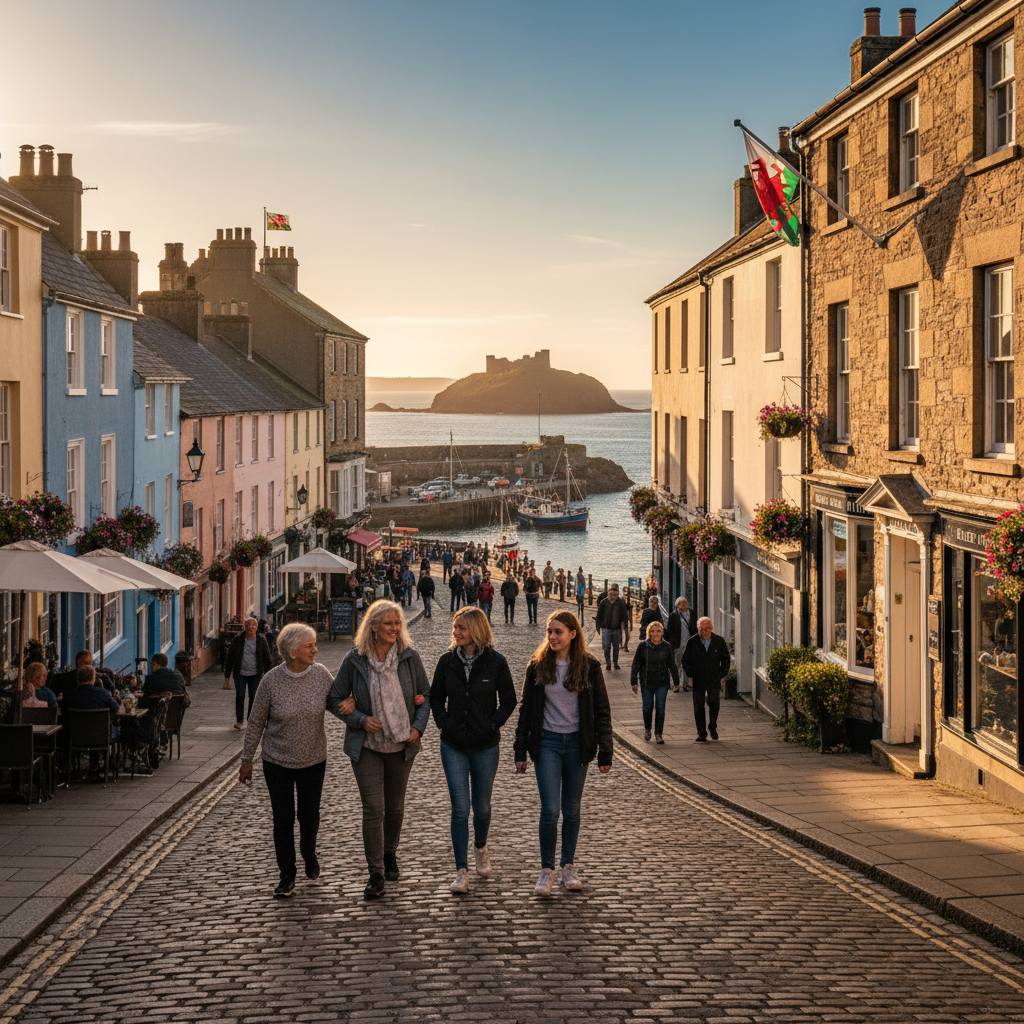
A romantic getaway in Pembrokeshire for couples promises unforgettable moments. Stroll hand-in-hand along coastal paths offering breathtaking ocean views, or get lost in the history-laden narrow streets of towns like Tenby, with its colorful houses and charming atmosphere. Discover local heritage through a shared experience, such as a scavenger hunt that will lead you to hidden corners and secret panoramas. It's the perfect opportunity to reconnect, share laughs, and solve puzzles together, creating intimate and unique memories amidst magnificent landscapes.
What to do in Pembrokeshire when it rains
Even in rainy weather, Pembrokeshire offers options to stay active. If you're wondering what to do in Pembrokeshire on a rainy day, our outdoor escape game is designed to be playable. Although it's an outdoor activity, a large part of the route (approximately 80%) takes place under arcades, covered passages, or in areas offering partial shelter. This allows you to continue the adventure without being fully exposed to the elements. Bring an umbrella and comfortable shoes, and let yourself be surprised by the city's beauty even under a gray sky, all while solving puzzles.
Where is Pembrokeshire, and where do the routes start?
Starting points of our routes and the places they pass through.
Route starting points
Places in Pembrokeshire
- St Davids Cathedral
- Cathedral Close Entrance Gate
- Bishop's Palace Exterior Walls
- St Davids City Cross (High Street)
- Oriel y Parc National Park Visitor Centre (exterior)
- St Non's Chapel Ruins (exterior)
- View from Porthclais Harbour coastal path
The history of Pembrokeshire
Early Christianity in Menevia
Pembrokeshire's history is linked to its religious significance in St Davids. The area's story begins in the 6th century with Saint David (Dewi Sant), the patron saint of Wales. He established a monastic community on the banks of the River Alun, at a place then known as "Glyn Rhosyn," where St Davids Cathedral now stands. This monastery, Menevia, became a leading church due to St David's influence. The site's importance grew, attracting pilgrims, and in 1123, Pope Calixtus II declared St Davids a pilgrimage centre. He decreed that two pilgrimages there equalled one to Rome, and three to Jerusalem. This papal decree solidified St Davids' status as a major religious site in the Western world.
Norman Construction and Medieval Expansion
With the Norman conquest, stability arrived in the 11th century, after centuries of Viking raids that had plundered the monastic community. In 1115, King Henry I of England appointed Bishop Bernard, a Norman, who began constructing a new cathedral, consecrated in 1131. The present St Davids Cathedral building largely dates from 1181, initiated by Bishop Peter de Leia. This new structure faced challenges; its central tower collapsed in 1220 and an earthquake caused damage in 1247/48. Significant modifications were undertaken in the 14th century by Bishop Henry Gower (1328–1347). He repaired and extended the cathedral, including the nave, choir, and a major stone screen. Bishop Gower was also responsible for much of the Bishop's Palace that stands today, transforming it from a dwelling into an immense palace between 1328 and 1347. The Reformation in the 16th century marked the decline of the Bishop's Palace, with Bishop William Barlow possibly stripping lead from its roofs, leading to its eventual ruin.
What to see in Pembrokeshire
- St Davids Cathedral — This purple-stoned cathedral, dating largely from 1181, is the resting place of Saint David, Wales's patron saint. Inside, visitors see the shrine of St David and St Justinian, and the woodcarving of the choir stalls from the late 15th century. The building shows marks of centuries of rebuilding and expansion, including a sloping floor and arcades that veer from the vertical due to past collapses and an earthquake.
- Bishop's Palace Exterior Walls — Adjacent to the cathedral, these ruins show the wealth of medieval bishops. Largely built by Bishop Henry Gower in the 14th century, visitors can discern the grand hall, private apartments, and the arcaded parapet that unified the palace's design.
- St Non's Chapel Ruins — Located on the coast, these ruins traditionally mark the birthplace of Saint David around 500 AD. The chapel is unusual for its north-south alignment, possibly due to the sloping terrain. Nearby is St Non's Well, a holy well historically sought for healing.
- Porthclais Harbour — This small, sheltered inlet harbour was built in the 12th century and was once a port for importing coal, timber, and limestone for the cathedral. Three well-preserved lime kilns are visible, used to process limestone for local farmers. The harbour is now used for watersports and offers access to the coastal path.
- Oriel y Parc National Park Visitor Centre — This facility serves as a gateway to the Pembrokeshire Coast National Park. It combines a National Park Visitor Centre with a gallery space, offering information about the local landscape, wildlife, and cultural heritage. It is a starting point for exploring the wider area.
When to visit Pembrokeshire
The best time to visit Pembrokeshire is between late spring and early autumn, from May to September. During May, wildflowers bloom along the cliffs, and the weather is often pleasant. June to September offers mild to warm weather, with average daytime temperatures around 20°C in summer, suitable for exploring the coastline and towns. July and August are peak season, with the warmest sea temperatures, but also the largest crowds. For a quieter experience with fewer crowds and good walking weather, consider visiting in May or September. Atlantic storms are most common from October to March, and winters are cold, wet, and windy, with average lows around 0.5°C to 5°C. Many seasonal services and attractions may have reduced hours or be closed during the off-peak winter months.
Getting around Pembrokeshire
Pembrokeshire is accessible by train, with services linking towns. Haverfordwest, Milford Haven, and Fishguard train stations offer onward bus connections. The TrawsCymru T11 service connects Haverfordwest and Fishguard via St Davids. The Pembrokeshire Coast National Park operates coastal bus services like the "Celtic Coaster" seven days a week during summer and a reduced service in winter, providing access to the Pembrokeshire Coast Path. These are "hail and ride" services. For more flexible travel, the fflecsi bus service operates Monday to Saturday, allowing booking pick-ups and drop-offs within designated zones, including St Davids. Parking in St Davids is available, with a National Trust car park at Porthclais Harbour. Some coastal paths can be steep and uneven, especially after wet weather, so sturdy footwear is recommended.
Things you probably do not know about Pembrokeshire
Verified details most visitors walk straight past.
- St Davids Cathedral
- Why does the floor of St Davids Cathedral noticeably slope, and why do its walls appear to lean? The cathedral's architectural quirks, including a sloping floor and arcades that veer from vertical, are a result of a tower collapse in 1220 and an earthquake in 1248, which necessitated extensive rebuilding and repairs over centuries.
- Bishop's Palace
- What role did a 16th-century bishop play in the ruination of the Bishop's Palace? Bishop William Barlow, the first Protestant Bishop of St Davids in 1536, is believed to have stripped the lead from the palace roofs to fund his daughters' dowries, initiating the palace's decline into ruin.
- St Non's Chapel Ruins
- What unusual feature sets the ruined Chapel of St Non apart from most other ancient Christian buildings in Wales? Unlike the typical east-west alignment of most churches, the Chapel of St Non is aligned north-south. This unusual orientation is likely due to the need to adapt the foundations to the severe slope of the land.
- Porthclais Harbour
- Beyond its role as a port, what industrial activity once thrived at Porthclais Harbour? Porthclais Harbour was home to three large, well-preserved lime kilns. These kilns were used to break down imported limestone into a powder, which local farmers then spread on their acidic land.
- St Davids Cathedral Close Entrance Gate (Porth y Twr)
- What historical purpose did Porth y Twr serve, and what unusual cargo did it once hold? Porth y Twr was one of four gates enclosing the medieval cathedral city. In 1730, the cathedral bells were removed from the main tower and placed in Porth y Twr to prevent another tower collapse.
- St Davids City Cross (High Street)
- What ancient artefact in St Davids provides a glimpse into early Celtic Christian art? The St Davids City Cross is an example of 11th-century Celtic art. It features a Christian cross interwoven with Celtic knot-work and inscriptions, and once marked the graves of Hedd and Issac, sons of Bishop Abraham.
Questions about visiting Pembrokeshire
How do I get around Pembrokeshire without a car?
Pembrokeshire has a network of local bus services, including coastal buses like the Puffin Shuttle and Celtic Coaster, which run frequently during summer. There are also train services connecting towns, and the fflecsi demand-responsive bus service offers flexible pick-ups and drop-offs.
How long should I stay in St Davids?
To appreciate St Davids and its immediate surroundings, including the Cathedral, Bishop's Palace, and coastal paths, a stay of 2-3 days is recommended. This allows time for exploration at a relaxed pace and to enjoy the local atmosphere. If you plan to explore more of the wider Pembrokeshire Coast National Park, allocate more time.
What is the best time of year to visit St Davids and Pembrokeshire?
The ideal time to visit is from May to September, when the weather is mild to warm, and the landscape is in full bloom. May and September offer pleasant conditions with fewer crowds, while June to August are peak season with the warmest temperatures.
Is St Davids suitable for families with children?
Yes, St Davids and the surrounding Pembrokeshire area offer many family-friendly activities. Children can explore the cathedral and palace ruins, walk along the coastal paths, and engage in watersports at places like Porthclais Harbour. The Oriel y Parc Visitor Centre also provides educational insights into the National Park.
What is the approximate budget for a visit to St Davids?
A mid-range budget for St Davids would typically cover accommodation, meals, and entry to attractions. Public transport costs are reasonable, with bus fares starting from around £2.65 for an adult single ticket. Many natural attractions like the coastal path are free to access, while historic sites may have admission fees.
Are there any specific local events or festivals in St Davids?
St Davids hosts the St Davids Cathedral Festival in May and June, showcasing classical music performances within the cathedral setting. While not exclusively in St Davids, the wider Pembrokeshire area also has events like the Pembrokeshire County Show in August and the Tenby Arts Festival in September.
Frequently asked questions
How much does an outdoor escape game cost in Pembrokeshire?
The price of our outdoor escape games in Pembrokeshire is very affordable and designed to be shared! It's €12 per team, regardless of the number of players (within the recommended limit of 2 to 6 people for the best experience). This single team price makes the activity particularly appealing for families, friends, or couples. You pay once for access to the complete game, with all puzzles and challenges included. It's excellent value for an immersive adventure that will make you discover the city in a completely new and exciting way.
Is it suitable for children / families?
Absolutely! Our outdoor escape games are perfectly suited for families and children. We recommend a minimum age of 8 for children to fully participate and understand the puzzles, but younger ones can certainly accompany and help search for clues. It's a fun and interactive activity that encourages collaboration and communication among all family members. Parents will enjoy watching their children get involved in solving mysteries while exploring the city together. An excellent way to create memorable family memories!
How long does an escape game last in Pembrokeshire?
The duration of our outdoor escape games in Pembrokeshire generally varies between 1 hour 30 minutes and 2 hours 30 minutes. This primarily depends on your team's pace and your ability to solve the puzzles. Some faster groups may finish in less time, while others prefer to take their time to enjoy the scenery and atmosphere. There is no strict time limit; you are free to play at your own pace. It's a flexible adventure that adapts to your desires, allowing you to take breaks if you wish to admire a monument or grab a refreshment.
Do I need to book in advance?
No, the beauty of our outdoor escape games is that they require no prior booking! You can start your adventure whenever you want. Simply purchase the game online, download the app, and go to the designated starting point in Pembrokeshire. This flexibility is ideal for spontaneous travelers or those who like to organize their day as they go. Whether you decide to play on a whim or plan your activity the day before, your adventure awaits, ready to be launched at your convenience.
What to visit in Pembrokeshire beyond escape games?
Beyond the excitement of our escape games, Pembrokeshire is full of treasures to explore. Don't miss the majestic Pembroke Castle, birthplace of Henry VII, or the serenity of St Davids Cathedral, a historic pilgrimage site. The Pembrokeshire Coast National Park offers breathtaking coastal landscapes, perfect for hiking and wildlife watching. Charming towns like Tenby, with its golden beaches and colorful houses, invite you to stroll. You can also visit islands like Skomer to see puffins, or explore hidden coves. The adventure never stops here!
What is the best season to visit Pembrokeshire?
The best season to visit Pembrokeshire depends on what you're looking for! To fully enjoy the beaches, water activities, and long sunny days, summer (June to August) is ideal, though busier. Spring (April to May) and autumn (September to October) offer mild temperatures, fewer crowds, and beautiful scenery, perfect for coastal hiking and our escape games. Winter is quieter and can be charming for those who appreciate wild landscapes and cozy fires. Each season has its unique charm in this magnificent region.
Other destinations in South and Valleys
Caerleon
In the footsteps of Roman legions
Cardiff
Welsh capital, where medieval castle meets modern bay
Gower
Between wild cliffs and golden beaches
Swansea
Where a spectacular bay meets Welsh industrial heritage
Mining Valleys
Dive into the heart of Welsh mining heritage