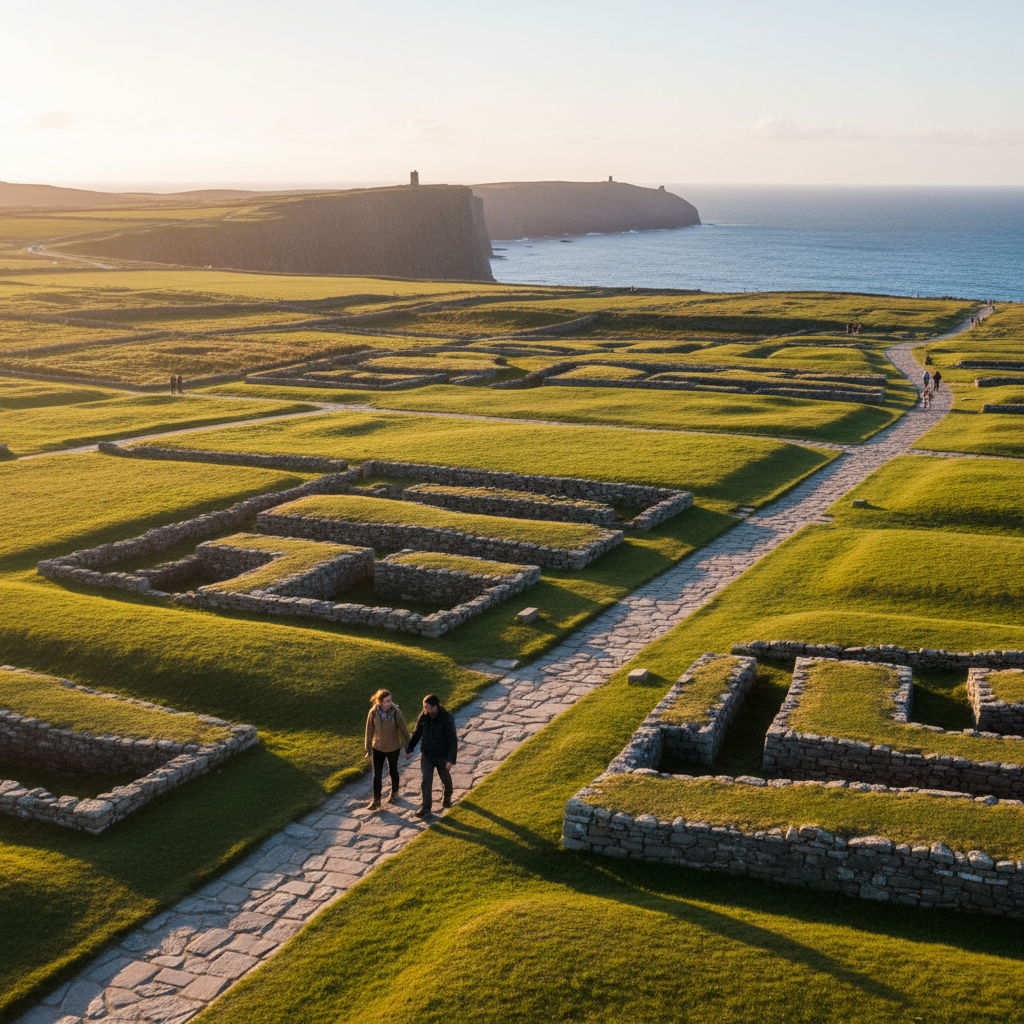
Céide FieldsOutdoor Escape Game & Treasure Hunt
Step back in time in a buried prehistoric landscape.
What to do in Céide Fields? Dive into the heart of a unique landscape, where history is read through the peatlands and spectacular cliffs. Céide Fields is not just a world-renowned archaeological site; it's also a life-sized playground for an unusual and memorable activity. Imagine exploring the remains of a prehistoric agrarian system, the oldest and most extensive in the world, dating back 5,000 years, all while embarking on a captivating treasure hunt. Our outdoor escape game invites you to unravel the mysteries of this ancient place, following clues scattered along the paths that wind between stone walls and megalithic tombs. Beyond the game, take time to visit the award-winning Interpretive Centre, whose observation tower offers breathtaking views of the Atlantic Ocean and the buried fields. It's an immersive experience, a true outdoor scavenger hunt that transforms heritage discovery into a thrilling adventure. Ideal for curious minds of all ages, Céide Fields promises a day rich in emotions and learning, far from the beaten path.
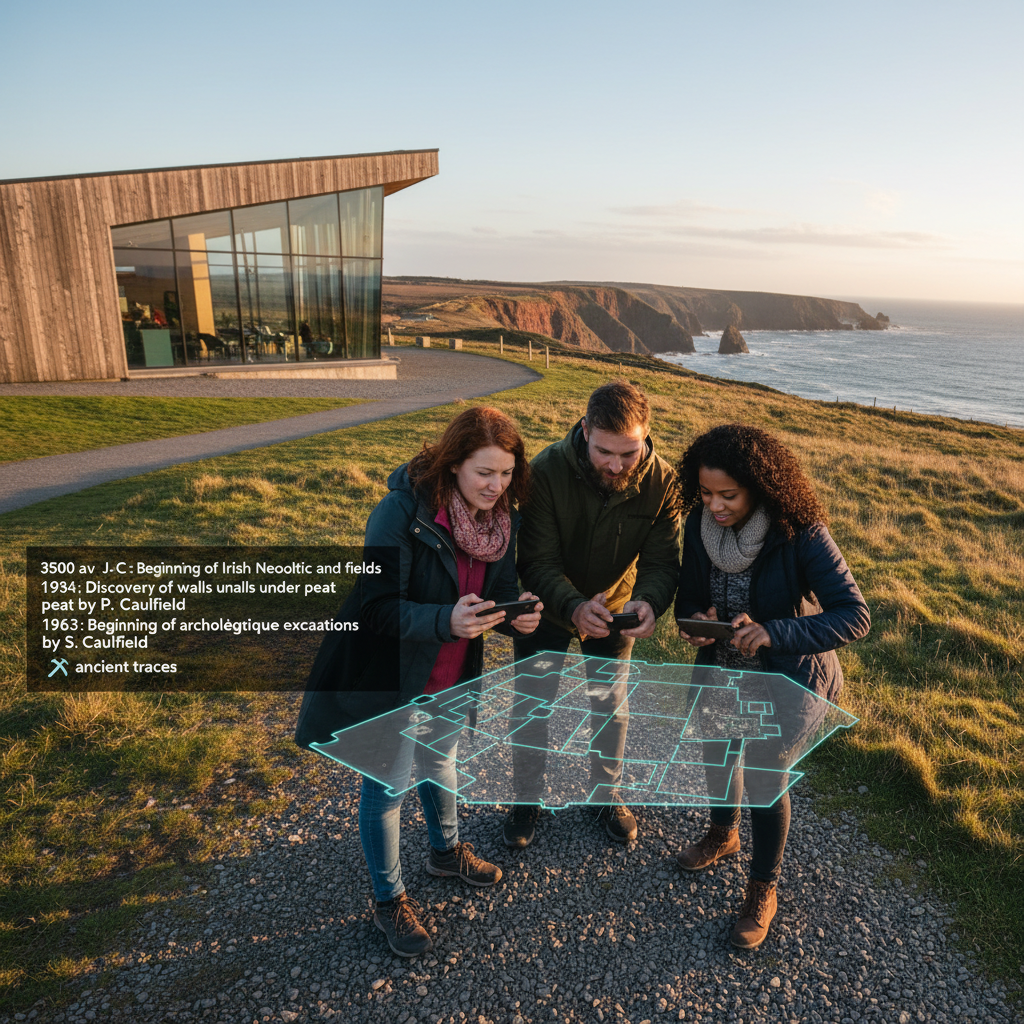
Unusual things to do in Céide Fields
For an unusual activity in Céide Fields, forget traditional guided tours and prepare for an original outing. Our outdoor escape game plunges you into the heart of an age-old enigma, where every stone, every view of the 110-meter-high cliffs, could hold part of the solution. It's a unique way to immerse yourself in this prehistoric landscape, transforming archaeological discovery into an interactive adventure. You won't just be spectators, but active explorers, deciphering codes and solving puzzles while admiring the wild beauty of the Irish coast. A memorable experience guaranteed.
Things to do in Céide Fields with kids
Discovering Céide Fields as a family is an adventure that will delight young and old. Our outdoor escape game is designed to be actively engaging from the age of 8, allowing children and teens to participate in solving puzzles. It's a fun and educational way to explore this fascinating prehistoric site. Imagine your children transformed into young archaeologists, searching for clues amidst ancient remains and magnificent landscapes. The game stimulates their curiosity, teamwork, and observation skills, while offering them a unique immersion in Irish history and nature. A day full of laughter and discoveries for the whole family!
Céide Fields for couples
For a romantic and enriching getaway, Céide Fields as a couple offers an exceptional setting. Away from the hustle and bustle, you'll share an intimate experience, exploring the mysteries of a distant past together. Our outdoor escape game is an invitation to complicity, where each solved puzzle strengthens your connection. Imagine yourselves hand in hand, strolling along the majestic cliffs, with the Atlantic Ocean as a backdrop, discovering the buried secrets of this prehistoric civilization. It's a unique opportunity to create memorable souvenirs, combining the wild beauty of Irish nature with the richness of its heritage, in an atmosphere of shared discovery.
What to do in Céide Fields when it rains
What to do in Céide Fields on a rainy day? Let's be honest, Céide Fields is an open-air archaeological site, and the main experience takes place under the Irish sky. There are no arcades or covered passages to shelter you along the route. We strongly advise you to bring waterproof clothing and appropriate footwear, or to reschedule your visit if the weather is too unpredictable. The Interpretive Centre offers a warm refuge and fascinating exhibits for an indoor break, but the main adventure remains a total immersion in nature.
Where is Céide Fields, and where do the routes start?
Starting points of our routes and the places they pass through.
Route starting points
Places in Céide Fields
- Céide Fields Visitor Centre (exterior)
- Viewpoint on the coastal cliffs
- Observation point of the fossil walls
- Exterior of a megalithic passage tomb
- Pole probing demonstration area
- Area where peat meets fertile land
- Commemorative plaque near the centre
- Main observation platform
The history of Céide Fields
A Landscape Shaped by Neolithic Farmers
The Céide Fields, on the North Mayo coast, represent an extensive Stone Age monument, dating back almost 6,000 years. This ancient landscape was developed by farming communities during the Neolithic period, from around 3700 BC to 3000 BC. These early inhabitants cleared large areas of pine and oak forests, transforming woodlands into land for agriculture and pasture for livestock. They established a system of stone walls, some extending for miles, to enclose their fields and manage their herds. These walls, preserved beneath a blanket of peat, show the structured lives of these prehistoric communities and their understanding of land management.
Buried by Nature, Rediscovered by Science
Around 3000 BC, a climate shift occurred, leading to increased rainfall and a decline in temperatures. This environmental change, with continuous forest clearing, contributed to the formation of peat bogs. The peat gradually covered the farmed land, burying the ancient field systems and settlements. This natural process, while forcing the abandonment of the area, preserved the Céide Fields for millennia. The site remained hidden until the 1930s when Patrick Caulfield, a local schoolteacher and peat cutter, noticed stones arranged in patterns deep within the peat. His observations were largely dismissed until the 1970s, when his son, Dr. Seamus Caulfield, an archaeologist, began systematic excavations. Using a probing technique, he mapped the network of walls and discovered the extent of this prehistoric agricultural system, revealing a chapter in human history that had been lost for thousands of years.
What to see in Céide Fields
- Céide Fields Visitor Centre — This building is integrated into the landscape and offers views of the Atlantic Ocean and the archaeological site. Inside, interactive exhibits and an audio-visual presentation explain the history, archaeology, and ecology of the Céide Fields.
- Coastal Cliffs Viewpoint — From this point, observe the 110-meter high cliffs that drop into the ocean. The rock layers show millions of years of geological history.
- Observation Point of the Fossil Walls — Here, see the ancient stone walls, dating back nearly 6,000 years, preserved beneath the peat. Interpretive panels explain the construction techniques and the significance of these prehistoric field systems.
- Exterior of a Megalithic Passage Tomb — This ancient burial site, visible from the walking trails, links to the spiritual beliefs of the Neolithic people. Its presence shows the lives of early inhabitants.
- Main Observation Platform — This accessible platform provides a view of the Céide Fields landscape, showing the scale of the prehistoric farming system and the peatlands that now cover it.
- Area Where Peat Meets Fertile Land — This location demonstrates the transition from the ancient, buried, fertile land to the overlying peat bog. It helps understand the environmental changes that shaped the Céide Fields.
When to visit Céide Fields
The best time to visit Céide Fields is during late spring and summer, from May to September. Temperatures are milder, typically 12°C to 18°C, and daylight hours are longer, allowing for more exploration. The visitor centre is fully operational, and guided tours are more frequent. Winter months (November to February) often bring strong winds, heavy rainfall, and shorter days, making outdoor exploration less comfortable. Some facilities may have reduced opening hours during the off-season. Avoid visiting on very windy or foggy days, as visibility can be poor and conditions challenging.
Getting around Céide Fields
Céide Fields is in a remote part of County Mayo, Ireland. The nearest major town is Ballina, about a 45-minute drive. The closest international airports are Ireland West Airport Knock (KNO), approximately 1.5 hours' drive, and Shannon Airport (SNN), about a 3-hour drive. A car is necessary for reaching the site, as public transport is limited. Free parking is available at the Céide Fields Visitor Centre. Walking is the primary way to explore the site, with boardwalks and trails. The visitor centre and main observation platform are wheelchair accessible. The visitor centre typically opens from 10:00 to 17:00, with extended hours in peak season; check their website for current schedules.
Things you probably do not know about Céide Fields
Verified details most visitors walk straight past.
- Céide Fields Visitor Centre
- Did you know the unique shape of the Céide Fields Visitor Centre isn't just modern architecture? The pyramid-like structure of the visitor centre is designed to mimic the ancient burial mounds found in the area, subtly integrating the modern building with the prehistoric landscape it interprets.
- Observation Point of the Fossil Walls
- How were the ancient stone walls of Céide Fields first discovered deep beneath the peat? The initial discovery was made by Patrick Caulfield, a local schoolteacher, in the 1930s. While cutting peat for fuel, he noticed regular patterns of stones, indicating human construction beneath the bog.
- Coastal Cliffs
- What geological secret do the dramatic cliffs at Céide Fields hold, beyond their striking beauty? The cliffs expose layers of sandstone and shale that formed over 300 million years ago, containing fossilized remains of marine life, offering a glimpse into ancient oceans.
- Megalithic Passage Tomb
- What unusual material was used to preserve the delicate pollen grains found near the passage tomb, helping archaeologists understand ancient vegetation? Archaeologists used a technique involving glycerine and paraffin wax to extract and preserve pollen samples from the peat, allowing them to reconstruct the prehistoric environment.
- Pole Probing Demonstration Area
- Why was a simple metal rod so crucial in mapping the vast, hidden network of ancient walls at Céide Fields? Dr. Seamus Caulfield developed a method of probing the peat with a metal rod to locate the buried stone walls, allowing him to map the extensive field system without large-scale excavation.
Questions about visiting Céide Fields
How much time should I allocate for a visit to Céide Fields?
To fully appreciate Céide Fields, including the visitor centre and a walk along the trails, plan for at least 2 to 3 hours. This allows enough time to engage with the exhibits, watch the audio-visual presentation, and explore the outdoor archaeological sites. Factor in additional time if you take a guided tour.
Is Céide Fields suitable for children?
Yes, Céide Fields is an educational experience for children. The visitor centre has interactive exhibits that appeal to younger audiences, and the outdoor boardwalks are easy to navigate. The open spaces and cliffs can also spark imagination about ancient civilizations and nature.
What kind of clothing should I wear for a visit to Céide Fields?
Given the coastal location, weather at Céide Fields can be unpredictable. Wear layers, including a waterproof and windproof jacket, even in summer. Sturdy, comfortable walking shoes are essential for boardwalks and potentially uneven terrain. A hat and sunscreen are also recommended on sunny days.
Are there any dining options available at Céide Fields?
The Céide Fields Visitor Centre has a small café that serves light refreshments, snacks, and hot beverages. It is a spot to get a coffee or a quick bite after exploring the site. For more substantial meals, drive to nearby towns such as Ballycastle or Ballina.
Can I bring my dog to Céide Fields?
Dogs are generally not permitted inside the Céide Fields Visitor Centre, with the exception of assistance dogs. However, well-behaved dogs on a leash are usually allowed on the outdoor walking trails, provided owners clean up after them. Check the official website for the most current pet policy before your visit.
What is the significance of the peat at Céide Fields?
The peat at Céide Fields is crucial because it acted as a natural preservative, safeguarding the ancient field systems and settlements for millennia. The acidic, oxygen-poor environment of the bog prevented the decomposition of organic materials, allowing archaeologists to uncover a remarkably intact prehistoric landscape.
Frequently asked questions
How much does an outdoor escape game cost in Céide Fields?
An outdoor escape game in Céide Fields is offered at a single price of €12 per team. This price is fixed, whether you are 2, 3, 4, or even 5 players. It's an excellent option for an affordable group activity, as the cost is shared among all participants. The price includes access to the app, all necessary clues, and a complete gaming experience. It's a minimal investment for hours of entertainment and discovery in an exceptional historical setting. Get ready for an unforgettable adventure without breaking the bank!
Is it suitable for children / families?
Absolutely! Our outdoor escape games are perfectly suited for families and children. We generally recommend active participation from the age of 8, but younger children can certainly accompany and help search for clues. It's a fun and educational activity that encourages teamwork and curiosity. The puzzles are designed to be accessible to everyone, and parents will enjoy exploring Céide Fields in this interactive way as much as the children. It's a great way to turn a cultural visit into an exciting adventure for the whole family.
How long does an escape game last in Céide Fields?
The average duration of an outdoor escape game in Céide Fields is approximately 1 hour 30 minutes to 2 hours. However, this duration may vary depending on your pace, your observation skills, and the complexity of the puzzles you encounter. Some quick explorers can finish in just over an hour, while others will prefer to take their time, admire the scenery, and fully immerse themselves in the site's history. There is no strict time limit; you are free to progress at your own pace and enjoy every moment of your adventure.
Do I need to book in advance?
No, it is not necessary to book in advance for our outdoor escape games in Céide Fields. The experience is accessible directly via our mobile application. You can show up at the site whenever you wish, download the game, and start the adventure immediately. This flexibility allows you to adapt your schedule and decide to play at the last minute, depending on the weather or your desires. All you need is a charged smartphone and an internet connection to launch the game and embark on your exploration!
What to visit in Céide Fields beyond the escape games?
Beyond the excitement of the escape game, Céide Fields offers a wealth of discoveries. The Interpretive Centre is a must-see: it houses fascinating exhibitions on prehistoric life, the site's archaeology, and the formation of the peatlands. Its observation tower offers spectacular panoramic views of the cliffs and the ocean. You can also walk along the marked trails that wind through the peatlands, discovering the remains of stone walls and megalithic tombs. It's a total immersion in a natural and historical landscape of breathtaking beauty.
What is the best season to visit Céide Fields?
The best season to visit Céide Fields is generally from spring to autumn (May to September). During these months, temperatures are milder and days are longer, offering more pleasant conditions for exploring the outdoor site. Although Irish weather can be unpredictable, this period offers the best chances for sunshine and fully enjoying the spectacular views of the cliffs and the ocean. Remember that even in summer, a light jacket and comfortable shoes are always advisable!
Other destinations in Connacht
Achill
The wild island of dramatic cliffs and golden beaches.
Aughrim
On the trail of a decisive battle in Irish history
Carrowmore
At the heart of Ireland's megalithic mysteries
Croagh Patrick
The holy mountain where St. Patrick fasted, between sky and sea.
Galway
Where Irish tradition, vibrant culture, and Atlantic breeze meet
Rathcroghan
Ireland's mythical heart, where ancient kings and legends intertwine.
Sligo
Between mountains of legends and wild coasts