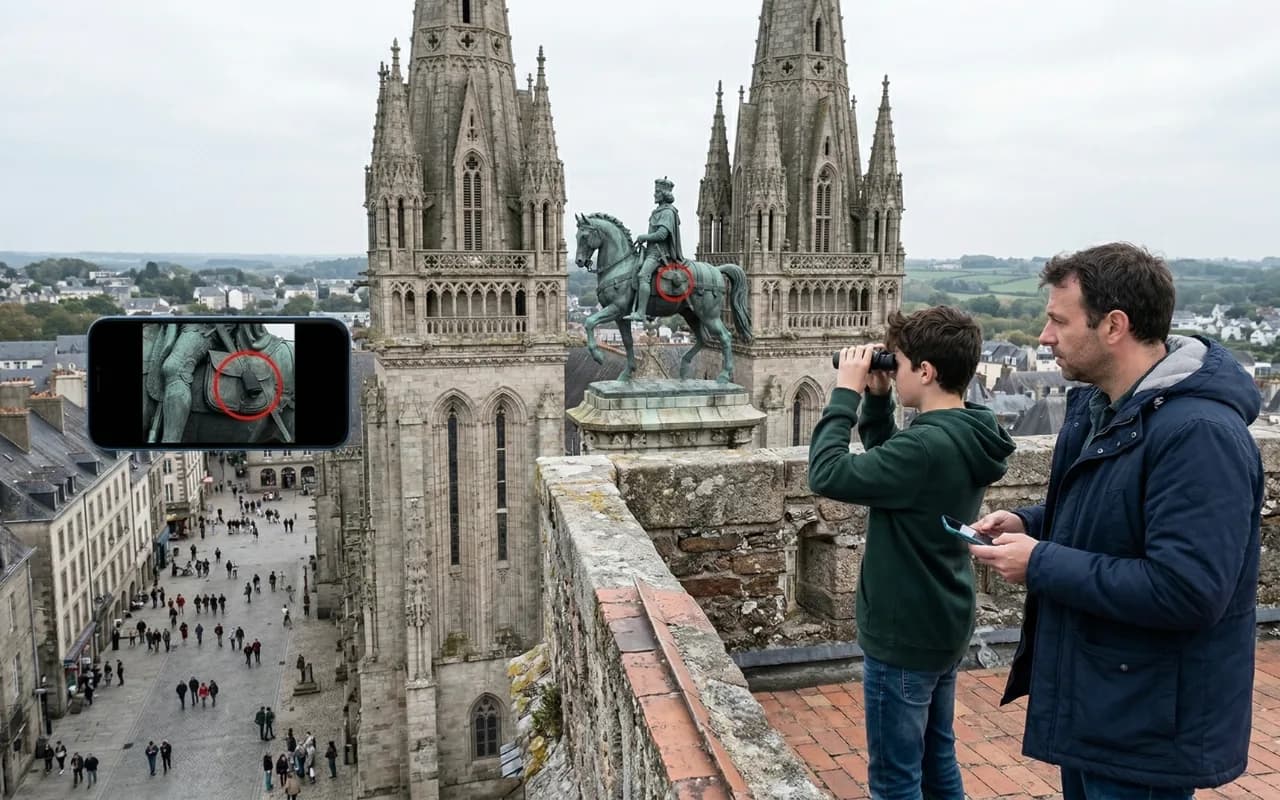
QuimperOutdoor Escape Game & Treasure Hunt
Gothic cathedral and Breton pottery
Quimper, the capital of Finistère, invites you to a unique immersion between history and Breton legends. Stroll through the cobbled streets of the Locmaria district, admire the majestic Saint-Corentin Cathedral, and let yourself be charmed by the half-timbered houses lining the Odet river. Beyond its famous potteries and authentic atmosphere, Quimper is an ideal playground for modern explorers. Looking for an unusual activity? Our outdoor escape games transform the city into a giant game board. Whether in the form of a captivating treasure hunt or a thrilling scavenger hunt, you'll discover Quimper from a new perspective while solving riddles. Get ready for a memorable adventure that combines cultural discovery and the thrill of investigation. Our games below await you for an unforgettable experience!
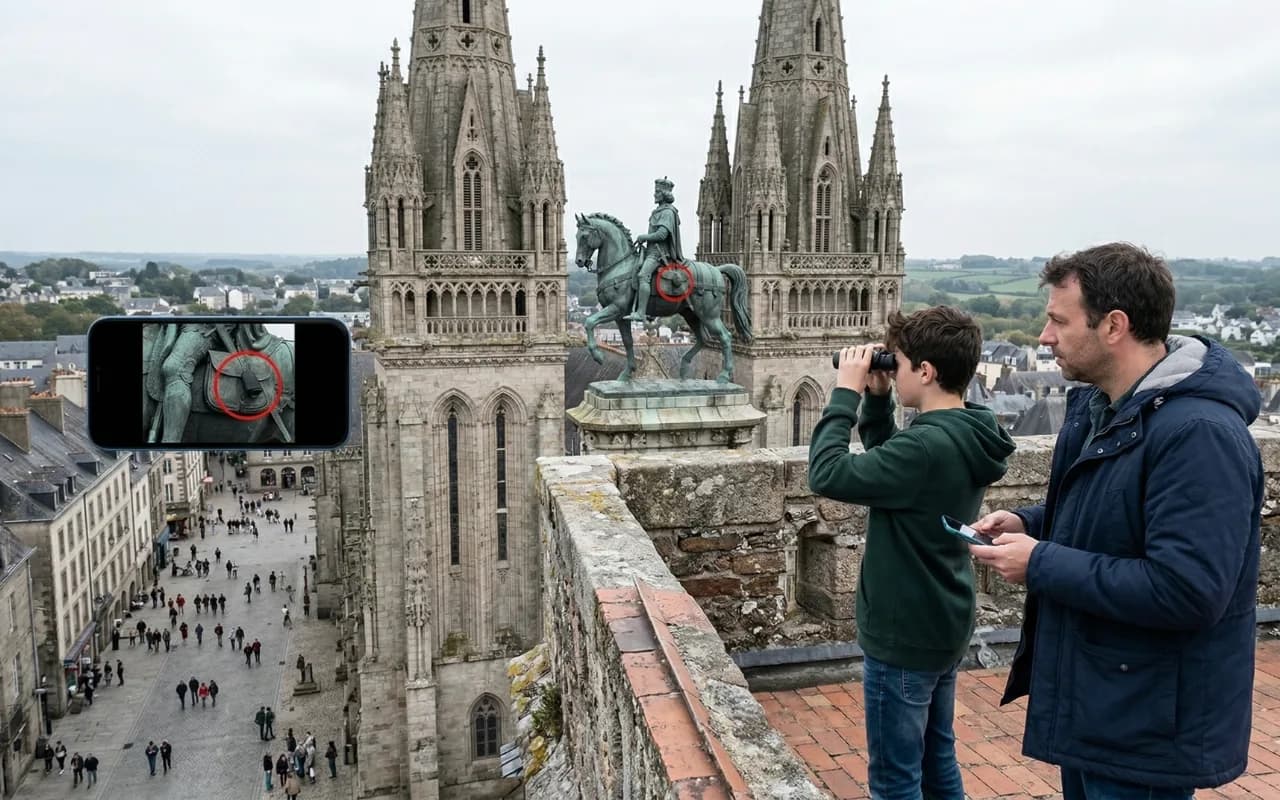
Unusual things to do in Quimper
Quimper is full of hidden treasures and opportunities for unusual activities. Beyond traditional visits, our outdoor escape games offer you the chance to transform the city into a life-sized adventure playground. Imagine solving riddles outdoors, deciphering codes in iconic locations, and exploring lesser-known corners of Quimper, all during a thrilling treasure hunt. It's an original and interactive way to discover Quimper's heritage, far from the beaten path. Let yourself be surprised by this unique experience that combines reflection, discovery, and fun, perfect for those seeking the extraordinary.
Things to do in Quimper with kids
Quimper is a fantastic destination for families, and our outdoor escape games are the ideal activity to create unforgettable memories. Both young and old can collaborate to solve riddles, follow clues, and explore the city in a fun and educational way. Our courses are designed to be accessible to all ages, transforming a simple stroll into a real urban treasure hunt. It's an excellent opportunity to stimulate children's curiosity and share a moment of togetherness outdoors. Let adventure guide you and discover Quimper as a family from a new and exciting perspective.
Quimper for couples
For a romantic getaway in Quimper, our outdoor escape games offer an original alternative to classic dates. Imagine yourselves hand in hand, exploring the city's charms while solving riddles together. It's a fun and interactive way to share a special moment, stimulate your teamwork, and discover romantic or unusual places you might not have noticed otherwise. Whether for a memorable first date or to rekindle the flame, our courses promise laughter, challenges, and beautiful memories to create together in the heart of Quimper.
What to do in Quimper when it rains
Quimper, like any Breton city, can sometimes experience rain. It's important to note that our escape games are primarily outdoor activities. If the weather is uncertain, plan to wear appropriate clothing and bring an umbrella to fully enjoy the adventure. For heavy rain days, we recommend seeking shelter in Quimper's museums, such as the Museum of Fine Arts, or visiting the potteries for an indoor activity. Our games remain an option if you don't mind a few drops!
Where is Quimper, and where do the routes start?
Starting points of our routes and the places they pass through.
Route starting points
Places in Quimper
- Cathédrale Saint-Corentin · West façade
- Medieval streets · Rue Kéréon & Rue du Sallé
- Musée départemental breton · Former bishop's palace
- Banks of the Odet · Flower-decked footbridges
- Mont Frugy · Wooded hill in the heart of Quimper
The history of Quimper
From Roman Port to Breton Capital
Quimper's story begins in antiquity, with archaeological evidence suggesting continuous habitation since the Neolithic period. A small port town developed on the banks of the Odet River in the Locmaria quarter during the 1st century AD, using the tides for commercial activities. This Gallo-Roman settlement, connected by roads to Vannes and Carhaix, included temples and a necropolis on Mont Frugy. This port was abandoned towards the end of the 3rd century during a crisis in the Roman Empire.
By AD 495, Quimper had become a Bishopric. In the 5th or 6th century, legend attributes its founding to King Gradlon, who supposedly gave his castle at the Odet's confluence to Saint Corentin for a cathedral. The name "Quimper" derives from the Breton word "kemper," meaning "confluence," describing a city at the meeting point of the Odet, Steir, and Jet rivers. In the 11th century, it was united with the Duchy of Brittany. The city sustained damage during the War of the Breton Succession (1341–1364).
Medieval Walls and Revolutionary Changes
Between the 13th and 14th centuries, Quimper fortified itself with a 1,500-meter-long belt of walls, including wide moats and high walls with machicolations for defense. These ramparts were no longer maintained after the mid-15th century as their military use declined; remnants are visible today. In 1762, a fire damaged the wooden houses of Rue Kéréon, showing the medieval city's structure.
The French Revolution brought changes to Quimper. In January 1790, it was designated the county town of the Finistère department, a decision that ensured its stable development by establishing government institutions. This period also saw revolutionary actions, including the ransacking of churches and the cathedral, and the conversion of religious buildings into barracks or prisons. Following this turmoil, the city experienced prosperity during the Consulate and Empire, benefiting from the marine blockade of Brest by the British Navy, which turned Quimper's small merchant port into a depot. The 19th century saw urban reorganization, with new roads and a marketplace built, and the town hall moving to the former Guernisac mansion on Place Saint-Corentin.
What to see in Quimper
- Cathédrale Saint-Corentin — The oldest Gothic structure in Lower Brittany. Construction began in 1239. The twin spires, 76 meters high, were added in the 19th century. Inside, 15th-century stained-glass windows are present.
- Vieux Quimper (Old Quimper) — Pedestrianized streets like Rue Kéréon contain half-timbered houses, some from the 14th century. This area has crêperies, artisan shops, and cafes.
- Musée départemental breton — Housed in the former bishop's palace, this museum covers regional history, archaeology, ethnology, and economics, detailing Brittany's past and present.
- Musée des Beaux-Arts de Quimper — Opposite the cathedral, this museum holds 14th to 21st-century paintings, including works by Boucher, Corot, and Rubens, as well as pieces by Pont-Aven School painters and a collection dedicated to Quimper-born poet Max Jacob.
- Locmaria Quarter — This historic district, about 1.5 kilometers south of the old city, is known for pottery making. The Musée de la Faïence de Quimper details the history of this craft, produced here since 1690.
- Banks of the Odet River — Walk along the quays and see the footbridges over the Odet. Boat trips are available to view private gardens along the water.
- Mont Frugy — This wooded hill in Quimper offers green spaces. Historically, it contained temples and a necropolis during the Gallo-Roman era.
When to visit Quimper
The period from June to September is suitable for visiting Quimper. During these months, temperatures are generally around 18-24°C (64-75°F). July and August are the busiest, with the warmest temperatures and events like the Festival de Cornouaille, leading to larger crowds and higher prices. May and September offer a balance of agreeable weather and fewer crowds.
Avoid visiting from October to March if you prefer less rain, as this period is wetter, with December being the wettest. Winters are mild, with temperatures around 7-10°C (45-50°F), but can be wet and overcast.
Getting around Quimper
Quimper is accessible by train, with the station a short walk from the city center. Quimper Bretagne Occidentale Airport (UIP) is a regional airport a few kilometers from the city, with connections to Paris. The city center is compact and suitable for walking, especially the medieval streets. For those arriving by car, parking is available, though finding spots in the historic core can be difficult. Parking on the outskirts and walking is an option. Public buses operate within the city and to nearby towns like Bénodet. Quimper hosts markets at Les Halles Saint-François on Tuesdays, Fridays, and Saturdays, offering local produce.
Things you probably do not know about Quimper
Verified details most visitors walk straight past.
- Cathédrale Saint-Corentin
- Have you ever noticed the unusual bend in the nave of Quimper's cathedral? The nave of Cathédrale Saint-Corentin is noticeably misaligned. This architectural peculiarity is said to be because the cathedral's foundations had to adapt to the existing layout of the old city walls and the former bishop's palace, which stood in the way of a perfectly straight construction.
- Rue Kéréon
- Why are some of the half-timbered houses on Rue Kéréon leaning so much? The leaning facades of some houses on Rue Kéréon are a result of medieval construction techniques. Upper floors were often built to overhang the street (known as jetties), a practice that maximized living space in a confined city but could lead to structural shifts over centuries.
- Place au Beurre
- What kind of unusual market used to take place on Place au Beurre? Place au Beurre, or 'Butter Square', gets its name from its historical function as the main market for salted butter. This specific trade was a significant part of Quimper's economy in centuries past.
- Locmaria Quarter
- What natural resource made the Locmaria district a hub for pottery for centuries? The Locmaria quarter became the heart of Quimper's famous faïence pottery industry due to an abundant local supply of clay, combined with the navigable Odet River for transport and skilled labor in the area.
- Medieval Ramparts
- Despite their imposing size, why were Quimper's medieval ramparts eventually neglected? By the mid-15th century, Quimper's extensive medieval ramparts, built between the 13th and 14th centuries, were no longer maintained. They had lost their military relevance and were deemed of no real use in changing warfare strategies.
Questions about visiting Quimper
How long should I plan to visit Quimper?
A full day is generally sufficient to explore the historic city center, including the cathedral, the Locmaria district, and one museum. If you wish to visit the surrounding villages or the coastline, such as Locronan or Concarneau, allow for two to three days.
What are the best ways to get around Quimper?
The historic center of Quimper is very walkable, with most major attractions easily accessible on foot. For destinations further afield, such as the Locmaria district or Mont Frugy, local buses are available. Taxis are also an option.
Is Quimper a good destination for families with children?
Yes, Quimper offers several family-friendly activities. Beyond exploring the historic streets and cathedral, families can enjoy walks along the Odet River, visit the Bonobo Parc for tree climbing, or explore the gardens of Lanniron Castle. The city also has museums that are suitable for younger audiences.
What is the typical budget for a trip to Quimper?
Quimper can be enjoyed on various budgets. Many attractions like the cathedral and river walks are free. Museum entry fees are moderate. Dining options range from affordable crêperies to more upscale restaurants. Accommodation varies from campsites to hotels, with prices generally higher during peak season in July and August.
Which neighborhoods are best for exploring or staying in Quimper?
The **Vieux Quimper** (Old Quimper) district is ideal for exploring, with its medieval streets, half-timbered houses, and proximity to the cathedral and museums. For a quieter stay with a focus on crafts, the **Locmaria** quarter offers a appealing atmosphere near the Odet River.
What local specialties should I try in Quimper?
Quimper is renowned for its crêpes and galettes, often accompanied by local cider. Seafood is also a highlight, given the city's proximity to the coast. Don't miss trying Quimper faïence pottery, though this is a craft to admire and purchase rather than eat!
Frequently asked questions
How much does an outdoor escape game cost in Quimper?
An outdoor escape game in Quimper with OddballTrip.com is offered at a single price of €12 per team. Yes, you read that right, the price is fixed regardless of the number of players in your team (within the recommended size for a better experience, usually 2 to 6 people). It's an excellent budget-friendly option for a group activity. This rate includes access to the application, the riddles, and support if you need help. Get ready for an urban adventure without breaking the bank!
Is it suitable for children / families?
Absolutely! Our outdoor escape games in Quimper are designed to be a quintessential family activity. The puzzles are varied and accessible, allowing children to actively participate in solving them and feel like real explorers. It's a wonderful way to combine entertainment, city discovery, and teamwork for the whole family. We generally recommend a minimum age of around 8 years old for children to fully understand and enjoy the challenges, but younger ones can also have fun searching for clues.
How long does an escape game last in Quimper?
The duration of an outdoor escape game in Quimper generally ranges between 1h30 and 2h30. This, of course, depends on your playing pace, your ability to solve riddles, and how quickly you move between different points of interest. The advantage is that you play at your own tempo: you can take breaks, grab a coffee, admire a monument, or even do some shopping if you feel like it. It's a flexible experience, designed to adapt to your day of exploring Quimper.
Do I need to book in advance?
No, advance booking is not mandatory for our outdoor escape games in Quimper, and that's one of our big advantages! You can purchase your game and start the adventure whenever you want. Simply download the OddballTrip app, choose your route in Quimper, and set off. It's ideal for a last-minute decision or to adapt to a flexible travel schedule. You have the freedom to play whenever the mood strikes, without the constraint of a fixed schedule.
What to visit in Quimper beyond the escape games?
Beyond the excitement of our escape games, Quimper is full of sites to discover. Don't miss the majestic Saint-Corentin Cathedral, a masterpiece of Gothic art, and stroll through the charming Locmaria district with its gardens and priory. The Museum of Fine Arts houses rich collections, while the famous Henriot Quimper potteries invite you to discover ancestral craftsmanship. Wander along the Odet, nicknamed "the most beautiful river in France," and get lost in the medieval streets of the historic center. Quimper offers a perfect blend of culture, history, and picturesque landscapes.
What is the best season to visit Quimper?
Quimper is pleasant to visit all year round, but each season has its charm. Spring (April-June) and autumn (September-October) offer mild temperatures and moderate tourist crowds, ideal for exploring the city and enjoying our outdoor escape games. Summer (July-August) is livelier, with many festivals and events, but also more crowded. Winter can be cool and damp, but the city retains a warm atmosphere, especially around the end-of-year holidays. For our games, prefer sunny or slightly overcast days for an optimal experience.
Other destinations in Brittany
Saint-Malo
Corsair city and ramparts facing the ocean
Concarneau
Fortified Ville Close and fishing port
Morlaix
Monumental viaduct and pondalez houses
Brocéliande
The enchanted forest of Merlin and Viviane
Carnac
The millennia-old megalithic alignments
Douarnenez
Sardine port and the legend of the city of Ys
Pointe du Raz
The end of the world facing Sein island
Vitré
Medieval castle and merchants' lanes
Brest
Maritime arsenal and millennia-old castle
Locronan
Granite village frozen in time
Belle-Ile-en-Mer
Brittany's largest island, wild and captivating
Guérande
Medieval city at the gates of the salt marshes
More cities in France
Mont-Saint-Michel
The medieval marvel between sky and sea
Nantes
Castle of the Dukes of Brittany and Jules Verne
Lessay
Its millennial abbey and legendary fair
Laval
Medieval city, between history and mystery
Sainte-Mère-Église
First liberated village — the 82nd paratroopers
Bayeux
First city liberated — from William to 1944