MéridaOutdoor Escape Game & Treasure Hunt
Rome in Spain: theater, bridge and temples
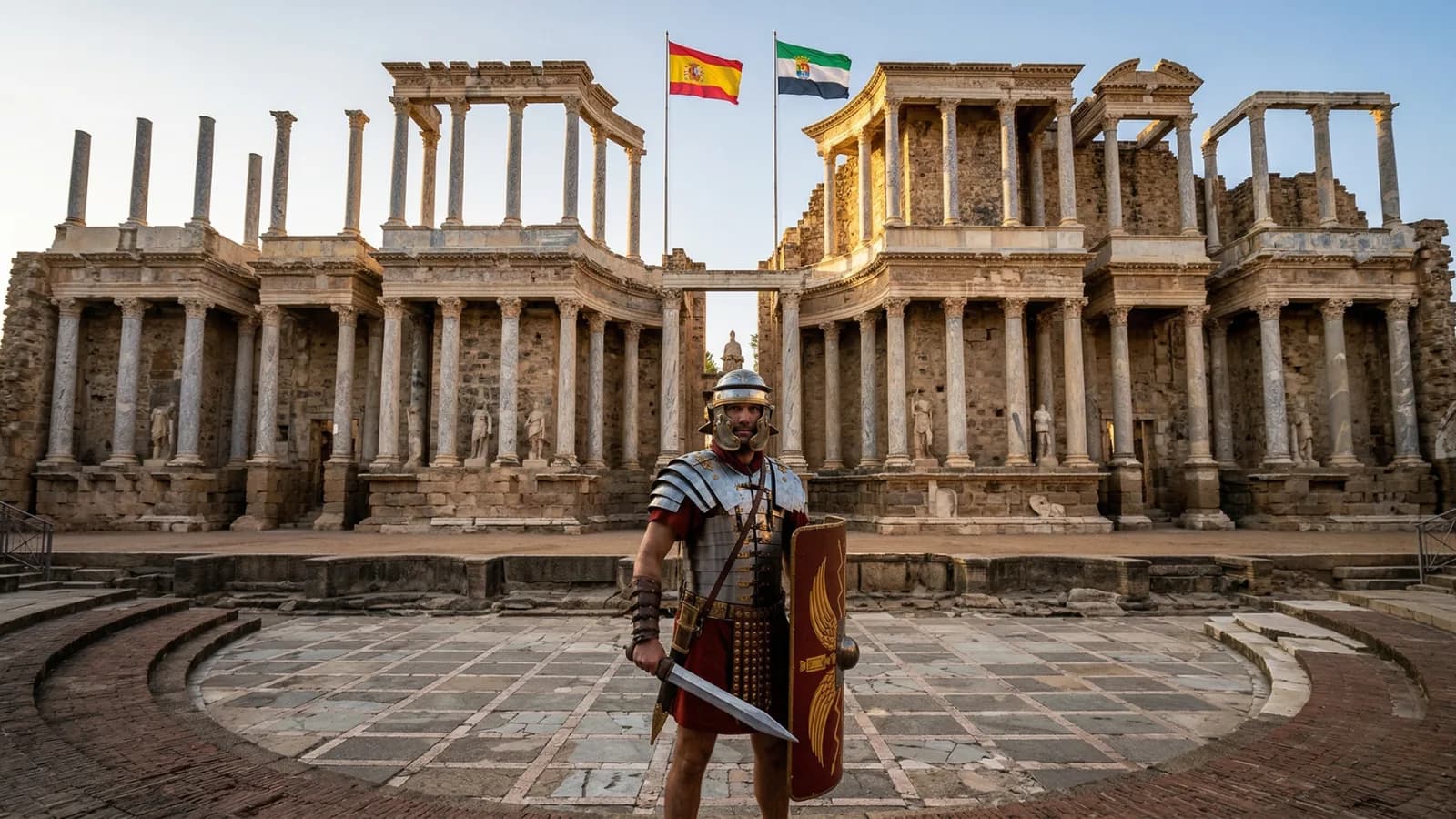
Welcome to Mérida, the "Rome of Spain"! Prepare for a fascinating journey into the heart of Roman history, where every stone whispers ancient tales. This extraordinary city, a UNESCO World Heritage site, is brimming with antique treasures such as the impressive Roman Theatre, the Amphitheatre, and the majestic Roman Bridge spanning the Guadiana River. Stroll through the historic quarter, discover the Temple of Diana, or admire the Miracles Aqueduct. For an unusual and immersive activity, our outdoor escape games in Mérida invite you to explore these iconic places in a completely new way. Transform your visit into a real-life treasure hunt or an outdoor scavenger hunt, and unravel the mysteries of ancient Augusta Emerita. Ready to take on the challenge and discover the secrets our games have in store for you?
Augusta Emerita
The Rome of Spain never forgot its glory
The Bridge of Empires
Every arch has known a different empire
Unusual things to do in Mérida
Mérida is not just an open-air museum; it's also an ideal playground for lovers of unusual activities. Beyond traditional visits, imagine solving puzzles at the foot of a thousand-year-old amphitheater or deciphering hidden codes near the Temple of Diana. Our outdoor escape games transform the city into a huge adventure, offering you a unique perspective on its heritage. It's an original and fun way to discover the secrets of ancient Rome, off the beaten path. Whether you're looking for thrills or simply a memorable experience, our games promise total immersion in Mérida's history, with a touch of mystery and adventure.
Things to do in Mérida with kids
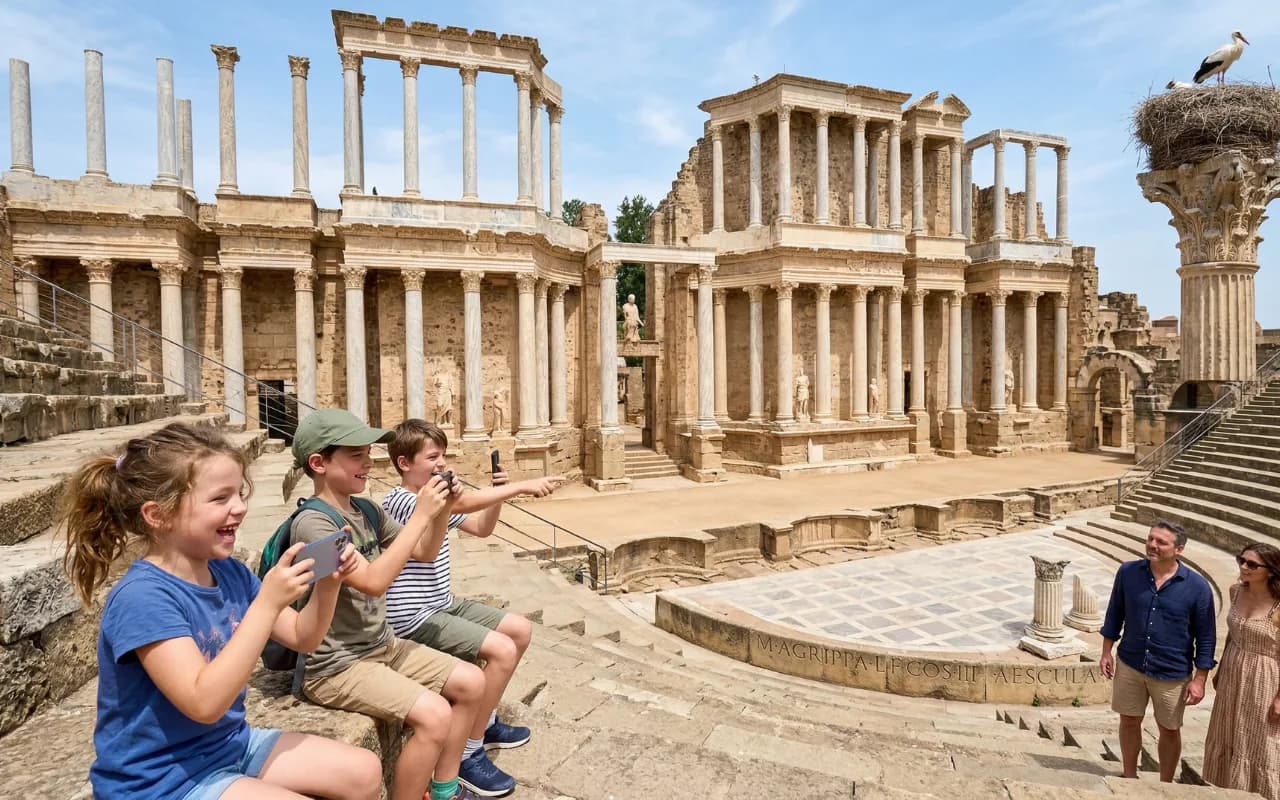
Mérida is a fantastic destination for families, and our outdoor escape games are the perfect activity for all ages! Let your children explore Roman history in an interactive and educational way. Rather than simply observing monuments, they will become the heroes of an adventure that will take them from the Roman Theatre to the Bridge, through history-filled streets. It's an excellent opportunity to collaborate, solve puzzles together, and create unforgettable memories. The games above are designed to be accessible and fun for all ages, transforming learning into a captivating game where the whole family actively participates in the treasure hunt.
Mérida for couples
For a romantic and original getaway in Mérida, our outdoor escape games offer a unique experience for couples. Imagine yourselves hand in hand, exploring ancient ruins, solving mysteries, and sharing laughs while discovering the city's hidden charms. It's an intimate and stimulating way to strengthen your bond, far from the usual candlelight dinners. Whether at sunset near the Temple of Diana or strolling on the Roman Bridge, our games above promise intimate and memorable moments. Treat yourselves to an extraordinary adventure for two, and turn your visit to Mérida into an unforgettable memory.
What to do in Mérida when it rains
Mérida, with its exceptional Roman heritage, is primarily a city to explore outdoors. Most of its wonders, like the Theatre and Amphitheatre, or the Roman Bridge, are open-air. Our escape games are, by nature, mostly outdoor activities. In case of rain, a visit to the National Museum of Roman Art is an excellent alternative to take shelter while continuing to explore the city's history. But don't forget your umbrella if you decide to brave the weather for our games, as adventure awaits you no matter what!
Where is Mérida, and where do the routes start?
Starting points of our routes and the places they pass through.
Route starting points
Places in Mérida
- Temple of Diana · Calle Romero Leal
- Roman Theatre of Mérida
- Roman Amphitheatre · Adjacent to the theatre
- Puente Romano over the Guadiana
- Alcazaba of Mérida · Bank of the Guadiana
- Alcazaba of Mérida
- Conventual Santiaguista · Calle de John Lennon
- Aqueduct of Los Milagros · North of the city
The history of Mérida
From Roman Capital to Modern City
Mérida, originally named Augusta Emerita, was founded in 25 BCE by Emperor Augustus. It served as a settlement for retired Roman soldiers, or emeriti, from two legions, hence its name. The city became the capital of Lusitania, a Roman province encompassing modern-day Portugal, and one of the most important cities in Iberia. At its peak, Augusta Emerita housed an estimated 60,000 residents, a population size it maintains today. The Romans built extensive infrastructure, including a theatre, amphitheatre, a large circus, and sophisticated water supply systems, many of which are preserved.
A Legacy of Layers: Visigoths, Moors, and Reconquista
Following the decline of the Western Roman Empire in the 5th century, Mérida continued as a significant center. It briefly served as the royal seat for the Suebi and later under Visigothic rule in the 7th century, becoming the second most important metropolis after Toledo. In 713 CE, Mérida was conquered by the Moors, who fortified the city, notably enlarging the Alcazaba, which was originally a Roman fort. Under Islamic rule, Mérida was one of the three border capitals of Al-Andalus, alongside Toledo and Zaragoza, controlling the western Iberian Peninsula. However, continuous rebellions against the central Umayyad power led to its decline. The city was recaptured by Christian forces in 1228 by Alfonso IX of León, who subsequently granted it to the Knights of Santiago. This succession of cultures has left its mark on Mérida's architecture and urban fabric, with Roman, Visigothic, and Moorish elements often found integrated within later Christian constructions.
What to see in Mérida
- Roman Theatre of Mérida — Commissioned by Marcus Vipsanius Agrippa around 15–16 BC, this theatre could originally seat up to 6,000 spectators. It is still used for performances today, notably during the Mérida Classical Theatre Festival.
- Roman Amphitheatre — Located next to the theatre, this arena hosted gladiatorial combats and other public spectacles. Visitors can explore the gladiatorial tunnels and walk through the arena.
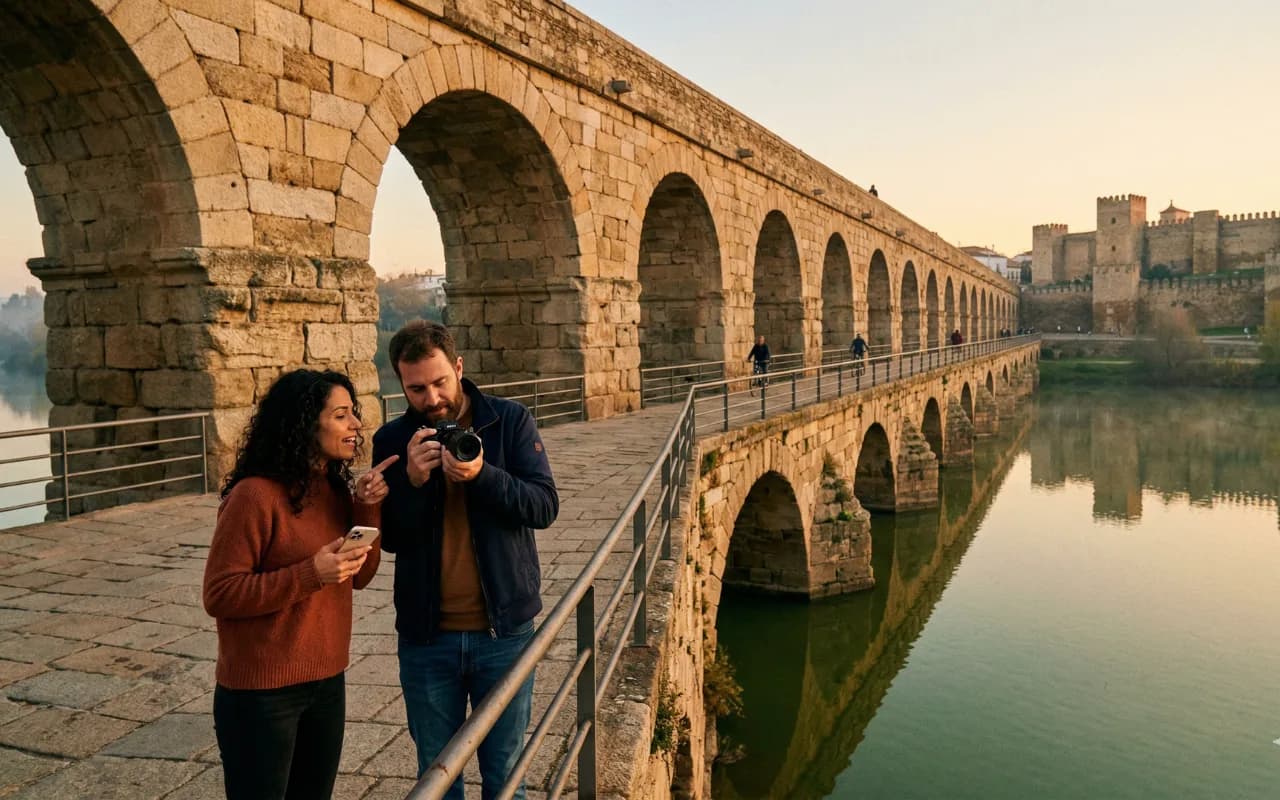
- Puente Romano over the Guadiana — One of the longest surviving Roman bridges, stretching 790 meters with 60 arches. It has been repaired and altered over centuries but remains a connection across the Guadiana River.
- Alcazaba of Mérida — Originally a Roman fort, this citadel was enlarged by the Moors in 835 CE. Its walls are built from granite ashlar blocks salvaged from Roman and Visigothic buildings. Inside, a rectangular reservoir from the same period provided a continuous water supply from the river.
- Aqueduct of Los Milagros — This aqueduct supplied water to the city from the Proserpina Reservoir, 10 kilometers away. It features granite and red brick arches up to 27 meters tall.
- Temple of Diana — This Roman temple was part of the city's central forum. Its surviving columns and reconstructed architectural elements show the scale of Roman Augusta Emerita.
- National Museum of Roman Art — Designed by architect Rafael Moneo, this museum houses a collection of Roman mosaics, sculptures, and artifacts discovered at archaeological sites in Mérida, providing context for the ruins.
When to visit Mérida
The best times to visit Mérida are during spring (April to mid-June) and autumn (mid-September to October). During these shoulder seasons, daytime temperatures are between 21°C and 25°C (70-77°F), suitable for exploring the outdoor Roman ruins. Crowds are also smaller than in peak summer. April and May offer green countryside and active storks nesting on the aqueducts.
Avoid July and August if you prefer to avoid intense heat, as daytime highs can reach 34-35°C (93-95°F). However, this is when the Mérida Classical Theatre Festival takes place nightly in the Roman Theatre. Winter (November to February) can bring chilly evenings and some rain, particularly in November.
Getting around Mérida
Mérida is a walkable city, with most major attractions within a 15-20 minute stroll of each other. Public transport within the city is generally not needed if you are staying centrally.
The nearest airport to Mérida is Badajoz, approximately 45 minutes away by car. Mérida is connected by bus and train from larger Spanish cities like Madrid (4.5 to 5 hours by bus or train) and Seville (2 hours by car, 3 hours by train). For parking, Parking Cervantes is an option, offering rates and a short walk to key attractions, but it fills quickly during peak times.
Many smaller shops and businesses may close between 2:00 PM and 5:00 PM for siesta, especially in the afternoon heat. Evenings in Spain often start later, with dinner reservations typically after 9 PM.
For local goods, the artisan market in Plaza de España on Saturday mornings features pottery, leather goods, and other crafts.
Things you probably do not know about Mérida
Verified details most visitors walk straight past.
- Roman Theatre of Mérida
- Why was such a Roman theatre hidden from view for centuries? After the Roman era, Christians considered the theatre and nearby amphitheatre immoral pagan landmarks. Much of the structure was deliberately buried under a thick layer of earth to erase its memory.
- Aqueduct of Los Milagros
- What's one unusual sight you might spot on the ancient arches of the Aqueduct of Los Milagros? Today, the granite and red brick arches of the Aqueduct of Los Milagros provide nesting places for storks, adding wildlife to the ancient structure.
- Alcazaba of Mérida
- What secret lies beneath the Moorish Alcazaba, revealing its Roman origins? The Alcazaba, though expanded by the Moors in 835 CE, was built upon an earlier Roman containment-dyke, and its walls incorporate granite ashlars salvaged from existing Roman and Visigothic buildings.
- Puente Romano over the Guadiana
- How did the Roman Bridge survive centuries of floods and conflicts, including a siege by the French? The Roman Bridge, originally constructed near the end of the 1st century CE, has undergone several restorations, notably by the Visigoths in 686 and by Philip III in 1610, allowing it to remain in use despite losing 17 of its 81 arches during the 1812 siege of Badajoz.
- Temple of Diana
- What modern structure is integrated into the ancient Roman Temple of Diana? The Temple of Diana, a Roman structure, has a Renaissance palace built directly into its ancient fabric, showcasing the continuous layers of history within Mérida.
- National Museum of Roman Art
- What feature of the National Museum of Roman Art helps visitors connect with Mérida's past? The museum, designed by Rafael Moneo, is not just a repository of artifacts; its vaulted, cathedral-like space is specifically designed to help visitors interpret the Roman ruins found throughout the city.
Questions about visiting Mérida
How many days should I spend in Mérida?
Most visitors find that two to three days are suitable to explore Mérida's main Roman sites and museums at a comfortable pace. A combined monuments ticket is valid for three days, aligning with this duration.
What are the best neighborhoods to stay in Mérida?
For a first visit, Santa Ana or central Centro are choices due to their walkability and proximity to attractions. Santiago offers a calmer atmosphere, while Santa Lucía is good for food and evening ambiance.
What is the best way to get around Mérida?
Mérida is a compact city and largely walkable. Most major historical sites, restaurants, and the train station are within a 20-minute stroll, making public transportation largely unnecessary for central exploration.
What is the typical budget for a trip to Mérida?
Mérida is generally considered a budget-friendly city compared to other major Spanish destinations. Accommodation, especially outside of peak festival times, tends to be more affordable, and many significant Roman sites can be visited with a single combined ticket or are free to access.
Are there any specific cultural customs I should be aware of in Mérida?
Mérida, like many Spanish towns, observes the *siesta*. Many small businesses and shops may close between 2:00 PM and 5:00 PM, especially during hotter months. It's a good time to rest, have a long lunch, or visit air-conditioned museums.
Is Mérida a good destination for families with children?
Yes, Mérida can be a family destination. The Roman ruins offer an engaging history lesson in an open-air setting, and the city's walkable nature makes it easy to navigate with children. Santiago is often recommended as a family-friendly neighborhood.
Frequently asked questions
How much does an outdoor escape game cost in Mérida?
Our outdoor escape games in Mérida are designed to be accessible and fun for everyone. The price is €12 per team, regardless of the number of players (within the recommended limit for a better experience). This unique team price allows you to enjoy a captivating adventure without worrying about the cost per person. It's an excellent economical option for groups of friends or families wishing to live a memorable and original experience in the heart of Mérida's Roman history.
Is it suitable for children / families?
Absolutely! Our escape games are perfectly suited for children and families. The puzzles are designed to be stimulating without being too difficult, encouraging collaboration between generations. It's a fun and interactive way for children to discover Mérida's Roman heritage. We recommend the presence of at least one adult per team to guide the younger ones. It's the ideal opportunity to share quality time, learn together, and create precious memories during a captivating outdoor adventure.
How long does an escape game in Mérida last?
The duration of our outdoor escape games in Mérida generally varies between 1 hour 30 minutes and 2 hours 30 minutes, depending on the chosen route and your pace of play. Some groups like to take their time to admire the monuments and surroundings, while others prefer to focus on solving puzzles. The important thing is to enjoy the experience your way. It's an ideal duration for an activity that allows you to immerse yourself in the city's history without monopolizing your entire day, leaving you time for other discoveries.
Do I need to book in advance?
Yes, it is highly recommended to book your outdoor escape game in Mérida in advance, especially if you have a specific date and time in mind. Although our games are available at any time once purchased, booking ensures peace of mind and allows you to plan your day without stress. It also helps us better anticipate demand. Booking is simple and quick via our online platform, ensuring your adventure will be waiting for you as soon as you are ready to explore the mysteries of Mérida.
What to visit in Mérida beyond the escape games?
Mérida is a true archaeological treasure! Beyond our captivating games, don't miss visiting the impressive Roman Theatre and Amphitheatre, two jewels of ancient architecture. The Roman Bridge, still in use, is a spectacle in itself. Explore the Temple of Diana, the Roman Forum, and the Miracles Aqueduct. The National Museum of Roman Art is also a must-see to deepen your knowledge. Every street corner reveals a story, making Mérida an unforgettable destination for history and culture enthusiasts.
What is the best season to visit Mérida?
The best season to visit Mérida is spring (April-May) or autumn (September-October). During these periods, the climate is mild and pleasant, ideal for exploring the many open-air archaeological sites and enjoying our escape games without suffering from the intense summer heat of Extremadura. Summer can be very hot, making long walks less comfortable. Winter is generally mild but can be rainy. Spring, in particular, offers green landscapes and perfect temperatures for adventure.
Other destinations in Extremadura
More cities in Spain
Toledo
Three cultures, a thousand secrets
Salamanca
The golden city and its university secrets
Ávila
Medieval walls and Saint Teresa
Segovia
The devil's aqueduct and Isabella's crown
Cuenca
Hanging houses and vertiginous gorges
Vigo
Sunken treasures and Celtic heritage
Activities to discover nearby
Guided tours, skip-the-line tickets and local experiences to book in advance.
💡 Optional booking — you can also buy on-site. All links open in a new window, your OddballTrip visit stays preserved.