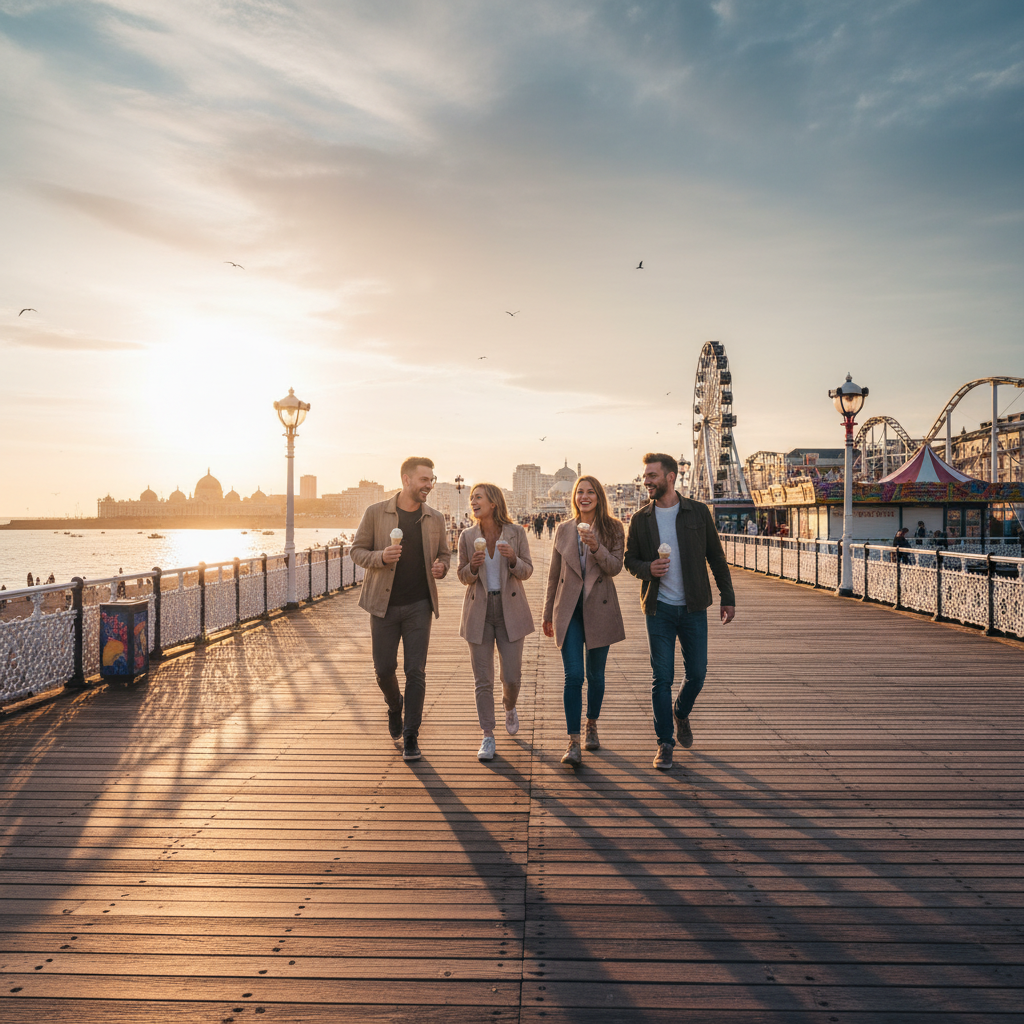
BrightonOutdoor Escape Game & Treasure Hunt
Vibrant seaside city, pier, and royal splendour
Brighton, this gem on England's south coast, is an invitation to escape and discovery. If you're wondering what to do in Brighton, know that the city is full of memorable experiences, well beyond its famous pebble beaches. Start by strolling through the labyrinthine alleys of The Lanes, where independent boutiques and charming cafes coexist. Admire the extravagance of the Royal Pavilion, a palace worthy of the Arabian Nights, or breathe in the sea air on the Brighton Palace Pier. But for a truly fun and unusual activity, why not embark on an outdoor escape game? It's a unique way to turn the city into a giant playground. Imagine a life-sized treasure hunt, a captivating scavenger hunt that will lead you through Brighton's secrets while solving puzzles. It's the perfect adventure to explore the city from a new angle, with friends or family, and create unforgettable memories.
Unusual things to do in Brighton
For an unusual activity in Brighton, let yourself be surprised by its bohemian and avant-garde spirit. Beyond the classic attractions, the city is a playground for curious minds. Take a themed guided tour about urban legends or the city's punk history, or explore its hidden street art. But for an original outing that combines exploration and intellectual challenge, the outdoor escape game is unbeatable. It's an opportunity to see Brighton differently, to solve puzzles outdoors while discovering unsuspected corners, transforming every street into a clue and every monument into a stage of your adventure.
Things to do in Brighton with kids
Brighton is a fantastic destination for families with children and teens, offering a multitude of activities for all ages. The Sea Life Centre will amaze the youngest with its marine creatures, while the Brighton Palace Pier offers classic fairground attractions that will delight everyone. For an experience that stimulates teamwork and imagination, an outdoor escape game is a perfect option. Generally suitable from 8 years old (with parental help), it's a playful scavenger hunt that allows children and teens to discover the city interactively, solving puzzles together and learning while having fun.
Brighton for couples
For a romantic getaway in Brighton as a couple, the city offers a seductive blend of historic charm and relaxed atmosphere. Stroll hand-in-hand through the cobblestone streets of the North Laine, discovering vintage boutiques and cozy cafes. Enjoy breathtaking sea views from the top of the British Airways i360 at sunset, or share a moment of serenity exploring the architectural heritage of the Royal Pavilion. An outdoor escape game can also be an intimate and fun activity for two, strengthening your complicity by solving mysteries together, while discovering the city from a new and playful angle.
What to do in Brighton when it rains
Even in rainy weather, Brighton loses none of its charm, and there's always something to do! Our outdoor escape game is particularly well-suited to the whims of the weather: approximately 80% of the route takes place under arcades, covered passages, or near shelters, allowing you to enjoy the adventure without getting soaked. Beyond that, you can explore the city's museums, like the Brighton Museum & Art Gallery, or take refuge in one of the many independent cafes in North Laine for a warm drink and a cozy atmosphere.
Where is Brighton, and where do the routes start?
Starting points of our routes and the places they pass through.
Route starting points
Places in Brighton
- Royal Pavilion (main facade)
- Pavilion Gardens (west side)
- Old Steine
- Royal Chapel of Brighton (ext.)
- Brighton Dome (main facade)
- Marlborough Place and its Georgian houses
- Clifden House (ext.)
- Pavilion Gardens (south side, near the gate)
The history of Brighton
From Fishing Village to Royal Retreat
Brighton's story begins over a thousand years ago as 'Brighthelmstone,' an Anglo-Saxon farmstead first recorded in the Domesday Book of 1086. For centuries, it remained a fishing and agricultural settlement, with its economy reliant on the sea, particularly herring and mackerel. The area now known as The Lanes, with its narrow, winding streets, preserves the medieval street plan of this original fishing village.
The town faced hardships in the early 18th century, including a storm in 1703 and a decline in the fishing industry. A turning point arrived in the mid-1700s when Dr. Richard Russell of Lewes began promoting sea bathing and drinking seawater for health. His 1750 paper attracted wealthy patients, starting Brighton's transformation into a health resort. The growth began in 1783 with the first visit of George, Prince of Wales (later King George IV), who was interested in Brighton's society. He rented a farmhouse, eventually transforming it into the Royal Pavilion between 1787 and 1823, establishing Brighton's status as a Regency-era destination.
The Victorian Era and Modern City
The arrival of the London and Brighton Railway in 1841 made the town accessible to day-trippers from London. Brighton's population increased from 7,339 in 1801 to over 120,000 by 1901. This period saw the construction of many landmarks, including the Grand Hotel (1864), the West Pier (1866), and the Palace Pier (1899), which remain features of the city. In 2000, Brighton, along with Hove, was granted city status.
What to see in Brighton
- Royal Pavilion — This former royal residence, built for King George IV, has an Indo-Saracenic exterior with onion domes and minarets, and Chinoiserie interiors. It contrasts with traditional English architecture.
- The Lanes — These narrow, winding alleyways preserve the medieval street plan of Brighthelmstone, the original fishing village. They contain independent jewellers, antique shops, boutiques, cafes, and pubs.
- Brighton Palace Pier — Opened in 1899, this Victorian pier extends into the English Channel and offers amusement arcades, fairground rides, and food stalls.
- Old Steine — Once an open green space for drying fishing nets, this central thoroughfare is now a landscaped garden featuring the Victoria Fountain, erected in 1846, and several memorials, including the Brighton War Memorial. It is a public space adjacent to the Royal Pavilion.
- Brighton Dome — Part of an arts complex, this venue was originally the Prince Regent's stables for the Royal Pavilion. It now hosts music, dance, and theatre, and is home to the Brighton Festival.
- Marlborough Place — This street displays Georgian houses, showing Brighton's architectural development during the Regency era when the town became a resort.
When to visit Brighton
Brighton has a moderate climate with warm summers and mild winters. The period for warm-weather activities is from mid-June to early September, when average daily high temperatures are above 80°F. July and August are the busiest months, with more crowds and higher prices for accommodation and travel.
Spring (March to May) offers cooler temperatures, ranging from 50°F to 64°F, and is the second busiest time for tourism, with occasional rainfall. Autumn (September to November) sees temperatures drop, with more frequent rainfall. Winter (December to February) is cold, with average temperatures between 45°F and 50°F, and 7-9 days of rain or snowfall per month, making it the least crowded season. Avoid December if you prefer less humidity, as it is typically the most humid month.
Getting around Brighton
Brighton is well-connected and easy to navigate. Brighton railway station offers direct train services, notably from London, which contributed to the city's growth. For air travel, London Gatwick Airport (LGW) is accessible by train.
The city center is compact and can be explored on foot. The Brighton & Hove bus network is extensive and frequent, offering a way to get around the city. Day, week, or monthly saver tickets are available. Cycling is also common, with cycle routes along the beachfront and a bike-share scheme, BTN BikeShare.
Parking can be difficult, especially in peak season. Public parking lots and on-street spots exist, but consider using public transport or booking accommodation with parking. The Lanes area is largely pedestrianized.
Things you probably do not know about Brighton
Verified details most visitors walk straight past.
- Royal Pavilion
- Did you know the Royal Pavilion has secret underground passages? Indeed, a network of tunnels was built beneath the Royal Pavilion, allowing the Prince Regent (later King George IV) private travel between his palace and the beach, avoiding public scrutiny.
- Old Steine
- What's the real meaning behind the name 'Old Steine'? The word 'Steine' comes from the Old English 'stoene,' meaning 'stony place.' This refers to the large sarsen stones that once lay in the area, some of which can still be seen at the base of the Victoria Fountain.
- Brighton Dome
- What was the Brighton Dome originally used for before it became a concert hall? The magnificent Brighton Dome complex, now a major arts venue, was originally built as the stables for the Royal Pavilion, housing the Prince Regent's horses and carriages.
- The Lanes
- Why are the streets in The Lanes so narrow and winding? The labyrinthine layout of The Lanes directly reflects the medieval street plan of Brighthelmstone, the original fishing village, where houses were built close together for shelter and quick access to the shore.
- Brighton Palace Pier
- When the Palace Pier first opened, what kind of entertainment did it offer that's very different from today's amusement rides? Upon its opening in 1899, the Palace Pier featured a 1,500-seat theatre, reading rooms, and dining pavilions, offering a more genteel form of entertainment before it evolved into an amusement park.
- The Cricketers Arms (Black Lion Street)
- Which historic Brighton pub has a name linked to a measure of fish? The Cricketers Arms, one of Brighton's oldest pubs, is said to date from around 1545 when it was known as the 'Laste and Fishcart,' a 'laste' being an old measure equivalent to 10,000 herrings.
Questions about visiting Brighton
How long should I plan to stay in Brighton?
For a comprehensive visit, plan at least 2-3 days to explore the main attractions like the Royal Pavilion, The Lanes, and the Palace Pier, with extra time for museums or day trips to the South Downs. Many visitors also enjoy extended weekend stays.
What are the best neighborhoods to stay in Brighton?
For first-time visitors, the central Lanes area or the seafront offers walkable access to key attractions. Kemptown is known for its bohemian vibe and nightlife, while Hove provides a quieter, more residential atmosphere, suitable for families. North Laine is popular for its quirky shops and artistic influence.
How can I get around Brighton without a car?
Brighton is very walkable, especially the city center. The extensive Brighton & Hove bus network is a convenient and eco-friendly option. Cycling is also popular, with dedicated routes and a bike-share scheme. Taxis and ride-hailing apps are also readily available.
What is the typical budget for a day in Brighton?
Accommodation prices vary, with budget rooms starting around £33-£52, but realistic midweek rates are typically £80-£150 per night. Daily expenses for food, activities, and transport can range depending on your choices, but Brighton can be enjoyed on various budgets.
Is Brighton a good destination for families with children?
Yes, Brighton offers many family-friendly activities, including the rides and arcades on Brighton Palace Pier, Sea Life Brighton with its underwater tunnel, watersports at Hove Lagoon, and various playgrounds like the Imagination Station.
What's the best time of year to avoid crowds in Brighton?
To avoid the largest crowds, consider visiting during the winter months (December to February). While it's colder with more rain, tourism is relatively low, and hotel tariffs may be more affordable. Early spring or late autumn can also be less crowded than peak summer.
Frequently asked questions
How much does an outdoor escape game cost in Brighton?
An outdoor escape game in Brighton is designed to be an accessible and friendly activity. The price is generally €12 per team, which is very advantageous if you come as a group of friends or family. This single rate covers access to the game for your entire team, regardless of the number of participants (within the recommended limit for a better experience). It's an excellent alternative to more expensive activities, offering several hours of entertainment and city discovery for a controlled budget. Get ready for a memorable adventure without breaking the bank!
Is it suitable for children / families?
Absolutely! Our outdoor escape games in Brighton are perfectly suitable for families and children. We generally recommend active participation from 8 years old, but younger ones can certainly follow along and help with observation. It's a fantastic activity to stimulate teamwork, logic, and a sense of direction for everyone. The puzzles are designed to be fun and engaging, allowing parents and children to collaborate and share laughs while exploring the city. It's a playful and educational way to discover Brighton together.
How long does an escape game in Brighton last?
The duration of an outdoor escape game in Brighton typically ranges between 1 hour 30 minutes and 2 hours 30 minutes, depending on your pace and your team's efficiency in solving puzzles. The advantage is that you are completely free to take your time! If you want to take breaks to admire a monument, grab a coffee, or simply enjoy the city's atmosphere, it's entirely possible. The game is designed to adapt to your rhythm, offering a flexible and personalized experience. The goal is to have fun and discover Brighton at your own pace.
Do I need to book in advance?
For our outdoor escape games in Brighton, advance booking is not strictly mandatory, but it is highly recommended, especially if you have a specific date or time slot in mind. By booking, you ensure availability and can start your adventure whenever you like, without waiting. Furthermore, it allows us to better anticipate the number of participants and offer you the best possible experience. It's a simple and quick process that guarantees peace of mind before your immersion into the mysteries of Brighton.
What to visit in Brighton beyond escape games?
Brighton is full of treasures to explore! Beyond our exciting outdoor escape games, don't miss the majestic Royal Pavilion, an oriental-style palace that will transport you to another world. Stroll through the famous The Lanes and North Laine, picturesque neighborhoods with their independent boutiques, art galleries, and trendy cafes. The Brighton Palace Pier is a must-see for its attractions and seaside atmosphere. For breathtaking views, hop aboard the British Airways i360. And of course, enjoy the pebble beaches for a breath of fresh air!
What is the best season to visit Brighton?
Brighton is charming in every season, but the best time to visit depends on your preferences! Summer (June to August) offers warmer weather, ideal for enjoying the beach, festivals, and lively atmosphere. Spring (April to May) and autumn (September to October) are also excellent, with mild temperatures, fewer crowds, and beautiful light for exploring the city. Winter can be cool, but the city retains its charm, and indoor attractions are perfect. Our outdoor escape games are playable all year round, although a small umbrella might be useful!
Other destinations in South East
Arundel
Between its medieval castle and its cathedral
Battle
Where 1066 changed England's destiny forever
Canterbury
Follow pilgrims' footsteps and Chaucer's tales
Chichester
Roman and medieval city of Sussex
Dover
The white cliffs, historical guardians of England
Winchester
Ancient royal capital, historical cradle of England
Activities to discover nearby
Guided tours, skip-the-line tickets and local experiences to book in advance.
💡 Optional booking — you can also buy on-site. All links open in a new window, your OddballTrip visit stays preserved.