
DurhamOutdoor Escape Game & Treasure Hunt
Tobacco city turned innovation hub
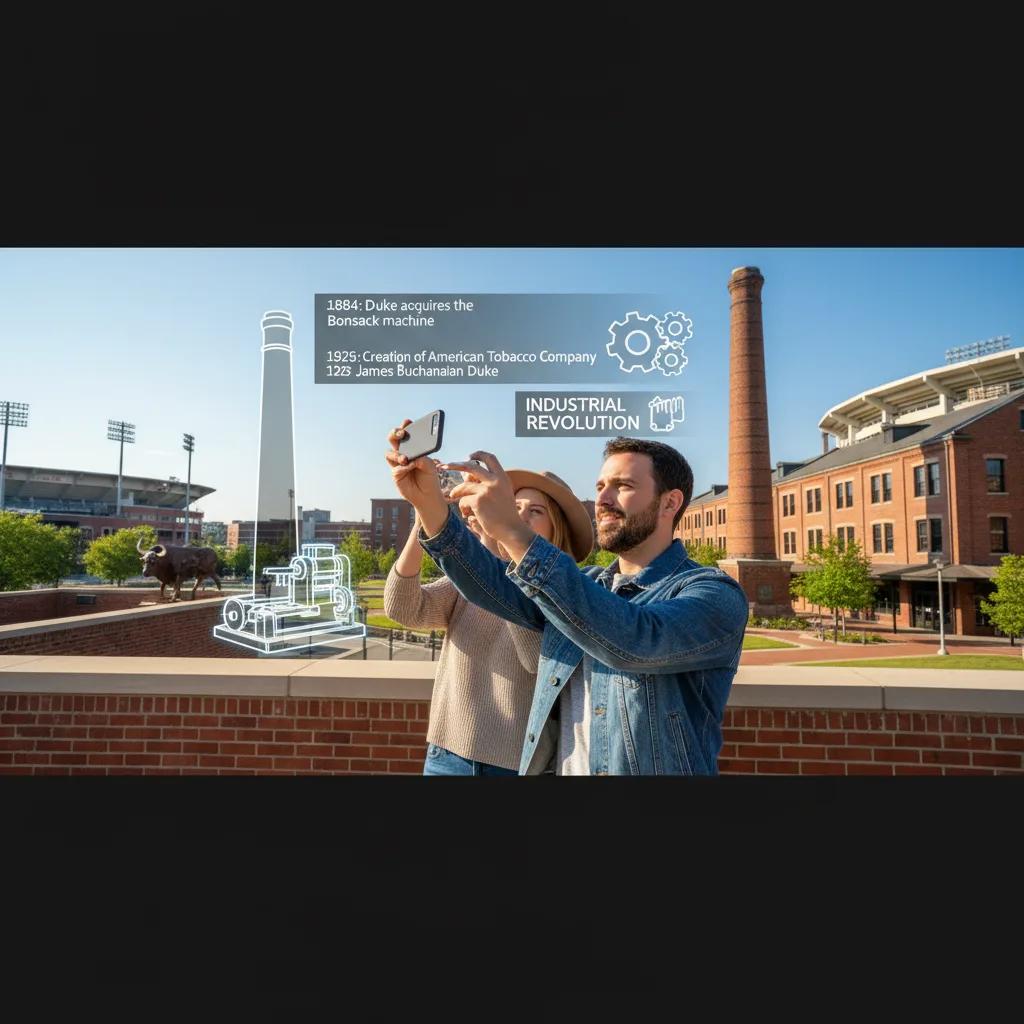
Durham, nicknamed the "Bull City" after its tobacco industry heritage, has transformed into an innovation and culture hub. What to do in Durham? Explore this dynamic Research Triangle city through our outdoor escape game, a captivating treasure hunt that leads you from the red brick American Tobacco Campus to the shaded walkways of Duke University. This urban scavenger hunt reveals Durham's creative soul, from contemporary art galleries to innovative downtown food trucks, passing by industrial remnants converted into cultural spaces. An unusual activity that turns your city discovery into an interactive investigation through its revitalized neighborhoods. Here's our trail through Durham:
Landmarks of Durham
Monuments and sites covered by our escape games across the city.
Unusual things to do in Durham
Among the unusual things to do in Durham, our outdoor puzzle trail unveils the hidden secrets of this former tobacco capital. Explore the underground passages of Duke University Campus, discover the murals of the Central Park district, or follow traces of industrial history in the converted warehouses of American Tobacco Campus. The riddles reveal details even locals don't know: a hidden sculpture in a university garden, the mysterious inscription of an old tobacco silo. An original Durham outing that blends industrial heritage with contemporary culture.
Things to do in Durham with kids
What to do with the family in Durham? Our outdoor escape game is perfect from age 8 and turns Bull City discovery into an interactive family adventure. Kids love hunting for clues in Duke University gardens, while teens get excited about tobacco history and parents appreciate the converted industrial architecture. The GPS trail avoids heavy traffic areas and focuses on downtown pedestrian spaces and university walkways. A kids' activity that combines cultural discovery with treasure hunting, ideal for an educational and fun teen outing.
Durham for couples
Durham for couples reveals its charm in the romantic Sarah P. Duke Gardens, the intimate terraces of American Tobacco Campus, and the cobbled streets of the historic district. Our outdoor trail, perfect for a couples outing, guides you through 2 hours of shared exploration where each puzzle becomes a chance to discover the city's artistic soul together. This unexpected romantic activity leads you from contemporary art galleries to hidden downtown cafes, creating intimate moments away from typical tourist paths. A romantic getaway that reinvents Durham discovery.
What to do in Durham when it rains
What to do in Durham when it rains? Our outdoor escape game stays playable in light rain: 70% of the trail unfolds under the covered arcades of American Tobacco Campus, Duke University's interior galleries, and downtown covered passages. The converted industrial buildings offer plenty of natural shelter between puzzles. A wet-weather activity that reveals covered Durham and its historic interior spaces, when rain gives a special atmosphere to the city's red bricks.
Where is Durham, and where do the routes start?
Starting points of our routes and the places they pass through.
Route starting points
Places in Durham
- American Tobacco Campus - Historic Smokestack
- Durham Bulls Athletic Park - Bull Sculpture
- Brightleaf Square - Former tobacco warehouse
- Historic Durham Depot - 515 West Pettigrew Street
- Duke University East Campus - Former laboratory site
- Historic Downtown - Former Fidelity Bank headquarters
- Duke Memorial Gardens - Family Mausoleum
- Washington Duke Inn - Historic Lounge
The history of Durham
Tobacco Cultivation and Post-War Growth
Durham's development is linked to tobacco. The North Carolina Railroad's arrival in 1854 spurred growth. In 1858, Robert Morris established the first tobacco production facility, selling "Best Flavored Spanish Smoking Tobacco." The Civil War increased demand for Durham's tobacco, as Union soldiers passing through the area developed a preference for the local product. John Ruffin Green, who acquired Morris's business, helped establish Durham as a post-war tobacco manufacturing center. The W.T. Blackwell Company's Bull Durham Tobacco, founded in 1869, became a national brand and, for a period, the largest smoking tobacco factory globally, employing 900 people within 15 years.
The Duke Family and University Foundation
The Duke family, led by Washington Duke, entered the tobacco business in the 1870s with W. Duke, Sons and Company. They specialized in cigarettes and, through production and marketing strategies, gained control of the American Tobacco Company by 1904. This company accounted for 80% of all tobacco products in the U.S., excluding cigars. In 1911, the U.S. Supreme Court dissolved American Tobacco due to antitrust violations. Washington Duke was a benefactor in bringing Trinity College to Durham in 1892. In 1924, his son James B. Duke established the Duke Endowment, leading to Trinity College being renamed Duke University in honor of his father. By the late 1990s, tobacco manufacturing in Durham ended. The American Tobacco Campus, a former factory complex, reopened in 2004 as a mixed-use development, marking Durham's economic shift.
What to see in Durham
- American Tobacco Campus — This area contains red-brick factory buildings, once a tobacco production site, now housing restaurants, shops, and offices. The historic smokestack and the Lucky Strike water tower remain.
- Durham Bulls Athletic Park (DBAP) — This stadium, opened in 1995, hosts minor league baseball games. It is the home of the Durham Bulls, the Triple-A affiliate of the Tampa Bay Rays, and provides views of the tobacco complex.
- Brightleaf Square — Two Romanesque-style brick tobacco warehouses, built in 1904, have been converted into a shopping and dining area.
- Duke University East Campus — This campus features Georgian-style architecture, rebuilt between 1925 and 1927. The Sarah P. Duke Gardens are on this campus, covering 55 acres with botanical displays.
- Duke Chapel — This Collegiate Gothic-style chapel is on Duke University's West Campus and was completed in 1935.
- Museum of Durham History — Exhibits here trace the city's past, from its tobacco origins to its modern identity, detailing key moments and figures.
- Eno River State Park — This park, located near downtown, offers over 4,000 acres with wooded trails and riverbanks.
When to visit Durham
The periods from early May to mid-June and from mid-August to mid-October offer pleasant weather for outdoor activities in Durham. Temperatures are mild, suitable for exploring gardens, downtown, and parks. Fall provides colorful foliage and local festivals. Spring features blooming flowers and baseball games. Summers are hot and humid, with July averaging 88°F. Winters are cooler, with January lows averaging 33°F and more clouds. Avoid major university events like Duke move-in, graduation, or basketball weekends to find fewer crowds and lower costs for accommodation and parking.
Getting around Durham
Raleigh-Durham International Airport (RDU) serves Durham, located about 14 miles southeast of downtown. GoDurham operates over 20 bus routes, all departing from Durham Station, facilitating transfers. Many routes offer service every 15 minutes during daytime hours. GoTriangle provides regional bus service connecting Durham to Chapel Hill and Raleigh. Walking and biking are options, with over 50 miles of bike lanes and walking trails.
Parking is available. The City of Durham operates parking garages and surface lots. Weekend and evening parking (after 7 p.m.) is free in city-owned garages and for on-street parking, except during special events. On weekdays, on-street metered parking costs $2.50 per hour from 8 a.m. to 7 p.m. The Church Parking Garage and Morgan-Rigsbee Parking Garage offer one hour of free parking during weekly daytime hours.
Things you probably do not know about Durham
Verified details most visitors walk straight past.
- American Tobacco Campus
- What happened to the American Tobacco Campus after the factories closed down in the 1980s? After cigarette operations ceased in the mid-1980s, the campus was shuttered and sat abandoned for over a decade, even being used for tactical training by local police before its revitalization began in the early 2000s.
- Durham Bulls Athletic Park (DBAP)
- Is the current Durham Bulls Athletic Park the same stadium where the famous movie 'Bull Durham' was filmed? No, the current Durham Bulls Athletic Park, which opened in 1995, is not the original stadium. The 1988 film 'Bull Durham' was shot at the historic Durham Athletic Park, nicknamed 'The DAP,' which was home to the Bulls from 1926 to 1994.
- Brightleaf Square
- What was the original purpose of the grand red-brick buildings that now make up Brightleaf Square? The buildings of Brightleaf Square, constructed in 1904, were originally the Watts and Yuille Warehouses, used by the American Tobacco Company to store prized bright leaf tobacco.
- Duke University East Campus
- Before becoming Duke University, what was the school called, and when did it begin admitting women? Duke University originated as Union Institute Academy in 1838, later becoming Trinity College. In 1897, at Washington Duke's request, the school began admitting women as regular students, making it an early co-educational institution.
- Washington Duke Inn
- The current Washington Duke Inn is a hotel, but was there an earlier 'Washington Duke Hotel' in downtown Durham? Yes, an earlier Washington Duke Hotel, a 16-story structure, was built in downtown Durham between 1924 and 1925. It was a central gathering place for fifty years before being deemed unprofitable and imploded in 1975.
- Historic Durham Depot (515 West Pettigrew Street)
- What significant historical event took place in Durham in April 1865, involving two prominent Civil War generals? In April 1865, Confederate General Joseph E. Johnston surrendered the Southern armies in the Carolinas, Florida, and Georgia to his Union adversary, General William T. Sherman, at Bennett Place in Durham.
Questions about visiting Durham
How do I get to Durham?
Durham is served by Raleigh-Durham International Airport (RDU), located approximately 14 miles southeast of downtown. It is also accessible via major highways, as it is part of the Research Triangle region.
What is the best way to get around Durham?
GoDurham provides a bus network with over 20 routes, all connecting through Durham Station. Many routes offer frequent service. Walking and biking are also options, with dedicated lanes and trails. Rideshare services are available.
How many days should I spend in Durham?
A typical visit to Durham is two to three days to see main attractions like Duke University, the American Tobacco Campus, and downtown. A longer stay of four to five days allows for more in-depth exploration and additional activities.
What are the best neighborhoods to explore in Durham?
Downtown Durham is a central area with attractions like Brightleaf Square and the Durham Performing Arts Center. Other areas of interest include the Duke University campus with its gardens and museums, and the American Tobacco Campus.
What is the typical budget for a trip to Durham?
Durham offers various price points. Accommodation prices vary. Free attractions include the Sarah P. Duke Gardens and the Nasher Museum of Art. Public transportation is currently fare-free, and many parking options are free after 7 p.m. and on weekends.
Is Durham a good destination for families with children?
Yes, Durham offers family-friendly activities. The Museum of Life and Science features hands-on exhibits and a butterfly house. Eno River State Park provides outdoor activities. The Durham Bulls Athletic Park is also a popular spot for family outings.
Frequently asked questions
How much does an outdoor escape game in Durham cost?
Our outdoor escape game in Durham costs €12 per team (1 phone). For larger groups, budget €19 for 2 phones and €25 for 3. The price stays the same regardless of team size, making it a very economical activity to discover Durham with family or friends.
Is the Durham escape game suitable for children?
Absolutely! Our Durham trail is accessible from age 8. Puzzles are designed for team solving: kids excel at spotting visual clues, teens crack the codes, and adults connect it all to Bull City's local history. The GPS system safely guides you through Durham's family-friendly neighborhoods.
How long does an outdoor escape game in Durham last?
Plan about 2 hours to complete the Durham trail, but you can adapt the pace to your preferences. Since the game is self-guided, you can pause to visit Duke University, grab coffee at American Tobacco Campus, or simply enjoy the gardens. No time constraints!
Do I need to book in advance for Durham?
Booking isn't mandatory but highly recommended, especially during university periods when Duke University attracts many visitors. You receive your activation code by email immediately after purchase, usable whenever you want with no expiry date.
What to visit in Durham beyond escape games?
Durham is packed with attractions: the beautiful Duke University Campus with Sarah P. Duke Gardens botanical gardens, the converted American Tobacco Campus cultural and shopping center, the Nasher Museum of Art, and the vibrant downtown district with innovative restaurants. The nearby Research Triangle Park adds a unique technological dimension to the region.
When is the best time to visit Durham?
Spring (March-May) and fall (September-November) offer the best conditions: pleasant temperatures, active university campus, and beautiful colors in Duke's gardens. Summer can be hot and humid, but numerous shaded areas make the outdoor activity very enjoyable. Winter remains mild in North Carolina, perfect for urban exploration.
Other destinations in North Carolina
Asheville
Artistic gem of the Appalachians
Bath
North Carolina's oldest incorporated town
Edenton
North Carolina's first colonial capital
Greensboro
Birthplace of the civil rights movement
Kitty Hawk
Birthplace of modern aviation
New Bern
North Carolina's first capital
Roanoke
On the Roanoke River, where history meets nature
Roanoke Island
Mysterious birthplace of English America
Wilmington
Historic gem of the Atlantic coast