GroningenOutdoor Escape Game & Treasure Hunt
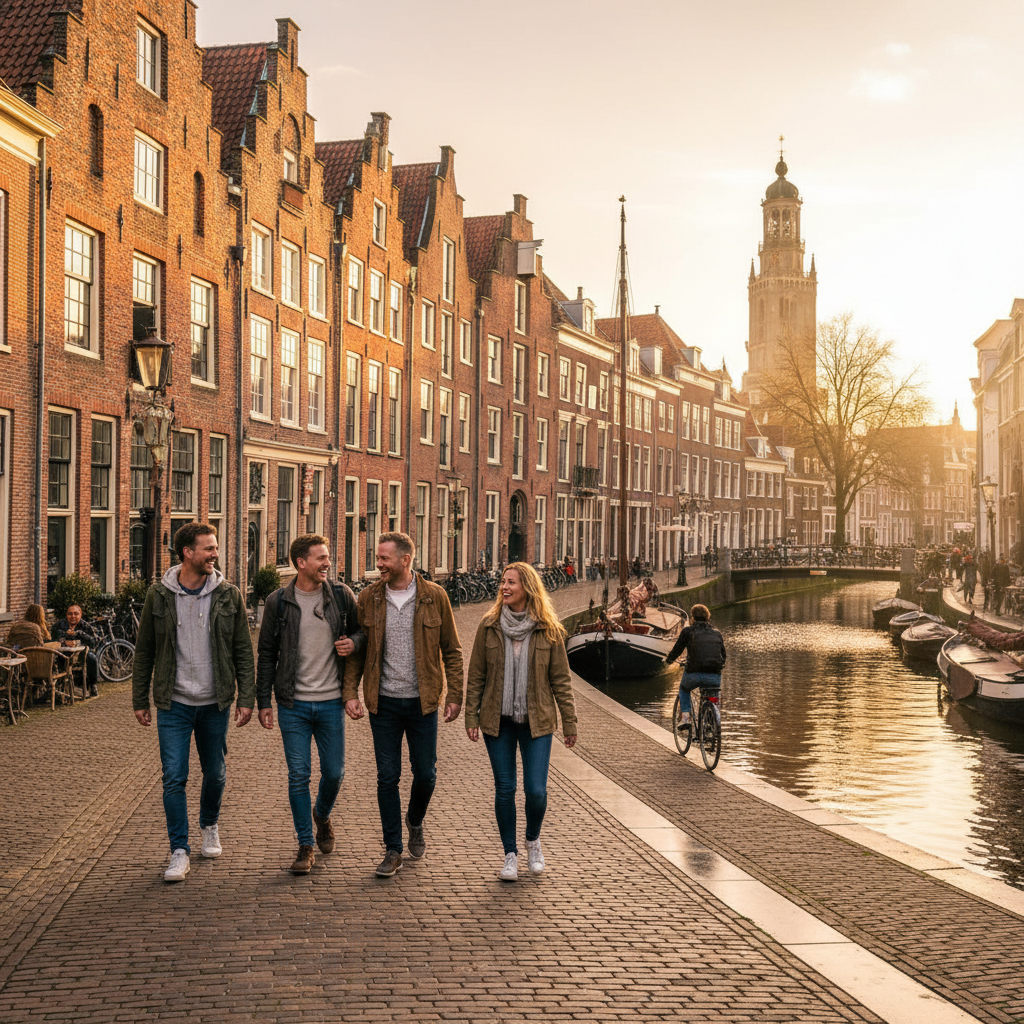
Dynamic student city in the Netherlands, where history meets vibrant canals.
Groningen, this pearl of the northern Netherlands, is much more than just a student city; it's a true playground for urban explorers. If you're wondering what to do in Groningen, prepare to be surprised by its unique blend of vibrant history and relaxed modernity. Start by strolling around the Grote Markt, dominated by the impressive Martinitoren, from where the view over the city is breathtaking. But for a truly memorable experience, why not turn your visit into a real adventure? An outdoor escape game through Groningen's winding alleys and along its picturesque canals will allow you to discover its hidden secrets. Imagine a real-life treasure hunt, where each clue leads you to a new facet of the city, such as the peaceful Hofjes or the lush gardens of the Prinsentuin. It's an unusual activity that combines the fun of a game with cultural discovery, transforming every street corner into a stage of your personal scavenger hunt. A unique and playful way to immerse yourself in Groningen's very special atmosphere.
Unusual things to do in Groningen
For an unusual activity in Groningen, step off the beaten path and delve into the world of the Hofjes, these hidden inner courtyards, true havens of peace that tell the city's social history. It's an original and contemplative outing, far from the hustle and bustle. Or, let yourself be surprised by the urban art scene by exploring the frescoes and graffiti that adorn certain walls. But to combine discovery and thrill, nothing beats an OddballTrip.com scavenger hunt. It's a unique way to turn the city into a giant playground, solving riddles while admiring the architecture and canals. A memorable experience guaranteed!
Things to do in Groningen with kids
Groningen is a fantastic city for a family outing! If you're looking for what to do in Groningen with family, our scavenger hunts are perfect for entertaining children and teens from 8 years old. It's a playful activity that transforms discovering the city into a captivating adventure. Imagine your children solving puzzles together, exploring the canals and parks like the Noorderplantsoen, all while learning interesting facts about the city. The collaborative aspect strengthens family bonds, and the excitement of the treasure hunt keeps everyone engaged. A memorable way to create memories and enjoy Groningen all together.
Groningen for couples
For a romantic getaway, Groningen as a couple offers a charming and intimate setting. Let yourself be charmed by the cobblestone streets of the Hoge der A district, lined with historic houses and cozy cafes, perfect for a hand-in-hand stroll. Climb the Martinitoren for a breathtaking panoramic view of the city at sunset, an unforgettable moment to share. Explore the peaceful Hofjes, these secret gardens that invite contemplation and confidences. For a touch of adventure, an OddballTrip.com scavenger hunt can transform your walk into a playful quest, discovering Groningen's heritage in an original and complicit way. An experience that strengthens bonds and creates precious memories.
What to do in Groningen when it rains
Don't let the rain spoil your exploration of Groningen! Our outdoor escape game is designed to be an excellent option even on grey days. A large part of the route (approximately 80%) takes place under arcades, covered passages, or in areas where you can easily find shelter, particularly around the charming shopping arcades and historic passages of the city center. You can thus continue your scavenger hunt without getting soaked, enjoying Groningen's unique atmosphere while staying dry.
Where is Groningen, and where do the routes start?
Starting points of our routes and the places they pass through.
Route starting points
Places in Groningen
- Goudkantoor
- Base of the Martinitoren
- Academiegebouw
- Provinciehuis
- Prinsenhof Garden
- Pelstergasthuis
- Waagstraat 1 (The Waag)
- Hoge der A / Lage der A
The history of Groningen
Early Settlements and Hanseatic Growth
Groningen's history begins with archaeological findings indicating settlements around 3950–3650 BC, with a community present by 3 AD. The city was established on the northernmost point of the Hondsrug ridge, a natural elevation that provided defense against floods and invaders in the surrounding marshlands. Its position on the Drentsche Aa river, where sand met clay, was suitable for trade. The first written record of Groningen, then named "Villa Cruoninga," dates to 1040, when German Emperor Henry III granted the lands to the Bishop of Utrecht.
By the 13th century, Groningen had become a trading center, fortifying itself with city walls. Its influence expanded, and in the 14th century, it joined the Hanseatic League, a commercial and defensive confederation of merchant guilds and market towns in Northwestern and Central Europe. This membership brought economic growth and allowed Groningen to become a player in North German trade networks. For centuries, Groningen functioned as an independent city-state, controlling much of the surrounding province of Friesland in the late 15th century.
University, Sieges, and Reconstruction
A significant development occurred in 1614 with the founding of the University of Groningen, which established the city as an educational and intellectual center. This period also saw urban expansion and the construction of new city walls. These fortifications were important in 1672 during the Third Anglo-Dutch War, when the city resisted a siege by Bernhard von Galen, the Bishop of Münster, an event still observed annually on August 28th as "Groningens Ontzet." Groningen was under French control from 1795 to 1814 during the Napoleonic era. The city sustained damage during World War II, particularly in April 1945 during the Battle of Groningen, which largely destroyed the Grote Markt. However, structures like the Martinitoren, Goudkantoor, and the city hall remained. Post-war reconstruction shaped much of the city center visible today.
What to see in Groningen
- Martinitoren — This bell tower, known as "d'Olle Grieze" (the Old Grey One), stands 97 meters above the Grote Markt. Completed around 1482, it served as a watchtower and the bell tower for the adjacent Martinikerk. Visitors can climb its 251 steps for views that reach the Wadden Sea on a clear day.
- Goudkantoor — Built in 1635 in Dutch Renaissance style, this building on Waagstraat was originally the provincial tax receiver's office. Its sandstone facade, with shell-shaped gables and carved coats of arms, was designed to convey authority. The Latin inscription "Date Caesari quae sunt Caesaris" (Render unto Caesar that which is Caesar's) on its facade refers to its original function.
- Academiegebouw — This building houses the University of Groningen, founded in 1614. It is the second-oldest university in the Netherlands. The Academiegebouw is a historic building.
- Prinsenhof Garden (Prinsentuin) — A Renaissance-style garden, dating back to the 16th century, with flowers, a rose garden, and a historic sundial. It offers a quiet space.
- Pelstergasthuis — This almshouse, with parts from the 13th century, shows Groningen's social history. It is one of the oldest hofjes (courtyards) in the Netherlands, providing housing for the elderly or poor for centuries.
- Hoge der A / Lage der A — This canal area reflects Groningen's past as an inland port. Old merchant houses line the waterways, showing the city's Hanseatic trading heritage. The terms 'Hoge' (Higher) and 'Lage' (Lower) refer to different wharf levels, historically used due to tidal variations.
When to visit Groningen
The period from late June to late August offers pleasant weather for visiting Groningen. Average daytime temperatures range from 21°C to 23°C (69-73°F), with comfortable evenings. This time of year also has festivals and outdoor terraces. May and early autumn (September) also provide agreeable conditions with fewer crowds and pleasant temperatures, though with a higher chance of rain. May is often the sunniest month.
Avoid visiting from November to March if you prefer warmer weather, as winters are long, cold, and mostly cloudy, with average daily highs below 8°C (46°F) and significant rainfall.
Getting around Groningen
Groningen is connected by train. Groningen Central Station (Hoofdstation) is the main railway hub, located near the city center, with connections to other major Dutch cities. Direct trains from Amsterdam Schiphol Airport take just over two hours. The city also has two other stations: Groningen Europapark and Groningen-Noord.
Most attractions are within walking or cycling distance. Cycling is a common mode of transport. Public buses, operated by Qbuzz, provide a network for reaching outer districts. An OV-chipkaart (public transport chip card) can be used for buses and trains, or single tickets can be purchased.
For parking, consider using one of the five free Park & Ride (P+R) lots on the city's outskirts (Haren, Kardinge, Reitdiep, Hoogkerk, Meerstad). From there, a P+R bus takes you to the city center; a return ticket costs €6.25 for up to five people. On-street parking in the city center is paid, typically €4.50-€5 per hour, enforced Monday to Saturday from 09:00 to 24:00, and Sundays/public holidays from 12:00 to 17:00.
Markets are held at the Vismarkt and A-kerkhof for fresh produce on Tuesdays, Fridays, and Saturdays from 9:00 to 17:00, and a smaller market on Wednesdays. The Grote Markt also has a commodity market on Tuesdays, Thursdays, Fridays, Saturdays, and Sundays.
Things you probably do not know about Groningen
Verified details most visitors walk straight past.
- Martinitoren
- The Martinitoren has been rebuilt multiple times. Do you know what caused the destruction of its first two iterations? The first Martinitoren, built in the 13th century, was destroyed by a lightning strike in 1408. Its successor, constructed in the 15th century, also met a fiery end due to lightning in 1465.
- Goudkantoor
- The Goudkantoor, a building known for its elaborate Renaissance facade, has an inscription that might seem a bit unusual for a former tax office. What does it say? The inscription on the facade of the Goudkantoor reads: 'Date Caesari quae sunt Caesaris' (Render unto Caesar that which is Caesar's), directly referencing its original function as the provincial tax receiver's office.
- Grote Markt
- While the Grote Markt is a square today, much of what you see was rebuilt after a devastating event. What happened there in 1945? During the Battle of Groningen in April 1945, the Grote Markt was largely destroyed. Many buildings on its west, north, and east sides were severely damaged or ruined, leading to extensive post-war reconstruction.
- Prinsenhof Garden
- Beyond its flowers, the Prinsenhof Garden holds an annual event. What kind of festival takes place there? Once a year, the Prinsenhof Garden hosts the 'Dichters in de Prinsentuin' (Poets in the Prinsentuin) poetry festival, where poets gather to read their works aloud in the tranquil setting.
- Pelstergasthuis
- The Pelstergasthuis has a long history of providing care, but it also has a surprising feature in its chapel. What makes it stand out? The Pelstergasthuis chapel features a unique and well-preserved medieval mural depicting the Last Judgment, a rare example of such artwork in the Netherlands.
- Waagstraat 1 (The Waag)
- The Waagstraat, where the Goudkantoor stands, is named after a historic building that is no longer there. What was the Waag, and why was it demolished? The original Waag (weigh house), which gave the Waagstraat its name, was demolished in 1874 without any structural necessity. It was a place where goods were officially weighed for trade.
Questions about visiting Groningen
How many days should I spend in Groningen?
A weekend (2-3 days) is generally sufficient to explore Groningen's city center, visit key attractions, and experience its atmosphere. If you wish to delve deeper into museums or explore the surrounding region, consider extending your stay to 4-5 days.
What is the best way to get around Groningen?
Groningen is a compact city, making it ideal for walking or cycling. Bicycles are the most popular mode of transport, and rentals are widely available. For longer distances or to reach outer districts, the public bus system, operated by Qbuzz, is efficient.
Is Groningen a good city to visit with children?
Yes, Groningen offers several family-friendly activities. Children might enjoy climbing the Martinitoren, exploring the Noorderplantsoen park, or visiting the Groninger Museum, which often has engaging exhibitions. The city's pedestrian-friendly center makes it easy to navigate with a family.
What are the typical costs for a day in Groningen?
A moderate budget for a day in Groningen could range from €50-€100 per person, covering meals, public transport (or bike rental), and entry to a museum or two. Accommodation costs would be additional. There are options for various budgets, from student-friendly eateries to more upscale dining.
What are the main neighborhoods or areas to explore in Groningen?
The city center, particularly around the Grote Markt, is the historical heart with most landmarks. The Westerhaven area offers shopping, while the Ebbingekwartier is known for its modern architecture and cultural venues. The canal district, including Hoge der A and Lage der A, provides handsome strolls.
Are there any specific local customs or etiquette I should be aware of in Groningen?
While generally relaxed, it's polite to greet shopkeepers and use 'please' and 'thank you' (alstublieft and dank u wel). Cyclists have priority in many areas, so be mindful of bike paths. Tipping in restaurants is appreciated but not mandatory, usually around 5-10% for good service.
Frequently asked questions
How much does an outdoor escape game cost in Groningen?
That's an excellent question, and the good news is that our prices are designed to be affordable and transparent. For an OddballTrip outdoor escape game in Groningen, the price is €12 per team, not per person! This means that if you come with a group of friends or family, the cost per participant becomes very advantageous. This single team price gives you access to the full adventure, puzzles, and city discovery. It's an economical and super fun way to explore Groningen, with no budget surprises.
Is it suitable for children / families?
Absolutely! Our outdoor escape games in Groningen are designed to be a fantastic activity for the whole family. The puzzles are crafted to be stimulating without being overly complex, allowing children from 8 years old to actively participate and have fun. It's a great opportunity for parents, children, and teens to collaborate, solve challenges together, and discover the city in an interactive way. The playful aspect of the treasure hunt keeps everyone engaged, making this experience a memorable one for all ages. Get ready to laugh and explore as a team!
How long does an escape game last in Groningen?
Generally, an OddballTrip outdoor escape game in Groningen lasts between 1 hour 30 minutes and 2 hours 30 minutes. The exact duration depends on your pace, how quickly your team solves the puzzles, and, of course, the time you take to admire the beautiful city sights you'll encounter! We've designed the route to be enjoyable and unhurried, allowing you the freedom to take breaks if you wish, snap photos, or stop for a drink. It's your adventure, at your own pace!
Do I need to book in advance?
No, one of the great advantages of our outdoor escape games is flexibility! There's no need to book in advance. You can purchase your game online whenever you want and start the adventure immediately, or later. The game is accessible 24/7, offering you complete freedom to organize your day in Groningen. Whether you decide to play on a whim or plan your activity weeks in advance, you choose the perfect time to start your urban treasure hunt. Convenient, isn't it?
What to visit in Groningen beyond escape games?
Groningen is full of treasures to discover! After or before your escape game, don't miss climbing the Martinitoren for a breathtaking view of the city. Stroll through the Grote Markt, Groningen's beating heart, and explore the charming canals that wind through the city. Green space lovers will appreciate the Noorderplantsoen, a magnificent park perfect for a walk or a picnic. For a cultural touch, the Groninger Museum, with its audacious architecture, is a must-see. And don't forget to get lost in the "Hofjes," these historic inner courtyards that are true hidden havens of peace. There's so much to see and do!
What is the best season to visit Groningen?
Groningen is charming in every season, but each period offers a different atmosphere. Spring (April-May) is ideal with its blossoming trees and mild temperatures, perfect for walks. Summer (June-August) is very pleasant, with a lively city, numerous festivals, and the opportunity to enjoy canal-side terraces. Autumn (September-October) offers beautiful colors and a cozier atmosphere. Even winter has its charm, especially with Christmas lights and markets. For an outdoor escape game, spring and summer are often preferred for comfort, but our route is perfectly feasible in cooler or even rainy weather, thanks to the many shelters.
Other destinations in Groningen
More cities in Netherlands
Amsterdam
Historic canals, art, and freedom: the Venice of the North awaits.
Haarlem
Dutch gem, where art, history, and canals intertwine
Utrecht
Historic canals and the majestic Dom Tower
Leiden
Rembrandt's birthplace, historic university city
The Hague
Royal seat and city of peace, between sea and history.
Delft
Blue pottery, picturesque canals, and Vermeer's timeless art.
Rotterdam
Bold architecture and a giant port
Maastricht
Where history meets European charm
Activities to discover nearby
Guided tours, skip-the-line tickets and local experiences to book in advance.
💡 Optional booking — you can also buy on-site. All links open in a new window, your OddballTrip visit stays preserved.