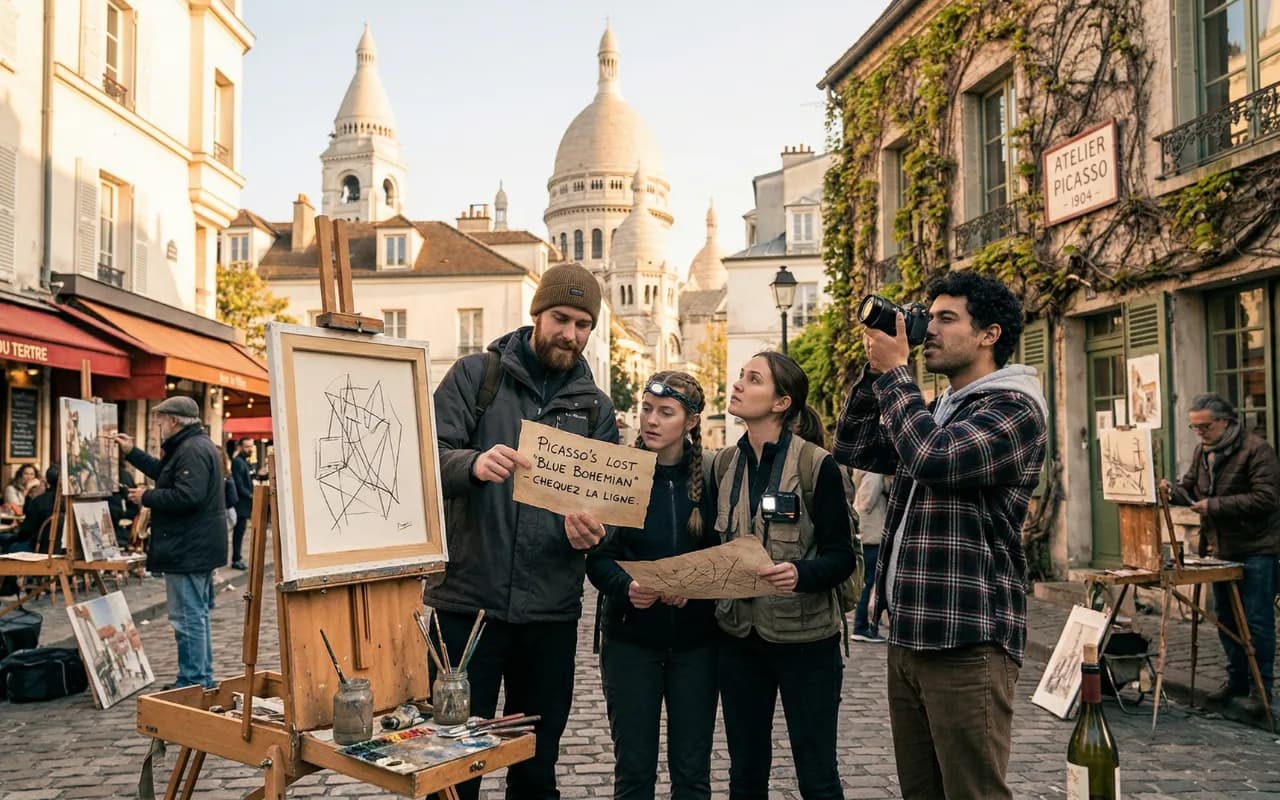
Paris — MontmartreOutdoor Escape Game & Treasure Hunt
The bohemian hill of artists and Sacré-Cœur
What to do in Paris – Montmartre? Immerse yourself in the unique atmosphere of this mythical district, perched on its hill, far from the Parisian hustle and bustle. Montmartre is a true village within the city, famous for its Sacré-Cœur Basilica, its Place du Tertre bustling with artists, and its cobbled streets that have inspired so many painters and writers. For an unusual activity and an original discovery, our outdoor escape games offer a captivating scavenger hunt. Transform your stroll into a life-sized treasure hunt, where every street corner, every facade, and every staircase holds clues. It's a fun way to uncover the secrets of Montmartre, from its windmills to its vineyards, passing through its historic cabarets. Discover below the trail we offer to explore Montmartre differently.
Unusual things to do in Paris — Montmartre
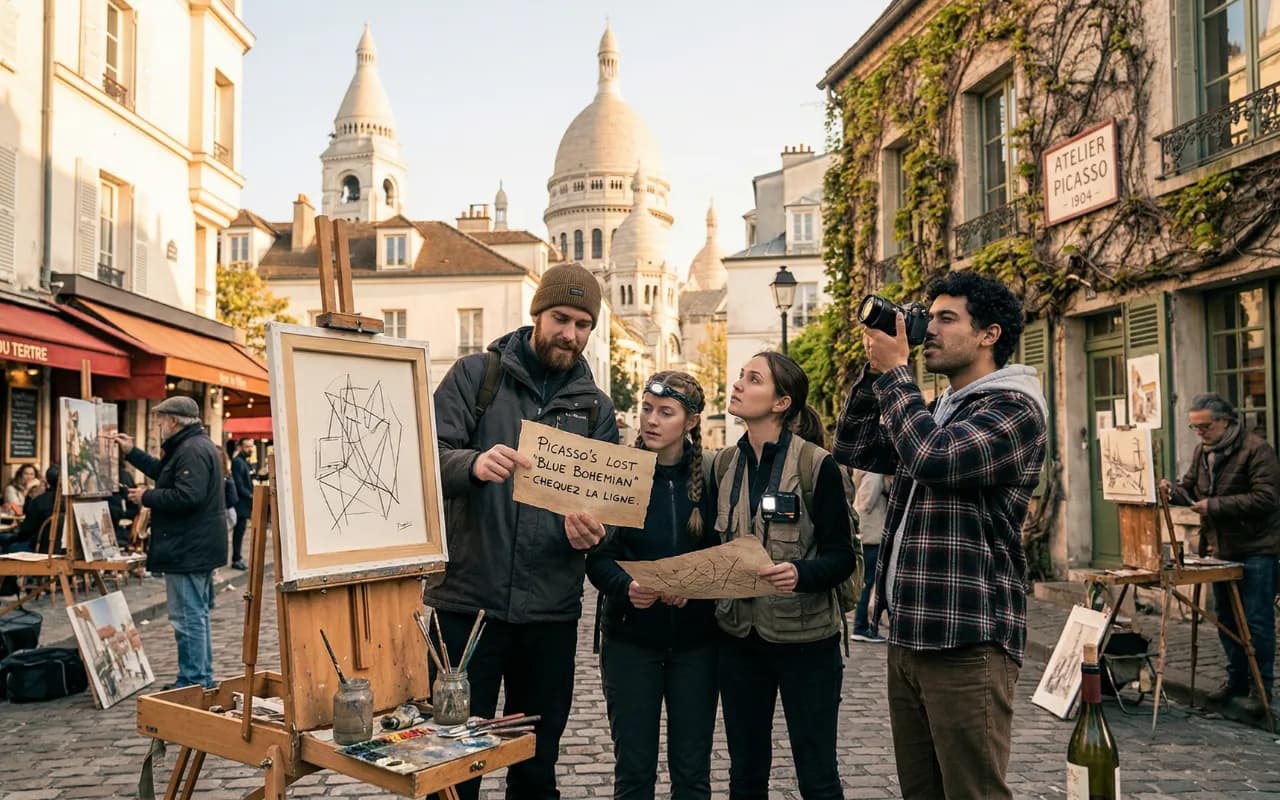
For an unusual activity in Paris – Montmartre, our escape games are an excellent option. Far from classic tourist circuits, the trail leads you through secret passages, hidden staircases, and unsuspected squares. You'll discover anecdotes about the Bateau-Lavoir, the Montmartre vineyards, or the Wall of Love, places not always seen on a first visit. It's an original outing that invites you to look up, observe architectural details, and decipher messages carved in stone. An immersive experience for the curious seeking another side of the hill.
Things to do in Paris — Montmartre with kids
What to do with the family in Paris – Montmartre? Our outdoor escape games are perfectly suited for an outing with children or teenagers, from 8 years old. The trail is designed for everyone to participate: the youngest love searching for visual clues in the alleys, while the older ones take charge of solving puzzles and following the GPS. It's a kids' activity that combines play and cultural discovery, transforming the neighborhood visit into a collective adventure. A fun and interactive way to immerse yourselves in the history and art of Montmartre, away from screens and boredom.
Paris — Montmartre for couples
Montmartre for couples is a romantic experience par excellence. Our outdoor trails are an original couples' outing idea to explore the charms of the hill hand in hand. Stroll through the cobbled streets, admire the breathtaking views of Paris from the Sacré-Cœur, and share a intimate moment solving puzzles. It's a romantic activity that's out of the ordinary, where heritage discovery blends with the fun of the game. End your romantic getaway with a drink on a hidden terrace or dinner in one of the many typical restaurants in the neighborhood, reminiscing about the challenges you faced together.
What to do in Paris — Montmartre when it rains
What to do in Paris – Montmartre when it rains? While our escape games are primarily outdoors, Montmartre offers many options to take shelter and continue enjoying the unique atmosphere of the neighborhood. The small artists' shops, art galleries, and cozy cafes along the cobbled streets are perfect for a break. The trail will also lead you near covered passages and the Sacré-Cœur Basilica, where you can take refuge. A wet-weather activity can even add a mysterious touch to your treasure hunt, revealing a more intimate and less crowded Montmartre.
Where is Paris — Montmartre, and where do the routes start?
Starting points of our routes and the places they pass through.
Route starting points
Places in Paris — Montmartre
- Bateau-Lavoir · 13 Rue Ravignan
- Moulin Rouge · 82 Boulevard de Clichy
- Place du Tertre · Artists' studios
- Sacré-Cœur Basilica · Crypt
- Au Lapin Agile · 22 Rue des Saules
The history of Paris — Montmartre
From Roman Temples to Gypsum Mines
Montmartre's history begins in Gallo-Roman times. Archaeological excavations have uncovered 3rd-century coins and 2nd-century Roman bath vestiges. Its name likely comes from "Mons Martis" (Mount of Mars) or "Mons Mercurii" (Mount Mercury), indicating the presence of Roman temples dedicated to these gods on the hill.
In the 3rd century AD, Montmartre became a Christian site when Saint Denis, the first bishop of Paris, was martyred on the hilltop. By the 12th century, King Louis VI established the Royal Abbey of Montmartre, a Benedictine monastery that occupied much of the hill. The Church of Saint-Pierre de Montmartre, built in 1134, served as its abbey church. The hill also had gypsum mines, which operated from the Gallo-Roman period until 1860, providing the raw material for plaster of Paris.
The Commune and the Belle Époque
Montmartre remained a village outside Paris until 1860, when it was annexed and became part of the city's 18th arrondissement. In 1871, Montmartre was central to the Paris Commune uprising, a revolutionary period during which the French army's cannons were stored on the hill. The construction of the Sacré-Cœur Basilica, which began in 1875 and was completed in 1914 (dedicated in 1919), is considered by some an act of national reconciliation and atonement for the events of the Commune.
The late 19th and early 20th centuries, known as the Belle Époque (roughly 1872 to 1914), saw Montmartre become an artistic hub. Low rents and a convivial atmosphere attracted artists, including Pierre-Auguste Renoir, Maurice Utrillo, Raoul Dufy, Pablo Picasso, Vincent van Gogh, and Henri de Toulouse-Lautrec. Many lived and worked in communal studios like the Bateau-Lavoir, contributing to modern art movements such as Fauvism and Cubism.
What to see in Paris — Montmartre
- Basilique du Sacré-Cœur — This white-domed basilica, built between 1875 and 1914, offers views across Paris from the highest point of the Butte Montmartre. Its Romano-Byzantine architecture is distinctive, and inside, it contains the largest mosaic in France.
- Place du Tertre — A short walk from the Sacré-Cœur, this square is known for its open-air artists who set up easels to paint and draw portraits. You can observe artists at work.
- Musée de Montmartre — Housed in one of the oldest buildings on the Butte, this museum was once home to artists like Pierre-Auguste Renoir and Suzanne Valadon. It displays the history of Montmartre and its artistic community through paintings, posters, and drawings.
- Le Bateau-Lavoir — Located at 13 Rue Ravignan (now Place Émile Goudeau), this building was a residence and meeting place for early 20th-century artists, including Pablo Picasso, who developed Cubism here. Largely destroyed by fire in 1970 and rebuilt in 1978, it remains a historical art site.
- Au Lapin Agile — One of Montmartre's oldest cabarets, this pink house at 22 Rue des Saules has been a gathering place for artists, writers, and students since the late 19th century. It continues to host traditional French cabaret shows.
- Vigne de Montmartre (Clos Montmartre) — This small vineyard on the northern slope of the hill shows Montmartre's agricultural past. Replanted in the 1930s, it produces wine, and an annual grape harvest festival (Fête des Vendanges) is held in October.
When to visit Paris — Montmartre
The best times to visit Montmartre are during spring (April to June) and autumn (September to October). During these seasons, the weather is mild, typically ranging from 7°C to 20°C in September, and there are fewer crowds than in peak summer. Early mornings are good for avoiding large groups and for photography, especially around the Sacré-Cœur and Place du Tertre. Late afternoons and evenings are suitable for experiencing the cafés and sunset views. Avoid midday visits in summer if possible, as popular areas can become crowded.
Getting around Paris — Montmartre
Montmartre is connected by Paris' public transport system. The most direct Metro stations are Abbesses (Line 12) and Anvers (Line 2). Abbesses station has a lift. Anvers is at the foot of the Sacré-Cœur hill, offering access to the funicular. Pigalle (Lines 2 and 12) is another nearby option. From Charles de Gaulle Airport (CDG), take the RER B train to Gare du Nord, then transfer to the Metro (Line 12 to Abbesses or Line 2 to Anvers). The journey takes around 45-55 minutes.
Exploring Montmartre is best done on foot due to its steep, narrow, and often cobbled streets. A funicular runs from Place Saint-Pierre to the Sacré-Cœur, accessible with a standard Metro ticket, providing an alternative to climbing the 222 steps. Driving and parking in Montmartre can be difficult. On-street parking is paid Monday to Saturday from 9:00 to 20:00, with a rate of around €4 per hour in Zone 2, and a maximum stay of 6 hours. Underground car parks like Parking Indigo Montmartre (Rue Forest) or Parking Abbesses (Rue de Steinkerque) are available.
Things you probably do not know about Paris — Montmartre
Verified details most visitors walk straight past.
- Le Bateau-Lavoir (13 Rue Ravignan)
- Why was this famous artists' residence in Montmartre called the 'Bateau-Lavoir' (Washhouse Boat)? The building, originally a ballroom and piano factory, was divided into small, unheated workshops with a single water source. Its dark, cramped conditions and tendency to sway and creak during storms reminded people of the laundry boats on the Seine River, leading poet Max Jacob to coin the nickname.
- Place des Abbesses
- What historical figures are commemorated by the name of this Montmartre square? Place des Abbesses is named after the 46 abbesses who led the Royal Abbey of Montmartre, a Benedictine monastery that once occupied much of the hill before its dismantling during the French Revolution in 1792.
- Moulin de la Galette
- Beyond being a famous dance hall, what was the original, practical purpose of this Montmartre windmill? The Moulin de la Galette was one of up to thirteen windmills on Montmartre, originally built in the 16th century to grind wheat, barley, and rye. Some of these windmills were later converted into dance halls and entertainment venues in the 19th century.
- Sacré-Cœur Basilica
- What hidden detail lies beneath the grand white domes of the Sacré-Cœur Basilica? Beneath the main structure of the Sacré-Cœur Basilica, there is a crypt that is open to visitors. It houses various relics and artifacts, offering a different perspective on this significant place of worship.
- Rue de l'Abreuvoir
- What makes Rue de l'Abreuvoir a notable street in Montmartre, and what famous house can be found there? Rue de l'Abreuvoir is considered one of Paris' most photographed streets, retaining an old-world character. It is home to La Maison Rose, a pink house once frequented by artists like Maurice Utrillo and Pablo Picasso.
- Montmartre Funicular
- How many steps would you have to climb to reach the Sacré-Cœur if you chose not to take the funicular? If you opt to ascend to the Sacré-Cœur on foot from the base of the hill near Square Louise-Michel, you would need to climb a total of 222 steps.
Questions about visiting Paris — Montmartre
How do I get to Montmartre from Paris airports?
From Charles de Gaulle Airport (CDG), take the RER B train to Gare du Nord, then transfer to Metro Line 12 (to Abbesses) or Line 2 (to Anvers). The journey typically takes 45-55 minutes. From Orly Airport, take the Orlyval shuttle to Antony, then RER B to Châtelet-Les-Halles, and finally Metro Line 4 to Barbès-Rochechouart.
What is the best way to get around Montmartre?
Montmartre is best explored on foot due to its steep, narrow, and often cobbled streets. The Montmartre Funicular offers an easy way to reach the Sacré-Cœur from Place Saint-Pierre, and it accepts standard Metro tickets. Several Metro stations also provide access to different parts of the neighborhood.
How long should I plan to spend in Montmartre?
To explore the streets, visit the Sacré-Cœur, and enjoy a café, plan for 2–4 hours. If you wish to visit museums or take a guided tour, you might extend your visit. Early mornings or late afternoons are recommended to avoid peak crowds.
Which neighborhoods are near Montmartre and worth visiting?
Montmartre is part of the 18th arrondissement. Nearby, you can explore the Pigalle district, known for its nightlife and the Moulin Rouge. The area around Place de Clichy also offers a lively atmosphere with various brasseries and entertainment venues.
What is the typical budget for a day in Montmartre?
Montmartre can accommodate various budgets. Entry to the Sacré-Cœur Basilica is free, but other attractions like museums or cabaret shows have entrance fees. Food and drink prices vary, with many cafés and bistros offering options. Public transport is affordable, and walking is free.
Is Montmartre suitable for families with children?
Yes, Montmartre can be enjoyable for families. Children might enjoy the funicular ride, watching the artists in Place du Tertre, and exploring the streets. However, be aware of the steep hills and cobblestones, which can be challenging for strollers or young children.
Frequently asked questions
How much does an outdoor escape game in Paris – Montmartre cost?
Our outdoor escape games in Paris – Montmartre start at €12 per team (1 phone). For more players on the same trail, budget €19 for 2 phones and €25 for 3. The price is fixed per team, regardless of the number of participants, making it a very accessible activity to explore the district.
Are the Montmartre escape games suitable for children / families?
Yes, our Montmartre trail is suitable for children from 8 years old. The puzzles are designed to be solved in a group, encouraging collaboration between young and old. Children love searching for visual clues and being guided by the GPS, while adults appreciate the cultural and historical aspects. It's a safe activity, the GPS guides you step-by-step with no risk of getting lost.
How long does an outdoor escape game in Paris – Montmartre last?
Expect between 1h30 and 2h30 to complete our escape game in Paris – Montmartre, depending on your pace and puzzle-solving skills. Our games are self-guided, meaning you can start whenever you want and take breaks if needed. Ideal for fitting into your schedule and fully enjoying the walk.
Do I need to book in advance for an escape game in Montmartre?
Online booking is not mandatory, but it is highly recommended, especially if you plan to play on weekends or during peak tourist seasons. You receive an activation code instantly by email, usable whenever you want – there is no expiry date, so you have full flexibility.
What else to visit in Montmartre beyond escape games?
Montmartre is full of iconic places to visit. Don't miss the majestic Sacré-Cœur Basilica for its panoramic view of Paris, the famous Place du Tertre with its artists, and the Wall of Love, a unique work of art. The Montmartre Museum and the Clos Montmartre vineyards are also must-sees. Our trail naturally incorporates these places, allowing you to discover them while playing.
When is the best season to visit Montmartre?
Spring (April-June) and early autumn (September-October) are ideal for visiting Montmartre. Temperatures are mild, the light is beautiful for photos, and crowds are slightly less dense than in mid-summer. Summer is still pleasant early in the morning or late in the afternoon. Even in winter, the charm of the alleys and cafes remains intact, offering a more intimate atmosphere for your scavenger hunt.
Other destinations in Île-de-France
Paris — Île de la Cité
The historic heart of Paris and Notre-Dame
Paris — Catacombs
The underground empire of Paris's dead
Paris — Covered Passages
The secret arcades of Romantic Paris
Versailles
The Sun King's palace and its intrigues
Compiègne
Imperial city in the heart of the royal forest, stage for French history.
Drancy
Drancy, memory and renewal in Seine-Saint-Denis.
Paris
The City of Light, cradle of riddles and legends
Vitry-sur-Seine
Where urban art meets the Seine, a city in motion
More cities in France
Reims
Coronation cathedral of the kings of France
Orléans
In Joan of Arc's footsteps, between Loire and history
Rouen
Joan of Arc's city and Monet's cathedral
Blois
Royal castle and assassination of the Duke of Guise
Vézelay
Eternal hill and departure point for the Crusades
Amboise
Leonardo da Vinci's final home
Activities to discover nearby
Guided tours, skip-the-line tickets and local experiences to book in advance.
💡 Optional booking — you can also buy on-site. All links open in a new window, your OddballTrip visit stays preserved.