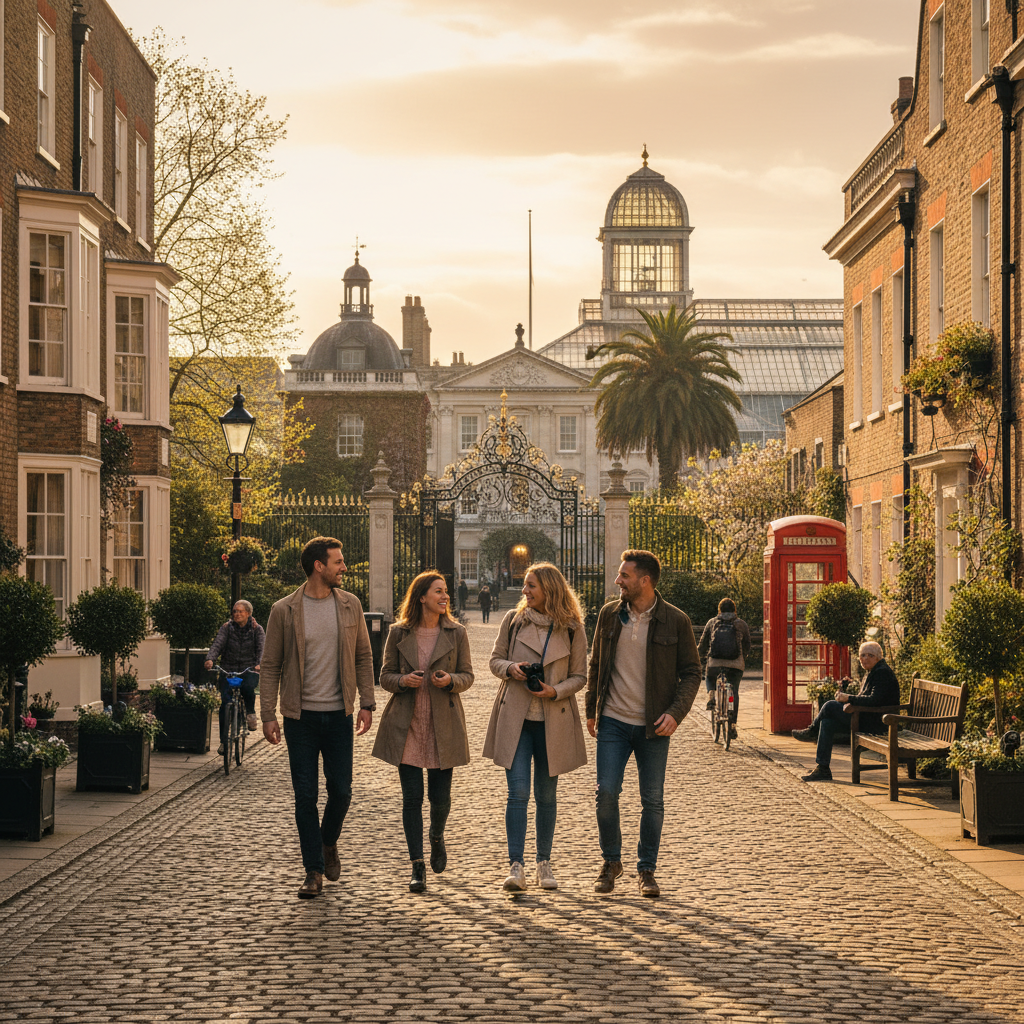
KewOutdoor Escape Game & Treasure Hunt
A royal green haven of a thousand treasures
What to do in Kew? In the heart of this charming London borough, adventure awaits far beyond its famous gardens. Kew is an invitation to exploration, where every street and monument whispers stories. Of course, the majestic Royal Botanic Gardens, Kew (Kew Gardens) are unmissable, a true green lung where one could spend entire days admiring the floral and architectural diversity, such as the Chinese Pagoda or the Palm House. But for curious minds seeking an unusual activity, why not transform your visit into a grand scavenger hunt? Imagine solving puzzles outdoors, a real treasure hunt that will lead you from the historic Kew Palace to the peaceful banks of the Thames, thus discovering the hidden secrets of the town. Our outdoor escape game offers a unique and playful way to immerse yourself in Kew's royal and verdant atmosphere, combining cultural discovery with the thrill of investigation. It's a memorable experience that will awaken your sense of observation and teamwork, all while enjoying Kew's serene beauty.

Unusual things to do in Kew
For an unusual activity in Kew, step off the beaten path! Beyond its famous gardens, Kew is full of surprises for those seeking an original outing. How about embarking on a life-sized scavenger hunt? Our outdoor escape game offers a unique immersion into local history and legends. You'll explore little-known corners, decipher hidden codes on historical monuments, and discover fascinating anecdotes. It's a fun and interactive way to see Kew from a new angle, combining adventure and cultural discovery. A memorable experience guaranteed, far from classic guided tours, that will stimulate your curiosity and team spirit.
Things to do in Kew with kids
Kew is an ideal destination for families seeking adventure and discovery. What to do in Kew with family so that both young and old have fun? Besides the immense Botanic Gardens, perfect for a day of games and picnicking, our outdoor escape game is a playful activity that will delight children and teens from 6-8 years old, accompanied by adults. It's an interactive treasure hunt where everyone has a role to play, from the youngest spotting visual clues to the older ones solving complex puzzles. An excellent way to strengthen family bonds while exploring the city in an original and stimulating way.
Kew for couples
For a romantic getaway, Kew as a couple offers an idyllic setting. Far from the urban hustle, this district invites leisurely strolls and discoveries for two. Walk hand-in-hand through the secret paths of the Botanic Gardens, discover hidden pavilions and exotic greenhouses. Stroll along the banks of the Thames for picturesque views and soak up the charm of the historic streets lined with Victorian houses. Our scavenger hunt can even transform your walk into a shared adventure, a unique opportunity to solve puzzles together and create memorable souvenirs in this verdant and intimate heritage.
What to do in Kew when it rains
What to do in Kew when it rains? Even if Kew is beautiful under the sun, a shower won't spoil your OddballTrip adventure! Our outdoor escape game is designed to allow you to enjoy the city, even under grey skies. Indeed, approximately 80% of our route takes place under arcades, covered passages, or near shelters, thus protecting you from bad weather. This allows you to continue solving puzzles and exploring without getting soaked. Bring an umbrella for short transitions, but rest assured that the essential experience remains comfortable and fun, whatever the weather.
Where is Kew, and where do the routes start?
Starting points of our routes and the places they pass through.
Route starting points
Places in Kew
- Elizabeth Gate
- Kew Green (village square)
- St Anne's Church Exterior
- Kew Bridge (pedestrian area)
- Thames Path near Kew Pier
- National Archives Main Entrance (exterior)
- Kew Gardens perimeter wall along Kew Road
- Facade of a historic house on Kew Green
The history of Kew
Royal Residences and Botanical Science
Kew's history is linked with the British monarchy and the development of botanical science. The area, possibly a Roman army fording point in 54 BC, gained importance with the Tudors, when Kew Farm was a significant property. By the 18th century, Kew was a country retreat for royalty. George II and Queen Caroline were among the first royals to lease properties here in the 1720s, including what is now Kew Palace. This brick mansion, built in 1631 for silk merchant Samuel Fortrey, became a more permanent home for George III and his family after he purchased it in 1781.
The Royal Botanic Gardens, Kew, a UNESCO World Heritage Site, formally began in 1759. Princess Augusta, Dowager Princess of Wales, established the first botanic garden, initially a 4-hectare space for medicinal plants. Under the directorship of William Hooker in the mid-19th century, the gardens expanded to 30 hectares, with the arboretum growing to 109 hectares, reaching its current size of 121 hectares (300 acres).
From Ferries to a Grand Bridge
Before any bridge existed, a ferry service crossed the Thames at Kew, possibly dating back to the Roman period. The Tunstall family operated this ferry from 1659. The first Kew Bridge, built by John Barnard, opened in 1759, replacing the ferry. It was inaugurated by the Prince of Wales, later King George III, and his mother. This initial structure, with stone arches at each end and seven timber arches in between, proved costly to maintain and lasted only 30 years.
A second, entirely stone bridge, designed by James Paine (who also designed Richmond Bridge), was constructed alongside the first to avoid traffic disruption and opened in 1789, again by King George III. This bridge remained a toll bridge until 1873 when the Metropolitan Board of Works purchased it, making it toll-free. The current Kew Bridge, also known as King Edward VII Bridge, was designed by John Wolfe-Barry and Cuthbert Arthur Brereton and opened in 1903 by King Edward VII and Queen Alexandra. Made of granite from Aberdeenshire, Scotland, it is still in use today and was Grade II listed in 1983.
What to see in Kew
- Kew Palace — The smallest royal palace, originally a 1631 mansion for a silk merchant, later a private retreat for Georgian royalty, including George III during his illness.
- Kew Green — A village green, roughly oval, framed by broadleaf trees and surrounded by Georgian townhouses. It is home to the Kew Cricket Club, which has played there since the 1700s.
- St Anne's Church — Consecrated in 1714 with support from Queen Anne, this church has served royal families for centuries. Its churchyard contains the tombs of artists Thomas Gainsborough and Johan Zoffany.
- Kew Bridge — The current granite bridge, opened in 1903, is the third iteration at this site. It offers views of the Thames and connects the boroughs of Richmond upon Thames and Hounslow.
- Thames Path near Kew Pier — A walk along the river, where you can see the Kew Gardens Pier. From here, river buses or tourist ferries once operated.
- The National Archives — This institution holds 900 years of historical records, including the Domesday Book.
- Royal Botanic Gardens, Kew (exterior) — From the perimeter, you can see some of the world's largest botanical collections. The gardens encompass 121 hectares (300 acres) of plants and botanical glasshouses.
When to visit Kew
Kew can be visited year-round, with each season offering a different experience. Spring (March to May) brings magnolias, cherry blossoms, tulips, bluebells, and daffodils. The annual Orchid Festival takes place in the Princess of Wales Conservatory in February and March. Summer (June to August) sees the gardens in full bloom, with various outdoor events. Autumn (September to October) offers tree colors as crowds thin, with ginkgo and maple trees turning golden and red. Winter (November to February) is quieter; the glasshouses provide warmth, and from mid-November to early January, the garden has light installations for "Christmas at Kew."
Avoid peak school holidays and weekends if you prefer fewer visitors, as the official car park fills quickly.
Getting around Kew
Kew is connected to central London. You can reach Kew Gardens station via the District Line (Underground) or London Overground. The station is a 5-10 minute walk to the Victoria Gate entrance of Kew Gardens. If traveling with a buggy, consider going to Richmond station and then taking a train one stop back to Kew Gardens for easier platform access.
For drivers, there is an official car park at Brentford Gate, but spaces are limited (around 300) and fill quickly, especially on weekends and holidays. It costs £9 per day, with free parking for Blue Badge holders. On-street parking is available on some residential roads like Kew Road and Gloucester Road, but restrictions apply, usually Monday to Friday, 10:00 am to 4:30 pm, with hourly rates typically £2-£4. Walking is the best way to explore Kew's village feel and green spaces.
Things you probably do not know about Kew
Verified details most visitors walk straight past.
- Kew Palace
- What unusual feature can you find above the entrance of Kew Palace? The initials of Samuel Fortrey and his wife Catherine, the wealthy silk merchant who originally built the palace in 1631, are visible above the entrance.
- St Anne's Church, Kew Green
- Which famous French Impressionist painter captured St Anne's Church in his artwork? Camille Pissarro, a renowned French painter, depicted St Anne's Church in one of his paintings in 1892.
- Kew Bridge
- What significant event happened to the future King George III on Kew Bridge shortly after its first opening? In 1760, shortly after the first Kew Bridge opened, Prince George (the future King George III) was crossing it when he received news of his father King George II's death.
- Kew Green
- What surprising sporting history does Kew Green hold? Kew Green has been a venue for cricket matches since the 1700s, with records showing a match between London XI and Middlesex XI played there in 1732. It remains the home ground of Kew Cricket Club.
- Kew Gardens (Palm House)
- What unique construction detail sets the Palm House apart? The Palm House, built between 1844 and 1848, was the first large-scale structural use of wrought iron, and all its glass panes are hand-blown.
- Kew Gardens (Temperate House)
- What is remarkable about the size of the Temperate House compared to the Palm House? The Temperate House, designed by Decimus Burton, is twice the size of the monumental Palm House, making it the world's largest Victorian glasshouse.
Questions about visiting Kew
How long should I plan to spend in Kew?
To experience Kew, especially the Royal Botanic Gardens, plan for at least a half-day. Many visitors find a full day is needed to explore the gardens and other local attractions without feeling rushed.
What are the best ways to get around Kew?
Kew is suitable for walking, allowing you to appreciate its village atmosphere and green spaces. For longer distances, London Underground (District Line) and London Overground services connect to Kew Gardens station. Buses also serve the area.
Is Kew suitable for visiting with children?
Kew offers activities for families, particularly within the Royal Botanic Gardens, which includes a Children's Garden, treetop walkway, and various family-friendly trails and events throughout the year.
What is the typical budget for a day in Kew?
Entry to Kew Gardens is a significant part of the budget, with adult tickets ranging from £16 to £24 online depending on the season. Beyond that, costs will depend on meals and any additional activities or souvenirs. There are free areas to enjoy, such as Kew Green and the Thames Path.
Are there any specific areas or neighborhoods to explore in Kew?
Beyond the Royal Botanic Gardens, Kew Green is a central point with historic buildings. Kew Village offers independent shops and a relaxed feel. The Thames Path provides riverside walks.
What are the public transport options to reach Kew?
Kew Gardens station is served by the District Line (London Underground) and London Overground. Several bus routes also operate in the area, connecting Kew to other parts of London.
Frequently asked questions
How much does an outdoor escape game in Kew cost?
An OddballTrip outdoor escape game in Kew costs €12 per team. This single price covers your entire group, regardless of the number of participants (typically 2 to 6 players for an optimal experience). It's a very affordable option for a fun and immersive activity that allows you to explore the city in a whole new way. Plus, no hidden fees: once the game is purchased, you're ready to embark on your adventure whenever you wish. It's excellent value for a memorable outing in Kew!
Is it suitable for children / families?
Absolutely! Our outdoor escape games are designed to be a fantastic activity for the whole family. Children and teenagers, from 6-8 years old, can actively participate by helping to find clues and solve puzzles, especially when accompanied by adults. It's a great opportunity to work as a team, stimulate the curiosity of the youngest, and spend quality time together exploring Kew. The playful aspect and outdoor discovery appeal greatly to all ages, making this treasure hunt an unforgettable family outing.
How long does an escape game in Kew last?
The duration of an outdoor escape game in Kew generally ranges from 1 hour 30 minutes to 2 hours 30 minutes. This depends on your team's pace, your ability to solve puzzles, and how much time you want to take to admire the sights and surroundings. There's no imposed time limit, so you can take breaks for coffee or visit a point of interest. The goal is to fully enjoy the experience and discover Kew at your own pace, without pressure.
Do I need to book in advance?
For our outdoor escape games in Kew, advance booking is not strictly mandatory, as the game is available online and you can start it whenever you wish. However, we recommend purchasing your game a few days before your visit, especially if you plan to play during weekends or peak periods. This ensures everything is ready and allows you to familiarize yourself with the instructions. Once purchased, the game remains valid, and you can launch it as soon as you are on site, at the indicated starting point.
What to visit in Kew beyond the escape games?
Beyond the excitement of our escape games, Kew is full of treasures to explore. The crown jewel is undoubtedly the Royal Botanic Gardens, Kew (Kew Gardens), a UNESCO World Heritage site, offering magnificent greenhouses, a Chinese pagoda, and miles of green pathways. Don't miss the charming Kew Palace, the smallest of the British royal residences, and a relaxing stroll along the banks of the Thames. The district itself, with its independent shops and welcoming cafes, invites leisurely wandering. Kew is a destination that perfectly combines nature, history, and culture.
What is the best season to visit Kew?
Kew has its charm in every season, but the best time to visit depends on your preferences. Spring (April-May) is spectacular with the blooming of rhododendrons, tulips, and cherry blossoms, while summer (June-August) offers long, sunny days, ideal for fully enjoying the gardens and outdoor activities. Autumn (September-November) transforms Kew into a palette of flamboyant colors, and winter, though cooler, offers a peaceful atmosphere and special events like Christmas illuminations. Our escape game is playable all year round, adapting to the atmosphere of each season.
More cities in England
Lewes
Cradle of English democracy
Winchester
Ancient royal capital, historical cradle of England
Cambridge
University city of excellence, blending history and innovation.
Pevensey
Where William the Conqueror landed in 1066
Rye
Medieval hilltop town of cobbled streets
Canterbury
Follow pilgrims' footsteps and Chaucer's tales
Activities to discover nearby
Guided tours, skip-the-line tickets and local experiences to book in advance.
💡 Optional booking — you can also buy on-site. All links open in a new window, your OddballTrip visit stays preserved.